Table of Contents
- What’s Happening in Korea Right Now?
- The Background: Why Did This Start?
- What Are Koreans Actually Saying?
- What This Reveals About Korean Culture
- How Does This Compare Internationally?
- Conclusion & What to Do If You’re Visiting
If your social feed has recently shown you a video of a Seoul hiking trail vanishing under a moving black cloud, you’ve met the lovebug. Every summer since 2022, swarms of lovebugs have descended on Seoul in numbers large enough to blanket apartment walls, subway station entrances, and mountain ridgelines, and 2026 has been the most intense year yet. The insects showed up earlier than usual this year, peaked around June 24, and pushed the Seoul Metropolitan Government into deploying sticky traps, spraying drones, and biological larvicide across all 25 districts of the city. Here’s why lovebugs are swarming Seoul, what locals actually think about it, and what it says about how Korea is adapting to a warming climate.
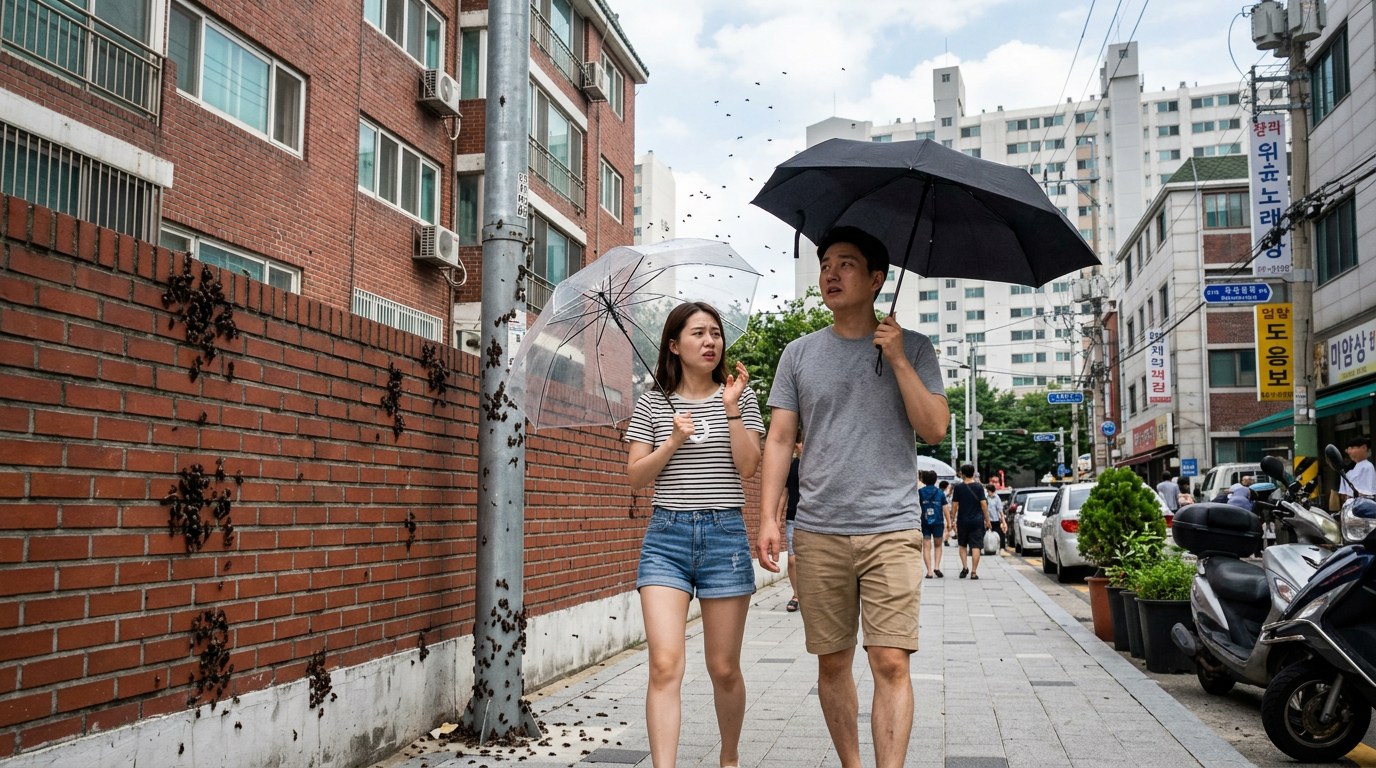
What’s Happening in Korea Right Now?
The lovebug swarm invading Seoul this summer is not a one-off scare story — it’s become an annual event, and 2026 broke the pattern in a new way: it started earlier. According to Korea’s National Institute of Forest Science, which tracks the insect using a temperature-based "bio-season model," the unusually warm spring accelerated the bugs’ development from larva to pupa to adult, pulling the emergence window forward by about two days compared with 2025. Lovebugs, scientifically Plecia longiforceps, get their nickname because mating pairs fly locked together, often for the insect’s entire adult lifespan of three to seven days. That habit is harmless to look at up close, but multiplied by the millions, it produces the thick, low-flying clouds that have become a fixture of the Seoul lovebug season.
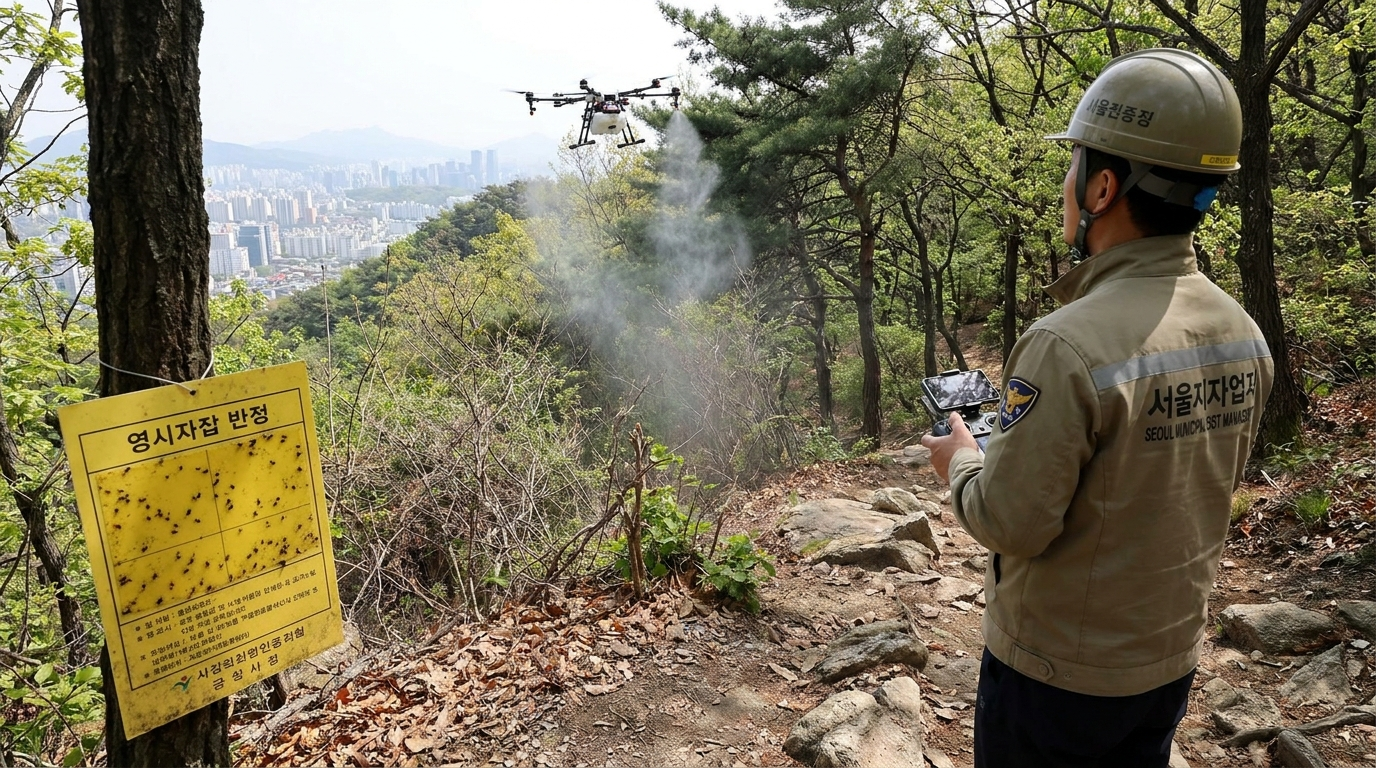
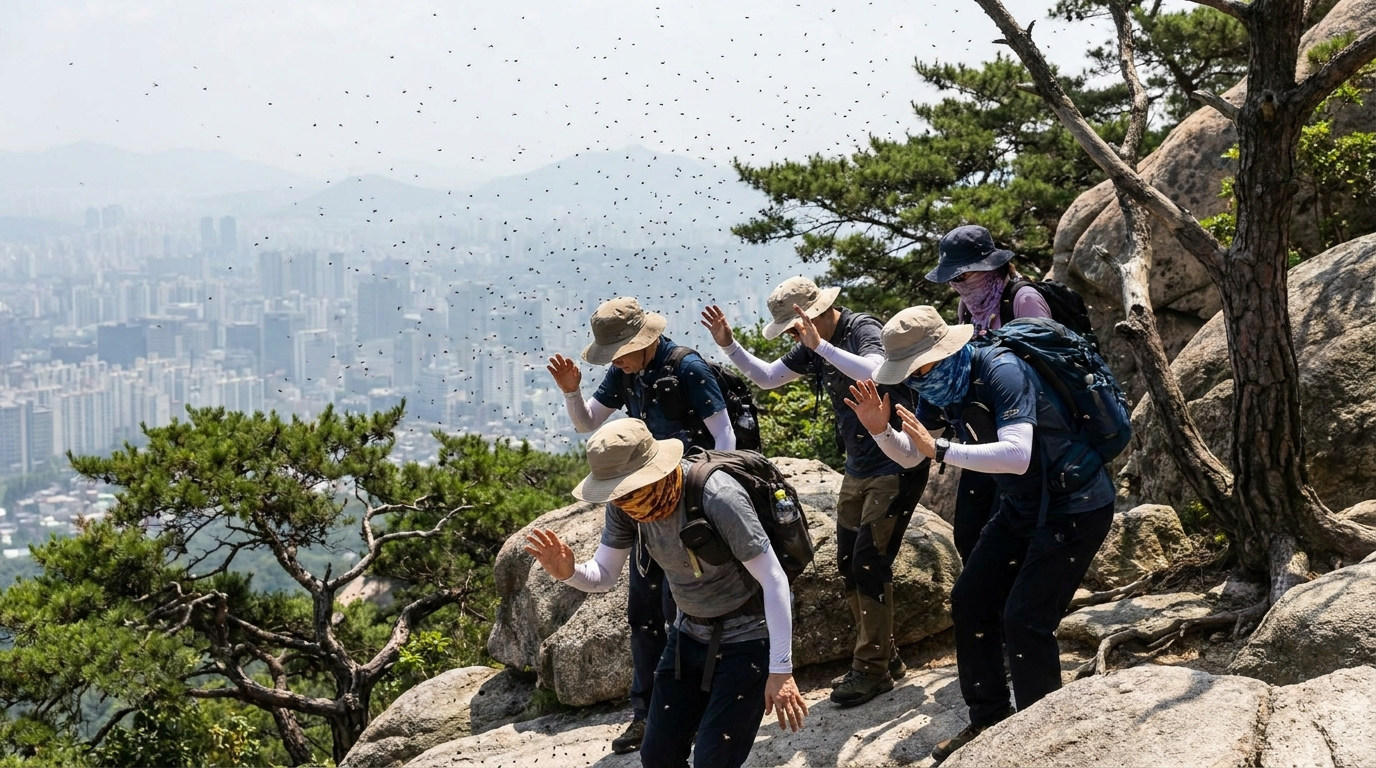
This year’s swarm activity ran roughly from mid-June through late June, with the Seoul lovebug outbreak peaking around June 24, according to Seoul Economic Daily’s reporting. Hiking trails on Bukhansan, Gyeyangsan in Incheon, and other peaks in the greater Seoul area were the hardest hit, with hikers filmed swatting at clouds of bugs so dense they obscured the trail. One video from Gyeyangsan reportedly drew more than nine million views as viewers watched a hiker try to fend off the swarm with a shovel and a fly swatter. The Seoul Metropolitan Government responded with an aggressive, multi-pronged control campaign: roughly 10 kilometers of sticky traps, nearly 4,895 pheromone lure traps (up from an initially planned 1,300), water-spraying drones that use downdraft to knock lovebugs out of the air, and Bacillus-based biological larvicide applied to breeding sites on mountains like Bulamsan, Suraksan, Bongsan, and Baengnyeonsan. Officials say the larvicide killed up to 98% of larvae within 48 hours in lab testing, and monitoring is now conducted daily across all 25 districts of the city.
Coverage of the lovebug swarm has spread well beyond Korea’s borders. The Korea Times reported as early as May that Seoul was moving to get ahead of the summer invasion months in advance, and U.S. outlet PBS NewsHour ran on-the-ground photos of a mountain peak blanketed in insects, underscoring just how visually dramatic the swarms had become. Local reporting described trailside railings and vegetation so thickly coated in lovebugs that hikers said the ground itself appeared to be moving — the kind of image that turned a local nuisance into a global news story, and exactly what officials are trying to prevent from repeating through earlier, larger-scale intervention in future years.
The Background: Why Did This Start?
Lovebugs are not new to East Asia, but they were essentially unknown in Seoul before 2022. Scientists believe the insect, native to warmer subtropical regions of China and Taiwan, expanded its range northward as Korea’s climate warmed and its cities got hotter through the urban heat island effect. Seoul’s summer nights have grown measurably warmer over the past decade — a trend documented in Korea’s ongoing record-breaking heatwaves — and lovebugs thrive in exactly the warm, humid conditions that now describe a Seoul July. Once the insects established breeding populations on forested mountains ringing the city, like Gyeyangsan and Bukhansan, the annual cycle became self-sustaining: eggs laid in leaf litter one summer hatch into larvae that overwinter in the soil, then emerge as adults the following year in even greater numbers.
That’s exactly what happened heading into 2026. The heavy breeding season of 2025 left an unusually large reserve of eggs in the soil, and this year’s early heat pulled the hatching and pupation schedule forward. The result was a shorter but more concentrated emergence window — instead of a gradual buildup, huge numbers of lovebugs appeared in a compressed span of about two weeks. Importantly, lovebugs are not disease vectors and don’t bite or sting; entomologists actually classify them as a beneficial species, since their larvae help decompose leaf litter and the adults pollinate flowers. The problem is purely one of sheer volume and public discomfort, not danger.
What Are Koreans Actually Saying?
Reaction to the lovebug swarm in Seoul is split, and the split runs roughly along generational and neighborhood lines. In a 2024 survey of 1,000 Seoul residents, 86% said that even though lovebugs are technically a beneficial insect, encountering them in large numbers feels like a pest infestation regardless. On social media, the tone is more comedic than panicked: users share close-up videos of walls and windows coated in bugs with captions along the lines of "I thought this year would be better, but they’re already here," and hikers post exasperated commentary about trails that look like they’re covered in a moving carpet. Local news coverage leans into the same slightly absurd energy — the drone footage of water cannons knocking lovebugs out of the sky went semi-viral in its own right, with commenters joking that Seoul had declared war on an insect.
There’s also a quieter, more serious thread in the conversation: residents of districts like Eunpyeong-gu and Nowon-gu, where lovebugs breed on nearby mountains, have pushed the city government for faster, more consistent responses year over year, arguing that a phenomenon repeating for five summers straight shouldn’t still be treated as a surprise. That pressure is part of why the city moved its 2026 pest-control operation earlier and expanded pheromone traps nearly fourfold from the original plan. Older residents and mountain-adjacent apartment dwellers tend to describe the swarms as a genuine seasonal nuisance affecting laundry, windows, and outdoor dining; younger, social-media-native Koreans are more likely to treat it as dark comedy — content to film, caption, and move on from.
What This Reveals About Korean Culture
The lovebug swarm says less about insects than it does about how Korea handles a shared, recurring public annoyance. Seoul’s response — daily monitoring, city-wide coordination across all 25 districts, drones, biological larvicide, and public communication about swarm forecasts — reflects a broader pattern in Korean urban governance: a strong civic expectation that municipal government will proactively manage the physical environment on residents’ behalf, not just respond after complaints pile up. That’s the same instinct behind Korea’s dense network of free public cooling centers during heatwaves and its rapid, technology-forward responses to other seasonal urban stressors.
At the same time, the meme-ified, slightly self-mocking way Koreans talk about lovebugs online is very consistent with how the country tends to process minor collective irritations — through humor and shared content rather than outrage. A swarm of insects becomes fodder for viral videos, wordplay on the "love" in lovebug, and comparisons to horror movies, rather than a purely negative story. For visitors, that combination — genuine, well-funded government response paired with a public that’s already laughing about it — is a small but telling window into Korean civic life.
How Does This Compare Internationally?
Korea is far from alone in dealing with a beneficial-but-annoying seasonal insect boom tied to a warming climate. The southeastern United States has dealt with true lovebugs (a related species, Plecia nearctica) swarming highways and windshields for decades, with Florida and Texas drivers describing near-identical scenes of paired insects blanketing cars. Japan experiences its own seasonal insect nuisances, from swarms of midges near rivers to cicada population booms that residents track closely each summer. What sets the Seoul lovebug swarm apart is the speed of its emergence as a phenomenon — essentially unknown in the city before 2022 — and the scale of the coordinated municipal response, which is unusually well-resourced and closely tied to public climate anxiety. As cities across Asia grow hotter, urban entomologists expect more of this pattern: species migrating north and adapting to city heat islands, forcing municipal governments to treat insect population management as a recurring line item rather than an emergency.
Conclusion: Should You Worry About Lovebugs in Seoul?
If you’re traveling to Seoul in future summers, the honest answer is: probably not, but come prepared to see them. Lovebugs don’t bite, sting, or spread disease, and by late July the heaviest swarms of the season have typically already passed their peak. If you’re hiking Bukhansan or another mountain trail during lovebug season, a hat, sunglasses, and a light buff over your nose and mouth make the experience far more pleasant, and locals recommend avoiding forested trailheads in the late afternoon when the bugs are most active. The bigger takeaway for outsiders is what the lovebug saga reveals about a city that treats even a mildly absurd seasonal problem with real institutional seriousness — while its residents laugh about it online in the meantime.
Want more stories about the surprising, funny, and genuinely useful sides of life in Korea? Explore unboxingkorea.com’s Korean Culture & Trends section for more deep dives, or check out our guide to hiking trails in Seoul, our roundup of other only-in-Korea trends taking over Seoul right now, and our coverage of Korea’s record 2026 heatwave before you plan your trip.