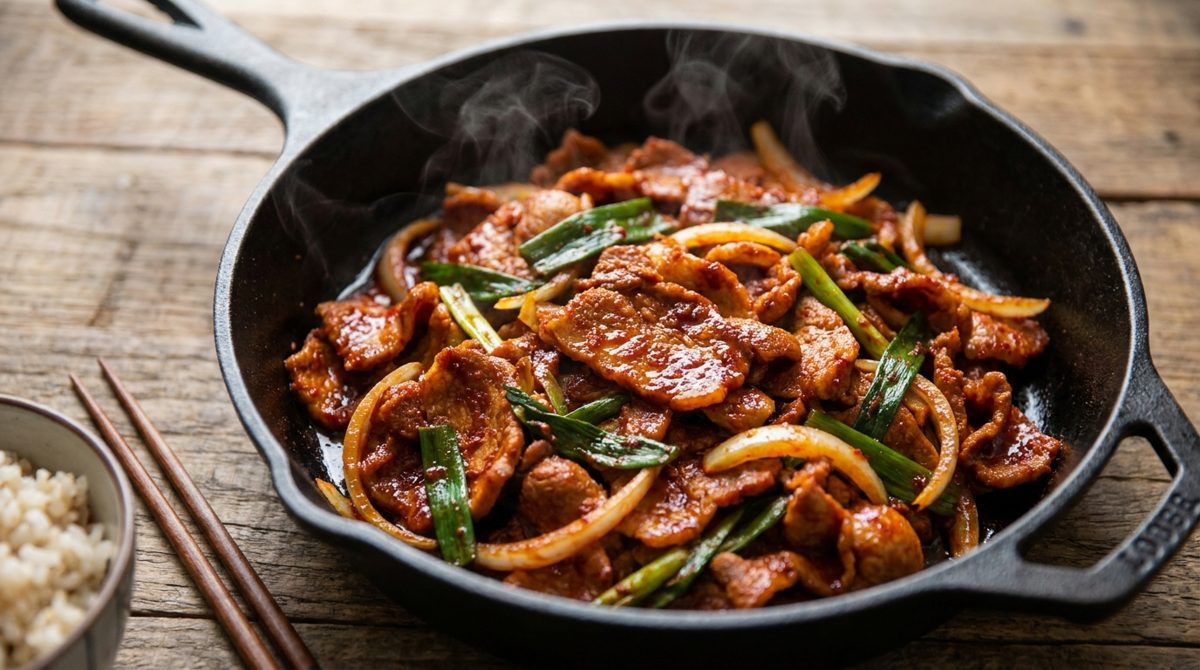
Staring at a sizzling red pan on a Korean menu and wondering what jeyuk bokkeum is? Jeyuk bokkeum (제육볶음) is Korea’s classic home-style dish of thin-sliced pork — usually shoulder or belly — stir-fried in a spicy-sweet gochujang and gochugaru marinade with onions and scallions, then served as a “baekban” set with rice, soup, and banchan. It’s cheap, filling, and one of the most-ordered lunches in Korea. This decoder page covers taste, spice, allergens, halal status, real 2026 prices, and exactly how to order it.
Table of Contents
- Jeyuk Bokkeum Quick Facts
- What Is Jeyuk Bokkeum, Exactly?
- What Does Jeyuk Bokkeum Taste Like?
- Dietary Guide: Vegetarian, Vegan, Halal & Allergens
- How to Order Jeyuk Bokkeum in Korean (+ 2026 Prices)
- How to Eat Jeyuk Bokkeum Like a Local
- Types of Jeyuk Bokkeum
- Where to Try Jeyuk Bokkeum
- Jeyuk Bokkeum FAQ
Jeyuk Bokkeum Quick Facts
| Item | Details |
|---|---|
| Korean name | 제육볶음 (jeyuk bokkeum) — “pork stir-fry” |
| Pronunciation | jeh-yook boh-kkeum |
| Type | Stir-fried pork main dish, usually a home-style “baekban” set |
| Spice level | 🌶️ 3 / 5 — noticeably spicy but not extreme |
| Price (2026) | ₩10,000–₩13,000 for a baekban set with rice, soup and banchan in Seoul |
| Vegetarian | ❌ No — built entirely around pork |
| Vegan | ❌ No |
| Halal-friendly | ❌ No — pork dish, not halal, no substitution possible |
| Main allergens | Soy, sesame, wheat (gochujang contains fermented grain and often a wheat-based thickener) |
| Best for | Everyday lunch or dinner, budget travelers, spice lovers who want stir-fry texture over soup |
What Is Jeyuk Bokkeum, Exactly?
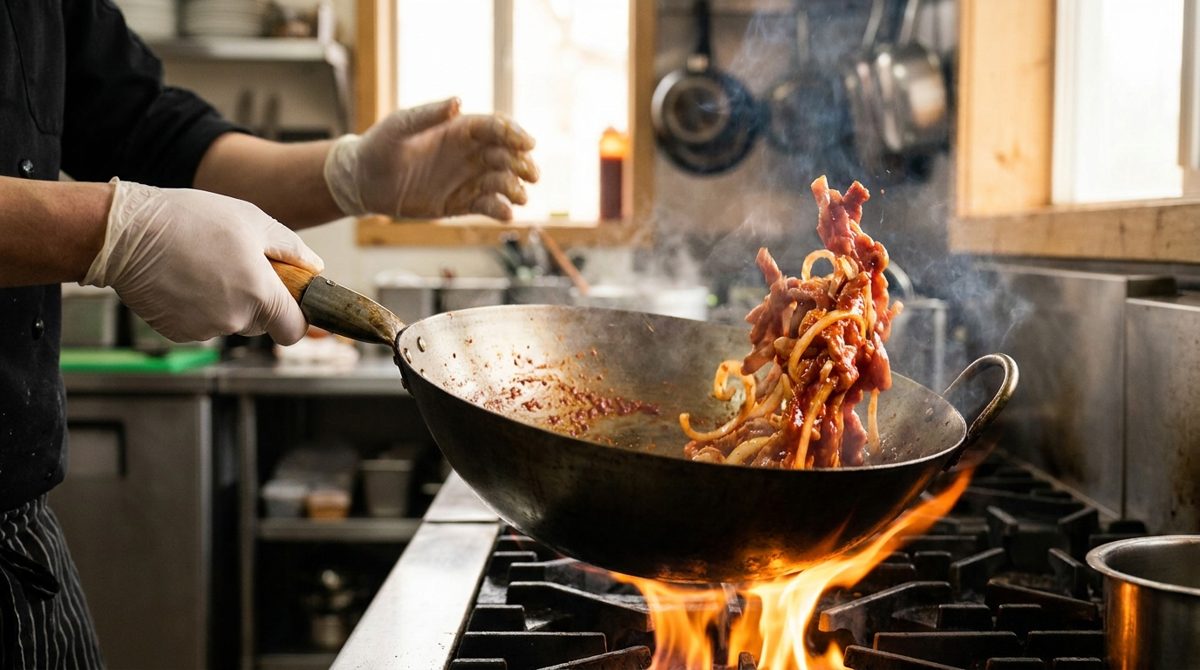
Jeyuk bokkeum is one of the most-cooked dishes in Korean homes, and one of the most-ordered lunches in Korean offices. The name is literal: jeyuk (제육) means pork, and bokkeum (볶음) means stir-fried. Thin slices of pork shoulder or belly are marinated in a paste built from gochujang (fermented chili paste), gochugaru (chili flakes), garlic, ginger, soy sauce, and a little sugar, then flash-fried in a hot pan with onion and scallion until the sauce caramelizes onto the meat.
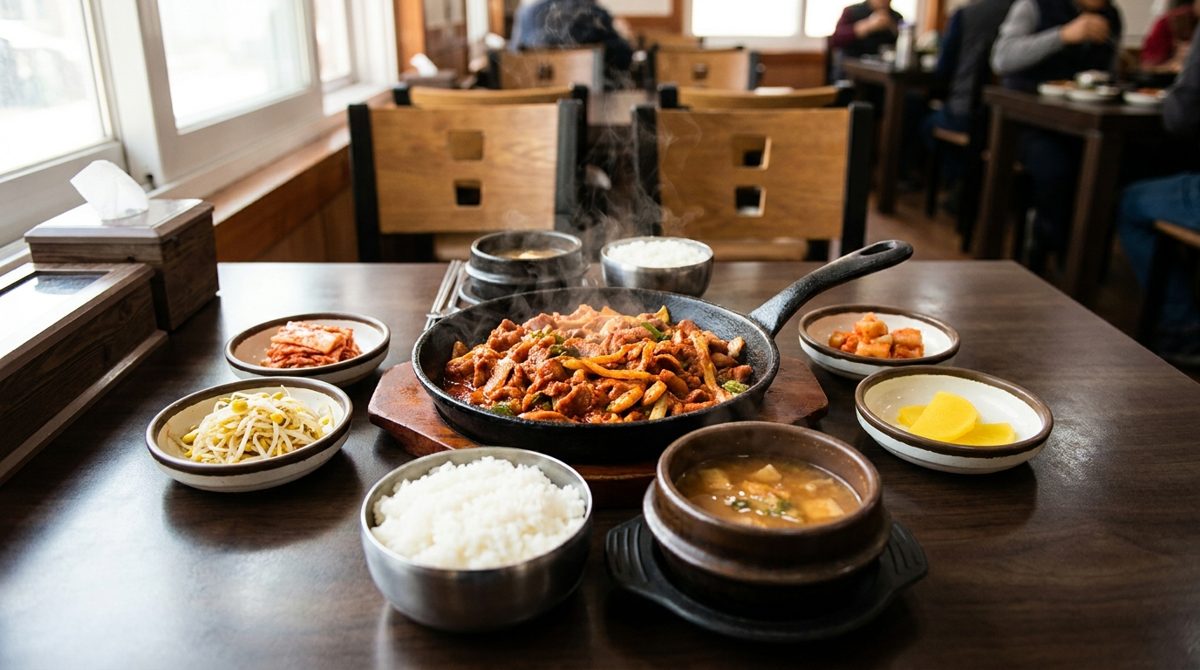
It belongs to a category Koreans call baekban — a “white rice” set meal where one hot main dish arrives with steamed rice, a small soup, and a handful of banchan side dishes, all for one flat price. Jeyuk bokkeum has held a spot on that rotating baekban menu at neighborhood diners for generations because it’s fast to cook, cheap to make, and reliably delicious. Office workers on tight lunch breaks and students on tight budgets both gravitate to it for the same reason: a full, satisfying meal in under fifteen minutes.
Unlike samgyeopsal, which you grill yourself at the table over live charcoal, jeyuk bokkeum arrives already cooked — no tongs, no scissors, no smoke clinging to your clothes afterward. It’s the dish Koreans reach for when they want pork with real kick but don’t want the time or ceremony of a barbecue night. Think of it as the everyday, weekday cousin of Korean BBQ: same core ingredient, completely different pace and setting.
The dish also has deep roots as comfort food tied to Korea’s post-war economic growth era, when pork became a more affordable protein than beef for ordinary households, and gochujang-based marinades stretched a modest cut of meat into a flavorful, filling dinner for a whole family. That frugal, homey origin is still visible today: jeyuk bokkeum rarely appears at upscale restaurants, and that’s exactly the point — it’s meant to taste like someone’s mother made it.
What Does Jeyuk Bokkeum Taste Like?
Jeyuk bokkeum tastes sweet, savory, garlicky, and distinctly spicy, with a sticky-glossy sauce that clings to every slice of pork. The onions soften and turn slightly sweet from the stir-fry, balancing the heat, while scallions add a fresh, sharp bite on top. It’s less about broth or depth (like a stew) and more about bold, immediate flavor and chewy-tender texture — closer to a Korean answer to spicy stir-fried noodles than to soup food.
The char from the hot pan matters too: good jeyuk bokkeum has slightly caramelized, almost blistered edges on the pork and onion where the sugar in the marinade briefly burns against the metal, adding a faint smoky-sweet note you won’t get from a slow-simmered dish. Every bite should deliver heat, sweetness, and a little bit of garlic punch all at once, cut by the crunch of the onion.
Is Jeyuk Bokkeum Spicy?
Yes, meaningfully so — jeyuk bokkeum sits at roughly 3 out of 5 on the spice scale. It’s spicier than bibimbap or bulgogi, but tamer than truly fierce dishes like buldak or spicy yukgaejang. The heat comes from a fixed marinade cooked directly into the meat, so unlike bibimbap you can’t simply leave the sauce off. If you’re spice-sensitive, ask for “deo an maepge” (더 안맵게 — less spicy) when ordering, or pair a small bite with extra rice and water, not more spicy food, to cool your mouth down. Ordering the cheese-topped variant is another easy way to soften the heat without giving up the dish entirely.
Jeyuk Bokkeum Dietary Guide: Vegetarian, Vegan, Halal & Allergens
This is a dish where the dietary answer is simple, and travelers with restrictions should read it plainly rather than hope for workarounds. There is no version of jeyuk bokkeum that removes the core ingredient, so knowing this before you sit down saves a confusing conversation with the kitchen.
| Ingredient concern | In standard jeyuk bokkeum? | How to handle |
|---|---|---|
| Pork | Always — it’s the entire dish | No substitution exists; skip the dish entirely |
| Beef | No | Not applicable |
| Seafood / fish sauce | Rarely, though some marinades include a touch of fish sauce or anchovy stock | Ask “aekjeot an neoheoyo?” (액젓 안 넣어요? — no fish sauce?) if avoiding seafood |
| Egg | No | Not typically present |
| Wheat / gluten | Often, via gochujang and soy sauce | Most commercial gochujang and soy sauce contain wheat; hard to avoid |
| Soy | Yes | Soy sauce and gochujang (fermented soybean base) are core ingredients |
| Sesame | Yes | Sesame oil and seeds are standard garnish and seasoning |
| Dairy | Only in the cheese variant | Order the standard version to avoid dairy; ask if cheese is melted on top |
| Nuts | No | Traditional recipes contain neither tree nuts nor peanuts |
| Alcohol | No | Not used in the marinade |
Is Jeyuk Bokkeum Vegetarian or Vegan?
No, and there’s no meaningful workaround. Jeyuk bokkeum’s entire identity is stir-fried pork in a spicy marinade — remove the pork and there is no dish left, unlike bibimbap where you can simply ask for no meat. The sauce itself is also cooked together with the meat’s juices from the start, so even the marinade alone isn’t a safe meat-free option once it’s been used in the pan. Vegetarian and vegan travelers should skip this one entirely and look toward vegetable-forward options like a meat-free tteokbokki or a vegetable bibimbap instead, both of which deliver similar gochujang flavor without any meat.
Is Jeyuk Bokkeum Halal?
No. Jeyuk bokkeum is a pork dish, plainly and without exception — it is not halal, and there is no halal-certified version of this specific recipe because pork is the defining ingredient, not a swappable add-on. Muslim travelers should not attempt to special-order this dish or ask a restaurant to substitute a different protein into the same pan, since cross-contamination with pork residue would remain a concern even if they did. Instead, look for dak galbi (spicy stir-fried chicken), which uses the same gochujang marinade style and stir-fry technique but swaps in chicken, giving a very similar flavor experience with none of the pork. Check the Korea Tourism Organization’s Muslim-friendly restaurant listings for certified halal options in your area.
How to Order Jeyuk Bokkeum in Korean (+ 2026 Prices)
Jeyuk bokkeum is a neighborhood diner staple, so ordering is straightforward even with basic Korean or pointing at a menu photo. Most baekban restaurants post the day’s set price near the door, and jeyuk bokkeum is almost always one of the two or three rotating mains on offer.
| What you want | Say this | Romanized |
|---|---|---|
| One jeyuk bokkeum, please | 제육볶음 하나 주세요 | jeyuk bokkeum hana juseyo |
| Less spicy | 덜 맵게 해주세요 | deol maepge haejuseyo |
| With extra rice | 공기밥 추가요 | gonggibap chuga-yo |
| Wrapped in lettuce (ssam style) | 상추 좀 더 주세요 | sangchu jom deo juseyo |
| To-go / takeout | 포장해 주세요 | pojanghae juseyo |
What it costs in 2026: a jeyuk bokkeum baekban set runs ₩10,000–₩13,000 in Seoul, including rice, a small soup, and 3–5 banchan. Standalone portions at pork-specialist restaurants meant for sharing can run higher, ₩15,000–₩20,000 for a large sharing plate that easily feeds two to three people. It’s consistently one of the best-value hot lunches in the country — see our Korean dining etiquette guide for how banchan refills and table manners work.
How to Eat Jeyuk Bokkeum Like a Local
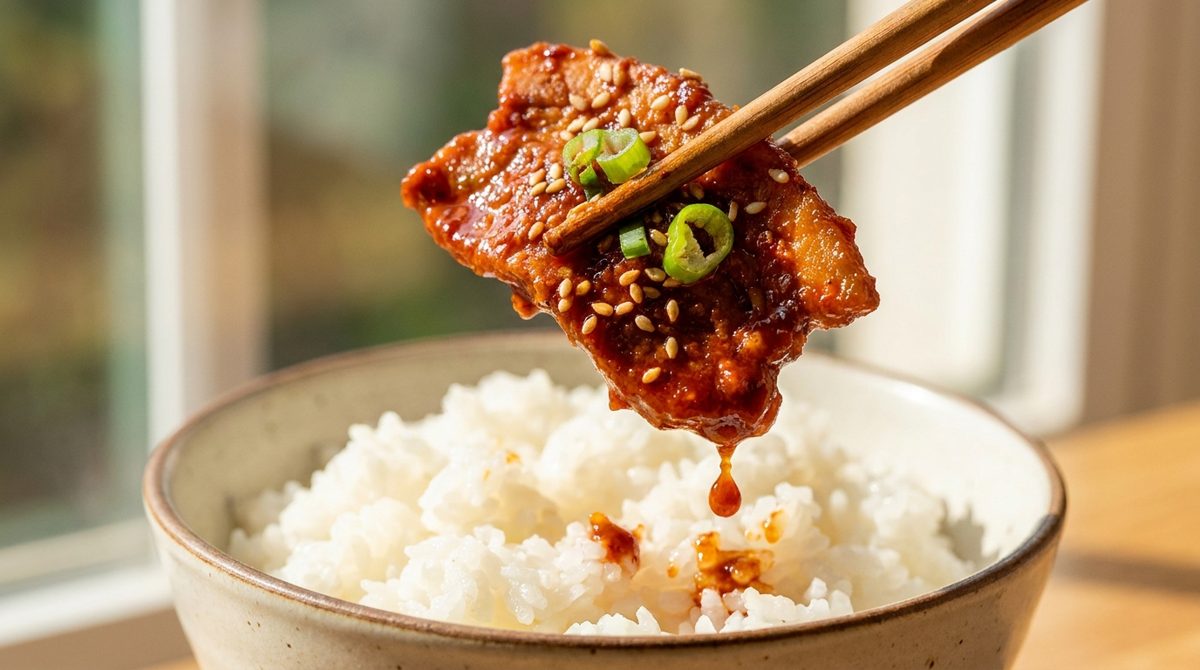
Scoop a spoonful of rice, top it with a piece of pork and a little sauce, and eat them together — the sauce is designed to soak into rice, not to be eaten alone. Many diners also serve lettuce or perilla leaves alongside; wrap a piece of pork, a dab of ssamjang (fermented paste), and a scoop of rice into a leaf for a ssam bite, the same style used with samgyeopsal.
Don’t skip the banchan. Pickled radish or fresh cucumber kimchi cuts the richness of the pork between bites, and the accompanying soup — often a simple bean sprout or seaweed soup — is meant to be sipped throughout the meal, not saved for last. If the pan arrives still audibly sizzling, give it thirty seconds before diving in; the meat continues cooking slightly in its own residual heat, and the sauce firms up just enough to stop dripping everywhere.
One local trick worth knowing: at the very end of the meal, if any pork and sauce remain in the pan, ask the server to fry it together with a scoop of rice right there (“bokkeumbap haejuseyo” — 볶음밥 해주세요). The rice soaks up every last bit of gochujang sauce stuck to the pan and turns into a second, smaller course that many Koreans consider the best part of the meal.
Types of Jeyuk Bokkeum You’ll See on Menus
Jeyuk bokkeum baekban (제육볶음 백반) — the standard order: pork stir-fry plus rice, soup, and banchan, the version most diners serve and the one you should try first. Chijeuyuk (치즈제육볶음, “cheese jeyuk”) — the same spicy pork topped with a blanket of melted mozzarella to mellow the heat, popular with younger diners and a good option if you want the flavor without the full spice punch. Ssam jeyuk bokkeum (쌈제육볶음) — served with a large plate of lettuce and perilla leaves for wrapping, common at restaurants built around sharing plates rather than individual set meals. Jeyuk bokkeumbap — leftover jeyuk bokkeum fried again with rice at the end of the meal, a beloved finishing move at Korean tables and sometimes ordered as its own dish. Jeyuk gui (제육구이) — a close relative that’s grilled rather than stir-fried in a saucy pan, drier and slightly smokier, often confused with jeyuk bokkeum on menus but worth knowing apart.
Where to Try Jeyuk Bokkeum
You’ll find jeyuk bokkeum on the daily specials board of practically any Korean home-style diner (백반집, baekban-jip) in any neighborhood — this is not a dish that requires seeking out a famous restaurant, since quality is consistently good at unglamorous local spots. Markets and food streets covered in our Seoul food guide often have dedicated pork-specialist restaurants serving generous cheese jeyuk versions for sharing. If you’re near a university district or office neighborhood at lunchtime, following the crowd of local workers into a diner is a reliable way to land a great, cheap plate — jeyuk bokkeum is exactly the kind of dish where the busiest, least touristy restaurant is usually the best one.
Jeyuk Bokkeum FAQ
What does jeyuk bokkeum mean in English?
“Stir-fried pork.” Jeyuk means pork, bokkeum means stir-fried — a literal, no-frills name for a literal, no-frills dish.
Is jeyuk bokkeum very spicy?
It’s moderately spicy, about 3 out of 5 — noticeably hotter than bibimbap or bulgogi but not among Korea’s fiercest dishes. You can ask for it less spicy, but the marinade is cooked into the meat, so you can’t remove the heat entirely the way you can with bibimbap’s optional sauce.
Is jeyuk bokkeum halal?
No. It is a pork dish through and through, and there is no halal version. Muslim travelers should choose dak galbi (spicy stir-fried chicken) instead, which uses a very similar gochujang marinade and cooking style.
Is jeyuk bokkeum the same as bulgogi?
No. Bulgogi is typically beef in a sweet soy-based marinade with little to no spice, while jeyuk bokkeum is pork in a spicy gochujang-gochugaru marinade. They share a stir-fry cooking method but taste quite different — bulgogi is mild and sweet, jeyuk bokkeum is hot and savory.
How much does jeyuk bokkeum cost in Korea in 2026?
A baekban set with rice, soup, and banchan runs ₩10,000–₩13,000 in Seoul. Larger sharing portions at pork-specialist restaurants, sometimes topped with cheese, can run ₩15,000–₩20,000.
The Verdict: Should You Order It?
Yes — jeyuk bokkeum is one of the best everyday introductions to real Korean home cooking. It’s affordable, comes as a complete meal with rice and banchan included, and delivers a satisfying, moderate spice kick without the ceremony of grilling your own meat. Just remember it’s pork through and through, so it’s a hard no for vegetarian, vegan, and halal diets — plan accordingly and consider dak galbi as your alternative. Ready to decode more dishes? Browse the full Korean Food Decoder for every major Korean dish explained with spice levels, allergens, and ordering phrases.