Wandering a Korean convenience store at 8am and staring at a wall of plastic-wrapped bread? That’s the Korean convenience store sandwich shelf — the everyday grab-and-go breakfast that fuels half the country. For ₩2,000–4,000 you get egg salad, ham and cheese, club sandwiches, microwaved convenience-store burgers, and Korea’s viral fruit-and-cream sandwich. This guide breaks down every variety, real 2026 prices, where they sit in the store, and the internet-famous snack that started as a K-pop green-room rumor.
Table of Contents
- Quick Facts
- What Are Korean Convenience Store Sandwiches?
- The Full Sandwich & Burger Lineup (2026 Prices)
- The “Inkigayo-Style” Fruit Cream Sandwich
- Why Office Workers Live on These
- Where to Find Them in the Store
- Dietary Notes & Allergens
- FAQ
Quick Facts
| Item | Details |
|---|---|
| What it is | Pre-packaged sandwiches and mini burgers sold refrigerated at every Korean convenience store |
| Price (2026) | ₩2,000–₩4,000 across sandwiches and convenience-store burgers |
| Where to find it in-store | Open refrigerated shelf near the register, same section as gimbap and dosirak lunchboxes |
| Best chains for it | GS25, CU, 7-Eleven, and emart24 all stock a similar core range nationwide |
| Signature item | The viral “Inkigayo-style” fruit cream sandwich — fruit and sweetened cream on soft white bread |
| Dietary notes | Contains egg, dairy, and wheat in almost every variety; vegetarian options limited, vegan very hard to find |
| Best for | Fast breakfasts, budget travelers, anyone curious about Korean commuter food culture |
What Are Korean Convenience Store Sandwiches?
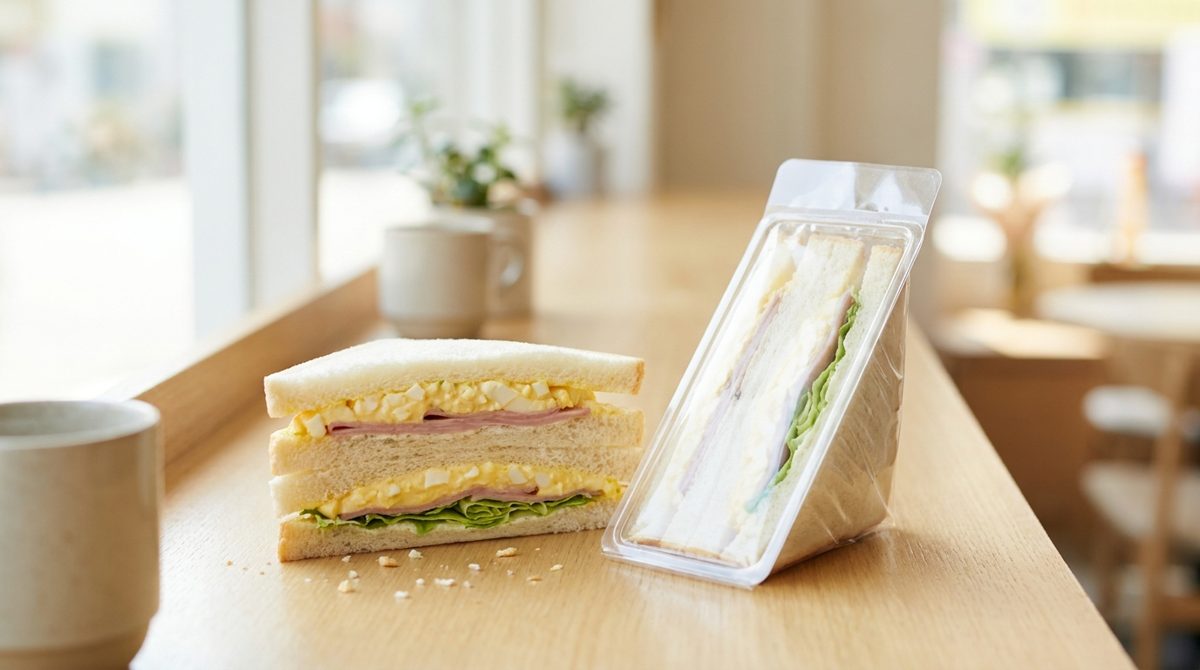
Korean convenience store sandwiches are factory-made, individually wrapped sandwiches and mini burgers restocked daily on open refrigerated shelves. They’re not a snack food exactly — they’re closer to what a bagel or a granola bar is for a rushed commuter elsewhere, except softer, cheaper, and available literally on every block in the country. GS25, CU, 7-Eleven, and emart24 each carry a near-identical core lineup, with rotating seasonal specials.
The category exploded over the last decade as one-person households and long commutes reshaped how Koreans eat. Rather than skip breakfast, workers stop at the store on the way to the subway, grab a sandwich and a canned coffee, and eat standing at the counter or walking. It’s unglamorous, but it’s one of the most authentic slices of daily Korean life a visitor can taste for under ₩4,000.
Unlike restaurant food, convenience store sandwiches are engineered for speed and consistency rather than flavor complexity. Central kitchens produce them in bulk overnight, chains compete on packaging design and seasonal flavors rather than price, and the whole category is treated as a logistics problem first and a food product second. That’s exactly why it works so well for travelers: no menu to decipher, no waiting, no language barrier — just point, pay, and eat.
A Short History of the Category
Convenience store sandwiches arrived in Korea alongside the first 7-Eleven and LG25 (now GS25) stores in the early 1990s, riding the same wave that brought triangle kimbap and instant ramyeon to store shelves. For years the category stayed simple — plain ham and egg varieties aimed at students and shift workers. The 2010s brought real diversification: club sandwiches, premium fillings, and eventually the fruit cream sandwich that would later go viral online. Today sandwiches are a standard fixture at all four major chains, restocked as reliably as milk or bottled water.
How Fresh Are They, Really?
Convenience store sandwiches are made same-day or next-day in central kitchens and delivered on tight schedules — most stores restock twice daily. Check the printed date sticker on the wrapper; anything sold same-day is fine, and staff pull expired stock automatically. Texture-wise, the bread is soft, slightly sweet, and crustless on most varieties — closer to Japanese shokupan-style bread than Western sandwich bread.
The Full Sandwich & Burger Lineup (2026 Prices)
Every chain’s shelf looks similar. Here’s what you’ll actually see, with real 2026 pricing:
| Item | What’s in it | Price (2026) |
|---|---|---|
| Egg salad sandwich (계란샐러드샌드위치) | Mashed egg salad, mayo, soft white bread — the best-seller | ₩2,000–2,800 |
| Ham & cheese sandwich (햄치즈샌드위치) | Sliced ham, cheese, lettuce, mustard mayo | ₩2,300–3,200 |
| Club sandwich (클럽샌드위치) | Triple-decker with ham, egg, cheese, and vegetables | ₩3,200–4,000 |
| Fruit cream sandwich (과일생크림샌드위치) | Sliced fruit (usually strawberry or mixed) with sweetened whipped cream on white bread | ₩2,800–3,800 |
| Convenience-store hamburger (수제버거/미니버거) | Grilled or pre-cooked patty, bun, sauce — microwaved in-store on request | ₩2,500–4,000 |
| Chicken cutlet sandwich (치킨커틀렛샌드위치) | Breaded chicken patty with cabbage and sauce | ₩2,800–3,500 |
Prices are set nationally, so a Seoul sandwich costs the same as one in Busan or Jeju. Seasonal limited editions (bulgogi burgers, strawberry-season fruit sandwiches, kimchi cheese toasts) rotate in and out, usually priced within the same ₩2,000–4,000 band. For a wider tour of what else sits on the same shelves, see our Korean convenience store food guide.
Do GS25, CU, 7-Eleven, and emart24 Differ?
Not dramatically — all four chains carry the same core range of egg salad, ham and cheese, club, fruit cream, and burger options at nearly identical prices, since suppliers overlap across chains. Minor differences show up at the edges: GS25 and CU tend to push more seasonal collaborations and limited-edition flavors, while 7-Eleven and emart24 lean slightly more toward simple, classic fillings. If you’re chain-hopping to compare, the easiest test is the fruit cream sandwich — recipes and fruit ratios vary just enough between chains that regulars have real preferences.
Seasonal & Limited-Edition Varieties
Beyond the core lineup, expect rotating seasonal items tied to Korean produce calendars and pop-culture tie-ins: strawberry season (December–April) brings extra-thick fruit cream sandwiches, summer brings lighter cold-noodle-style sandwiches in some stores, and chains regularly run collaboration burgers with restaurant chains or entertainment brands. These limited editions are usually marked with a bright “NEW” or “한정판” (limited edition) sticker on the shelf tag and disappear within four to eight weeks, so if a flavor looks interesting, don’t wait to try it.
The “Inkigayo-Style” Fruit Cream Sandwich
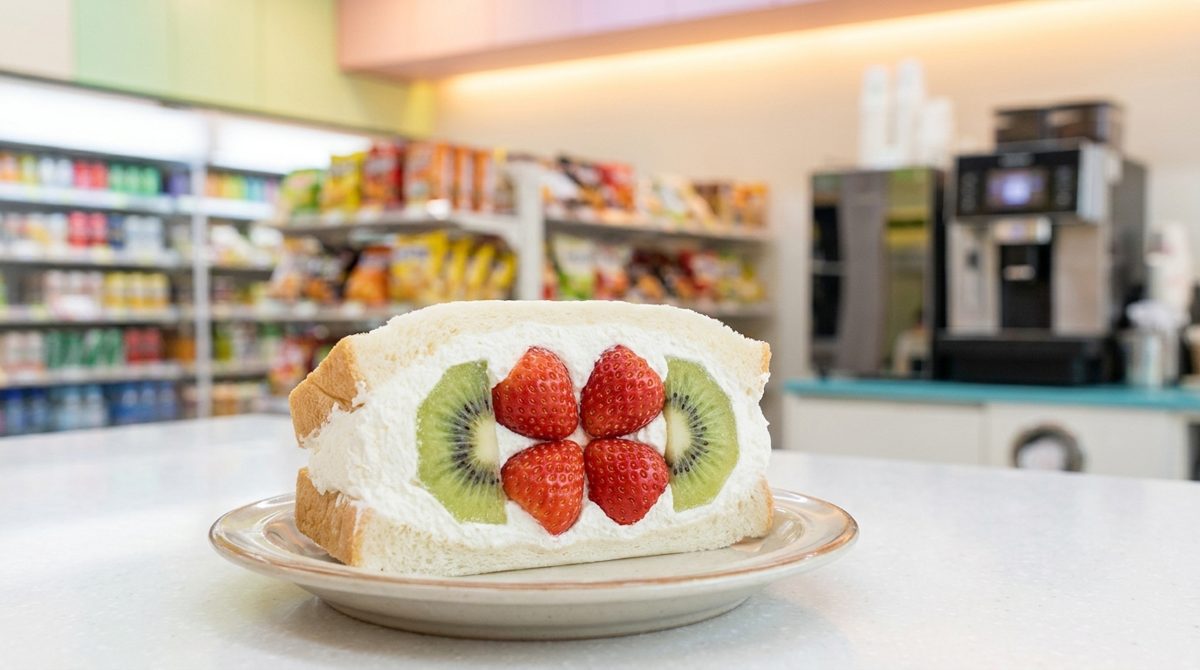
Ask a K-pop fan about the “Inkigayo sandwich” and they’ll know exactly what you mean. The fruit cream sandwich — fruit layered with sweetened whipped cream on soft white bread — picked up its nickname online after fans noticed it repeatedly showing up as a green-room and backstage snack associated with SBS’s music show Inkigayo (인기가요). It’s an internet and fandom story more than an official one: nobody claims the show invented the sandwich, but the association stuck hard enough on social media that the name became shorthand for the item itself.
Whatever the true origin, the effect was real: this specific style of fruit-and-cream sandwich became one of the most photographed convenience store items in Korea, driving visitors and locals alike to hunt it down. It’s a distinctly Korean-Japanese-influenced dessert sandwich — sweet, light, and closer to a fruit parfait than a savory lunch item. If you only try one novelty item from this list, this is the one worth the detour.
Fruit sandwiches like this trace their roots to Japanese fruit sando culture, adapted in Korea with slightly sweeter cream and a broader range of fruit combinations. What turned it into a genuine social-media phenomenon was the specific pairing with idol backstage content: fan-shot videos and photos of tables loaded with snacks between Inkigayo performances repeatedly featured the sandwich, and captions crediting it as “the Inkigayo sandwich” spread across Korean and international fan communities. Treat the name as folklore rather than fact — the sandwich itself long predates any single broadcast — but the nickname is now so widely used that convenience store apps and fan blogs both reference it.
What Does It Taste Like?
Expect soft, faintly sweet bread, a thick layer of lightly sweetened whipped cream, and juicy fruit (usually strawberry, sometimes kiwi or mixed fruit depending on season) in the center. It eats more like a cold dessert than a sandwich — best enjoyed chilled, straight from the fridge shelf, within a day of purchase for the freshest cream texture.
Why Office Workers Live on These
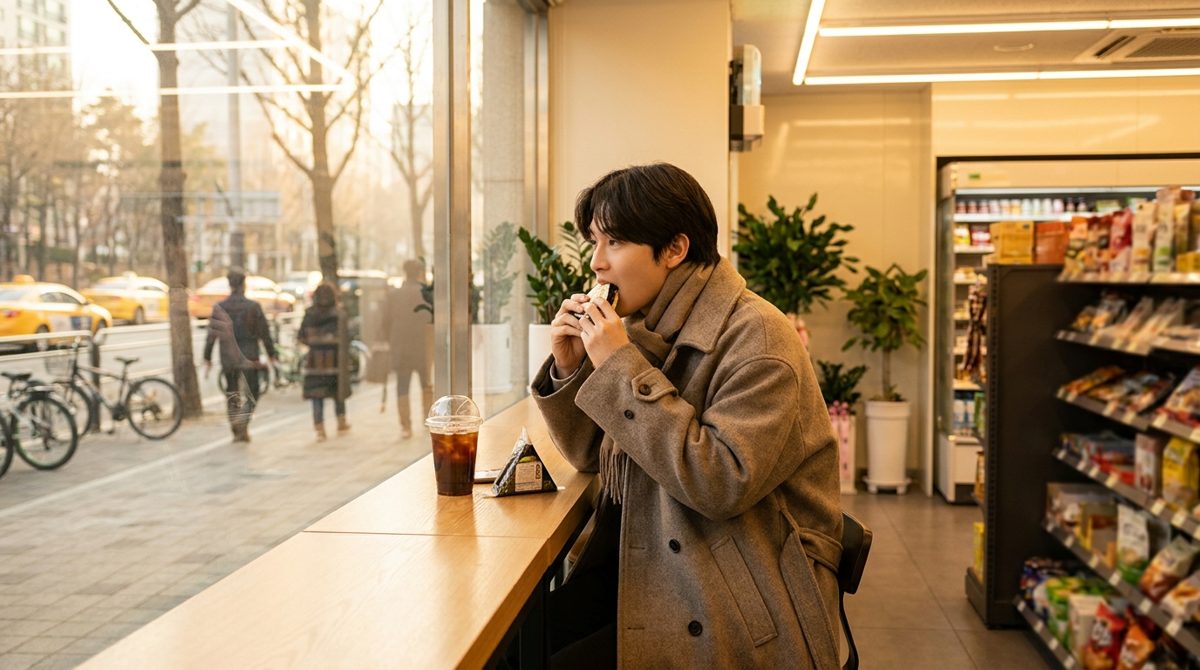
For Korean 직장인 (office workers), the convenience store sandwich is the number one grab-and-go breakfast. Long commutes and early start times leave little room for a sit-down meal, so millions of workers swing by a store on the way to the subway, grab a sandwich, and pair it with a canned coffee for under ₩5,000 total. It’s fast, cheap, and predictable — the same egg salad sandwich tastes identical whether you buy it in Gangnam or Daejeon.
Many stores have a small standing eating counter near the window specifically for this ritual — workers unwrap the sandwich, eat in a few minutes standing up, and head straight out. It’s a genuinely useful cultural experience for a visitor: standing at that counter at 8am with a coffee in hand is as authentic a slice of Seoul life as any restaurant meal. Pair it with a proper cup of coffee from our convenience store coffee guide to complete the commuter combo.
The math explains the habit: a sandwich plus canned coffee runs ₩4,000–5,500, takes under three minutes to buy, and requires zero table service. Compare that to a sit-down breakfast, which most Korean office culture simply doesn’t have time for given early start times and long work hours. Surveys on Korean commuter habits consistently rank convenience store food as the most common breakfast substitute for workers under 40, and sandwiches specifically outperform kimbap and dosirak for breakfast because they don’t need a spoon, chopsticks, or reheating.
Sandwich Etiquette for Visitors
There’s very little etiquette to worry about — this is the most casual food category in Korea. A few small courtesies still matter: don’t linger at the standing counter if it’s busy and others are waiting, throw your wrapper in the store’s trash bin rather than taking it outside, and if you’re eating a hot microwaved burger at the counter, angle it away from other customers’ bags. For more on Korean dining norms in sit-down settings, see our Korean dining etiquette guide.
Where to Find Them in the Store
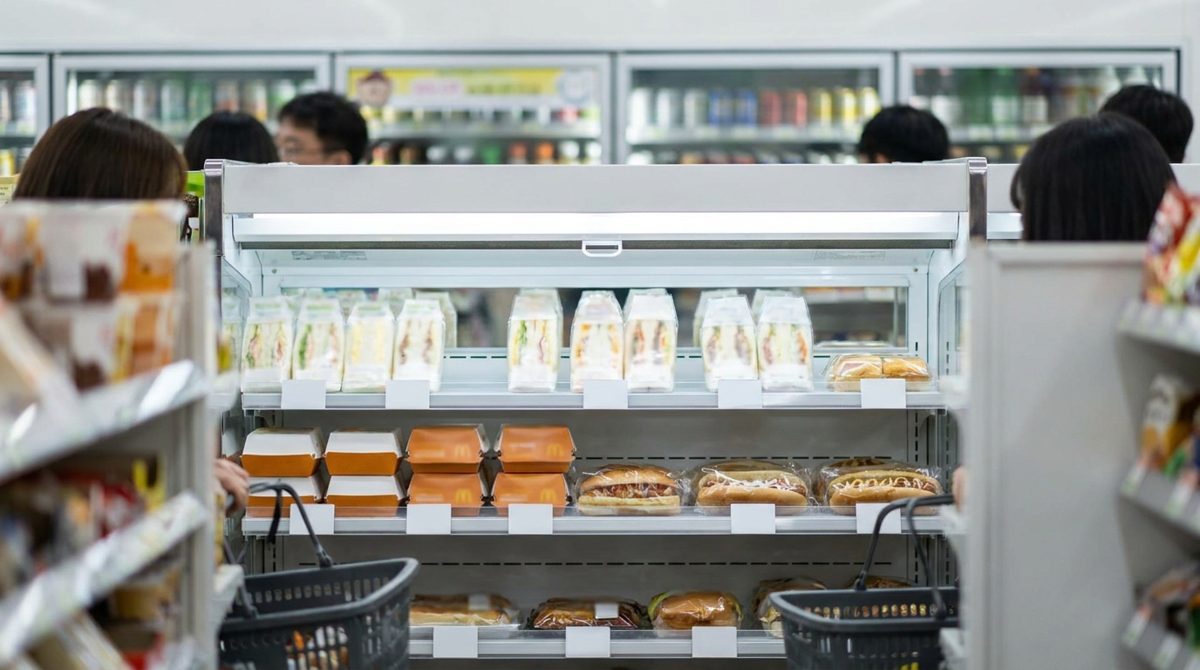
Sandwiches and burgers are always kept refrigerated on an open-front shelf, almost always positioned near the register or checkout counter for easy last-minute grabs. It’s typically the same fixture — or right next to — the gimbap and dosirak lunchbox section, since all three are the store’s “meal replacement” category. Look for bright packaging with a clear plastic window showing the actual sandwich inside — you’ll always see what you’re buying before opening it.
Convenience-store hamburgers are usually stocked in the same refrigerated area but need a quick trip to the in-store microwave to melt the cheese and warm the patty — just ask staff to “hamburger, microwave-hae juseyo” (햄버거 전자레인지 해주세요) or simply point and gesture; every clerk knows the routine.
Dietary Notes & Allergens
This category is convenient, but it’s not a friendly one for restricted diets. Nearly every sandwich relies on egg-based mayo, dairy cheese, or sweetened cream, and 100% of them use wheat bread. If you’re managing allergies or dietary restrictions, this is one aisle where reading labels — or asking staff directly — genuinely matters more than guessing from the packaging photo.
| Concern | In standard sandwiches? | Notes |
|---|---|---|
| Egg | Almost always | Egg salad sandwiches are pure egg and mayo; most other varieties use egg-based sauces |
| Dairy | Very common | Cheese in ham & cheese and club varieties; whipped cream in fruit sandwiches |
| Wheat / gluten | Yes, always | All varieties use wheat bread; no gluten-free options exist in this category |
| Pork | Sometimes | Standard ham is usually pork-based; check labels if avoiding pork |
| Vegetarian options | Limited | Egg salad and fruit cream sandwiches are meat-free but contain egg/dairy |
| Vegan options | Very rare | Nearly every variety contains egg, dairy, or mayo — pack your own snacks if strictly vegan |
Ingredient labels are printed in Korean only at most stores, though CU has begun rolling out multilingual translation tools at some tourist-area locations. If you have a serious allergy, use a translation app to photograph the label before buying — the ingredient list is always printed on the back of the wrapper. For a broader rundown of what’s safe to eat across the whole store, see our Korean Food Decoder.
Portion sizes also matter for planning meals: a single sandwich (roughly 250–350 kcal depending on variety) is a light breakfast, not a full lunch. Many travelers pair one with a boiled egg or a small side from the same shelf area to make it more filling, especially before a long day of sightseeing. Fruit cream sandwiches run slightly higher in sugar and calories than savory varieties because of the whipped cream, so treat them more like a dessert than a meal replacement.
FAQ
How much do convenience store sandwiches cost in Korea in 2026?
₩2,000–₩4,000 covers the entire category, from basic egg salad sandwiches at the low end to club sandwiches and convenience-store burgers at the top. Prices are consistent nationwide across GS25, CU, 7-Eleven, and emart24.
What is the “Inkigayo sandwich”?
It’s the internet nickname for Korea’s fruit cream sandwich — fruit and sweetened whipped cream on soft white bread — after fans associated it with backstage snack culture on the SBS music show Inkigayo. The name is a fan-culture nickname rather than an official product tie-in, but it’s how most people now search for and order this specific item.
Are Korean convenience store sandwiches good?
Yes, for what they are — a cheap, reliable, fast breakfast rather than gourmet food. Egg salad and fruit cream varieties are the most consistently well-reviewed. Freshness is generally high thanks to twice-daily restocking.
Can I microwave a convenience store burger?
Yes — most stores have a free customer microwave, and staff will happily warm a burger for you if you ask. It takes about 30–60 seconds and noticeably improves the patty and bun texture.
Are there vegetarian or vegan convenience store sandwiches?
Vegetarian options exist (egg salad and fruit cream sandwiches skip meat) but nearly always contain egg or dairy, so vegan options are very rare. Strict vegans should check our convenience store food guide for other plant-based picks in the same stores.
The Verdict: Should You Try One?
Yes — a Korean convenience store sandwich is one of the cheapest, fastest, and most authentic bites of everyday Korean life you can have. Grab an egg salad sandwich for a safe first try, then hunt down the viral fruit cream “Inkigayo” version for the full experience. Pair it with a canned coffee, eat standing at the counter like a local, and you’ve just lived a genuine Korean weekday morning for under ₩5,000.
None of it will win a Michelin star, and that’s the point — this is fast, democratic, everyday food that every commuter in the country eats without a second thought. For a first-time visitor, that ordinariness is exactly what makes it worth trying: it’s one of the few foods on this site that shows you how Korea actually eats on a Tuesday morning, not how it eats when it’s showing off. Keep exploring the aisles with our full Korean Convenience Store Explorer series.