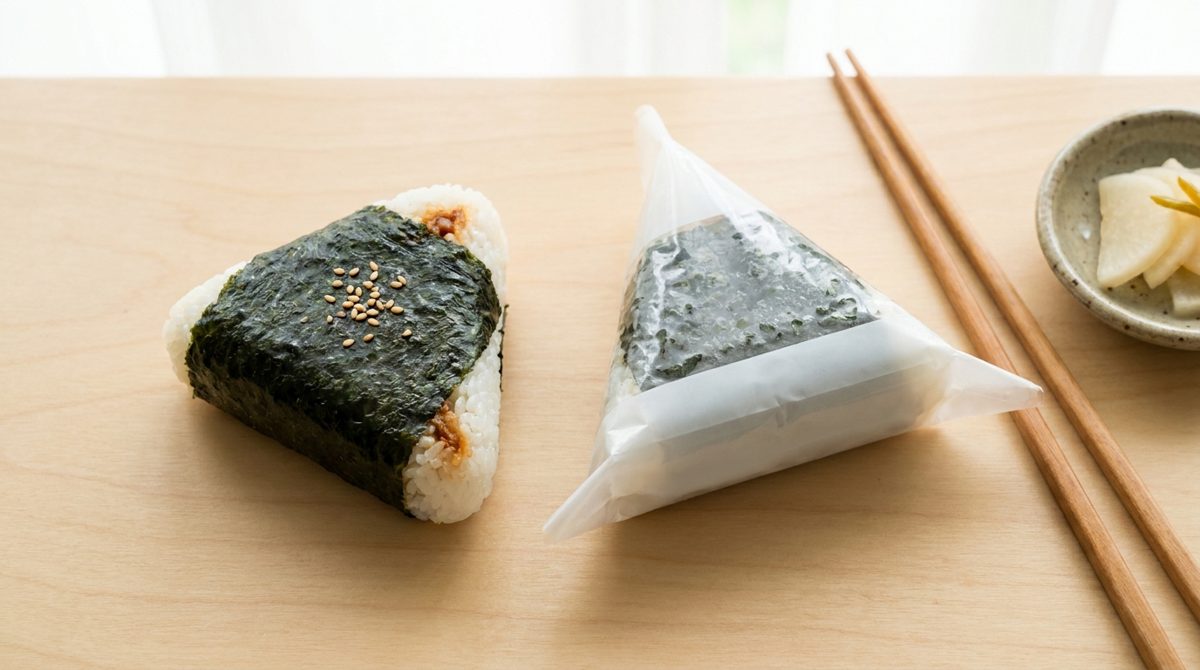
Grabbing a triangle kimbap for the first time? Triangle kimbap (삼각김밥, samgak kimbap) is Korea’s beloved convenience store rice ball: a triangular block of seasoned rice with a savory filling, wrapped in crisp seaweed that stays dry thanks to a clever plastic barrier. It costs ₩1,100–₩2,000, sits in every convenience store chiller, and opens with a famous 1-2-3 tab system that trips up nearly every first-time visitor. This guide covers the flavors worth grabbing, the opening method done right, and the etiquette locals follow.
Table of Contents
- Triangle Kimbap Quick Facts
- What Is Triangle Kimbap, Exactly?
- How to Open Triangle Kimbap: The 1-2-3 Method
- The 2026 Flavor Lineup (Real Names + Prices)
- Freshness, Expiry Dates & the Microwave Question
- Hacks, Combos & Counter Etiquette
- Dietary Guide: Vegetarian, Halal & Allergens
- Triangle Kimbap FAQ
Triangle Kimbap Quick Facts
| Item | Details |
|---|---|
| Korean name | 삼각김밥 (samgak kimbap) — “triangle kimbap” |
| What it is | Triangular rice ball with filling, wrapped in dry seaweed |
| Where in the store | Chilled fresh-food case, next to rolled kimbap and sandwiches |
| Price (2026) | ₩1,100–₩1,500 standard; ₩1,500–₩2,000 premium/double-size |
| Best chains for it | GS25 (strongest kimbap reputation), CU, 7-Eleven, emart24 |
| Spice level | 🌶️ 0–3 / 5 depending on flavor (cheongyang tuna is the hot one) |
| Vegetarian | ⚠️ Rare — most fillings are tuna, meat, or spam |
| Halal-friendly | ⚠️ Tuna flavors are pork-free; spam/bulgogi are not halal |
| Main allergens | Fish, egg (mayo), soy, wheat, sesame; spam = pork |
| Best for | Budget meals, late-night snacks, the classic ramyeon pairing |
What Is Triangle Kimbap, Exactly?
Samgak kimbap is Korea’s answer to the Japanese onigiri — same triangular DNA (here’s the Wikipedia history if you’re curious), but with unmistakably Korean fillings: tuna mixed with mayo, bulgogi beef, spicy pork, kimchi fried rice. It arrived in Korean convenience stores in the early 1990s and became the defining budget food of students, soldiers on leave, and anyone who has ever missed the last bus.
The engineering is the charming part. Fresh seaweed goes soggy against moist rice within hours, so the wrapper hides a plastic film between the seaweed and the rice. Open it correctly and the dry, crackling seaweed wraps around the rice only at the moment you eat it. Open it wrong and you’re holding a shredded mess with plastic fused into your lunch — which is why the opening method below is genuinely worth 60 seconds of your attention.
Don’t confuse it with rolled kimbap, the sliced seaweed-rice roll sold in long packs one shelf over — that’s a related but different animal, fully decoded in our what is kimbap guide. Triangle kimbap is the single-serving, one-handed, ₩1,500 version of the same idea.
Culturally, samgak kimbap punches far above its price. It’s shorthand in Korean dramas for the broke intern, the studying teenager, the overtime office worker. Koreans eat hundreds of millions of them a year, chains fight annual “kimbap wars” over premium fillings, and new flavor launches get reviewed on YouTube like phone releases. When a convenience store item has its own mukbang genre, its own opening-technique tutorials, and its own nostalgic think-pieces, it has stopped being a snack and become an institution.
How to Open Triangle Kimbap: The 1-2-3 Method
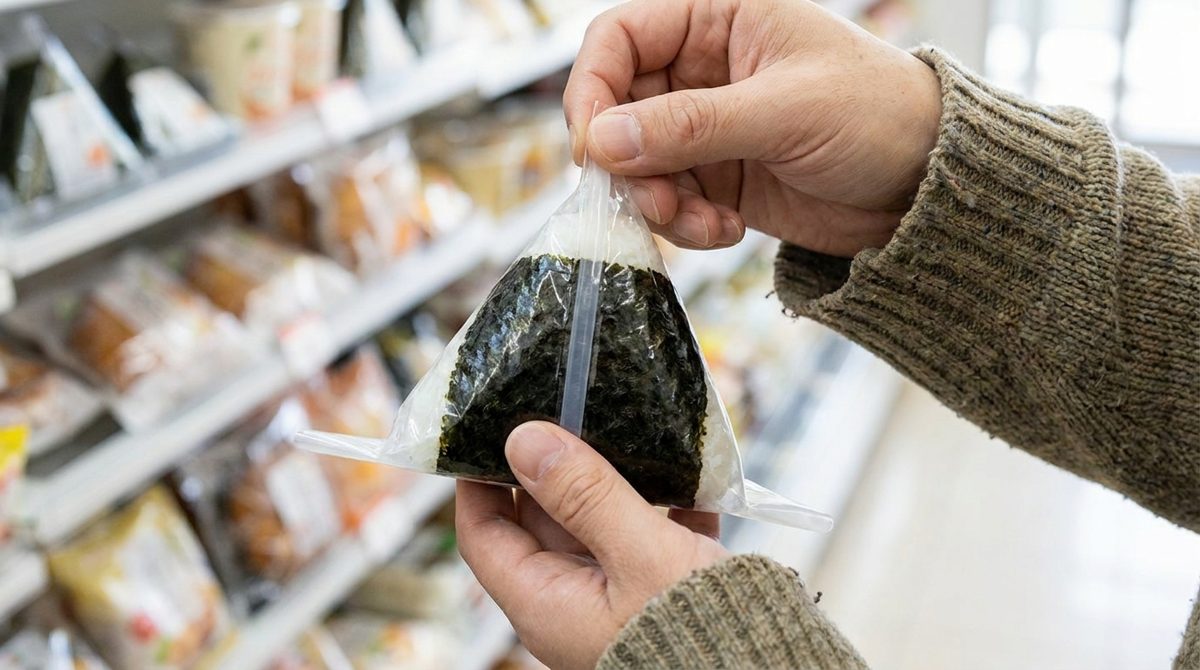
Every wrapper prints the numbers ①, ②, ③ on it, and yet the failed-opening video is practically a rite of passage on TikTok. Koreans can spot a tourist by a mangled samgak kimbap. Here’s the method, exactly:
- Find tab ① at the top point of the triangle. It’s a thin strip running down the center of the front face. Pinch it and pull it straight down and all the way around the bottom to the back, splitting the wrapper into two halves. It should tear cleanly along its perforation like a zipper.
- Pull corner ② sideways. Hold the rice triangle gently through the wrapper with one hand, grab the right-hand corner of the plastic, and slide it off sideways — the inner film slips out with it, leaving the seaweed behind, now resting directly on the rice.
- Pull corner ③ the other way. Slide the remaining half off to the left. Done: intact seaweed, intact triangle, zero plastic in your food.
Where everyone goes wrong: skipping tab ① and ripping the wrapper open from a corner like a candy bar. That tears the seaweed, leaves the inner film welded between seaweed and rice, and ends with you picking plastic shreds out of your dinner. Slow is fast here. If you do butcher it, no shame — peel patiently and eat the pieces. Koreans have all been there once, usually at age six.
One more pro detail: pull tab ① with steady, medium speed. Yank it violently and the perforation can veer off course; go too timidly and it stops halfway. Think “opening a letter,” not “starting a lawnmower.”
The 2026 Flavor Lineup (Real Names + Prices)
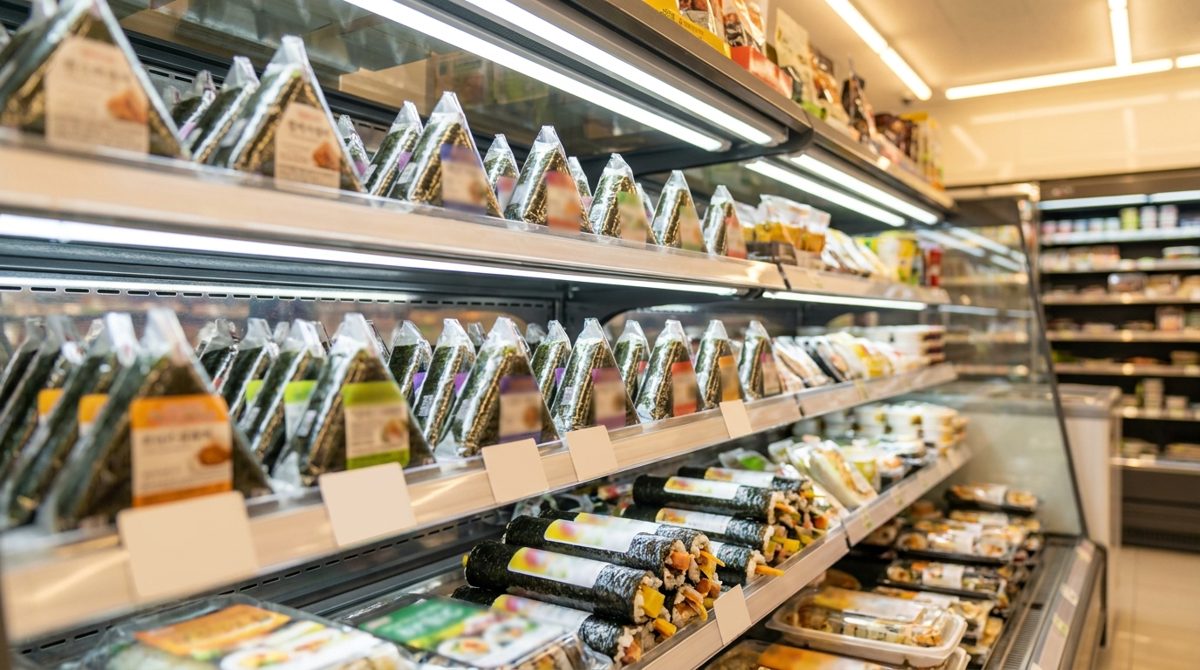
Each chain runs 10–20 flavors and rotates seasonal specials monthly, but a core cast appears everywhere. Prices are uniform nationwide as of April 2026 — the same ₩1,300 in Seoul, Busan, or a highway rest stop:
| Flavor (Korean) | What’s inside | Spice | Price 2026 |
|---|---|---|---|
| Tuna mayo (참치마요) | Canned tuna folded into sweet mayo — the undisputed #1 bestseller | 🌶️ 0/5 | ₩1,100–₩1,300 |
| Cheongyang tuna mayo (청양참치) | Tuna mayo spiked with cheongyang chili — genuinely hot | 🌶️ 3/5 | ₩1,200–₩1,400 |
| Bulgogi (불고기) | Sweet soy-marinated beef, the meaty classic | 🌶️ 0/5 | ₩1,200–₩1,500 |
| Jeonju bibimbap (전주비빔밥) | Gochujang-seasoned rice with vegetables, bibimbap in triangle form | 🌶️ 1/5 | ₩1,200–₩1,500 |
| Spam / grilled spam (스팸구이) | A slab of grilled spam over seasoned rice — salty, glorious | 🌶️ 0/5 | ₩1,300–₩1,600 |
| Kimchi fried rice (김치볶음밥) | Tangy stir-fried kimchi rice, sometimes with a tuna center | 🌶️ 2/5 | ₩1,200–₩1,500 |
| Premium/jumbo lines | Double-size or fancy fillings (crab, galbi, whole ingredients) | varies | ₩1,500–₩2,000 |
First-timer order: tuna mayo. It’s the flavor Korea votes for with its wallet every single year, it’s mild, and it tells you immediately whether you’re a samgak kimbap person (you are). Second purchase: cheongyang tuna if you like heat, bulgogi if you don’t. And if you spot a seasonal collab flavor with a cartoon character on the wrapper, grab it — those vanish within weeks and never come back.
Chain differences are real but subtle. GS25 has the strongest kimbap reputation among Koreans in 2026, CU counters with meatier premium fillings, and 7-Eleven and emart24 hold their own on the classics — the full breakdown lives in our GS25 vs CU vs 7-Eleven comparison. Watch the shelf tags too: triangle kimbap frequently appears in 1+1 (buy one get one) or 2+1 promotions, and the free item rings up automatically at ₩0.
Freshness, Expiry Dates & the Microwave Question
Triangle kimbap is fresh food, not shelf food. Every piece carries a printed expiry down to the hour, usually 24–36 hours after production, and stores legally must pull expired stock. Deliveries arrive once or twice daily, so a samgak kimbap bought in Korea is almost always hours old, not days. That’s why the rice tastes so much better than you’d expect from something sold next to motor oil and phone chargers.
Check the date stamp (소비기한) on the wrapper before buying — late at night the remaining stock is closest to expiry, and popular flavors sell out entirely. If the tuna mayo shelf is bare at 11 pm, that’s not bad management; that’s Korea agreeing with you about tuna mayo.
Reading the label without Korean: the expiry line shows a date and time in the format 07.08 23시 (that’s July 8, 11 pm). The flavor name is the biggest text on the front, and a chili icon or red color scheme reliably signals spice. When in doubt, wrapper color is a decent cheat code — tuna mayo lines are almost always blue-toned, bulgogi warm brown-red, and premium jumbo versions physically bigger. At CU’s roughly 70 tourist-area stores, an AI translation screen at the counter can even read labels out in English if you ask.
Should you microwave it? Cold rice straight from the chiller is slightly firm, and plenty of Koreans warm their samgak kimbap for 10–20 seconds in the store’s free self-service microwave. Etiquette notes: keep the wrapper on (it’s microwave-safe for that short burst), stick to 10–20 seconds — any longer and the seaweed steams soggy and the mayo fillings turn weirdly hot — and wipe up any mess. Bulgogi, spam, and kimchi flavors improve warmed; tuna mayo is a cold-camp classic, though warm-tuna partisans exist and are surprisingly passionate.

Hacks, Combos & Counter Etiquette
The canonical pairing first: a triangle kimbap next to a steaming cup of noodles from the store’s hot-water station is the single most Korean convenience store meal that exists — about ₩3,000 total, and greater than the sum of its parts. Bite of kimbap, slurp of broth, repeat. Our ramyeon machine guide walks you through the noodle half of that equation, and our 12 best convenience store eats ranks where samgak kimbap sits in the bigger lineup.
More local moves worth stealing:
- The dip hack. Some Koreans drop chunks of tuna mayo samgak kimbap straight into hot ramyeon broth. Sounds chaotic; tastes like a deluxe rice soup.
- Stack the promotions. Shelf tags marked 1+1 or 2+1 apply automatically at the register — the free item rings up at ₩0. Chain apps (GS25’s 우리동네GS, CU’s 포켓CU) layer extra coupons on top.
- Two is a meal. One samgak kimbap is a snack; two plus a banana milk is a legitimate ₩4,500 lunch. Grab different flavors and you’ve built a tasting menu.
- Train and hike fuel. It travels perfectly for KTX rides and mountain trails — Korean hikers carry them by the bagful. Just eat within the stamped time and don’t leave it in a hot bag all day.
- Self-checkout works. Late-night stores often run unmanned registers; scan the barcode on the wrapper’s back seam. Visa and Mastercard work everywhere.
Counter etiquette is simple and matters: eat at the designated counter or outside tables rather than wandering the aisles mid-bite, bin your wrapper in the sorted recycling (plastic film with plastics), and stack any used ramyeon cup neatly by the water station. Staff quietly judge — and quietly appreciate. That’s the whole social contract, and it’s why the eating counter stays pleasant at 2 am.
Dietary Guide: Vegetarian, Halal & Allergens
Honest answers, because the wrapper’s ingredient list is in Korean:
| Concern | Reality check |
|---|---|
| Fish | Tuna flavors obviously; some seasoned rices use fish-based stock or anchovy seasoning |
| Pork | Spam, ham, and “jeyuk” (spicy pork) flavors — clearly pork. Bulgogi is beef. |
| Egg / mayo | All “mayo” flavors contain egg |
| Wheat & soy | Soy sauce and marinades appear in nearly every flavor |
| Sesame | Sesame oil is a standard rice seasoning |
| Dairy / nuts | Rare, but premium cheese flavors exist — check the label |
Vegetarian? Rarely. Even the vegetable-sounding flavors (kimchi fried rice, bibimbap) often include tuna, meat, or fish-stock seasoning. A dedicated vegetarian samgak kimbap appears occasionally as a seasonal item but you cannot count on one being in the case. Rolled vegetable kimbap one shelf over is usually the safer bet.
Halal? No triangle kimbap is halal-certified. Tuna mayo and cheongyang tuna contain no pork or meat — many Muslim travelers treat the tuna flavors as their pragmatic option — but spam, ham, and spicy pork flavors are unambiguously not halal, and bulgogi beef is not halal-slaughtered. If you keep strict halal, skip the category; the Korea Tourism Organization lists certified options on VisitKorea.
Triangle Kimbap FAQ
How do you open a triangle kimbap correctly?
Pull tab ① from the top point straight down and around the back to split the wrapper, then slide corner ② off to one side and corner ③ to the other. The plastic film comes away with the wrapper, leaving crisp seaweed on the rice. Never rip from a corner first.
How much does triangle kimbap cost in 2026?
₩1,100–₩1,500 for standard flavors like tuna mayo and bulgogi, and ₩1,500–₩2,000 for premium or double-size versions. Prices are uniform nationwide, and 1+1 or 2+1 promotions make it even cheaper.
What is the best triangle kimbap flavor?
Tuna mayo (참치마요) is Korea’s perennial bestseller and the ideal first order. Cheongyang tuna adds real chili heat, bulgogi is the mild meaty favorite, and jeonju bibimbap packs bibimbap flavors into triangle form.
Is triangle kimbap the same as onigiri?
They’re cousins. Samgak kimbap borrowed the triangular shape and wrapper engineering from Japanese onigiri, but the fillings are Korean — tuna mayo, bulgogi, kimchi fried rice, gochujang-seasoned rice — and it’s a convenience store item rather than a homemade staple.
Can you microwave triangle kimbap?
Yes — 10 to 20 seconds in the store’s free microwave, wrapper on. Meat and kimchi flavors improve warmed; longer than 20 seconds makes the seaweed soggy. Many Koreans eat it straight from the chiller, especially tuna mayo.
The Verdict: Should You Try It?
Absolutely — triangle kimbap is the cheapest genuinely delicious meal in Korea and a cultural rite in a plastic wrapper. Master the 1-2-3 opening, start with tuna mayo, pair it with cup noodles at the window counter, and you’ve eaten like a Korean student on exam week. At these prices you can afford to be a scientist about it: a new flavor every day for a week costs less than one restaurant meal. And it’s the perfect gateway item — once samgak kimbap wins you over, the rest of the chilled case suddenly looks like a treasure map instead of a wall of Korean text. Keep exploring: our Korean Convenience Store Explorer decodes every shelf of the store, one legendary item at a time.