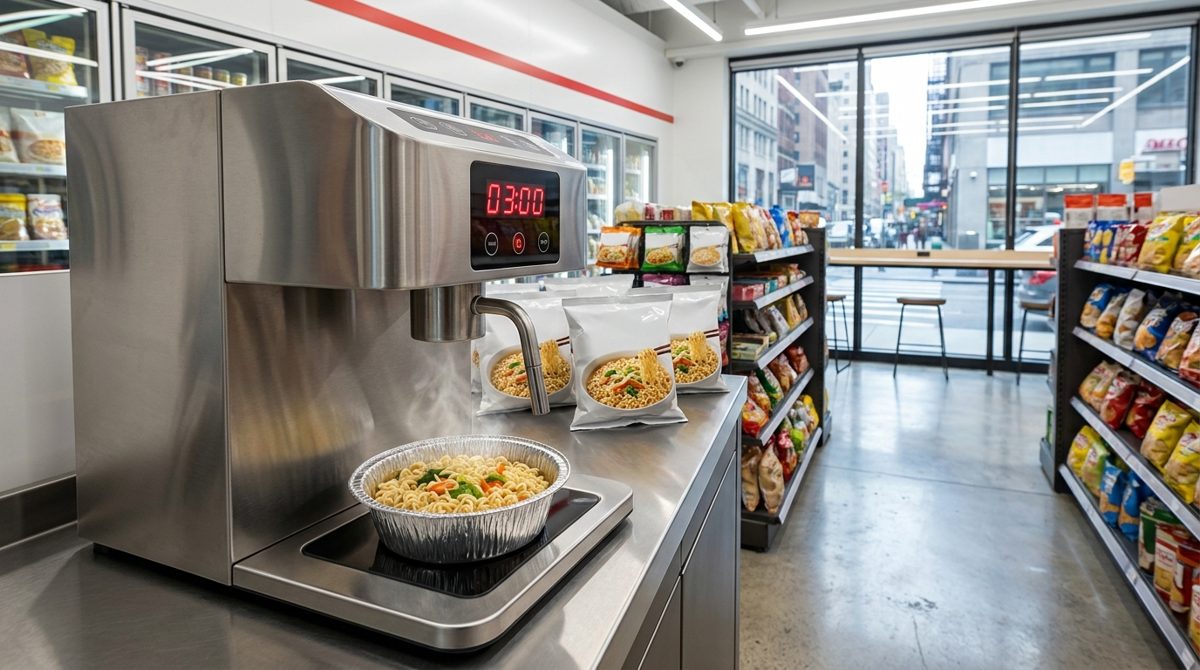
Confused by the beeping machine sitting next to the ramyeon shelf in a Korean convenience store? That’s the Korean ramyeon machine — a self-serve hot-water dispenser that cooks your cup noodles for you in about three to four minutes. Pay for your cup first, load it into the slot, wait for the timer, and eat at the counter. Here’s exactly how it works in 2026, plus what to do if your store doesn’t have one at all.
Table of Contents
- Ramyeon Machine Quick Facts
- What Is the Korean Ramyeon Machine?
- How to Use the Ramyeon Machine, Step by Step
- No Machine? Here’s the Manual Method
- Cup Ramyeon Prices in 2026
- Hacks: Eggs, Cheese & the Kimbap Combo
- Han River Ramyeon Culture
- Ramyeon Machine FAQ
Korean Ramyeon Machine Quick Facts
| Item | Details |
|---|---|
| What it is | Self-serve hot-water dispenser that fills and times your cup ramyeon |
| Where to find it | Near the eating counter/bar, close to the ramyeon shelf, in most convenience stores |
| Cook time | 3–4 minutes (a small screen on the machine counts down) |
| Price (2026) | ₩1,500–₩2,500 per cup — pay at the register before using the machine |
| Best chains for it | GS25 (≈18,800 stores), CU (≈18,700), 7-Eleven, emart24 — nearly universal |
| Not guaranteed at | Smaller/older stores — a manual hot water kettle or dispenser instead |
| Dietary notes | Most cup ramyeon contains wheat, soy, and often beef/pork flavoring — check the cup’s label |
| Best for | Budget meals, late-night snacks, and convenience store food beginners |
What Is the Korean Ramyeon Machine?
The ramyeon machine is one of the small conveniences that makes Korean convenience stores feel like a different species from stores back home. Instead of asking staff to boil water or hunting for a microwave, you place your cup of instant noodles under a nozzle, and the machine automatically fills it with hot water at the correct level and starts a countdown timer. No buttons to guess at, no scalding yourself pouring from a kettle.
It sounds like a tiny detail, but it’s a genuinely beloved piece of Korean food culture. Locals use it daily for a fast lunch between errands, and it’s become something of a rite of passage for visitors — the moment you successfully cook and eat a cup of Shin Ramyun at a convenience store counter, you’ve unlocked a real slice of everyday Korean life, not just a tourist photo op.
One important rule trips up almost every first-timer: the machine is not free self-service. You must buy the cup ramyeon at the register first. Only after it’s rung up and paid for do you carry it to the machine. Walking up with an unpaid cup and using the machine looks like — and is — an attempt to skip payment, so always pay first, machine second.
Compared to instant-noodle setups in other countries, the Korean version feels almost engineered for speed and courtesy. In Japan you’ll often find a plain hot-water pot with a manual tap; in Korea the machine measures the exact fill line for you, so you never end up with watery or under-filled noodles. Some newer machines even dispense at a slightly cooler, safer temperature than boiling to reduce burns, while still cooking the noodles fully within the timer.
It’s also worth knowing that the machine only handles water — it doesn’t heat, stir, or open anything for you. You’re still responsible for peeling the lid, adding any seasoning packets at the right stage, and stirring once it’s done. Think of it as a smart kettle bolted to the wall, not a full automatic cooker.
How to Use the Ramyeon Machine, Step by Step
The process is simple once you’ve seen it done, but here’s the exact sequence so you’re not standing there guessing while a line forms behind you.
- Pick your cup ramyeon from the shelf — Shin Ramyun, Chapagetti, Neoguri, and Jin Ramyeon are the most common brands.
- Pay at the register like any other item. The cashier will not open or prepare it for you.
- Peel back the lid partway (most cups have a fold line) and remove the small seasoning/flake packets if the recipe calls for adding them after cooking.
- Place the cup in the machine’s slot, usually a circular or notched holder sized for standard cup ramyeon.
- Let the machine fill it automatically with hot water to the fill line, then it starts a timer, usually displayed on a small digital screen (3–4 minutes is standard).
- Wait at the counter or eating bar nearby, then peel the lid fully, stir well, and eat there or take it out.
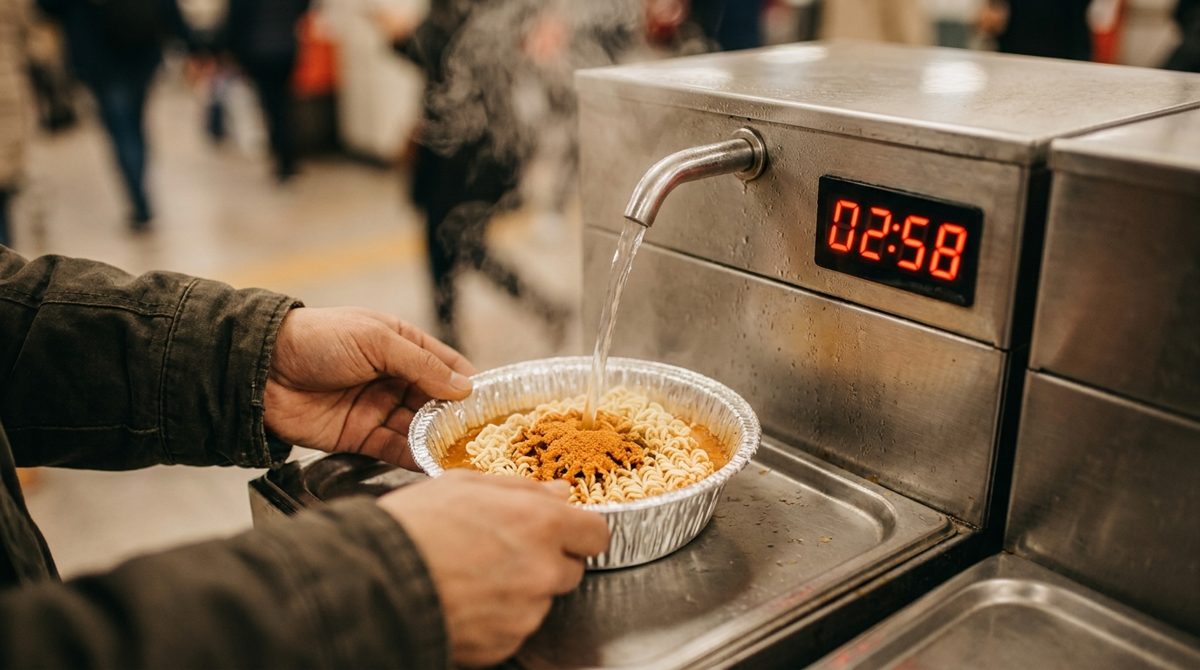
A couple of practical notes: the cup gets hot fast, so use the little cardboard sleeve if one’s provided, or grab a few paper napkins to wrap around it. And don’t remove the cup early just because it looks ready — the noodles need the full timer to soften properly, especially thicker styles like Jin Ramyeon.
If the store is busy, there’s an unspoken queue system: whoever’s cup finishes cooking clears out of the machine’s immediate space to eat, so the next person can load theirs. You don’t need to hover directly over the machine while your cup cooks — step back to the counter or a stool, and come back when the timer hits zero. Rushing the machine or repeatedly pressing buttons won’t speed anything up; the timer runs on a fixed internal clock.
Also double-check the fill line before walking away. Occasionally a machine’s nozzle position shifts slightly with cup size, so if the water looks noticeably low once it stops, you can top it off yourself from the same nozzle or ask staff — it happens rarely, but it’s an easy fix.
No Machine? Here’s the Manual Method
Not every convenience store has a dedicated ramyeon machine — smaller, older, or more rural locations often just have a hot water dispenser or an electric kettle sitting on the counter instead. Don’t worry, the process is identical, just manual: peel the lid partway, fill the cup to the marked line yourself, reseal the lid, and set a timer on your phone for 3–4 minutes.
This is actually a useful skill to have regardless, since even stores with a machine sometimes have it out of order or occupied during rush hours. The eating counter or bar with stools is standard 24-hour convenience store furniture either way, so you’ll always have somewhere to sit while you wait. If you want the fuller picture of what else is worth trying on the shelves, see our Korean convenience store food guide before you go.
You’ll most often run into the manual setup in small neighborhood shops, rest-stop convenience stores along the highway, or older locations that haven’t been renovated recently. None of this affects the taste of the noodles at all — the machine is a convenience upgrade, not a quality difference. Some solo travelers actually prefer the manual kettle method since it lets you control the water level precisely if you like your ramyeon a touch less soupy.
Cup Ramyeon Prices in 2026
Prices are uniform nationwide and haven’t moved much in 2026 — a cup of instant noodles remains one of the cheapest hot meals in the country. Here’s what to expect at GS25, CU, 7-Eleven, and emart24:
| Product | 2026 Price | Notes |
|---|---|---|
| Shin Ramyun cup | ₩1,500 | The spicy, classic default — most travelers’ first pick |
| Chapagetti cup | ₩1,800 | Black bean noodles, no soup — drain excess water before eating |
| Neoguri cup | ₩1,700–1,900 | Thicker, chewier noodles with a seafood-broth base |
| Jin Ramyeon cup | ₩1,600–1,800 | Mild or spicy versions available side by side |
| Premium/large cups | ₩2,000–₩2,500 | Bigger portions, gourmet flavors, or collaboration branding |
For a full rundown of every flavor and spice level worth trying, check our dedicated convenience store ramyeon guide. It’s worth reading before you commit to a cup, since spice levels vary a lot more than the packaging suggests.
Prices are effectively identical across GS25, CU, 7-Eleven, and emart24, since cup ramyeon is a nationwide staple rather than a chain-exclusive item — you’re paying for the brand, not the store. The one thing that does shift prices is rotating 1+1 and 2+1 promotions, which run monthly and are marked directly on the shelf tag. If a cup you want is on a “buy one get one” deal, it applies automatically at checkout, so it’s always worth a glance at the shelf sticker before you pick a flavor.
Hacks: Eggs, Cheese & the Kimbap Combo
Once you’ve got the basic mechanics down, locals have a few upgrades that turn a ₩1,500 cup into a genuinely satisfying meal. The most common is a boiled egg, usually sold in a small warming case right next to the ramyeon machine or at the register — just ask for “gyeran” (계란) if you don’t see it labeled in English. Crack or peel it straight into the hot noodles.
A cheese slice melted into the broth is another popular move, especially with spicier cups like Shin Ramyun — it mellows the heat and adds richness. Look for individually wrapped processed cheese slices near the dairy section.
But the single most iconic pairing is the ramyeon + kimbap combo: a triangle kimbap (samgak kimbap) eaten alongside your cup of noodles. It’s the unofficial national convenience store lunch, cheap, filling, and endlessly customizable depending on the kimbap filling you grab. If you’ve never tried one, our what is kimbap guide breaks down every common filling and how to unwrap the tricky plastic seal.
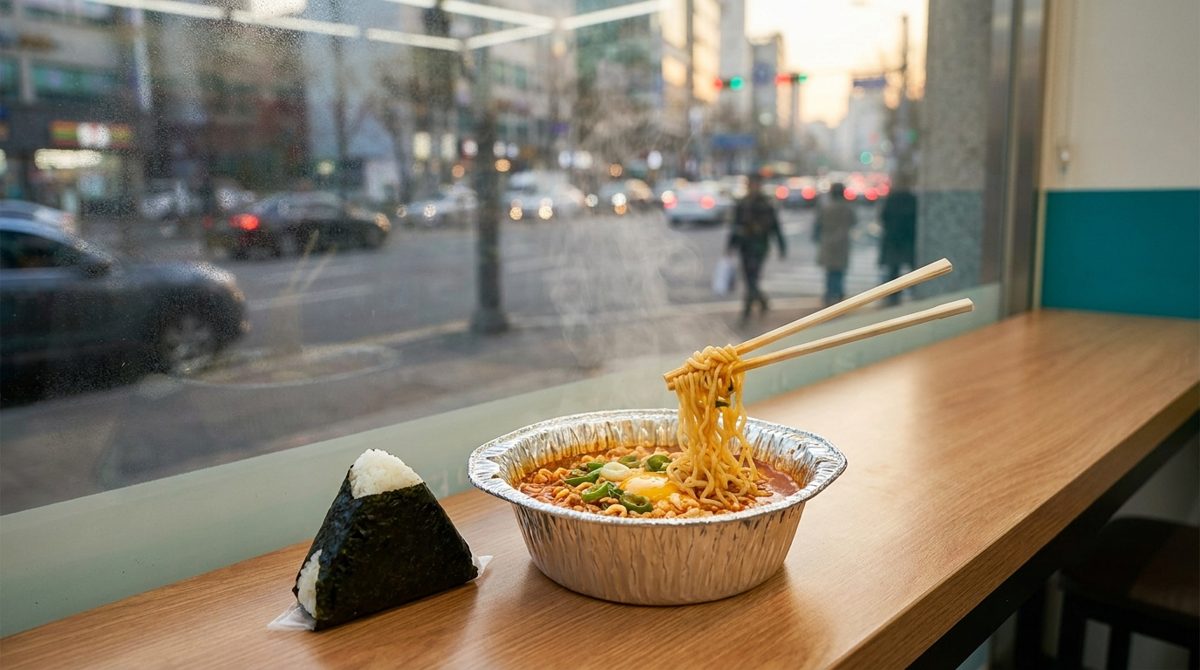
If you’re eating at the counter with others, basic manners still apply — keep noise down, clear your own cup and trash, and don’t linger for hours during a rush. Our Korean dining etiquette guide covers the small habits that make locals feel like you’re a considerate traveler rather than just a tourist passing through.
Other popular add-ins worth trying at least once: a spoonful of instant rice mixed into the leftover spicy broth at the end (a beloved trick for finishing every last drop of flavor), canned tuna stirred in for extra protein, or a handful of frozen dumplings dropped in during the last minute of cooking if the store sells them. None of these require any special equipment beyond the cup itself and a steady hand.
Han River Ramyeon Culture: Korea’s Favorite Picnic Meal
If there’s one image that sums up casual Korean food culture, it’s this: friends sitting on a mat along the Han River (한강) at sunset, a portable ramyeon-cooking station bubbling away nearby, cups and chopsticks passed around as the city lights come on across the water. It’s less a niche activity than a full-blown Seoul tradition, especially in the warmer months.
Several of the larger Han River parks — Ttukseom, Yeouido, and Banpo among them — have convenience stores right at the park entrance, some with communal cooking stations set up specifically for river-side ramyeon. You buy your cup inside, walk it out to the station, cook it there, and carry it back to your picnic spot to eat with a view of the water. It’s an easy, cheap way to spend a golden-hour evening like a local.

Weekend evenings get busy, so arrive a little before sunset to claim a mat spot and a working cooking station. Bikes, blankets, and portable speakers are all part of the scene — nobody will look twice at tourists joining in. For more on this kind of low-cost, high-charm eating, see our Korean street food guide, and for official park information check VisitKorea.
The tradition has only grown more visible thanks to Korean dramas and variety shows, which frequently feature characters cooking ramyeon riverside as a shorthand for carefree Seoul life. For visitors, it doubles as one of the cheapest “must-do” experiences in the city: a cup of noodles, a view of the Banpo Bridge fountain or Yeouido skyline, and zero reservation required. Bring your own cup ramyeon from a nearby store if the park’s own stock runs low during peak weekends, since popular spots can sell out fast on warm evenings.
Ramyeon Machine FAQ
Do I need to pay before using the ramyeon machine?
Yes, always. Pick your cup ramyeon, pay for it at the register like any other item, and only then carry it to the machine. Using the machine with an unpaid cup is treated the same as walking out without paying.
How long does the Korean ramyeon machine take to cook ramyeon?
Typically 3–4 minutes. The machine fills your cup with hot water automatically and displays a countdown on a small screen, so you don’t need your own timer — just wait nearby until it finishes.
What if my convenience store doesn’t have a ramyeon machine?
Smaller or older stores often have just a hot water dispenser or kettle instead. The process is the same, only manual: fill the cup to the marked line yourself, reseal the lid, and time 3–4 minutes on your phone.
How much does cup ramyeon cost in Korea in 2026?
Between ₩1,500 and ₩2,500 depending on the brand and size. A basic Shin Ramyun cup runs ₩1,500, Chapagetti is around ₩1,800, and premium or larger cups can reach ₩2,500.
Can I eat ramyeon by the Han River?
Absolutely — it’s one of Seoul’s most beloved traditions. Several Han River parks have convenience stores with communal ramyeon-cooking stations right near the entrance, especially popular for sunset picnics in the warmer months.
The Verdict: Should You Try It?
Yes — the ramyeon machine is one of the easiest, cheapest, and most satisfying small experiences you can have in Korea. It costs less than a coffee, takes four minutes, and drops you straight into a piece of everyday local life that most tourists never notice. Pay first, load the cup, watch the timer, and add an egg or a kimbap combo if you’re feeling ambitious. Ready to explore everything else Korean convenience stores have to offer? Browse our full Convenience Store Explorer series for every item, hack, and price worth knowing in 2026.