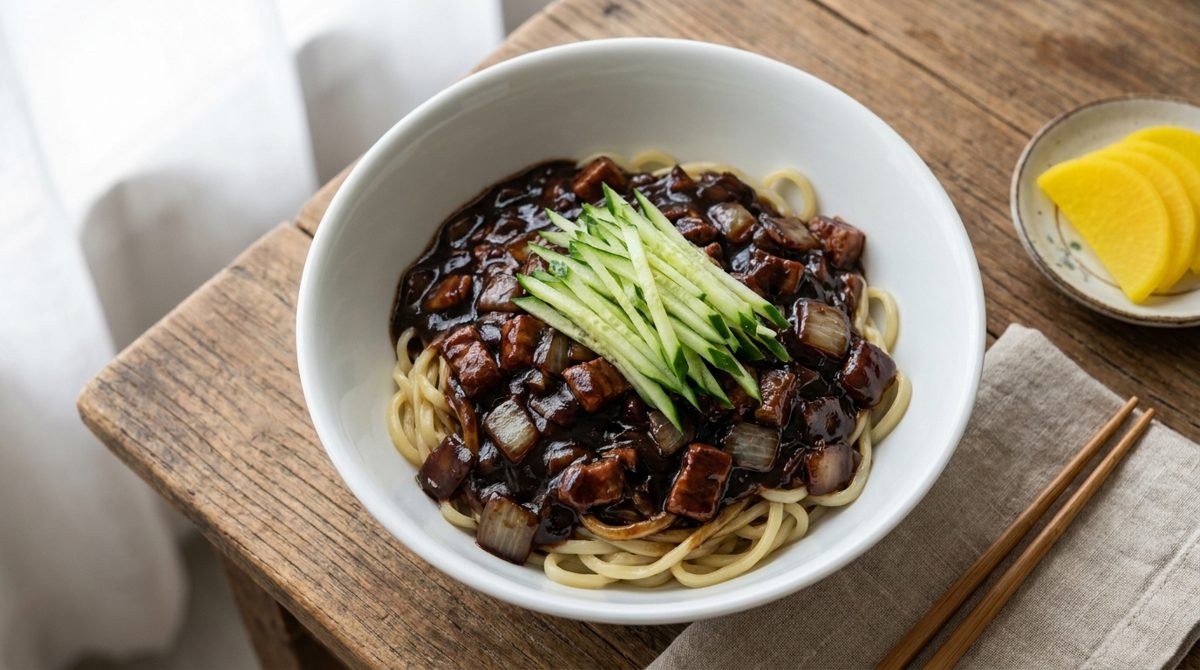
Saw a bowl of pitch-black noodles and wondered what jjajangmyeon is? Jjajangmyeon (짜장면) is Korea’s beloved Korean-Chinese noodle dish: thick, chewy wheat noodles smothered in a glossy black bean sauce made from caramelized chunjang paste, stir-fried with diced pork and onions. It’s savory, slightly sweet, completely non-spicy — and it’s the single most ordered delivery food in Korea. This decoder page covers taste, allergens, halal and vegetarian answers, real 2026 prices, and exactly how to order it in Korean.
Table of Contents
- Jjajangmyeon Quick Facts
- What Is Jjajangmyeon, Exactly?
- What Does Jjajangmyeon Taste Like?
- Dietary Guide: Vegetarian, Vegan, Halal & Allergens
- How to Order Jjajangmyeon in Korean (+ 2026 Prices)
- How to Eat Jjajangmyeon Like a Local
- Types of Jjajangmyeon
- Where to Try Jjajangmyeon
- Jjajangmyeon FAQ
Jjajangmyeon Quick Facts
| Item | Details |
|---|---|
| Korean name | 짜장면 (jjajangmyeon) — “fried sauce noodles” |
| Pronunciation | JJA-jang-myun |
| Type | Korean-Chinese noodle dish / single-serving main |
| Spice level | 🌶️ 0 / 5 — completely non-spicy, sweet-savory |
| Price (2026) | ₩7,000–₩9,000 at regular Korean-Chinese restaurants; premium gan-jjajang ₩9,000–₩12,000 |
| Vegetarian | ❌ Not by default — the sauce is stir-fried with pork |
| Vegan | ❌ Not by default — same pork issue; rare vegan versions at temple/vegan restaurants |
| Halal-friendly | ❌ Standard version contains pork; seafood (samseon) versions exist but cross-contact is common |
| Main allergens | Wheat (noodles), soy (chunjang paste), pork, heavy onion; sometimes shellfish in seafood versions |
| Best for | Spice-avoiders, kids, delivery-night experiences, anyone craving comfort noodles |
What Is Jjajangmyeon, Exactly?
Jjajangmyeon is what happened when Chinese cuisine emigrated to Korea and never went home. The dish descends from zhajiangmian (“fried sauce noodles”) brought by Chinese laborers from Shandong province in the late 1800s. In Incheon’s Chinatown — where the port workers settled — Korean-Chinese cooks sweetened and darkened the sauce with caramel-added chunjang paste, and a new national obsession was born. The restaurant Gonghwachun in Incheon, opened in the early 1900s, is celebrated as its birthplace, and today the same neighborhood hosts an entire Jjajangmyeon Museum in the original building.
What began as cheap dockworker fuel became Korea’s ultimate everyman food. For decades, jjajangmyeon was the treat families ordered on graduation days and moving days — and it remains the undisputed king of Korean delivery. Ask any Korean what arrives when nobody can decide what to eat: a steel delivery box with jjajangmyeon in it. Order volume surveys year after year rank it Korea’s #1 delivery dish.
It even owns a holiday. April 14 is Black Day, when singles who received nothing on Valentine’s Day (February 14) or White Day (March 14) gather to eat black noodles in mock mourning of their love lives. It’s self-deprecating, communal, and very Korean — and it means one day a year, jjajangmyeon restaurants are packed with people celebrating being single.
Culturally, jjajangmyeon sits somewhere between pizza night and grandma’s cooking in the Korean psyche. It’s the first restaurant meal many Koreans remember from childhood, the dish dads ordered to celebrate report cards, and the standard fuel for anyone moving apartments (the movers eat it too — on the floor of the empty room, straight from delivery bowls). Its price is so symbolically important that Korean media tracks it as an informal cost-of-living index. When jjajangmyeon prices rise, the country notices.
What Does Jjajangmyeon Taste Like?
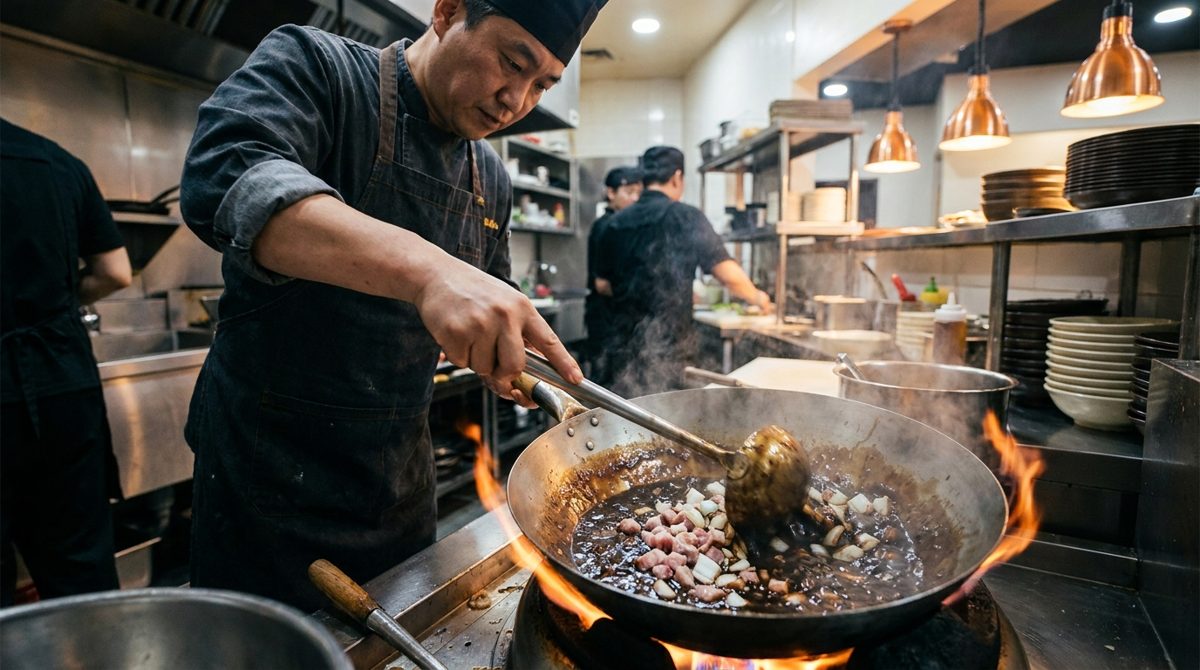
Imagine a savory-sweet gravy somewhere between hoisin sauce and caramelized onions, minus the spice. The chunjang black bean paste is deep-fried in oil first, which removes bitterness and adds a roasted, almost chocolatey darkness. Stir-fried with plenty of diced onions, pork, and often potato or zucchini, it turns silky and gently sweet. The noodles are the other half of the pleasure: thick, hand-pulled-style wheat noodles with a satisfying chew that Koreans prize. Fresh cucumber slivers on top cut the richness.
If you’re expecting Chinese-style zhajiangmian — saltier, funkier, drier — recalibrate. Korean jjajangmyeon is milder, sweeter, and saucier. First-timers usually describe it as “comfort food I didn’t know existed.”
Is Jjajangmyeon Spicy?
Not at all — jjajangmyeon is a genuine 0 out of 5. There’s no chili in the standard recipe, which makes it one of the best Korean dishes for children, spice-sensitive travelers, and anyone recovering from a tteokbokki incident. The only heat you’ll ever encounter is raw onion served on the side for dipping in chunjang paste. If you want spice, that’s what its fiery sibling jjamppong (spicy seafood noodle soup) is for — the eternal Korean dilemma is choosing between the two.
Jjajangmyeon Dietary Guide: Vegetarian, Vegan, Halal & Allergens
This is where jjajangmyeon needs honest labeling — the innocent-looking black sauce hides more animal products than most visitors assume.
| Ingredient concern | In standard jjajangmyeon? | How to handle |
|---|---|---|
| Pork | Yes — diced pork is standard, and the sauce is often fried in lard | Ask for samseon (seafood) jjajang, but cross-contact with pork is likely in the same wok |
| Beef | Rarely | Not a standard ingredient |
| Seafood / shellfish | Only in samseon versions | Samseon jjajang contains squid, shrimp, sea cucumber — avoid if shellfish-allergic |
| Wheat / gluten | Yes — the noodles are pure wheat | No gluten-free version exists; jjajangbap (sauce over rice) still has wheat in the sauce paste |
| Soy | Yes — chunjang is fermented soybean paste | Impossible to remove; it is the dish |
| Onion | Yes, heavily | Onions are the bulk of the sauce — a problem for low-FODMAP or allium-restricted diets |
| Egg | Sometimes | Some restaurants top the bowl with a fried egg or boiled egg half |
| Dairy / nuts | No | Traditional recipes contain neither |
If you carry a food allergy card, show it before ordering — Korean-Chinese kitchens move fast and substitutions are rare, but staff will tell you honestly whether a dish can work. The Korean phrase “저는 ___ 알레르기가 있어요” (jeoneun ___ allergy-ga isseoyo, “I have a ___ allergy”) plus pointing at the ingredient word usually gets a clear yes or no within seconds. When in doubt at a busy lunch rush, choose a different restaurant rather than gambling on a shared wok.
Is Jjajangmyeon Vegetarian or Vegan?
Not by default — and this catches people out because the sauce just looks like black beans. Standard jjajangmyeon contains diced pork, and many kitchens fry the chunjang paste in lard for flavor. Simply asking for “no meat” doesn’t fix the lard or the meat-stock base some restaurants use. Genuine vegetarian or vegan jjajangmyeon exists at dedicated vegan restaurants in Seoul (several in Itaewon, Hongdae, and near Jogyesa temple make excellent mushroom-based versions), and vegan instant jjajang ramyeon is easy to find in Korean convenience stores — check the label for 비건 (vegan). At a regular Korean-Chinese restaurant, assume it is not vegetarian.
Is Jjajangmyeon Halal?
The standard version is not halal — it contains pork, plainly and simply. Two partial workarounds exist. First, samseon (three-delicacy) jjajangmyeon swaps pork for seafood, but at a regular restaurant it’s cooked in the same wok and often with the same lard-fried sauce base, so strict halal eaters should skip it. Second, a small number of halal-certified Chinese-Korean restaurants operate in Seoul’s Itaewon area, and the Korea Tourism Organization lists Muslim-friendly restaurants on VisitKorea. If you want the comfort-noodle experience with certainty, halal-safe alternatives like vegetable bibimbap or seafood kalguksu at certified places are the smarter play.
How to Order Jjajangmyeon in Korean (+ 2026 Prices)
Korean-Chinese restaurants are fast, loud, and wonderfully unfussy — you’ll usually have noodles in front of you within ten minutes. These phrases cover everything:
| What you want | Say this | Romanized |
|---|---|---|
| One jjajangmyeon, please | 짜장면 하나 주세요 | jjajangmyeon hana juseyo |
| Premium fresh-fried sauce version | 간짜장 주세요 | gan-jjajang juseyo |
| Seafood version (no pork chunks) | 삼선짜장 주세요 | samseon-jjajang juseyo |
| Sauce over rice instead of noodles | 짜장밥 주세요 | jjajangbap juseyo |
| One tangsuyuk to share, please | 탕수육 하나 주세요 | tangsuyuk hana juseyo |
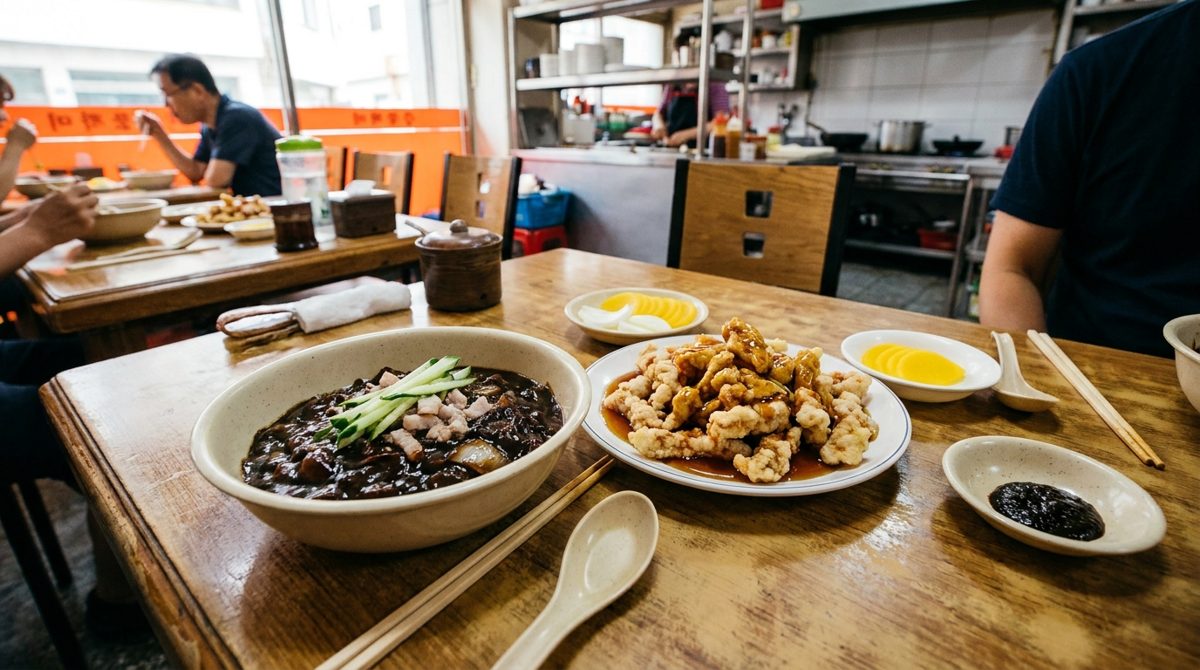
A tip on menu navigation: Korean-Chinese restaurants divide their menus into 식사 (siksa, “meals” — the cheap noodle and rice dishes) and 요리 (yori, “dishes” — the pricier shareable plates like tangsuyuk). Jjajangmyeon lives in the meals section. Portions are generous; one bowl is a full meal for one adult, and there’s no expectation to order more. Solo dining is completely normal here — Korean-Chinese joints are one of the easiest places in Korea to eat alone without a second glance.
What it costs in 2026: a standard bowl runs ₩7,000–₩9,000 at neighborhood Korean-Chinese restaurants — still one of the cheapest full meals in the country. Gan-jjajang (sauce wok-fried to order) adds ₩2,000–₩3,000, and samseon versions run ₩9,000–₩12,000. Delivery is where jjajangmyeon lives: apps like Baemin deliver it to parks, offices, and Han River picnic mats, though delivery fees add ₩2,000–₩4,000. The pickled yellow radish (danmuji) and raw onion with chunjang on the side are free — refills too, per standard Korean dining etiquette.
How to Eat Jjajangmyeon Like a Local
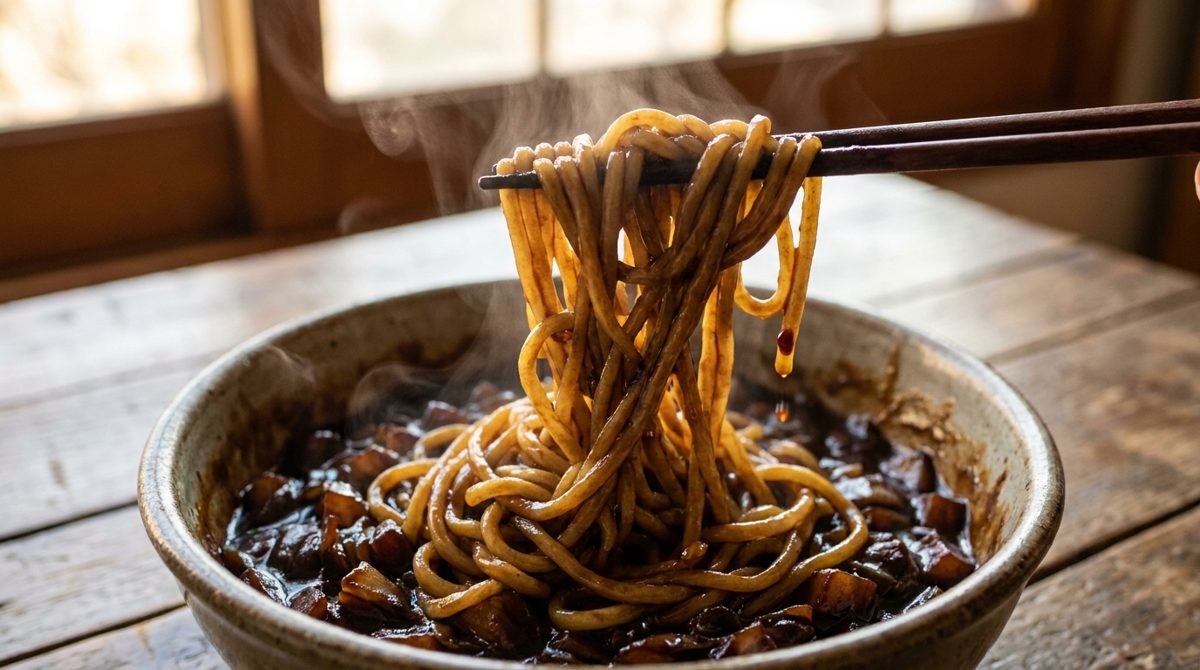
The sauce arrives sitting on top of the noodles. Your first job: mix, immediately and thoroughly. Chopsticks in, lift and turn from the bottom until every strand is black. Koreans mix with real intent — a half-mixed bowl means the last bites are plain noodles, which is a tragedy. Speed matters too, because the noodles keep absorbing sauce and soften as they sit.
Slurping is completely acceptable, even encouraged — this is not a quiet dish. Between mouthfuls, bite a piece of danmuji (yellow pickled radish) to reset your palate, or dip a wedge of raw onion into the chunjang paste if you want to eat like a true regular. And accept now that some sauce will end up on your shirt; Koreans joke that you can’t eat jjajangmyeon in a white top. If you’re two or more people, the ritual order is one jjajangmyeon, one jjamppong, and a shared tangsuyuk — dishes get passed around without ceremony.
One last local move: the delivery ritual. If you order jjajangmyeon to a park or the Han River, it often arrives in real bowls with plastic wrap stretched over the top. Peel the film, mix, eat, then leave the empty bowls stacked where couriers can collect them — restaurants genuinely come back for their dishes. It feels wrong the first time and wonderfully Korean every time after. Chopstick skills matter less than enthusiasm; nobody has ever eaten jjajangmyeon gracefully, including Koreans.
Types of Jjajangmyeon You’ll See on Menus
Gan-jjajang (간짜장) — the connoisseur’s choice: sauce wok-fried to order without added water or starch, served in a separate bowl. Drier, smokier, more intense. Samseon jjajang (삼선짜장) — “three delicacies”: squid, shrimp, and sea cucumber replace or join the pork. Jaengban jjajang (쟁반짜장) — a sharing platter version, noodles and sauce pre-tossed in the wok, often slightly spicy. Yuni jjajang (유니짜장) — sauce made with finely minced pork; smooth and kid-favorite. Jjajangbap (짜장밥) — same sauce over rice, usually with a fried egg. And the home version: Chapagetti, the instant jjajang ramyeon that became world-famous via the “ram-don” dish in the film Parasite.
Two menu-decoding notes. If you see 옛날짜장 (yennal jjajang, “old-style jjajang”), that’s the nostalgic version with more vegetables, a thinner sauce, and often a fried egg — comfort food squared. And portion hackers should know about jjamjjamyeon (짬짜면): a divided bowl serving half jjajangmyeon, half jjamppong, invented specifically to end the great Korean noodle dilemma. Not every restaurant offers it, but when you spot it, order it — it’s the best introduction to both dishes at once.
Where to Try Jjajangmyeon
For the pilgrimage version, take the subway (Line 1 to Incheon Station) to Incheon Chinatown, where the dish was born — the streets are lined with century-old Korean-Chinese restaurants, and the Jjajangmyeon Museum in the original Gonghwachun building tells the whole story. In Seoul, every neighborhood has a Chinese-Korean joint (look for 중국집 or red signage with 짜장면); quality is remarkably consistent because competition is brutal. For the most Korean experience of all, order it by delivery app to your accommodation on a lazy night — it arrives fast, cheap, and wrapped in plastic film you’ll peel back like a local. Pair the trip with our Seoul food guide, and if you want the cold-noodle counterpoint to this hot comfort bowl, read our naengmyeon decoder next.
Budget note: the Incheon Chinatown trip pairs perfectly with the neighboring Fairy Tale Village and Wolmido waterfront, making it an easy half-day excursion from Seoul for under ₩20,000 including the noodles. If you’d rather stay central, the Chinese restaurant floors of older buildings around Myeongdong and Euljiro serve versions that have fed office workers for fifty years — the shabbier the signage, the better the wok breath, as the local wisdom goes.
Jjajangmyeon FAQ
What does jjajangmyeon mean in English?
“Fried sauce noodles.” Jjajang comes from the Chinese zhajiang (fried sauce), and myeon means noodles. The dish is the Korean adaptation of Chinese zhajiangmian, developed in Incheon’s Chinatown.
Is jjajangmyeon Chinese or Korean food?
Both and neither — it’s Korean-Chinese. Chinese immigrants from Shandong brought the original, and Korean tastes transformed it with sweeter caramel-added chunjang paste. You won’t find this exact dish in China; it’s a Korean invention with Chinese ancestry.
Does jjajangmyeon have meat in it?
Yes — standard jjajangmyeon contains diced pork, and the sauce is often fried in lard. It looks vegetarian but isn’t. Seafood (samseon) versions replace the pork chunks, and fully vegan versions exist only at dedicated vegan restaurants.
What is Black Day in Korea?
April 14 — the day singles who got nothing on Valentine’s Day or White Day eat black jjajangmyeon together, humorously mourning their single status. It’s one of Korea’s most charming unofficial food holidays.
How much does jjajangmyeon cost in Korea in 2026?
₩7,000–₩9,000 for a standard bowl at Korean-Chinese restaurants, ₩9,000–₩12,000 for gan-jjajang or samseon versions. It remains one of the cheapest full meals in Korea.
The Verdict: Should You Order It?
A last practical note for planners: Korean-Chinese restaurants are among the few in Korea that reliably deliver to hotels and guesthouses, and most delivery apps now offer English interfaces. If your accommodation has a room number and you have an appetite, jjajangmyeon is the easiest authentic meal you’ll ever summon in a foreign country — faster than room service and a third of the price. Rainy evening, no plans, black noodles at your door in twenty-five minutes: that’s a Korea memory too, and a deliciously low-effort one.
Yes — jjajangmyeon is essential Korea, arguably more woven into daily life than bulgogi or bibimbap. It’s zero-spice, dirt cheap, deeply comforting, and eating it by delivery on a random night is a genuine cultural experience, not just a meal. Vegetarians and halal eaters should sit this one out or hunt certified alternatives — but everyone else should order it once with tangsuyuk and once as gan-jjajang. Ready to decode the next menu mystery? Explore the full Korean Food Decoder — every major Korean dish explained with spice levels, allergens, and ordering phrases.