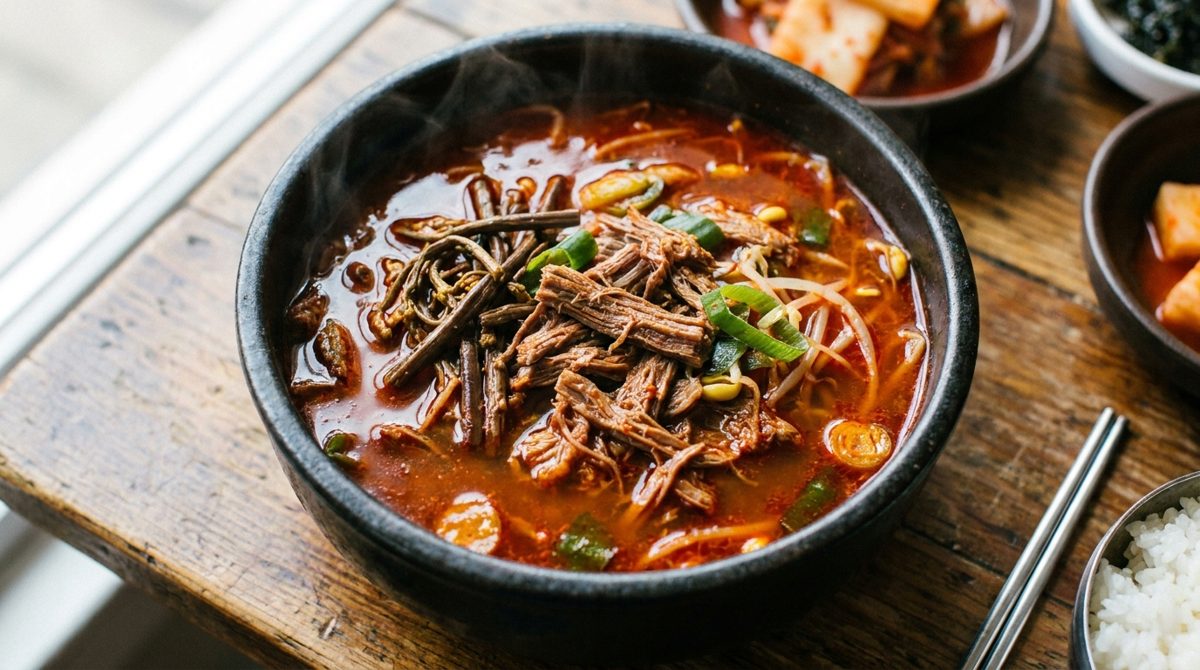
Staring at a bright-red, oily soup on the menu called yukgaejang and wondering what you’re about to order? Yukgaejang (육개장) is a fiery Korean beef soup made with shredded brisket, fernbrake (gosari), bean sprouts, and scallions simmered in a chili-oil-red broth seasoned with gochugaru and soy. It’s hearty, deeply savory, and beloved as a hangover cure and cold-weather comfort food. This decoder page covers taste, spice level, allergens, halal and vegetarian answers, real 2026 prices, and exactly how to order it in Korean.
Table of Contents
- Yukgaejang Quick Facts
- What Is Yukgaejang, Exactly?
- What Does Yukgaejang Taste Like?
- Dietary Guide: Vegetarian, Vegan, Halal & Allergens
- How to Order Yukgaejang in Korean (+ 2026 Prices)
- How to Eat Yukgaejang Like a Local
- Types of Yukgaejang
- Where to Try Yukgaejang
- Yukgaejang FAQ
Yukgaejang Quick Facts
| Item | Details |
|---|---|
| Korean name | 육개장 (yukgaejang) — “spicy dog-meat-style beef stew” (name is historical, modern dish is all beef) |
| Pronunciation | yuk-GAE-jang |
| Type | Spicy shredded beef soup, served with rice on the side |
| Spice level | 🌶️ 3 / 5 — noticeably spicy but not punishing |
| Price (2026) | ₩11,000–₩15,000 at standard Seoul restaurants |
| Vegetarian | ❌ No — built on beef brisket and beef broth |
| Vegan | ❌ No — same reason; no accidental vegan version exists |
| Halal-friendly | ⚠️ Conditional — beef-based so halal in principle, but restaurants are rarely certified |
| Main allergens | Soy, sesame, occasionally egg (garnish) |
| Best for | Hangover recovery, cold weather, spice lovers who want soup instead of stew |
What Is Yukgaejang, Exactly?
Yukgaejang’s name is a linguistic fossil. Gaejang (개장) originally referred to a spicy dog-meat soup once eaten in Korea; yuk (육) means “meat,” specifically beef here — so the name essentially means “beef version of gaejang.” The dog-meat dish it references has largely disappeared from modern Korean dining, but the name stuck to what became one of Korea’s most enduring beef soups, now made entirely with beef brisket.
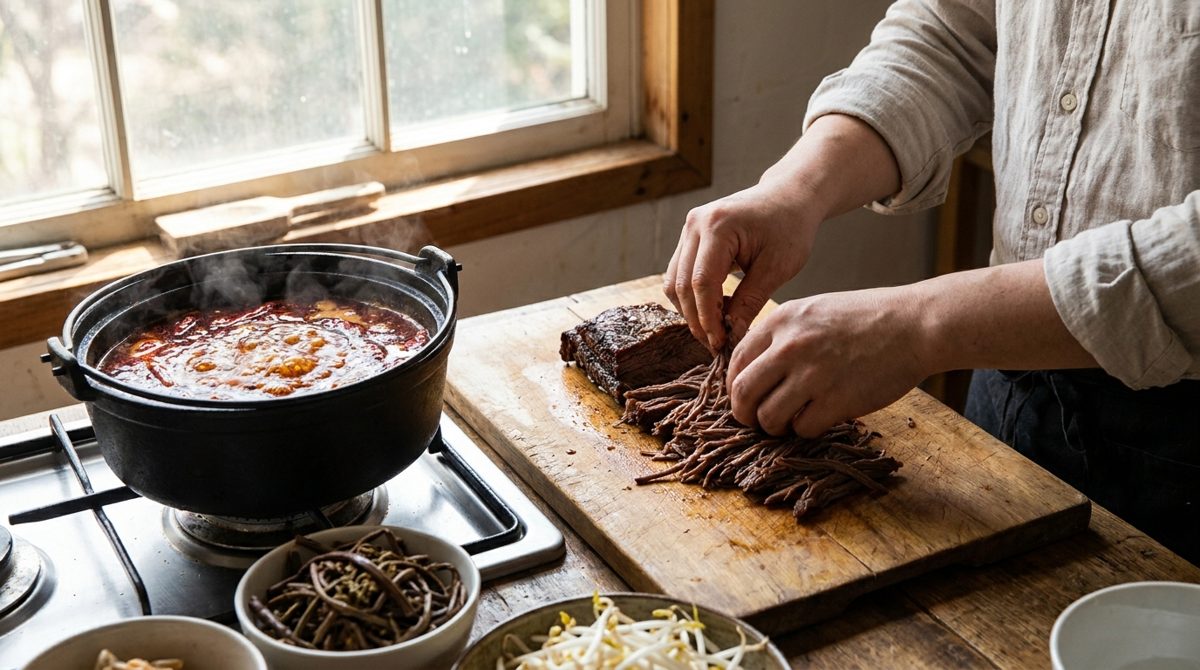
The soup is built by boiling beef brisket for hours until tender, shredding it by hand into long strands, then simmering it back into the broth with gochugaru (Korean chili flakes) oil, fernbrake (gosari), bean sprouts, and scallions cooked until soft. The result is a thick, deep-red soup that looks intimidating but tastes more savory-spicy than punishingly hot — closer to a rich beef chili than a throat-scorching broth.
Yukgaejang carries a quieter cultural role too: it’s traditionally served at Korean funerals and memorial gatherings (jesa), where large pots feed grieving families and visiting mourners over long hours. That context doesn’t make the dish somber to order at a regular restaurant — it’s a completely normal, everyday lunch choice — but it’s worth knowing the soup carries this dual identity as both comfort food and ceremonial food.
Historically, yukgaejang belongs to a broader family of Korean soups called haejangguk — literally “hangover-dissolving soup.” Other members of that family include seolleongtang (milky ox-bone broth) and gukbap-style soups served with rice. Yukgaejang stands apart from its haejangguk cousins by being spicy rather than mild and milky, which is why some travelers describe it as “the fiery answer to seolleongtang.” Regional versions differ mainly in how much gochugaru oil is used and how finely the beef is shredded, with some old-school restaurants in Daegu and Jeonju claiming their own signature styles.
What Does Yukgaejang Taste Like?
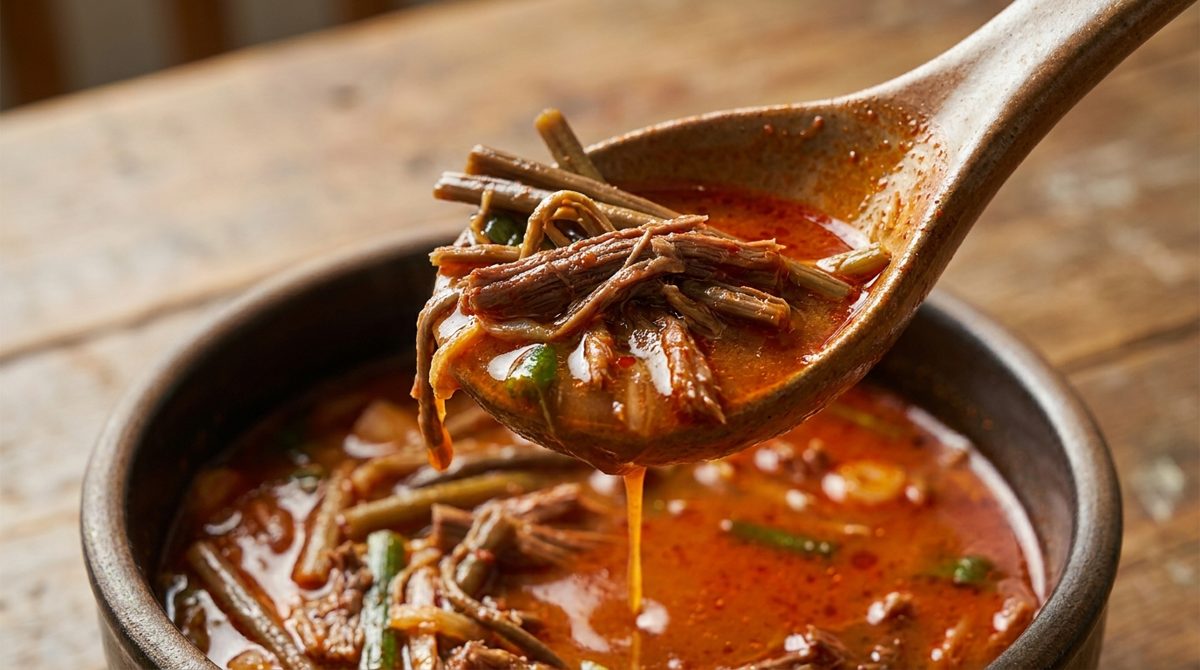
Yukgaejang tastes deeply savory and beefy first, with a building chili heat that arrives a beat behind the initial spoonful. The shredded brisket is soft and slightly stringy, the fernbrake adds an earthy, faintly bitter vegetal note, and the bean sprouts contribute crunch and a clean sweetness that balances the chili oil. Sesame oil rounds out the aroma. It’s less “hot sauce spicy” and more “slow-burn, warming spicy” — the kind of heat that builds sweat on a cold day rather than making your eyes water instantly.
Compared to other spicy Korean soups, yukgaejang sits in an interesting middle ground. It’s spicier and more complex in texture than galbitang (mild beef short rib soup), but less overwhelmingly rich than a thick jjigae stew. Think of it as the soup version of a spicy beef chili — familiar enough for Western palates to recognize the beefy, tomato-adjacent-but-not-tomato depth, while still being distinctly Korean in its use of gochugaru, sesame oil, and fernbrake instead of cumin or tomato paste.
Is Yukgaejang Spicy?
Yes, moderately — most visitors rate it a solid 3 out of 5. Unlike bibimbap or naengmyeon, the chili is cooked directly into the broth, so you can’t dial it down at the table. The heat is steady rather than sharp, closer to a chili-oil warmth than fresh-pepper burn, and the rice served alongside helps mellow each spoonful. If you’re spice-sensitive, order a smaller portion first or ask staff how spicy their version runs — recipes vary noticeably between restaurants, and some older establishments make theirs noticeably hotter than chain restaurants aiming for broader appeal.
Yukgaejang Dietary Guide: Vegetarian, Vegan, Halal & Allergens
Yukgaejang is one of the more restrictive Korean Food Decoder dishes for travelers with dietary needs — the entire dish is structurally built on beef, so there’s no easy substitution.
| Ingredient concern | In standard yukgaejang? | How to handle |
|---|---|---|
| Beef | Always — the core ingredient and broth base | No substitution exists; this is fundamentally a beef dish |
| Pork | No | Not a concern in standard recipes |
| Egg | Sometimes, as a thin egg-ribbon garnish | “Gyeran ppaego juseyo” (계란 빼고 주세요) = no egg |
| Wheat / gluten | Minimal — mainly from soy sauce seasoning | Ask if soy sauce used is gluten-free; not standard at most places |
| Soy | Yes | Soy sauce and sometimes soybean sprouts are core seasonings |
| Sesame | Yes | Sesame oil is essential to the aroma — hard to remove |
| Shellfish / fish | Rarely | Standard recipes don’t use seafood, but some broths add a touch of fish sauce or anchovy stock for depth |
| Dairy / nuts | No | Traditional yukgaejang contains neither |
Is Yukgaejang Vegetarian or Vegan?
No, and there’s no realistic workaround. Unlike bibimbap or japchae, yukgaejang can’t simply have the meat removed — the broth itself is built from hours of beef bone and brisket simmering, so the beef flavor is baked into the liquid, not just floating on top. Ordering it “without meat” would leave you with beef broth minus the visible protein, which defeats the purpose and still isn’t vegetarian. If you’re vegetarian or vegan, skip this dish entirely and try bibimbap without meat, or a vegetable-forward japchae instead — both give you comparable comfort-food satisfaction without the animal-based broth problem.
Nutritionally, a standard bowl of yukgaejang runs roughly 300–400 kcal, with high protein content from the shredded beef and a moderate fat level thanks to the chili oil. It’s naturally low in carbohydrates on its own — the carbs come mostly from the side of rice, which most people eat alongside it. Sodium is on the higher side, as with most Korean soups, since salt and soy sauce carry much of the seasoning.
Is Yukgaejang Halal?
Conditionally. Yukgaejang contains no pork and no alcohol, and beef itself is halal in principle — so the dish is halal-friendly by ingredient list. The catch is sourcing: Korean restaurants serving yukgaejang are very rarely halal-certified, meaning the beef used is standard, non-certified Korean beef, and broths are sometimes deepened with non-halal additions like fish sauce. Muslim travelers should treat regular restaurant yukgaejang as uncertain rather than automatically approved. For confidence, check the Korea Tourism Organization’s Muslim-friendly restaurant listings on VisitKorea before ordering, or ask staff directly whether the beef and stock are halal-sourced.
How to Order Yukgaejang in Korean (+ 2026 Prices)
Yukgaejang is a straightforward, single-dish order — no build-your-own decisions required. These phrases help with common requests:
| What you want | Say this | Romanized |
|---|---|---|
| One yukgaejang, please | 육개장 하나 주세요 | yukgaejang hana juseyo |
| Less spicy, if possible | 덜 맵게 해주세요 | deol maepge haejuseyo |
| No egg | 계란 빼고 주세요 | gyeran ppaego juseyo |
| With extra rice | 공기밥 추가요 | gonggibap chuga-yo |
| Is the beef halal? | 이 소고기 할랄인가요? | i sogogi hallal-inga-yo? |
What it costs in 2026: a standard bowl of yukgaejang at a Seoul restaurant runs ₩11,000–₩15,000, usually including a side of rice and free banchan. Prices trend toward the lower end at neighborhood diners and older-style restaurants specializing in the dish, and toward the higher end near business districts or tourist areas. It’s typically priced similarly to seolleongtang and other hearty soup-and-rice meals. Outside Seoul, expect prices roughly ₩1,000–₩2,000 lower at the same style of restaurant. See our Korean dining etiquette guide for how banchan refills and table manners work.
How to Eat Yukgaejang Like a Local
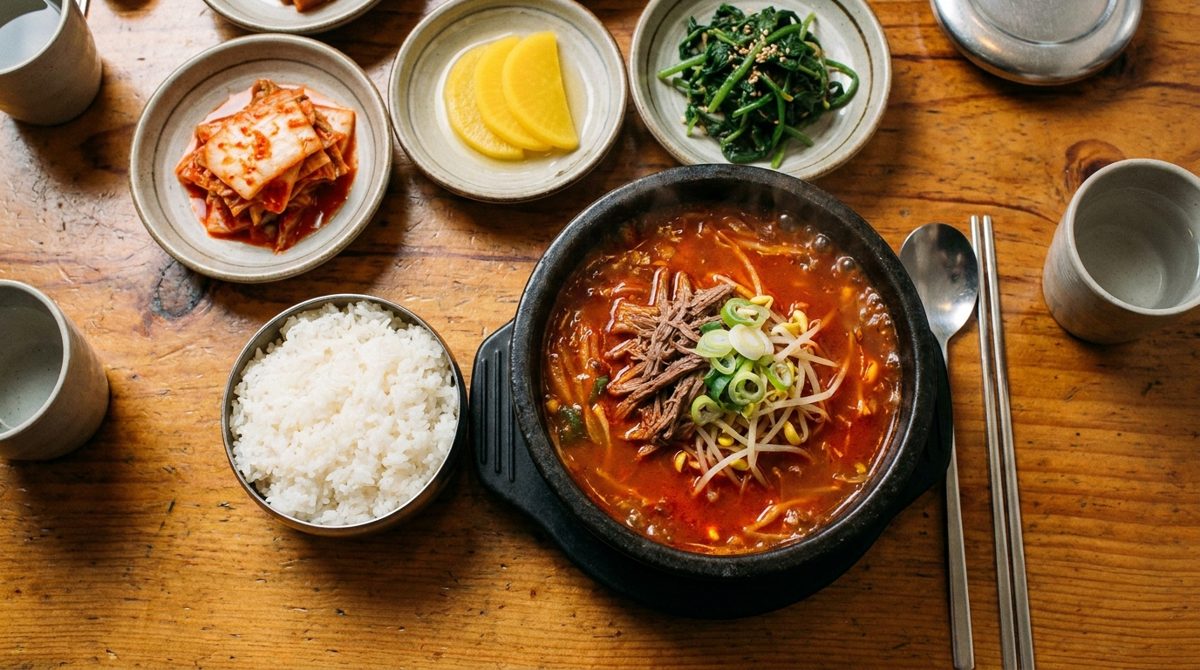
Yukgaejang arrives with a bowl of steamed rice on the side rather than mixed in. Locals either spoon rice directly into the soup a little at a time, or eat rice and soup alternately, using the rice to cool down each spicy bite. Don’t be shy about asking for extra rice (gonggibap chuga-yo) — a single bowl of soup is meant to be paired with a full portion of rice, not eaten alone.
Use the spoon for broth and rice, chopsticks for pulling out the beef strands and fernbrake. Because the broth is thick with chili oil, expect some staining potential — Korean restaurants rarely provide bibs, but a folded napkin as a lap guard is a reasonable precaution for light-colored clothing. Many diners also order this soup specifically as a hangover remedy the morning after drinking, so don’t be surprised to see it heavily ordered before noon on weekends.
If the broth arrives especially hot and oily, give it a minute before diving in — the surface layer of chili oil retains heat far longer than it looks. Stirring gently before your first bite redistributes the oil and prevents an unexpectedly scalding mouthful. It’s also common to order a side of kimchi or pickled radish alongside, even though banchan is already provided, simply because the extra crunch and acidity cut through the richness nicely.
Types of Yukgaejang You’ll See on Menus
Standard yukgaejang (육개장) — the classic version with shredded beef brisket, fernbrake, bean sprouts, and scallion in red chili broth; what you’ll get by default almost anywhere. Dak-gaejang (닭개장) — a chicken version using shredded chicken instead of beef, slightly lighter but similarly spiced; a good option if you prefer poultry, though it’s still not vegetarian. Glass noodle yukgaejang — some regional and home-style versions add dangmyeon (sweet potato glass noodles) into the broth for extra heartiness, giving the soup a texture closer to a spicy japchae-soup hybrid.
Daegu-style yukgaejang — the city of Daegu is famous for a particularly rich, oil-forward version of the soup, sometimes considered the regional benchmark by Korean food enthusiasts. Convenience-store and instant yukgaejang — pre-packaged versions sold at Korean convenience stores and supermarkets offer a milder, quicker introduction to the flavor profile if you want to try it before committing to a full restaurant bowl; quality varies but it’s a low-risk way to sample the taste. Jangtteokguk-adjacent regional variants — certain regions use more gochugaru oil for a thicker, almost stew-like consistency rather than a thin soup.
Where to Try Yukgaejang
Yukgaejang is a comfort-food staple rather than a tourist showpiece, so the best bowls tend to come from unassuming, long-running neighborhood restaurants rather than flashy spots. Look for restaurants with “육개장” prominently on hand-written or laminated menus — these specialists usually simmer their broth for hours and get the shredding technique right. Department store food courts and traditional markets like those covered in our Seoul food guide often have solid, no-frills versions.
It also frequently appears on funeral hall catering menus and at traditional Korean buffet restaurants, where large batches are made fresh daily. If you’re traveling outside Seoul, keep an eye out in Daegu specifically, since local specialists there are known nationwide for their version of the soup. Many gukbap-style restaurants that also serve seolleongtang or dwaeji-gukbap will have yukgaejang on the same menu, making it easy to compare soups side by side on a single trip.
Yukgaejang FAQ
What does yukgaejang mean in English?
Roughly “beef-style gaejang.” Yuk means beef/meat, and gaejang refers to an older spicy soup style historically made with dog meat, which yukgaejang replaced with beef entirely. The modern dish contains no dog meat whatsoever, and the older gaejang tradition it’s named after has essentially disappeared from Korean dining.
Is yukgaejang spicy?
Yes, moderately — most visitors rate it about 3 out of 5. The chili is cooked into the broth rather than added at the table, so the heat level can’t be adjusted after ordering, though you can ask the kitchen to make it milder before it arrives. It’s spicier than bibimbap but less intense than a thick, concentrated jjigae stew.
Is yukgaejang vegetarian or vegan?
No. The broth itself is made from hours of simmered beef, not just topped with beef, so there’s no way to remove the meat and still have a vegetarian dish. Vegetarians and vegans should choose a different soup entirely, such as a meat-free bibimbap or a vegetable-forward japchae.
Is yukgaejang halal?
Conditionally. It contains no pork or alcohol and is beef-based, which is halal in principle, but Korean restaurants serving it are rarely halal-certified and broths occasionally include non-halal additions like fish sauce. Confirm with staff or check certified restaurant listings before ordering.
How much does yukgaejang cost in Korea in 2026?
₩11,000–₩15,000 at standard Seoul restaurants, usually including a side of rice and free banchan. Prices are similar to other hearty Korean soup-and-rice meals like seolleongtang, and tend to run slightly lower outside the capital.
The Verdict: Should You Order It?
Yes — if you enjoy spice and want a soup with real depth rather than a stew you eat with chopsticks alone. Yukgaejang rewards patience: the shredded beef, earthy fernbrake, and slow chili burn add up to one of Korea’s most satisfying cold-weather and hangover-recovery meals. Just know going in that it’s a beef-only dish with no vegetarian workaround, and that halal-certainty requires asking ahead. Hungry for the next dish? Decode the whole menu with our Korean Food Decoder — every major Korean dish explained with spice levels, allergens, and ordering phrases.