Can you really buy soju at 2 a.m. and drink it at the plastic table outside? Yes — convenience store alcohol in Korea is cheap, legal to enjoy in public, and a full cultural experience: soju around ₩2,000, beer ₩2,500–2,800, makgeolli, fruit soju and canned highballs, all open 24/7. Here’s the 2026 lineup, the ID rules, the somaek ratio, and the etiquette that makes locals adopt you.
Table of Contents
- Convenience Store Alcohol Quick Facts
- The Fridge Lineup: Soju, Beer, Makgeolli & More (2026 Prices)
- Legal Age, ID Checks & Public Drinking Rules
- The Sacred Plastic Table
- Somaek 101: The Official Mixing Ratio
- Buying It: Phrases, Prices vs Bars & the Han River Kit
- Korean Drinking Etiquette Basics
- Convenience Store Alcohol FAQ
Convenience Store Alcohol Quick Facts
| Item | Details |
|---|---|
| What it is | A full bar in a fridge: soju, beer, makgeolli, fruit soju, highballs and wine, sold 24/7 at every convenience store |
| Price range (2026) | Soju ≈₩2,000 a bottle, beer 500ml cans ₩2,500–2,800, makgeolli ₩1,800–3,000, canned highballs ₩3,000–4,500 |
| Legal age | 19 by birth year — anyone born in 2007 or earlier can buy in 2026; passports are the accepted tourist ID |
| Public drinking | Legal in Korea, including at the store’s outdoor tables — disorderly behavior is what’s punished, not the drink |
| Where in the store | The tall glass-door fridge, usually the whole back wall; anju snacks shelved right beside it |
| Best for | The classic first-night-in-Korea experience, budget nights out, tasting soju without a bar bill |
The Fridge Lineup: Soju, Beer, Makgeolli & More (2026 Prices)
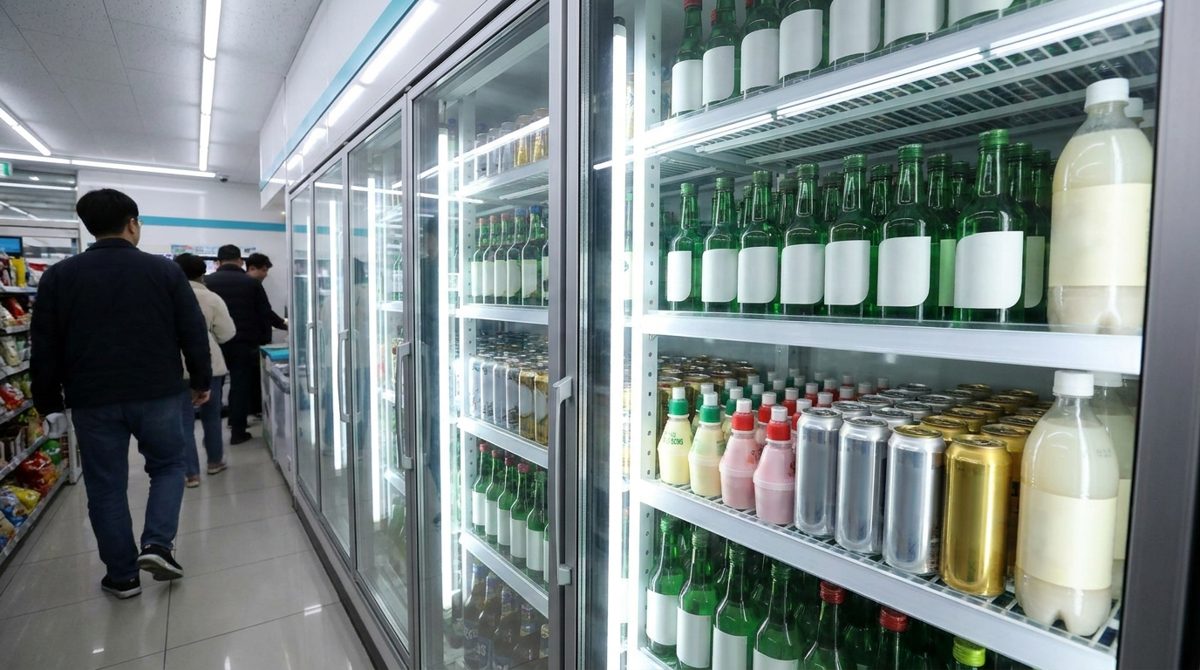
The alcohol fridge is the same in every GS25, CU, 7-Eleven and emart24 in the country, and prices are uniform nationwide. Here’s what you’re looking at, with real names and April 2026 prices:
| Drink | What it is | ABV | Price (2026) |
|---|---|---|---|
| Soju — Chamisul (참이슬), Cheoeum-cheoreom (처음처럼), Saero (새로) | The green bottle. Clean, neutral distilled spirit; Saero is the zero-sugar hit | 16–16.5% | ≈₩2,000 |
| Beer — Cass, Terra, Kelly, Kloud | Korean lagers, crisp and food-friendly; 500ml cans | 4.5–5% | ₩2,500–2,800 |
| Imported beer | Asahi, Tsingtao, Heineken, craft cans — famous rotating multi-can deals | 4–6% | ₩3,000–4,500 each |
| Makgeolli — Jangsoo (장수), Jipyeong (지평) | Cloudy, gently fizzy rice wine — swirl softly before opening | 5–6% | ₩1,800–3,000 |
| Fruit soju — Jinro green grape, grapefruit, plum | Sweetened 13% soju that tastes like juice — treat with respect | 13% | ₩2,000–2,500 |
| Canned highballs | The 2020s boom: yuzu, lemon and peach whisky highballs, gin fizzes | 5–9% | ₩3,000–4,500 |
| Wine & sparkling | Surprisingly decent store-label wine, mini bottles and full 750ml | 9–13% | ₩5,000–15,000 |
Two fridge-reading tips before you commit. First, the 0.0% shelf is real and growing — Cass 0.0, Hite Zero and imported alcohol-free beers sit alongside the regular cans, brilliant for designated navigators and anyone pacing a long trip. Second, check the multi-buy tags: imported beers famously rotate through bundle deals (four large cans for a flat price), and highballs increasingly join the 2+1 promotions — the shelf tag always tells the truth.
Soju is the star and the bargain of the century: a national icon for roughly the price of a bag of chips. If it’s your first bottle, know that modern soju is 16%, not the 25% of decades past — smooth, slightly sweet, built to accompany food. Makgeolli is the character actor: milky, tangy, lightly sparkling, criminally underrated with savory snacks. And the highball shelf is the current boom — Korean convenience stores went from zero to an entire fridge door of canned whisky highballs in about three years, and new flavors drop monthly.
Grab your anju (drinking snacks) from the shelf beside the fridge — dried squid, nuts, jerky and chips are all covered in our Korean convenience store snacks guide. A hot cup ramyeon from the hot-water station is the classic closer, and the 12 best convenience store eats list covers the full feast strategy.
Legal Age, ID Checks & Public Drinking Rules
The rules, stated plainly:
- Legal drinking age is 19 — counted by birth year. In 2026, anyone born on or before December 31, 2007 can legally buy alcohol, even if their 19th birthday hasn’t arrived yet. Korea counts the year, not the date.
- ID checks are normal and non-negotiable. Cashiers are personally liable for underage sales, so young-looking customers get carded every time. For tourists, a physical passport is the gold-standard ID; foreign driver’s licenses may be refused, and photos of documents are hit-or-miss.
- Drinking in public is legal. Korea has no open-container law — parks, riversides, beaches and the convenience store’s outdoor tables are all fair game. What is punished is drunken disorderly behavior, and some parks post local alcohol-restriction notices, so respect posted signs.
- Sales run 24/7. Unlike many countries, Korean convenience stores sell alcohol around the clock — the fridge never sleeps.
- Never drink and drive — including e-scooters. Korea’s DUI threshold is strict (0.03%) and enforcement covers shared scooters and bikes. Take the subway or a taxi; both are cheap and everywhere.
Also worth knowing: convenience stores cannot sell alcohol to someone who is already visibly, seriously drunk — staff can and do refuse. And if a cashier waves off your ID with a small laugh after you proudly present it, take the compliment gracefully; being carded in Korea is a two-way social ritual.
One cultural note: while public drinking is legal, Koreans keep it low-key in daylight and family spaces. The Han River park picnic with beer and fried chicken? Beloved institution. Drinking on the subway? Absolutely not — public transport is a no-alcohol zone in practice, and reading the room is the real law here.
The Sacred Plastic Table
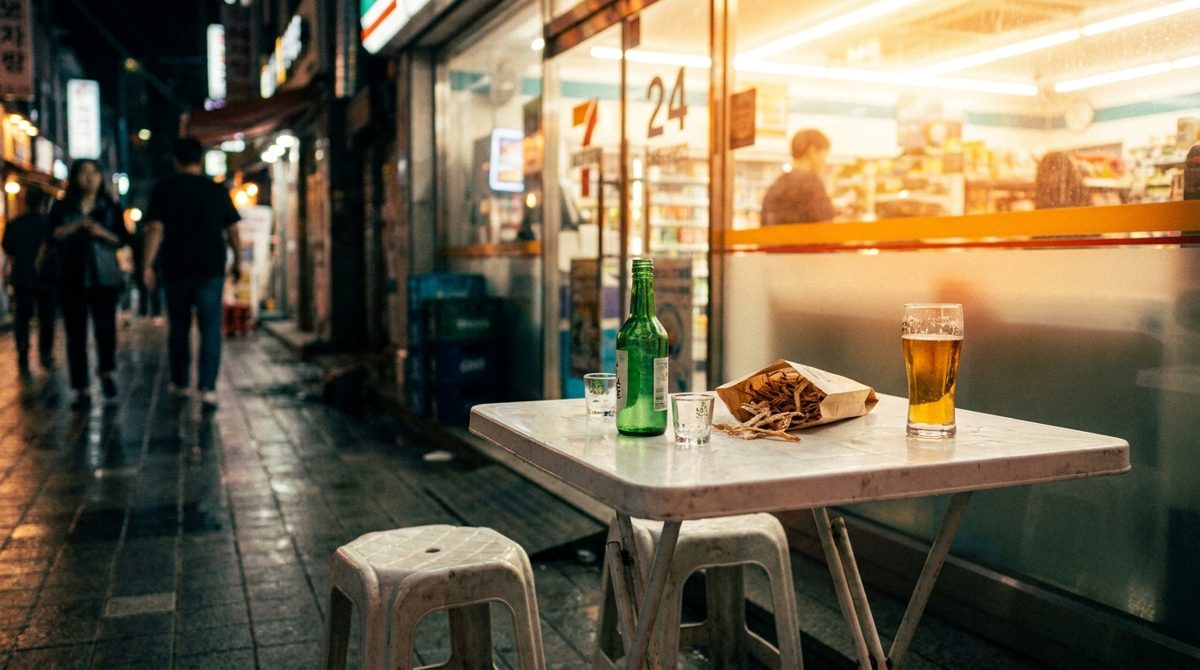
Outside most Korean convenience stores stands humble furniture with legendary status: white plastic tables and stools. This is the pyeonui-jeom table — the people’s pub. K-dramas stage breakups, reunions and life-advice scenes at these tables — half of Korean television’s emotional turning points happen over a green bottle on white plastic. Office workers decompress at them after overtime. Friendships are founded on them. At 1 a.m. on a warm night, they are the best seats in the entire country.
The unwritten rules of the table:
- Buy from the store you’re sitting at. The table is for that store’s customers — bringing outside alcohol to it is poor form.
- Assemble your set inside: drinks from the fridge, anju from the shelf, paper cups near the counter (free), ramyeon from the hot-water station if you’re going full experience.
- Clean up completely. Bag your trash and sort it into the store’s bins — cans and bottles in recycling, liquids poured out first. Leaving a messy table is the one way to genuinely disrespect the institution.
- Keep the volume neighborly after 10 p.m. Stores sit under apartments; noise complaints are why some stores stack their tables late at night. If the tables are stacked, that’s your answer for tonight.
- Weather rules apply to everyone. Summer nights are peak season; winter plastic-table drinking exists but is considered a personality trait.
Why do Koreans love it so much? It’s democratic. No reservation, no dress code, no service charge — just you, a friend, ₩10,000, and the city going by. Some of the best conversations in Korea happen on furniture that costs less than the drinks on it.
Somaek 101: The Official Mixing Ratio
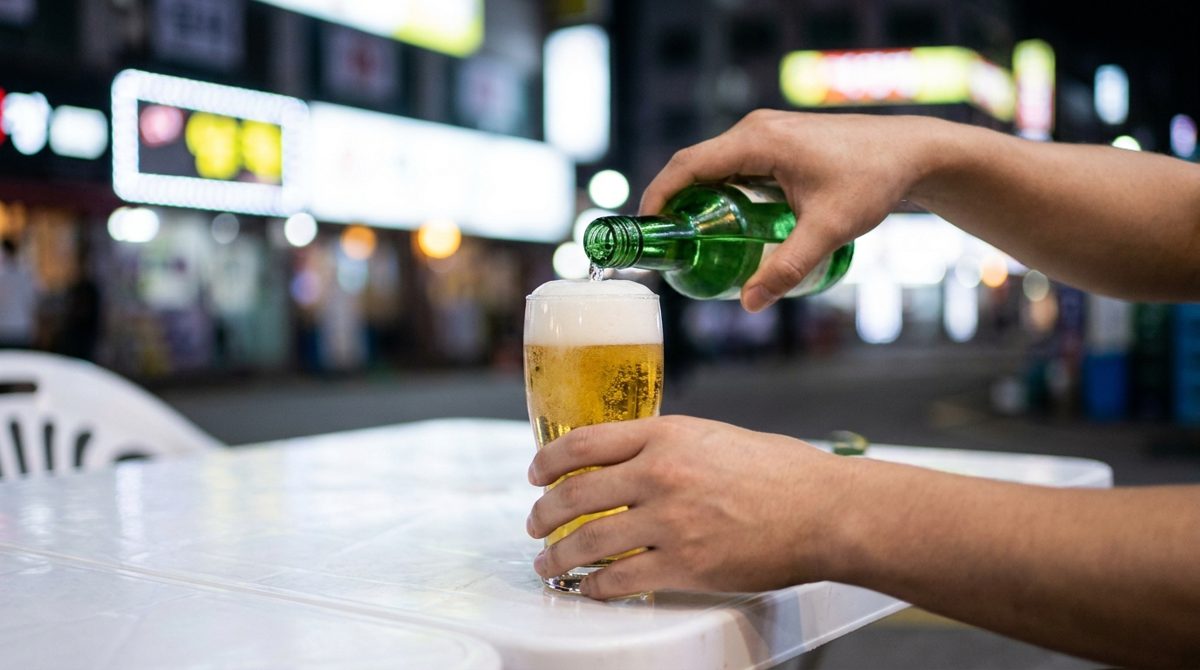
Somaek (소맥) = soju + maekju (beer), Korea’s national cocktail and the best gateway to soju for beginners. The soju adds kick and a hint of sweetness; the beer adds fizz and drinkability. Every Korean has a personal ratio, but the canon looks like this:
| Style | Ratio (soju : beer) | Character |
|---|---|---|
| Standard somaek | 3 : 7 | The golden ratio — balanced, dangerously smooth |
| Gentle (beginner) | 2 : 8 | Mostly beer with a whisper of soju |
| Strong (veteran) | 5 : 5 | Approach with a plan for tomorrow morning |
How to make it at the plastic table: pour soju into the cup first (about a fifth of the way), top with cold beer to 70–80% full, then mix. Bars slam a spoon into the glass to raise the foam; at the convenience store, a gentle swirl or chopstick stir does the job. Drink it fresh — somaek is about the fizz, and a flat somaek is a sad somaek.
A gentle honesty note: somaek goes down easier than its math suggests. A 3:7 mix in a paper cup carries roughly a strong beer’s worth of alcohol, and they tend to multiply. Alternate with water (the store sells 2L bottles for about ₩1,100), keep eating your anju, and remember the goal is the glow, not the blackout — Koreans respect a graceful exit far more than a heroic intake.
Buying It: Phrases, Prices vs Bars & the Han River Kit
Buying alcohol at a Korean convenience store needs zero language skill — grab, scan, tap card — but a few phrases smooth the moment the cashier asks for ID:
| Situation | Say / understand this | Romanized |
|---|---|---|
| Cashier asks for ID | 신분증 보여주세요 (they’re asking, just show your passport) | sinbunjeung boyeojuseyo |
| Ask for paper cups | 종이컵 주세요 | jong-i-keop juseyo |
| Ask for a bottle opener | 병따개 있어요? | byeong-ttagae isseoyo? |
| Can I sit outside? | 밖에 앉아도 돼요? | bakke anjado dwaeyo? |
| Cheers! | 건배! | geonbae! |
The price math is the quiet headline. A bar night in Seoul — two bottles of soju, two beers, one anju plate — runs ₩40,000–60,000. The identical spread from the convenience store fridge: about ₩12,000. Nobody is saying skip Korea’s bar culture (don’t — it’s glorious), but alternating bar nights with plastic-table nights is how budget travelers drink well for two weeks straight.
And the legendary variant: the Han River kit. Convenience stores inside Seoul’s riverside parks exist almost entirely to supply picnic drinkers — beer, ice cups, snacks, mats sold on the spot. Add delivery fried chicken (the couriers know the parks’ pickup zones by heart) and you’ve assembled chimaek on the Han, arguably Korea’s single most pleasant warm-evening activity. Same rules apply: bin your trash, mind the posted zones, enjoy the skyline.
Korean Drinking Etiquette Basics
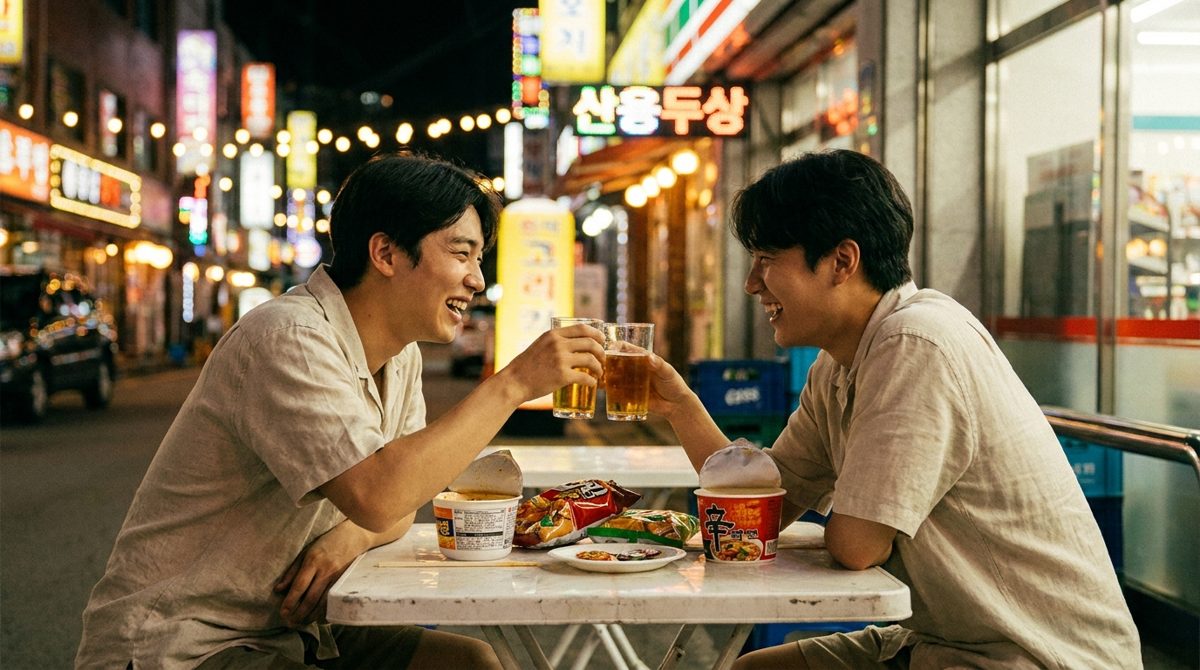
If you drink with Koreans — and if you sit at a plastic table long enough, you will — a few gestures earn enormous goodwill:
- Pour for others, not yourself. Watch companions’ glasses and refill them when empty; someone will do the same for you. Self-pouring isn’t scandalous among friends, but pouring for others is the love language.
- Two hands for respect. Pour and receive with both hands (or one hand touching your opposite forearm) when drinking with someone older or senior.
- Turn slightly away from elders when you drink. A small head-turn to the side is the traditional show of respect toward the senior person at the table.
- The first glass is communal. Wait for the group “geonbae!” (건배 — cheers) before drinking. Finishing the first pour together is common; after that, pace yourself freely.
- It’s completely fine to decline. “Sul mot masheoyo” (술 못 마셔요 — I can’t drink) is universally accepted, and toasting with a cider or zero-alcohol beer (the fridge has a growing 0.0% shelf) is a graceful move. Nobody worth drinking with will pressure you in 2026.
These rules run deeper at restaurant dinners and work gatherings — our Korean dining etiquette guide covers the full playbook. At the plastic table, the vibe is relaxed: get the pouring right and everything else is forgiven with a laugh. For more cultural primers, the Korea Tourism Organization is the authoritative source.
Convenience Store Alcohol FAQ
How much does soju cost at a Korean convenience store in 2026?
About ₩2,000 for a standard 360ml bottle of Chamisul, Cheoeum-cheoreom or Saero — uniform nationwide. The same bottle costs ₩5,000–7,000 at restaurants and bars, which is why the convenience store fridge is every budget traveler’s best friend.
What is the legal drinking age in Korea and what ID do I need?
Nineteen, counted by birth year — in 2026, anyone born in 2007 or earlier qualifies, regardless of birthday. Cashiers card young-looking customers every time because they’re personally liable. Tourists should carry their physical passport; foreign licenses are often refused.
Is it legal to drink outside a convenience store in Korea?
Yes. Korea has no open-container law, and drinking at the store’s outdoor plastic tables is a beloved national institution. Buy from that store, clean up after yourself, keep the volume down at night, and respect any posted alcohol-restriction signs in parks.
What is the correct somaek ratio?
The classic ratio is 3 parts soju to 7 parts beer — pour the soju first, top with cold beer, stir gently and drink while fizzy. Beginners should start at 2:8. Be warned: somaek drinks smoother than its strength, so pace yourself and keep water on the table.
Can I buy alcohol at Korean convenience stores late at night?
Yes — sales run 24/7 at GS25, CU, 7-Eleven and emart24, with no late-night alcohol cutoff. The only hard rules are the age check and, occasionally, outdoor tables being stacked after late hours to keep noise down for neighbors.
Verdict: Korea’s Best Bar Costs ₩10,000 and Has Plastic Stools
A green bottle, a cold can, a torn pack of dried squid and a white plastic table: that’s not a compromise — that’s one of the great drinking experiences in Asia. Legal, safe, absurdly affordable, and more authentically Korean than most bar districts. Do it once properly (somaek at 3:7, two-handed pours, trash sorted) and you’ll understand half of Korean social life. Then explore what else the store is hiding with our full Korean Convenience Store Explorer.