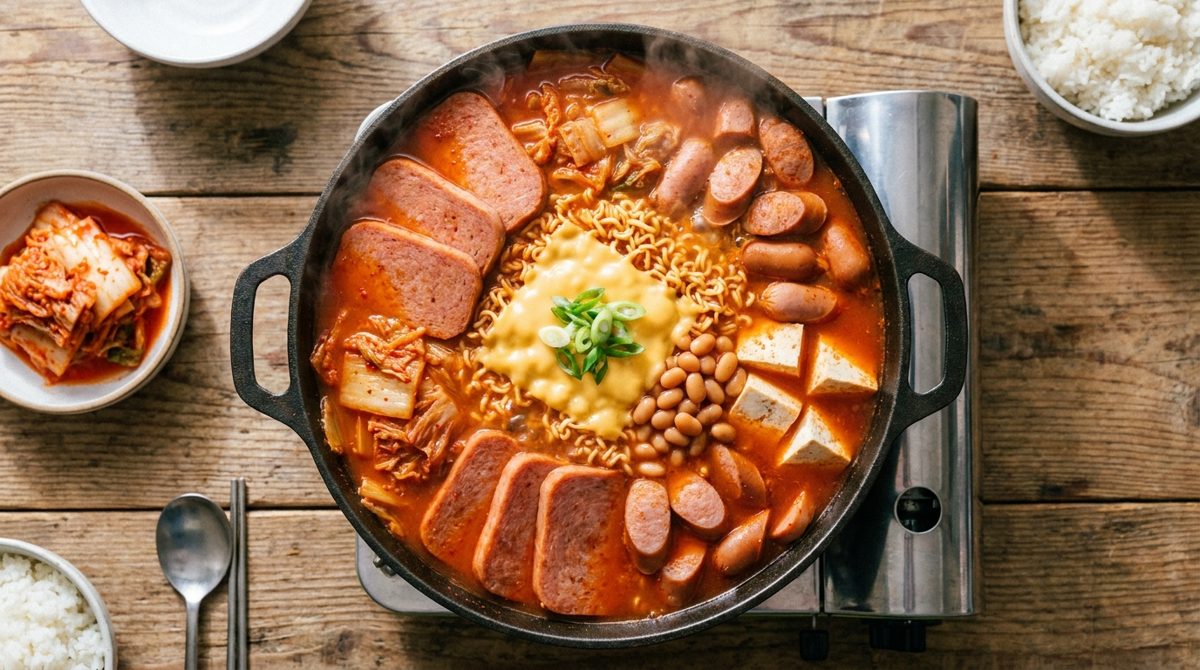
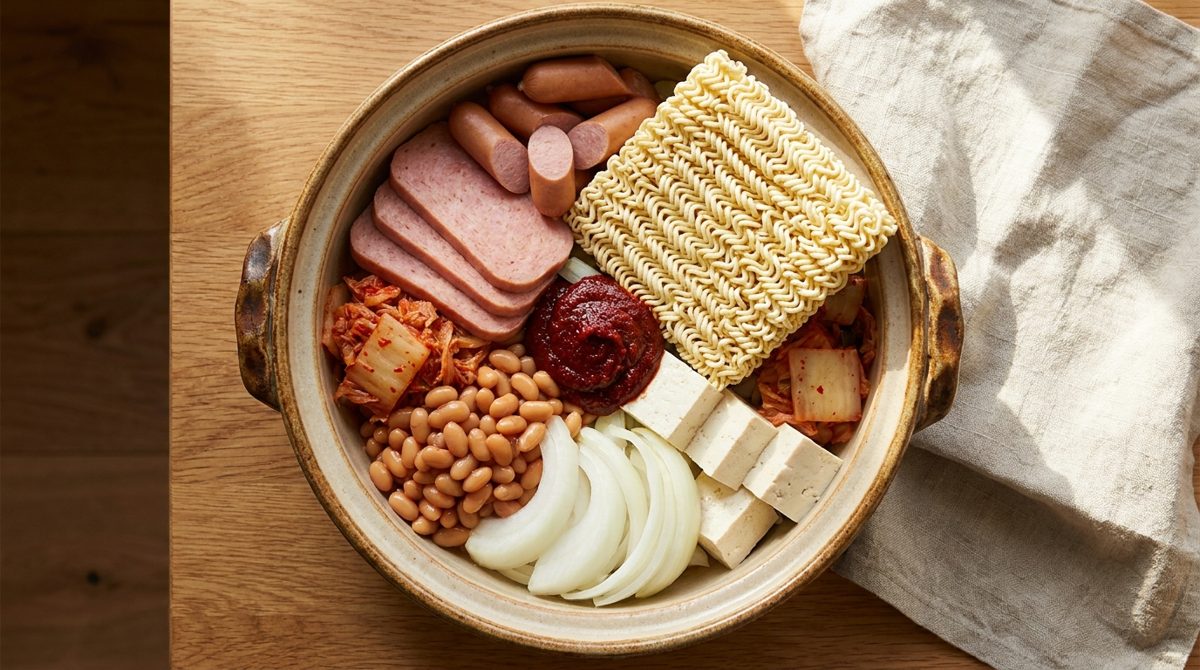
Heard about Korea’s famous “army stew” and wondering what budae jjigae actually is? Budae jjigae (부대찌개, “army base stew”) is a bubbling kimchi-broth hot pot loaded with spam, sausages, ramen noodles, tofu, baked beans, and a melting slice of cheese — born from American army surplus after the Korean War and perfected into one of Korea’s favorite comfort foods. It’s salty, spicy, gloriously unrefined, and always shared. This decoder covers the remarkable history, taste, spice level, allergens, halal and vegetarian answers, 2026 prices, and how to order it in Korean.
Table of Contents
- Budae Jjigae Quick Facts
- What Is Budae Jjigae, Exactly?
- What Does Budae Jjigae Taste Like?
- Dietary Guide: Vegetarian, Vegan, Halal & Allergens
- How to Order Budae Jjigae in Korean (+ 2026 Prices)
- How to Eat Budae Jjigae Like a Local
- Types of Budae Jjigae
- Where to Try Budae Jjigae
- Budae Jjigae FAQ
Budae Jjigae Quick Facts
| Item | Details |
|---|---|
| Korean name | 부대찌개 (budae jjigae) — “army base stew” |
| Pronunciation | BOO-deh jee-GEH |
| Type | Shared hot pot / social meal (usually minimum 2 servings) |
| Spice level | 🌶️ 3 / 5 — kimchi-broth warmth, softened by cheese and processed meats |
| Price (2026) | ₩10,000–₩13,000 per person; most restaurants require 2+ servings |
| Vegetarian | ❌ No — the dish is essentially a celebration of processed meat |
| Vegan | ❌ No |
| Halal-friendly | ❌ No — spam and sausage are pork; no realistic modification exists |
| Main allergens | Pork, wheat (ramen noodles), soy, dairy (cheese slice) |
| Best for | Groups, cold nights, history lovers, ramen fans, drinking dinners |
What Is Budae Jjigae, Exactly?
Budae jjigae is the most delicious history lesson in Korea. In the years after the Korean War ended in 1953, the country was devastated and food was desperately scarce — meat most of all. But around American military bases in towns like Uijeongbu and Pyeongtaek, there was one strange exception: surplus and leftover supplies from army kitchens. Spam, hot dogs, canned baked beans — processed foods Koreans had never cooked with before.
Local cooks did what Korean cooks have always done: they threw it in a stew. American canned meat met Korean kimchi, gochujang, and garlic in one pot, and the collision worked absurdly well. The salty-smoky processed meats melted into the sour-spicy broth; the broth soaked into the meats. People called it budae jjigae — “military unit stew” — and for years it carried the weight of that hardship. One early nickname was “Johnson-tang,” after President Lyndon B. Johnson. You can read more on Wikipedia’s budae jjigae entry.
Then something remarkable happened: the dish outlived its poverty. As Korea became wealthy, budae jjigae didn’t disappear — it became beloved. Instant ramen joined the pot in the 1980s, a cheese slice landed on top, and dedicated budae jjigae restaurants spread nationwide. Today it’s pure comfort food: the pot Koreans order on cold nights, payday dinners, and reunion meals, with zero shame and considerable pride.
That arc — from war survival food to national favorite — is why budae jjigae matters beyond flavor. It’s the single best dish for understanding modern Korean history through your stomach: resourcefulness, hardship, American influence, and the Korean genius for absorbing foreign ingredients into something unmistakably Korean.
What Does Budae Jjigae Taste Like?
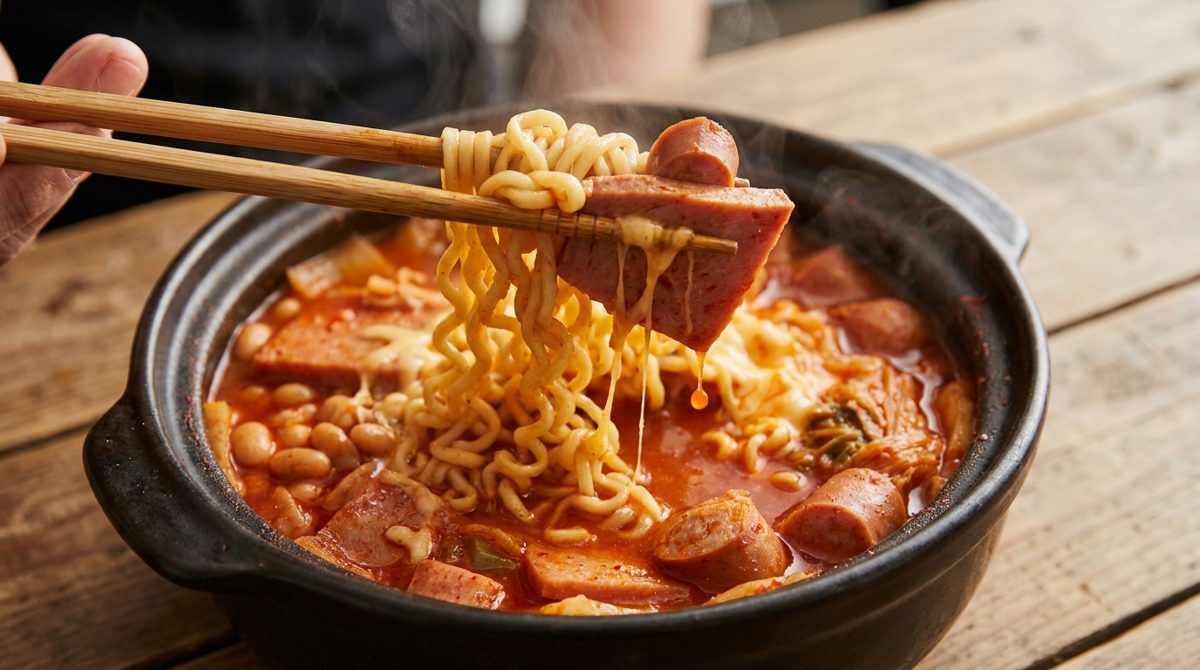
Like the best possible version of everything a nutritionist warns you about. The broth is kimchi-stew adjacent — sour, spicy, garlicky — but rounder and meatier, because spam and sausages leak their smoky salt and fat into it as it boils. The ramen noodles drink up that broth and become better than any packet ramen you’ve ever made. Baked beans add faint sweetness, tofu adds calm, and the cheese slice melts into the surface, softening the spice with every ladle.
Texture is half the fun: springy noodles, bouncy sausage coins, soft tofu, crunchy scallions, and rice cakes that turn chewy in the broth. Every scoop of the ladle pulls up a different combination. It is not subtle food — it’s loud, generous, and engineered for beer and soju on the side.
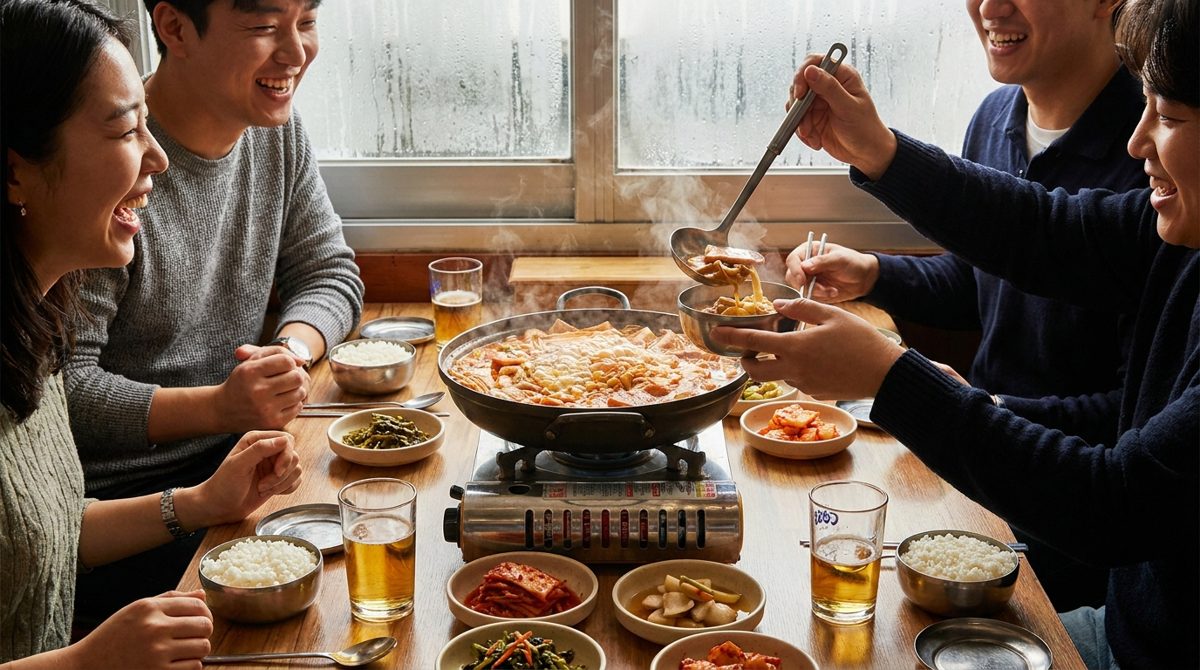
If you’re mentally filing it: budae jjigae sits somewhere between kimchi jjigae and a party hot pot — brothier than a stew, heartier than a soup, closer to an event than a dish. Koreans classify it as much as a jeongol (table-cooked hot pot) as a jjigae, which tells you exactly how it’s meant to be eaten: slowly, socially, over a flame, with the ladle doing constant laps around the table.
Is Budae Jjigae Spicy?
Moderately — most travelers rate it around 3 out of 5, similar to kimchi jjigae but tasting milder because fat and cheese blunt the heat. The spice comes from the kimchi-gochujang broth base and builds slowly rather than attacking. Most budae jjigae restaurants will happily tone it down: “deol maepge haejuseyo” (덜 맵게 해주세요 — less spicy, please). Between the cheese, the beans, and the noodles, this is one of the more beginner-friendly “spicy” Korean dishes — a good stepping stone before you attempt fire-level tteokbokki.
Budae Jjigae Dietary Guide: Vegetarian, Vegan, Halal & Allergens
Budae jjigae is the least flexible dish in our decoder series — its identity is processed pork in a shared pot. Here’s the full breakdown so nobody wastes an evening.
| Ingredient concern | In standard budae jjigae? | How to handle |
|---|---|---|
| Pork | Always — spam, sausages, and often bacon or minced pork are the core of the dish | Cannot be meaningfully removed; choose a different stew instead |
| Wheat / gluten | Always — ramen noodles, plus wheat in sausages and gochujang | You can skip the noodles, but wheat remains throughout |
| Dairy | Almost always — the cheese slice on top | “Chijeu ppaego juseyo” (치즈 빼고 주세요) = no cheese; easy fix |
| Soy | Yes — tofu, soy sauce, soybean elements in the broth | Cannot be removed |
| Fish / seafood | Often — anchovy broth base at many restaurants; fish sauce in kimchi | Ask, but assume yes |
| Egg | Sometimes — some shops crack an egg in or add egg-containing fish cake | Ask for no egg if needed |
| Beef | Sometimes — minced beef or beef-pork sausages | Varies by shop |
| Nuts | No | Not used |
Is Budae Jjigae Vegetarian or Vegan?
No — and unlike most Korean stews, there’s no realistic workaround at a normal restaurant. Processed meat isn’t a topping here; it’s the point of the dish, and the broth itself is flavored by it (plus, usually, anchovy stock underneath). A handful of vegan restaurants in Seoul have built plant-based “budae jjigae” with vegan sausage and dairy-free cheese — a fun novelty worth ordering if you find it — but as street-level advice: vegetarians should redirect to doenjang jjigae (asking for vegetable broth) or bibimbap, which deliver the Korean stew-and-rice experience without the meat problem.
Is Budae Jjigae Halal?
No. Budae jjigae is not halal and cannot be made halal — spam and sausages are pork products, and they define the dish. We won’t pretend otherwise, and you should politely decline if a well-meaning host suggests “just picking around the meat”; the broth itself is infused with pork fat. Better moves for Muslim travelers craving the same spicy-hot-pot energy: chamchi (tuna) kimchi jjigae, spicy dak-galbi (chicken), or seafood hot pots — and for certified restaurants, check the Korea Tourism Organization’s Muslim-friendly listings on VisitKorea. Korea has plenty of pork-free fire; this pot just isn’t it.
How to Order Budae Jjigae in Korean (+ 2026 Prices)
Budae jjigae is ordered by the serving (inbun) for the whole table, cooked on a burner in front of you. Most restaurants set a two-serving minimum — this is social food. Useful phrases:
| What you want | Say this | Romanized |
|---|---|---|
| Budae jjigae for two, please | 부대찌개 2인분 주세요 | budae-jjigae i-in-bun juseyo |
| Extra ramen noodles, please | 라면 사리 추가해주세요 | ramyeon sari chuga-haejuseyo |
| Less spicy, please | 덜 맵게 해주세요 | deol maepge haejuseyo |
| No cheese, please | 치즈 빼고 주세요 | chijeu ppaego juseyo |
| Fried rice at the end, please | 볶음밥 해주세요 | bokkeum-bap haejuseyo |
What it costs in 2026: expect ₩10,000–₩13,000 per person at budae jjigae restaurants, with the two-serving minimum making ₩20,000–₩26,000 the realistic table price — still an excellent group dinner deal since it comes with rice and banchan. Add-ins (sari) run ₩2,000–₩4,000: extra ramen, rice cakes, more spam, dumplings, or a second cheese slice. Famous Uijeongbu originals and premium versions with imported sausages run ₩13,000–₩16,000 per person.
The sari menu is where regulars show off — it’s a whole culture of add-ons. First-timers should get one extra ramen portion for the table (the noodles vanish fast) and save room for the closing act: fried rice made in the leftover broth. Solo traveler? Look for lunch-special “1인 부대찌개” (single-portion budae jjigae) spots and franchise chains, which increasingly serve individual pots for ₩9,000–₩11,000.
How to Eat Budae Jjigae Like a Local
The pot arrives raw or half-cooked with everything arranged in neat sections, then boils at your table. Resist the urge to stir immediately — let it reach a full rolling boil first, then push the ramen noodles under the broth. Noodles are ready in about three minutes, and locals eat them first, while they’re springy, before they overcook in the simmering pot. Ladle broth and meats into your personal bowl; don’t eat straight from the pot.
Keep the burner on low as you eat — budae jjigae is meant to stay bubbling for the entire meal, getting saltier and deeper as it reduces. Balance it with the free banchan and white rice. And know the finishing move: when the solids are nearly gone, ask for bokkeumbap — the staff will fry rice directly in the remaining broth with seaweed and sesame oil, scraping up crispy bits. Skipping it is the rookie mistake. For the unwritten rules of shared-pot dining — ladles, personal bowls, who stirs — our Korean dining etiquette guide has you covered.
What to drink is settled law: budae jjigae is anju — food designed for alcohol — and its natural partners are cold lager, soju, or the fifty-fifty somaek mix built at the table. The stew’s salt-fat-spice triangle is engineered for exactly this pairing. If you don’t drink, a cold cider (Korean lemon-lime soda) or sikhye plays the same cooling role. Either way, order drinks when you order the pot — the broth waits for no one.
Types of Budae Jjigae You’ll See on Menus
Uijeongbu-style (의정부식) — the original lineage from the army-base city north of Seoul: clearer, kimchi-forward broth that lets the ingredients speak; the city even has a dedicated budae jjigae street. Songtan-style (송탄식) — from the Pyeongtaek base area: richer and creamier, with more cheese and often American-style sausage; the heavier, louder cousin. Franchise-style — chains like Nolboo standardized a middle path and export it worldwide. Ramyeon-heavy variants — some shops essentially serve premium ramen hot pot with army-stew toppings; students’ favorite. Most menus also let you build your own with the sari add-in list, from extra spam to dumplings to a whole block of instant noodles.
Which to choose? If it’s your first pot, the generic or franchise version is genuinely representative. If you’re chasing the story, Uijeongbu’s clearer broth is the historical baseline, while Songtan’s cheese-heavy pot shows where the American influence ran deepest. Koreans argue Uijeongbu versus Songtan the way barbecue towns argue about sauce — there’s no wrong answer, only allegiances.
Where to Try Budae Jjigae
For the pilgrimage, take the subway an hour north of Seoul to Uijeongbu’s Budae Jjigae Street, where the founding restaurants — some run by the same families since the 1960s — still ladle out the original. In Seoul itself, budae jjigae restaurants cluster everywhere office workers drink: Jongno, Gangnam station alleys, university districts. Franchises (Nolboo and rivals) are reliable if unromantic. It’s also prime late-night delivery food — order it to your accommodation like a local on a rainy night. Fun footnote: spam became so embedded in Korean food culture from this dish that premium spam gift sets are now a standard holiday present — you’ll see them stacked in every Korean supermarket and convenience store before Chuseok.
Budae Jjigae FAQ
What does budae jjigae mean in English?
“Army base stew” — budae means military unit or base, jjigae means stew. The name records its origin: it was first made with surplus food from American army bases after the Korean War.
Why is there spam and cheese in Korean stew?
Because of history, not fusion-restaurant invention. In the food-scarce 1950s, American military surplus — spam, hot dogs, canned beans, processed cheese — was one of the only meat sources near army bases, and Korean cooks folded it into a kimchi-spiced stew. The dish stuck, and Korea is now one of the world’s biggest spam consumers.
Is budae jjigae halal?
No. Spam and sausages are pork, and they define the dish — the broth itself carries pork fat. There is no halal modification; tuna kimchi jjigae or chicken dak-galbi are better choices for the same spicy comfort.
How many people do you need for budae jjigae?
Two or more at most restaurants, which set a two-serving minimum for the shared pot. Solo diners can find single-portion versions at lunch specials and franchise chains for ₩9,000–₩11,000.
How much does budae jjigae cost in Korea in 2026?
₩10,000–₩13,000 per person at typical restaurants (so ₩20,000–₩26,000 for the usual two-person minimum), with add-ins like extra ramen or spam at ₩2,000–₩4,000. Uijeongbu originals and premium versions run ₩13,000–₩16,000 per person.
The Verdict: Should You Order It?
Absolutely — with a group, on a cold night, with something cold to drink. Budae jjigae is simultaneously Korea’s most fun hot pot and its most moving food story: a dish invented in the hardest years that became a celebration. Eat the noodles first, keep the pot bubbling, finish with fried rice, and raise a glass to the cooks of 1950s Uijeongbu who turned surplus cans into a national treasure. Hungry for the next dish? Decode the whole menu with our Korean Food Decoder — every major Korean dish explained with spice levels, allergens, and ordering phrases.