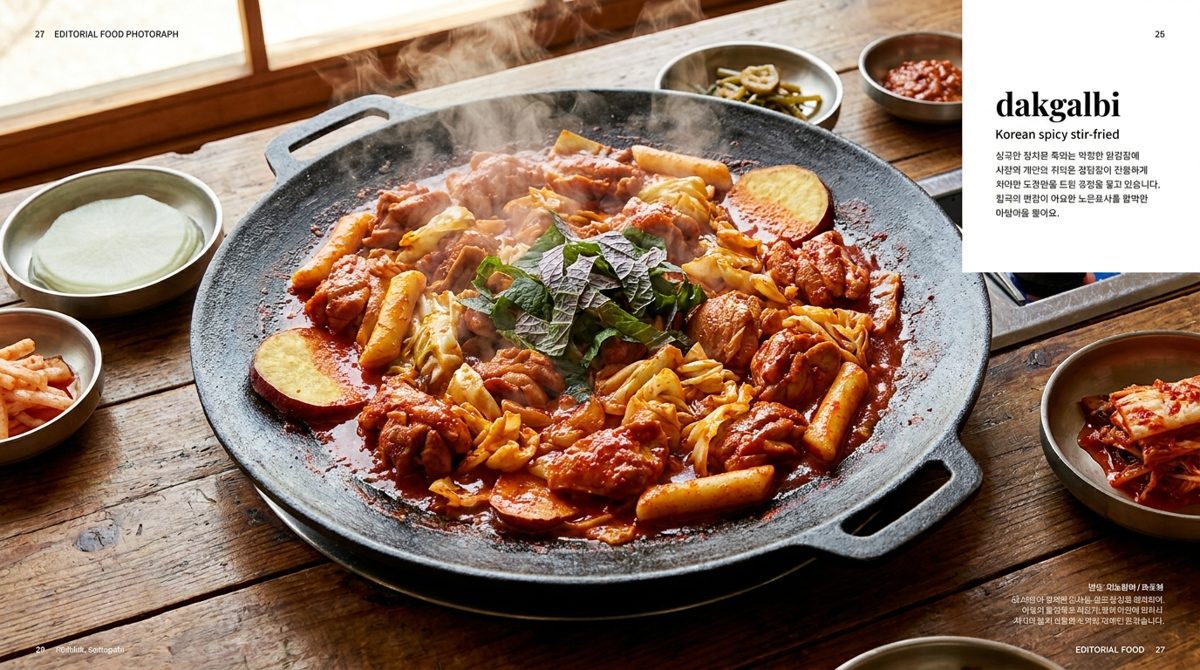
Wondering what dakgalbi is before you commit to that giant sizzling pan? Dakgalbi (닭갈비) is Korean spicy stir-fried chicken: bite-size chicken pieces marinated in a sweet-hot gochujang sauce, cooked on a huge hot plate at your table with cabbage, sweet potato, chewy rice cakes (tteok), and perilla leaves. It was born in the lakeside city of Chuncheon, it’s one of Korea’s great group meals, and it ends — non-negotiably — with fried rice made in the leftover sauce. This decoder covers taste, spice level, the cheese option, halal and allergen answers, 2026 prices, and the Chuncheon day trip.
Table of Contents
- Dakgalbi Quick Facts
- What Is Dakgalbi, Exactly?
- What Does Dakgalbi Taste Like?
- Dietary Guide: Vegetarian, Vegan, Halal & Allergens
- How to Order Dakgalbi in Korean (+ 2026 Prices)
- How to Eat Dakgalbi Like a Local
- Types of Dakgalbi
- Where to Try Dakgalbi (+ Chuncheon Day Trip)
- Dakgalbi FAQ
Dakgalbi Quick Facts
| Item | Details |
|---|---|
| Korean name | 닭갈비 (dakgalbi) — “chicken ribs” (no actual ribs involved) |
| Pronunciation | DAHK-gahl-bee |
| Type | Shared hot-plate stir-fry / group meal |
| Spice level | 🌶️ 3 / 5 — genuinely spicy but manageable; cheese cuts it dramatically |
| Price (2026) | ₩13,000–₩16,000 per person; 2-serving minimum is standard |
| Vegetarian | ❌ No — chicken is the dish; sauce clings to everything on the plate |
| Vegan | ❌ No |
| Halal-friendly | ⚠️ Relatively — it’s chicken and usually pork-free, but not certified; always confirm |
| Main allergens | Chicken, soy, wheat (sauce), sesame; dairy if you add cheese |
| Best for | Groups, spice-curious travelers, cheese-pull content creators |
What Is Dakgalbi, Exactly?
Dakgalbi means “chicken ribs,” which is the first of its little jokes — there are no ribs in it. The name borrowed the prestige of galbi (grilled beef ribs) for a dish invented around cheap chicken. In 1960s Chuncheon, a city northeast of Seoul, tavern owners started marinating chopped chicken in gochujang sauce and grilling it as an affordable anju for soldiers and students. It was nicknamed “commoner’s galbi” — all the fun of Korean barbecue at a fraction of the price.
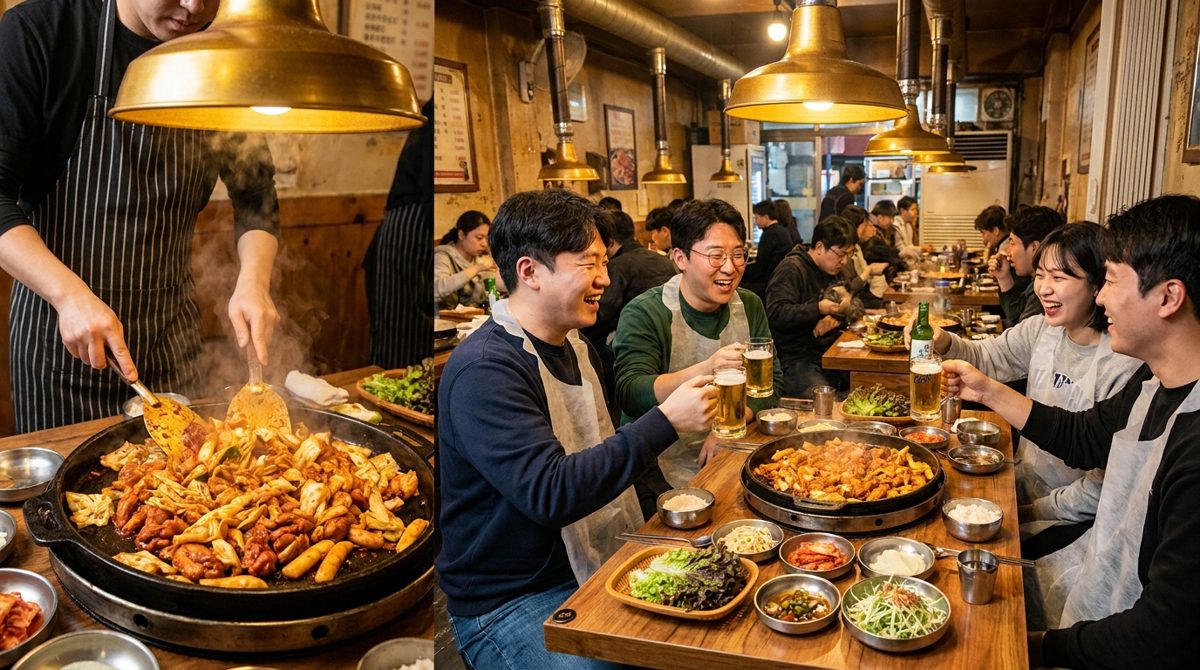
The modern format is pure theater. A wide, shallow pan — sometimes half a meter across — arrives at your table loaded with raw marinated chicken, cabbage, sweet potato, tteok (cylindrical rice cakes), and perilla leaves. Staff fire up the burner and stir everything with two flat spatulas as the sauce reduces and coats each ingredient. Ten-ish minutes of clanging, steam, and rising red gloss later, someone declares it ready and the table descends.
Chuncheon remains the spiritual capital — the city has an entire Dakgalbi Street and an annual festival — but the dish long ago conquered the whole country. Every Korean city has dakgalbi restaurants, and the cheese-fondue variation made it a social media juggernaut across Asia in the 2010s. It has range: student food, family dinner, first-date staple, and the standard answer to “what should we eat that’s fun?”
Where does it sit among Korea’s many chicken dishes? Think of a spectrum: jjimdak (soy-braised chicken) is the mild, savory end; dakgalbi is the sweet-spicy middle with the most theater; and buldak (“fire chicken”) is the scorching end that exists partly as a challenge. Dakgalbi is also a different universe from Korean fried chicken — one is a table event with vegetables and rice cakes, the other a delivery-box ritual. Most travelers find dakgalbi the best balance of flavor, fun, and survivable heat.
What Does Dakgalbi Taste Like?
Sweet heat is the headline: the gochujang-based sauce blends chili paste and powder with soy sauce, garlic, ginger, sugar, and often a splash of curry powder — a Chuncheon signature that adds a warm, fragrant undertone most visitors can’t quite place. The chicken stays juicy under its lacquer of sauce, cabbage and onion melt into sweetness, sweet potato adds starchy relief between spicy bites, and the tteok turn into chewy sauce sponges that many people end up loving more than the chicken.
It’s a loud, generous, layered flavor — less refined than galbi, more fun than most stir-fries. And because everything cooks together in one pan, every ingredient tastes like every other ingredient by the end, which is exactly the point.
Is Dakgalbi Spicy?
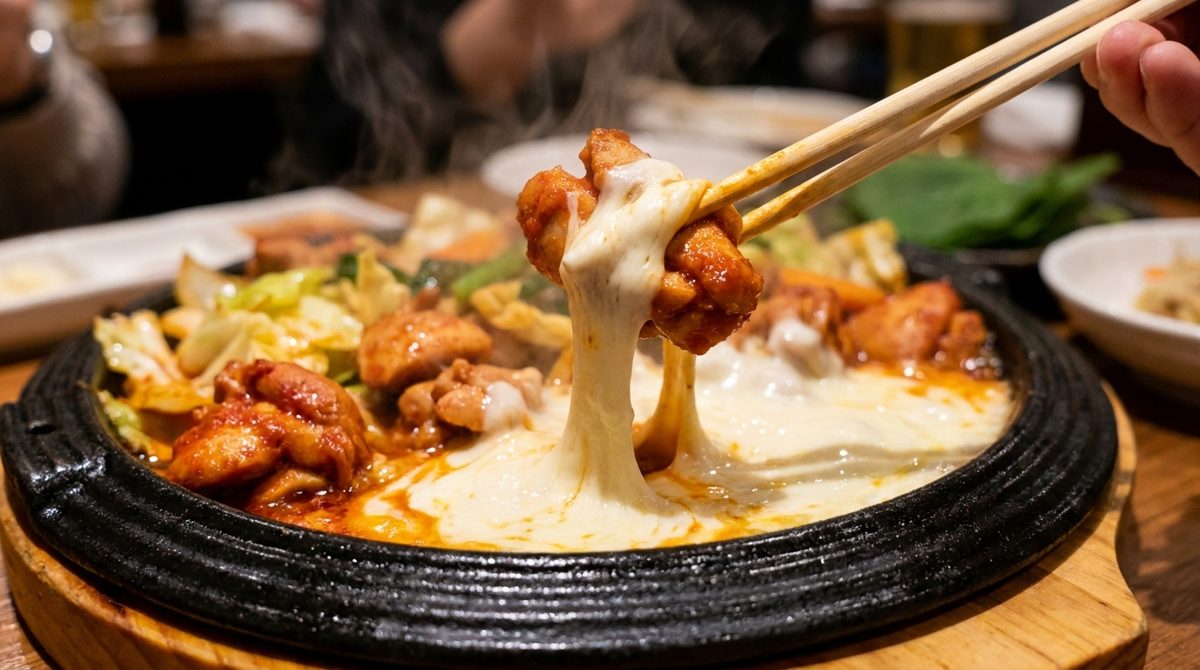
Yes — honestly, a solid 3 out of 5. This is not bibimbap-style optional heat; the chicken is marinated in the spicy sauce before it reaches your table, so you can’t order around it entirely. It’s a warm, building, sweet-edged heat rather than a sharp assault, and most travelers handle it fine with rice and drinks. Your relief valves: order cheese dakgalbi (melted mozzarella neutralizes chili like a fire blanket), ask for mild — “deol maepge juseyo” (덜 맵게 주세요) — and use the sweet potato and tteok as palate breaks. Serious chili-avoiders should note some shops offer a soy-based non-spicy version (ganjang dakgalbi), though it’s not universal.
Dakgalbi Dietary Guide: Vegetarian, Vegan, Halal & Allergens
Dakgalbi is more accommodating than most dishes in the adventurous tier — with important caveats.
| Ingredient concern | In standard dakgalbi? | Notes |
|---|---|---|
| Chicken | Yes — the dish | Thigh meat, marinated in spicy sauce |
| Pork | Usually not | Standard recipes are pork-free, but some shops mix in pork or use shared grills — ask |
| Wheat / gluten | Yes | Via the sauce (gochujang and soy sauce typically contain wheat); the tteok itself is rice |
| Soy | Yes | Soy sauce is core to the marinade |
| Sesame | Yes | Sesame oil and seeds in marinade and finishing |
| Dairy | Optional | Only if you order cheese dakgalbi |
| Egg | Rare | Steamed egg is a common side order, not part of the dish |
| Seafood / nuts | No | Not in standard recipes |
| Alcohol | No | None in the sauce at typical shops |
Is Dakgalbi Vegetarian or Vegan?
No. Chicken is the dish, and unlike bibimbap there’s no meaningful “hold the meat” version — the sauce, pan, and everything in it are chicken-adjacent from the first stir. The vegetables and tteok cook in the same sauce with the meat, so picking around the chicken doesn’t produce a vegetarian meal either. Vegetarians in a dakgalbi group should order separate dishes (many shops have naengmyeon, steamed egg, or plain rice and salad) or propose a different restaurant entirely.
Is Dakgalbi Halal?
Dakgalbi is one of the most halal-workable famous Korean dishes — with an honest asterisk. The positives: it’s chicken, standard recipes contain no pork and no alcohol, and gochujang itself is a fermented chili paste with no haram ingredients. The caveats: the chicken at regular restaurants is not halal-certified, occasional shops add pork or cook different meats on shared plates, and sauces vary. Practical approach for Muslim travelers who eat non-certified chicken: dakgalbi is one of your best mainstream options — just confirm “dwaeji-gogi eopseoyo?” (돼지고기 없어요? — no pork?) before ordering. For strictly certified dining, Seoul’s halal-certified Korean restaurants (several around Itaewon) serve dakgalbi-style chicken dishes; check current listings on VisitKorea. Either way, dakgalbi beats pork-centric BBQ like samgyeopsal by a mile for halal-conscious eaters.
How to Order Dakgalbi in Korean (+ 2026 Prices)
Dakgalbi ordering has one structural rule: it’s sold per serving (인분) with a two-serving minimum at virtually every shop, because the pan doesn’t work half-empty. Solo travelers can find rare one-person hot-plate shops, but this is fundamentally a bring-a-friend dish.
| What you want | Say this | Romanized |
|---|---|---|
| Two servings of dakgalbi | 닭갈비 이인분 주세요 | dakgalbi i-in-bun juseyo |
| With cheese, please | 치즈 추가해 주세요 | chijeu chuga-hae juseyo |
| Less spicy, please | 덜 맵게 해주세요 | deol maepge hae-juseyo |
| No pork, right? | 돼지고기 없어요? | dwaeji-gogi eopseoyo? |
| Fried rice at the end, please | 볶음밥 해주세요 | bokkeumbap hae-juseyo |
What it costs in 2026: expect ₩13,000–₩16,000 per person for the base dish in Seoul and Chuncheon, with the two-serving minimum making ₩26,000–₩32,000 the realistic table floor. Add-ons run ₩3,000–₩5,000 each: cheese, extra tteok, ramen noodles (sari), udon. The closing bokkeumbap is ₩3,000–₩4,000 per order. A full dakgalbi night for two — dish, cheese, fried rice, drinks — lands around ₩40,000. Chuncheon’s Dakgalbi Street runs slightly cheaper with bigger portions, one more argument for the day trip.
Learn the word sari (사리) and you unlock the dakgalbi power move: it means a noodle or ingredient add-on thrown into the pan mid-meal. Ramen sari is the crowd favorite — instant noodles absorbing dakgalbi sauce is cheap, glorious chaos — while udon and extra tteok are close seconds. Add them when the pan is about two-thirds eaten, before the sauce reduces too far.
How to Eat Dakgalbi Like a Local
Rule one: don’t touch the spatulas. Staff cook the pan through its stages — sauce down, chicken seared, vegetables folded, everything reduced — and they’ll tell you when it’s ready. Jumping in early with your chopsticks earns the same look worldwide that stirring someone else’s risotto would. Once released, eat straight from the pan: wrap bites in the perilla leaves or lettuce provided, chase with the pickled radish (the designated fire extinguisher), and keep the tteok moving so it doesn’t stick.
If you ordered cheese, it arrives as a moat or center pool of mozzarella kept molten by the plate. Drag each piece of chicken through it — the cheese mellows the burn and photographs absurdly well, which is why half the restaurant is filming their dinner. Etiquette basics like communal-pan manners and drink pouring are covered in our Korean dining etiquette guide.
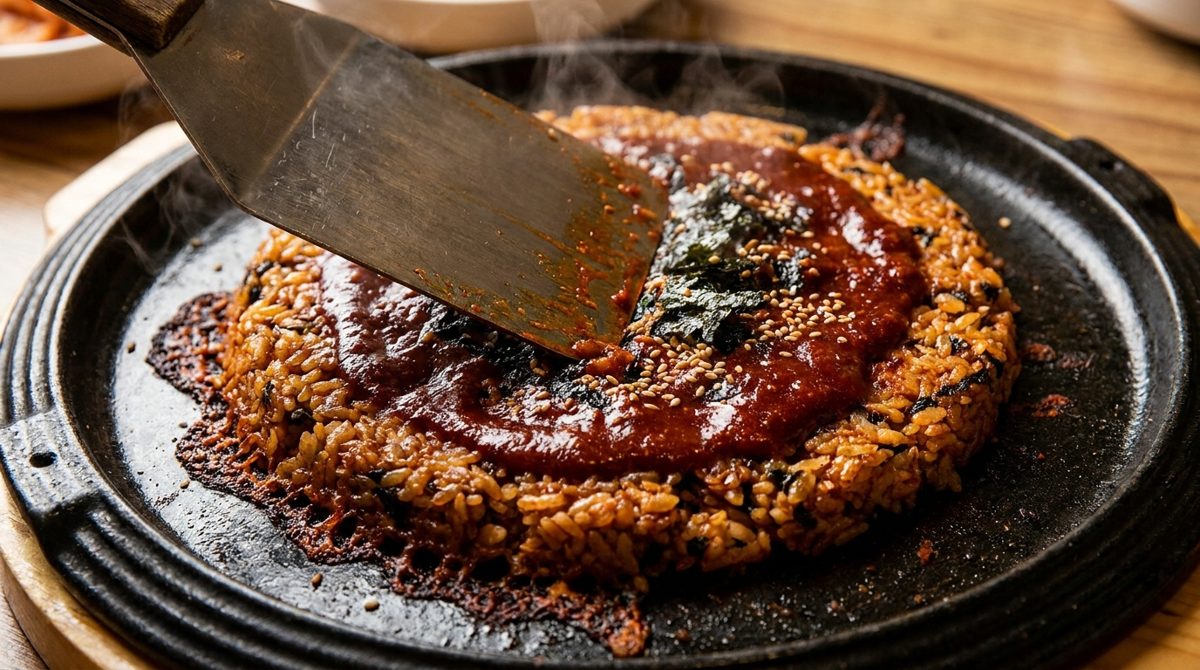
Then the finale, which we’re contractually obligated to insist on: bokkeumbap. When the chicken is nearly gone, flag the staff and order fried rice. They’ll scrape the pan, fold rice, seaweed, and sesame oil into the remaining sauce, press it flat, and let a crust form. Koreans consider the meal incomplete without it — many will tell you the fried rice is the actual main course and the chicken was the opening act. Do not leave without it.
Types of Dakgalbi You’ll See on Menus
Cheolpan dakgalbi (철판닭갈비) — the standard hot-plate version described above; what “dakgalbi” means by default. Cheese dakgalbi (치즈닭갈비) — with a pool of melted mozzarella; the 2010s viral star and the right call for spice-sensitive tables. Sutbul dakgalbi (숯불닭갈비) — the older Chuncheon style: marinated chicken grilled directly over charcoal, smokier and drier, no vegetables in the pan; purists’ choice. Ganjang dakgalbi (간장닭갈비) — soy-based, non-spicy variant for kids and chili-avoiders, available at some shops. Makguksu pairing — not a variant but a law in Chuncheon: cold buckwheat noodles ordered alongside to cool the burn between rounds.
Where to Try Dakgalbi (+ the Chuncheon Day Trip)
You can eat excellent dakgalbi anywhere in Korea — Seoul’s Sinchon and Hongdae student districts are full of reliable, cheap shops. But the source is worth the ride: Chuncheon is one of the easiest day trips from Seoul, roughly 70 minutes on the ITX-Cheongchun train from Yongsan or Cheongnyangni stations to Chuncheon Station, on a route skirting lakes and mountains. Head to Myeongdong Dakgalbi Street (named after Seoul’s Myeongdong, ten minutes’ walk from the station), where two dozen specialists have been perfecting the pan for decades — portions are bigger, prices slightly kinder, and the curry-tinged Chuncheon sauce tastes like the original because it is. Make a day of it: dakgalbi lunch, a lakeside walk or the Gangchon rail bike, makguksu or coffee, and the evening train back. If your Korea trip is chicken-themed — a legitimate life choice — cross-reference our Korean fried chicken guide for the other pillar of Korean poultry culture.
In Seoul, no pilgrimage required for a weeknight version: the Sinchon dakgalbi cluster near the university district has served students for decades, Hongdae shops stay open late, and Myeongdong (the Seoul one) has tourist-friendly menus with photos and English. Quality is remarkably consistent because the format forgives — the pan, the sauce, and the fried rice do the heavy lifting everywhere.
Dakgalbi FAQ
What does dakgalbi mean?
“Chicken ribs” — dak (닭) is chicken, galbi (갈비) means ribs. There are no ribs in the dish; the name was borrowed from prestigious beef galbi when 1960s Chuncheon taverns invented this cheaper chicken version, earning it the nickname “commoner’s galbi.”
How spicy is dakgalbi?
About 3 out of 5 — genuinely spicy but built on a sweet gochujang base rather than raw heat. You can order it milder (deol maepge juseyo), add cheese to soften it dramatically, or find soy-based non-spicy versions at some shops.
Is dakgalbi halal?
It’s one of the most halal-workable mainstream Korean dishes: chicken-based, normally pork-free, no alcohol in the sauce. But regular restaurants aren’t halal-certified, so strictly observant travelers should use certified restaurants in Seoul, while those comfortable with non-certified chicken should simply confirm no pork is added.
How much does dakgalbi cost in 2026?
₩13,000–₩16,000 per person with a standard two-serving minimum. Cheese, noodle add-ons, and the fried rice finale run ₩3,000–₩5,000 each; a generous dinner for two lands around ₩40,000.
Is Chuncheon worth visiting just for dakgalbi?
If you like easy day trips, yes. The ITX-Cheongchun train reaches Chuncheon from Seoul in about 70 minutes, Dakgalbi Street serves the original curry-tinged version in bigger portions, and the lake scenery, rail bike, and makguksu noodles round out a full day.
The Verdict: Should You Order It?
Yes — of the “adventurous” Korean dishes, dakgalbi is the one that isn’t actually a dare; it’s just a great time that happens to be spicy. It’s social, theatrical, affordable, halal-workable by mainstream standards, and armed with the two best insurance policies in Korean food: melted cheese and a fried rice finale. Gather at least one friend, order the cheese, save room for bokkeumbap, and consider the Chuncheon pilgrimage if your itinerary allows. Ready for the next dish? Decode the whole menu with our Korean Food Decoder — every major Korean dish explained with spice levels, allergens, and ordering phrases.