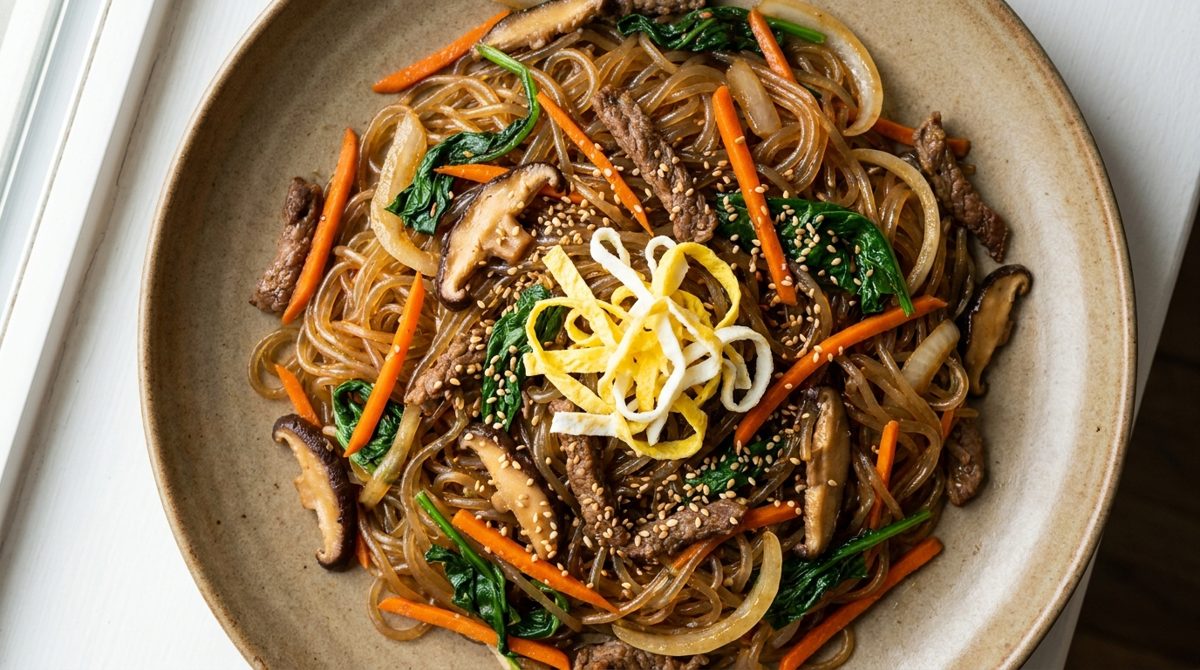
Spotted japchae on a menu or a party table and wondered what those shiny noodles are? Japchae (잡채, “mixed vegetables”) is Korea’s beloved glass noodle stir-fry: chewy, translucent noodles made from sweet potato starch, tossed with stir-fried vegetables, sesame oil, a sweet soy sauce, and often strips of beef. It’s mild, slightly sweet, and served everywhere from royal-style restaurants to family holiday tables. This decoder covers taste, the gluten question, allergens, vegetarian and halal answers, real 2026 prices, and exactly how to order japchae in Korean.
Table of Contents
- Japchae Quick Facts
- What Is Japchae, Exactly?
- What Does Japchae Taste Like?
- Dietary Guide: Vegetarian, Vegan, Halal & Allergens
- How to Order Japchae in Korean (+ 2026 Prices)
- How to Eat Japchae Like a Local
- Types of Japchae
- Where to Try Japchae
- Japchae FAQ
Japchae Quick Facts
| Item | Details |
|---|---|
| Korean name | 잡채 (japchae) — “mixed vegetables” |
| Pronunciation | JAP-cheh |
| Type | Glass noodle stir-fry — main dish, side dish (banchan), or party food |
| Spice level | 🌶️ 0 / 5 — sweet-savory, no chili in the classic recipe |
| Price (2026) | ₩8,000–₩12,000 as a restaurant dish; often free as banchan; japchae-bap (over rice) ₩8,000–₩10,000 |
| Vegetarian | ⚠️ Often contains beef — but vegetable-only versions are common and easy to request |
| Vegan | ⚠️ Ask for no beef and no egg garnish — the base is plant-based |
| Halal-friendly | ⚠️ Beef version isn’t certified; vegetable version is a low-risk choice — no pork in standard recipes |
| Main allergens | Soy, sesame, egg garnish, beef, wheat via soy sauce (the noodles themselves are gluten-free) |
| Best for | Noodle lovers, gluten-cautious travelers, anyone avoiding spice |
What Is Japchae, Exactly?
Japchae was born in a royal kitchen. The story dates to the early 1600s, when a court official prepared a dish of delicately seasoned mixed vegetables for King Gwanghaegun of the Joseon dynasty — the king reportedly loved it so much he promoted the man. The name still reflects that original dish: jap (mixed) + chae (vegetables). No noodles at all.
The glass noodles came three centuries later. In the early 1900s, sweet potato starch noodles called dangmyeon (당면) entered Korean cooking, and someone had the historic idea of tossing them into the royal vegetable dish. The combination stuck so completely that today “japchae” means the noodles — springy, translucent, glossy with sesame oil — with the vegetables in a supporting role.
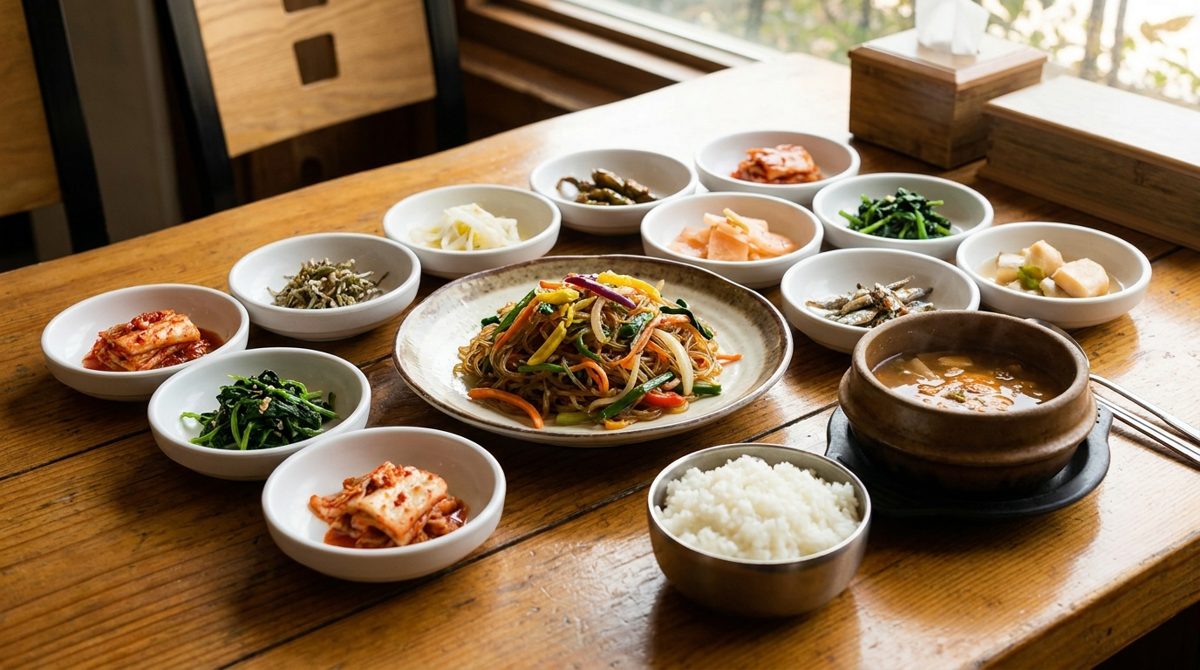
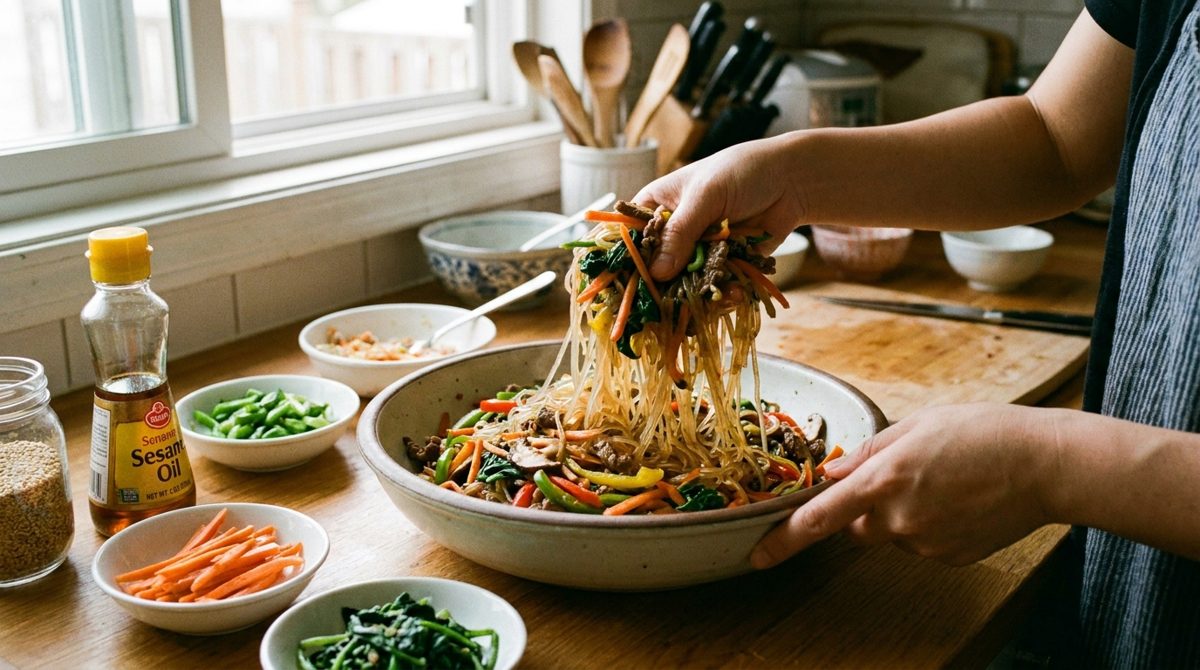
Understanding japchae’s social role helps you find it. It’s a celebration dish: labor-intensive (each vegetable is traditionally stir-fried separately), so it appears at holidays like Chuseok and Lunar New Year, birthdays, weddings, and any table trying to impress. At restaurants it shows up three ways — as a proper main dish, as a small free banchan side dish, or piled over rice as japchae-bap at Korean-Chinese restaurants.
For travelers, japchae is also one of the most forgiving dishes to try first. There’s no spice, no funk, no challenging texture — just sweet-savory noodles that taste familiar to almost every palate on earth. Korean parents feed it to toddlers; you’ll be fine.
One more identity note: japchae is the flagship of a whole dangmyeon family in Korean cooking. The same glass noodles thicken the broth in jjimdak (braised chicken), fill street-food kimmari rolls, and bulk out dumpling fillings. Learn to recognize their translucent shine and gentle chew here, and you’ll start spotting them across half the Korean menu — a genuinely useful skill for gluten-conscious and texture-curious eaters alike.
What Does Japchae Taste Like?
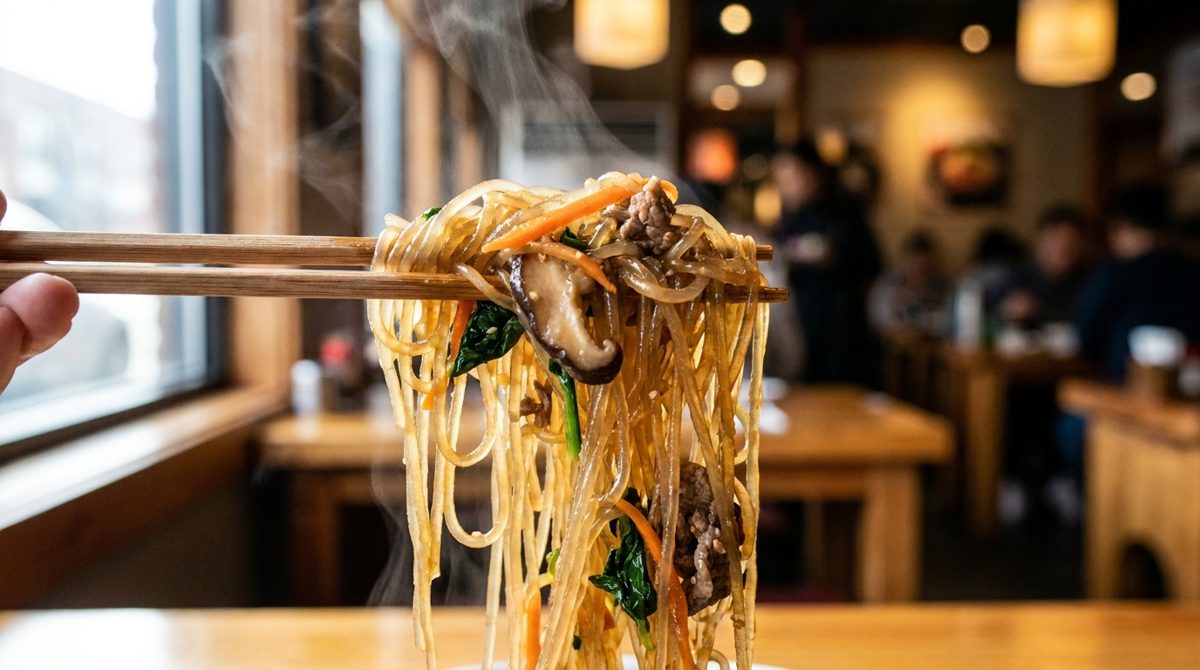
Sweet, savory, and nutty — the flavor trio of soy sauce, sugar, and sesame oil. But the real event is texture: dangmyeon noodles are unlike Italian pasta or ramen. They’re springy and chewy with a gentle bounce, slippery enough to shine, and they soak up the sauce while staying distinct. Add crunchy carrots, silky mushrooms, sweet onions, and tender spinach, and every bite lands differently.
If you’ve eaten bulgogi, the seasoning will feel familiar — japchae uses essentially the same sweet soy-garlic-sesame logic, and the beef in japchae is often marinated bulgogi-style. The two dishes are flavor cousins, which is why they share tables at celebrations. Try our bulgogi decoder if that flavor family is your thing.
Temperature surprises some visitors: japchae is served warm or at room temperature, not piping hot. At a banchan spread it might be fully room-temp — that’s correct, not a kitchen mistake. The noodles hold their chew either way, and Koreans happily eat leftover japchae cold from the fridge (or stir-fried with rice the next morning).
Is Japchae Spicy?
No — classic japchae is a flat 0 out of 5. There’s no chili in the traditional recipe at all; the flavor is sweet-savory throughout. The only spicy relative is gochu-japchae (고추잡채), a Korean-Chinese stir-fry of shredded peppers and pork served with steamed buns — a different dish despite the shared name. If a menu just says 잡채, expect zero heat.
Japchae Dietary Guide: Vegetarian, Vegan, Halal & Allergens
Japchae has a genuinely useful dietary superpower — gluten-free noodles — plus a few traps. Here’s the full picture:
| Ingredient concern | In standard japchae? | How to handle |
|---|---|---|
| Beef | Often | “Gogi ppaego juseyo” (고기 빼고 주세요) = without meat; many banchan versions are already meat-free |
| Pork | Rarely | Standard japchae uses beef if any meat; gochu-japchae (a different dish) uses pork |
| Wheat / gluten | Via the sauce | The noodles are sweet potato starch (gluten-free), but Korean soy sauce contains wheat |
| Soy | Yes | Soy sauce is the backbone of the seasoning — unavoidable |
| Sesame | Yes | Sesame oil and seeds are essential — hard to remove |
| Egg | Often | Thin egg-ribbon garnish (jidan) is traditional — easy to omit or pick off |
| Mushrooms | Usually | Shiitake and wood-ear mushrooms are classic ingredients |
| Dairy / nuts / alcohol | No | Traditional recipes contain none |
The gluten question deserves a straight answer, because japchae is often recommended to gluten-free travelers. The noodles themselves are 100% sweet potato starch — naturally gluten-free. But the dish is seasoned with regular Korean soy sauce, which contains wheat. So restaurant japchae is “low gluten,” not celiac-safe, unless the kitchen uses gluten-free soy sauce — worth asking at upscale or health-focused restaurants, and easy to control if you cook it yourself with tamari.
Is Japchae Vegetarian or Vegan?
Frequently yes, and always easily. Restaurant japchae often includes beef strips, but the dish loses nothing essential without them — vegetable japchae is a standard, respected version, not a compromise. Banchan portions at traditional restaurants are commonly meat-free already. Ask “gogi ppaego juseyo” to be sure. Vegans have two extra checks: the egg-ribbon garnish (skip it) and the small chance vegetables were stir-fried alongside meat. Temple-cuisine and vegetarian restaurants in Seoul serve fully vegan japchae with pride — it’s one of Korean cuisine’s most naturally plant-friendly celebration dishes.
Is Japchae Halal?
Japchae sits in the friendly-with-caveats zone. Standard recipes contain no pork and no alcohol — the meat, when present, is beef. At a regular restaurant that beef isn’t halal-certified, so Muslim travelers usually order the vegetable version, which involves nothing haram in a typical kitchen. For certified peace of mind, halal Korean restaurants (concentrated around Itaewon in Seoul) often have japchae on the menu, and the Korea Tourism Organization’s VisitKorea lists Muslim-friendly restaurants nationwide. Compared with most Korean mains, vegetable japchae is one of the easier safe orders.
How to Order Japchae in Korean (+ 2026 Prices)
Japchae ordering is simple — the useful vocabulary is about what to leave out:
| What you want | Say this | Romanized |
|---|---|---|
| Japchae, please | 잡채 주세요 | japchae juseyo |
| Japchae over rice | 잡채밥 주세요 | japchae-bap juseyo |
| Without meat | 고기 빼고 주세요 | gogi ppaego juseyo |
| Without egg | 계란 빼고 주세요 | gyeran ppaego juseyo |
| Is there wheat/flour in it? | 밀가루 들어가요? | milgaru deureogayo? |
What it costs in 2026: as a standalone dish at Korean restaurants, japchae runs ₩8,000–₩12,000 for a generous plate. Japchae-bap — a mound of japchae over rice, usually with a fried egg, at Korean-Chinese restaurants — is the filling budget move at ₩8,000–₩10,000. At traditional set-meal restaurants (hanjeongsik or baekban), japchae often appears free as one of the banchan side dishes. Market delis and department store food halls sell it by weight for picnics — a few thousand won buys a solid portion.
How to Eat Japchae Like a Local
Chopsticks, and don’t be shy about a big first grab — japchae noodles are long and slippery, and Koreans lift a proper tangle rather than fishing for single strands. There’s no dipping sauce and nothing to add; the dish arrives fully seasoned. If it comes as banchan alongside a meal, treat it like any side: a few bites between spoonfuls of rice and soup.
The japchae-bap route deserves special mention for hungry travelers. Korean-Chinese restaurants (the jjajangmyeon places) serve japchae over rice with a fried egg on top, sometimes with a light black-bean or soy gravy. Mix it all together — egg yolk into noodles into rice — and you have one of Korea’s great cheap lunches. Pair it with a few pieces of tangsuyuk (sweet and sour pork) if you’re two or more.
And if you’re at a Korean home or holiday gathering, know this: japchae disappearing quickly is the highest compliment. The dish takes real labor — vegetables cut and cooked separately, noodles boiled and seasoned at the right moment — so enthusiasm is etiquette. Second helpings are expected. Read our Korean dining etiquette guide for the rest of the table rules.
Leftovers, if you self-cater: japchae keeps a day or two refrigerated and revives beautifully in a hot pan — Koreans consider next-day fried japchae-bap a legitimate second dish, not a compromise. And for drink pairings, the gentle sweetness loves makgeolli (cloudy rice wine) at a traditional pub, or simply barley tea at lunch.
Types of Japchae You’ll See on Menus
Classic japchae (잡채) — dangmyeon noodles, five-plus vegetables, optional beef, egg garnish; the version at celebrations and traditional restaurants. Japchae-bap (잡채밥) — japchae over rice at Korean-Chinese restaurants; a complete meal. Haemul japchae (해물잡채) — with squid, shrimp, and other seafood; common at banquet restaurants. Beoseot japchae (버섯잡채) — mushroom-forward, often meat-free; the vegetarian’s default. Gochu-japchae (고추잡채) — the spicy shredded-pepper-and-pork Korean-Chinese stir-fry served with fluffy buns; shares the name, not the noodles. And keep an eye out for kimmari (김말이) at street stalls — japchae rolled in seaweed, battered, and deep-fried, then dunked in tteokbokki sauce. It’s one of the best-value bites in the entire Korean street food universe.
Where to Try Japchae
Japchae hides in plain sight. Traditional set-meal restaurants often include it among the banchan, so you may meet it for free with your first Korean lunch. For japchae as a proper main, look to traditional restaurants and jeon (Korean pancake) pubs, where a big plate accompanies makgeolli rice wine beautifully. Korean-Chinese restaurants cover the japchae-bap angle on every corner. For the street-food remix, market stalls sell crispy kimmari next to the tteokbokki vats — Gwangjang Market in Seoul is the classic spot, covered in our Seoul food guide. And the department store food halls’ banchan counters sell beautifully made japchae by weight — ideal for a hotel-room dinner or Han River picnic.
A budgeting tip: because japchae is priced as a mid-tier dish, the best value is often the baekban (home-style set meal) route — order a ₩9,000–₩12,000 set and japchae frequently arrives among the sides, alongside soup, rice, and half a dozen other banchan. You taste more of Korea for the same money, and if the japchae wins your heart, order a full plate next time. This is exactly how Koreans eat it most days: not as an event, but as one delicious corner of a crowded table.
Japchae FAQ
What are japchae noodles made of?
Sweet potato starch and water — nothing else. These noodles, called dangmyeon (당면), turn translucent and springy when cooked, which earns them the English nickname “glass noodles.” They’re naturally gluten-free and nearly flavorless on their own, built to carry the sweet soy-sesame sauce.
Is japchae gluten-free?
The noodles are — they’re pure sweet potato starch. But the dish is seasoned with Korean soy sauce, which contains wheat, so restaurant japchae isn’t celiac-safe by default. Made at home with tamari or gluten-free soy sauce, it’s one of the easiest Korean dishes to make fully gluten-free.
Is japchae vegetarian?
Often, and easily. Many versions — especially banchan portions — are meat-free already, and any kitchen can make it without beef (“gogi ppaego juseyo”). Vegans should also skip the egg-ribbon garnish.
What does japchae mean in English?
“Mixed vegetables” — jap (잡) means mixed, chae (채) means vegetables. The name predates the noodles: the original 17th-century royal dish was noodle-free, and the sweet potato glass noodles were only added in the early 1900s.
How much does japchae cost in Korea in 2026?
₩8,000–₩12,000 as a standalone restaurant dish, ₩8,000–₩10,000 for japchae-bap (over rice) at Korean-Chinese restaurants, and often free as a banchan side dish at traditional set-meal restaurants.
The Verdict: Should You Order It?
Yes — especially if you’re spice-shy, noodle-obsessed, or feeding a group with mixed dietary needs. Japchae is celebration food with zero barriers to entry: sweet, savory, bouncy, and adaptable from full-beef to fully vegan. Try the classic plate at a traditional restaurant, then the street-food kimmari remix, and you’ll have tasted four hundred years of delicious evolution (the Wikipedia entry on japchae has the full royal backstory). Hungry for the next dish? Decode the whole menu with our Korean Food Decoder — every major Korean dish explained with spice levels, allergens, and ordering phrases.