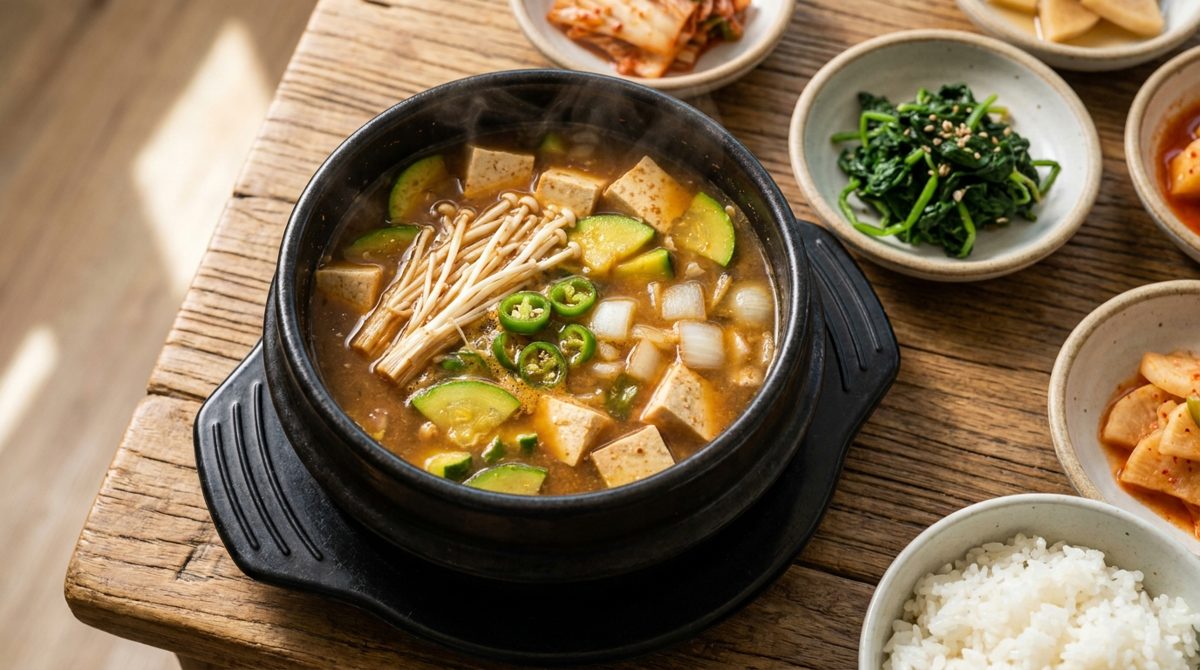
Keep seeing doenjang jjigae on menus and wondering what’s in that brown bubbling pot? Doenjang jjigae (된장찌개) is Korea’s fermented soybean paste stew: a savory, earthy broth loaded with tofu, zucchini, mushrooms, and onion, served boiling hot with rice. Think of it as miso soup’s older, stronger, far more intense sibling — and one of the least spicy dishes in the entire Korean canon. This decoder covers taste, spice level, allergens, halal and vegetarian answers, 2026 prices, and exactly how to order it in Korean.
Table of Contents
- Doenjang Jjigae Quick Facts
- What Is Doenjang Jjigae, Exactly?
- What Does Doenjang Jjigae Taste Like?
- Dietary Guide: Vegetarian, Vegan, Halal & Allergens
- How to Order Doenjang Jjigae in Korean (+ 2026 Prices)
- How to Eat Doenjang Jjigae Like a Local
- Types of Doenjang Jjigae
- Where to Try Doenjang Jjigae
- Doenjang Jjigae FAQ
Doenjang Jjigae Quick Facts
| Item | Details |
|---|---|
| Korean name | 된장찌개 (doenjang jjigae) — “soybean paste stew” |
| Pronunciation | DWEN-jang jee-GEH |
| Type | Stew / everyday main or side, served with rice |
| Spice level | 🌶️ 1–2 / 5 — earthy and savory, not spicy; a sliced chili adds mild warmth |
| Price (2026) | ₩8,000–₩10,000 as a main; often free or ₩2,000–₩3,000 alongside Korean BBQ |
| Vegetarian | ⚠️ The solids are mostly plants and tofu, but the broth is usually anchovy-based; some versions add clams or beef |
| Vegan | ⚠️ Only where the broth is vegetable/kelp-based — temple and vegan restaurants do it properly |
| Halal-friendly | ⚠️ Usually pork-free, but broth and shared kitchens are unverified; seafood versions are the safer lean |
| Main allergens | Soy (heavy), fish (broth), shellfish (clams in some versions), wheat (in some doenjang) |
| Best for | Spice-avoiders, fermentation fans, anyone wanting Korea’s true daily flavor |
What Is Doenjang Jjigae, Exactly?
If kimchi is Korea’s most famous fermented food, doenjang is its most fundamental. This dense brown paste of fermented soybeans has seasoned Korean cooking for well over a thousand years — made by boiling soybeans, shaping them into blocks (meju), and aging them in earthenware jars through the seasons. Dissolve a scoop of it in broth with tofu and whatever vegetables the season offers, and you have doenjang jjigae.
It’s hard to overstate how central this stew is to daily Korean life. Kimchi jjigae might be the national favorite, but doenjang jjigae is the national default — the stew most Korean families eat several times a week, the one that appears automatically beside grilled meat at BBQ restaurants, the smell most Koreans associate with home. Where kimchi jjigae shouts, doenjang jjigae hums.
The tradition behind the paste runs deep enough that UNESCO inscribed Korea’s jang-making culture — the communal craft of fermenting doenjang, ganjang (soy sauce), and gochujang — on its Intangible Cultural Heritage list in 2024. In the countryside you can still find houses where the family’s doenjang jar has been continuously topped up for generations, the culinary equivalent of a sourdough starter with a family registry.
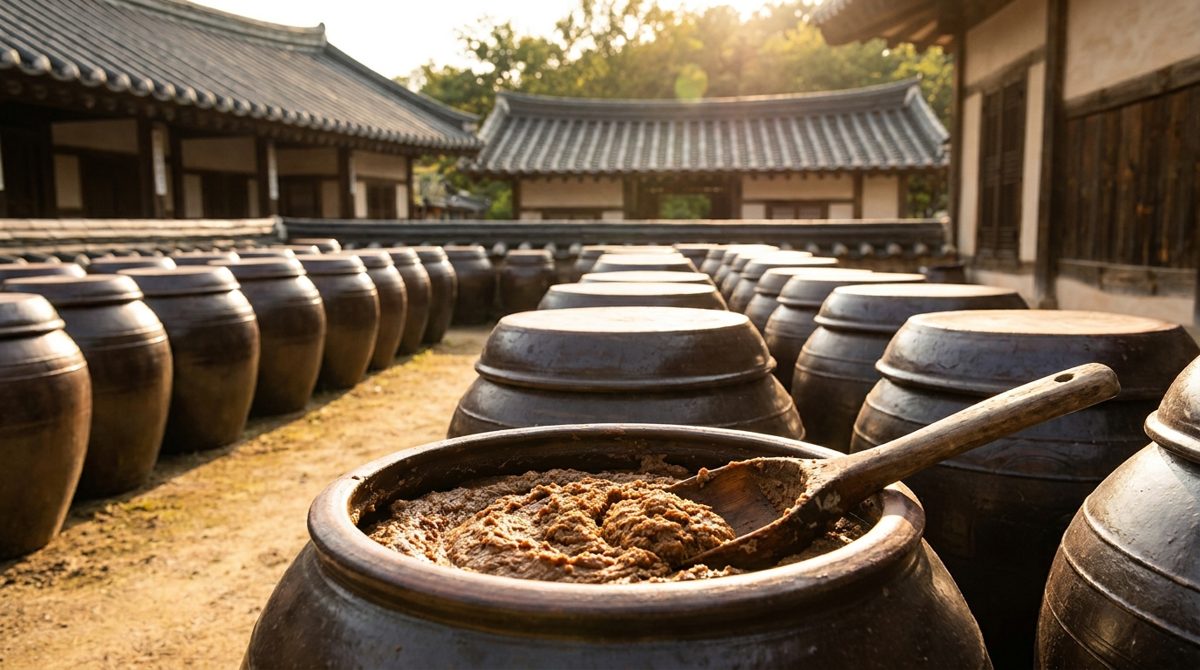
The paste itself is a cousin of Japanese miso, but the comparison only goes so far. Doenjang is fermented longer, with wild rather than cultivated cultures, and no rice or barley to soften it — so it’s deeper, saltier, and unapologetically funky. If miso is a polite handshake, doenjang is a bear hug. You can read more about the paste’s history on Wikipedia’s doenjang entry.
What Does Doenjang Jjigae Taste Like?
Deeply savory, earthy, and comforting. The first flavor is umami — a big, brothy savoriness that coats the tongue — followed by the paste’s signature funk: nutty, slightly cheesy, faintly sweet from the long fermentation. The tofu is silky, the zucchini and mushrooms turn tender and sweet, and the whole thing tastes like something that has been cooked with patience even when it took eight minutes.
First-timers usually react one of two ways: “this tastes like home” or “this smells stronger than I expected.” Both are correct. The aroma is bolder than miso soup — that’s the wild fermentation talking — but the flavor is gentler than the smell suggests. Almost everyone who pushes past the first spoonful becomes a convert by the third.
Is Doenjang Jjigae Spicy?
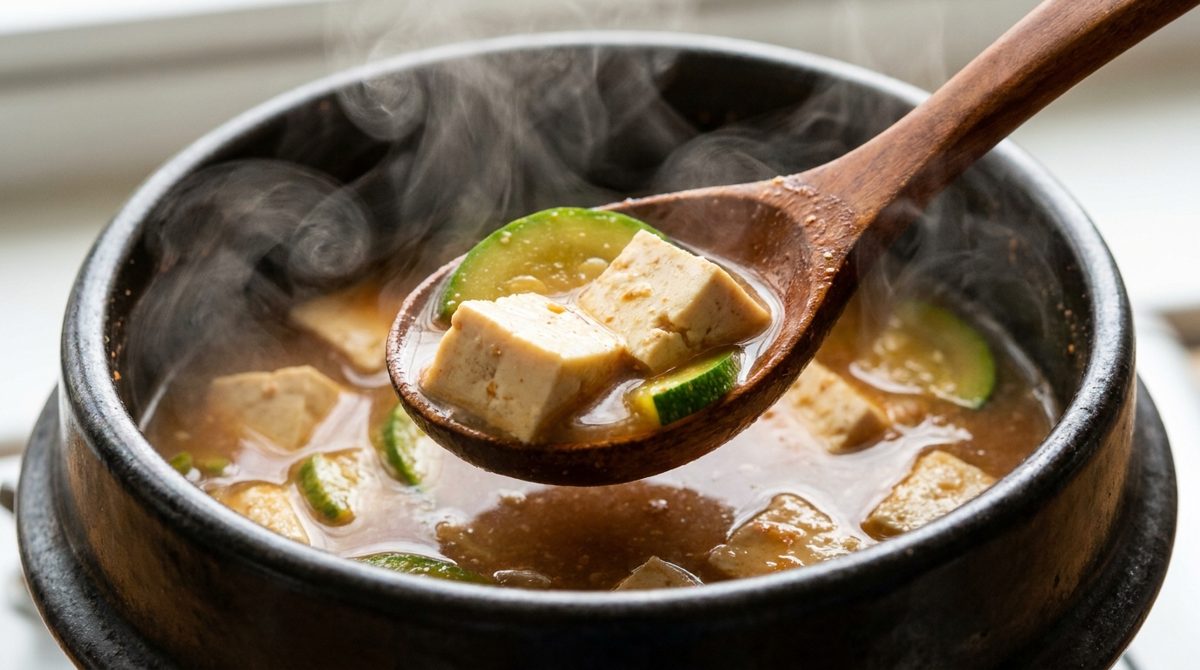
Barely — this is one of the best dishes in Korea for people who can’t handle heat. The base stew has no chili at all; most kitchens add a few slices of green chili or a pinch of gochugaru for brightness, landing it around 1–2 out of 5. If even that worries you, say “an maepge haejuseyo” (안 맵게 해주세요 — not spicy, please) and you’ll get a completely mild pot. On a Korean table it plays the calming counterpart to spicier dishes — which is exactly why BBQ restaurants serve it beside the grill.
This makes it the strategic order for mixed tables. Traveling with kids, a spice-averse partner, or a grandparent suspicious of red food? Doenjang jjigae is the dish that lets everyone eat Korean at the same restaurant: the chili-heads get their kimchi jjigae, the cautious get this, and both get the same rice-and-banchan experience. One warning for the truly sensitive: the floating green chili slices are sometimes cheongyang chilies, Korea’s hottest common pepper — easy to spot and push aside.
Doenjang Jjigae Dietary Guide: Vegetarian, Vegan, Halal & Allergens
Doenjang jjigae looks like the most vegetarian-friendly stew in Korea — it’s mostly tofu and vegetables — but the broth writes the real rules. Here’s the honest matrix.
| Ingredient concern | In standard doenjang jjigae? | How to handle |
|---|---|---|
| Soy | Heavily — the paste is fermented soybeans and the tofu doubles down | Unavoidable; this is not the dish for soy allergies |
| Fish / seafood | Usually — the broth base is typically anchovy and kelp | Ask “chaesik yuksu ye-yo?” (vegetable broth?); temple and vegan places use kelp-only |
| Shellfish | Sometimes — clams (jogae) are a common add-in, shrimp occasionally | “Jogae ppaego juseyo” (조개 빼고 주세요) = no clams; ask before ordering |
| Beef / pork | Sometimes — beef brisket or pork versions exist, especially at BBQ restaurants | Ask “gogi deureogayo?” (고기 들어가요? — is there meat?) |
| Wheat / gluten | Possibly — some commercial doenjang contains wheat flour | Traditional 100% soybean doenjang is gluten-free; hard to verify at restaurants |
| Egg / dairy / nuts | No | Traditional recipes contain none of these |
| Alcohol | No | Not used |
Is Doenjang Jjigae Vegetarian or Vegan?
Closer than most Korean stews, but not by default. The solids — tofu, zucchini, mushroom, onion, potato — are plant-based, and the paste itself is vegan. The catch is the broth: most restaurants build it on anchovy stock, and some toss in clams or a few slices of beef for depth. A meaningful number of home cooks and temple kitchens make it with kelp-and-mushroom broth instead, so genuinely vegan doenjang jjigae absolutely exists — Korean temple food restaurants and Seoul’s vegan spots serve it as a staple. At a regular diner, asking for no meat and no clams gets you “vegetarian-ish”: plant solids in a fish-based broth. Decide where your line is before you’re hungry.
Is Doenjang Jjigae Halal?
Conditionally. The stew usually contains no pork and no alcohol, which puts it well ahead of most Korean stews for Muslim travelers — but it isn’t certified anywhere ordinary, broths are seafood-based, and BBQ-restaurant versions sometimes include meat of unverified origin. Practical approach: order the seafood or plain tofu-vegetable version at regular restaurants and ask about meat, or eat it worry-free at halal-certified Korean restaurants — the Korea Tourism Organization keeps Muslim-friendly listings on VisitKorea. Compared with pork-heavy stews like budae jjigae, doenjang jjigae is one of the easier dishes to navigate.
How to Order Doenjang Jjigae in Korean (+ 2026 Prices)
You’ll rarely need to seek this stew out — it finds you. But when ordering it as a main, these phrases help:
| What you want | Say this | Romanized |
|---|---|---|
| One doenjang jjigae, please | 된장찌개 하나 주세요 | doenjang-jjigae hana juseyo |
| Not spicy, please | 안 맵게 해주세요 | an maepge haejuseyo |
| No clams, please | 조개 빼고 주세요 | jogae ppaego juseyo |
| Is there meat in it? | 고기 들어가요? | gogi deureogayo? |
| Extra rice, please | 공기밥 추가요 | gonggi-bap chuga-yo |
What it costs in 2026: as a standalone meal with rice and banchan, doenjang jjigae runs ₩8,000–₩10,000 at regular Seoul restaurants — reliably one of the cheapest full meals on any menu. At Korean BBQ restaurants it’s often free or ₩2,000–₩3,000 as the finishing stew that accompanies your meat course. Premium versions with hand-made country doenjang (jip-doenjang) or beef brisket run ₩11,000–₩14,000 and are worth trying once for the difference.
Ordering rhythm to expect: at lunch diners the stew arrives within five minutes of ordering — it’s a speed dish — with rice, and anywhere from three to eight banchan. Water and banchan refills are self-serve or free on request. At BBQ restaurants, the stew usually lands near the end of the meat course; if you want it earlier as a starter for the table, just say “doenjang jjigae meonjeo juseyo” (먼저 = first). Nobody will blink.
How to Eat Doenjang Jjigae Like a Local
Like all jjigae, it’s a rice-partner, not a soup course. Spoon rice, dunk it in the stew, ride the alternation: bite of stew-soaked rice, bite of banchan, repeat. Many Koreans go one step further and spoon the stew directly over their rice bowl — completely acceptable, quietly encouraged, and honestly the best way to eat it. The pot arrives at a rolling boil and stays dangerous for a solid two minutes; let it calm down.
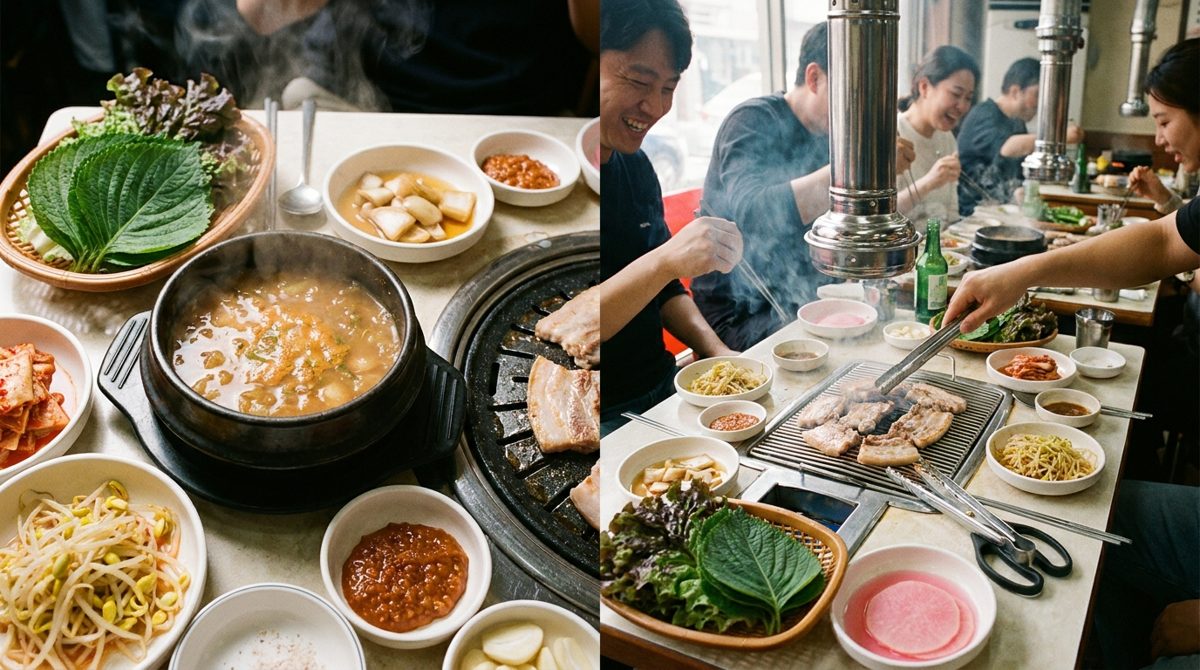
At a Korean BBQ restaurant, the stew has a specific job: it lands mid-meal or at the end, cutting through the richness of grilled pork with its salty, earthy tang. A spoonful of doenjang jjigae after a wrap of samgyeopsal is one of the great one-two punches in Korean eating — see our samgyeopsal beginner’s guide for how the whole meal flows. And don’t confuse the stew with ssamjang, the thick dipping paste for wraps — same doenjang family, different job.
Types of Doenjang Jjigae You’ll See on Menus
Standard doenjang jjigae (된장찌개) — tofu, zucchini, mushroom, onion, chili; the everyday version described on this page. Chadol doenjang jjigae (차돌 된장찌개) — with thin-sliced beef brisket; richer, and a lunch-set favorite. Haemul doenjang jjigae (해물 된장찌개) — with clams and shrimp; brinier and popular near the coast. Gang-doenjang (강된장) — the concentrated cousin: a thick, intense reduction eaten as a dip or spooned sparingly over rice with vegetables. Cheonggukjang (청국장) — the extreme sibling: fast-fermented soybean stew with a famously powerful aroma. If doenjang jjigae is a bear hug, cheonggukjang is a headlock — and its fans wouldn’t have it any other way.
Where to Try Doenjang Jjigae
Everywhere rice is served — it’s arguably Korea’s most ubiquitous dish. Every baekban (home-style set meal) restaurant, every BBQ house, every highway rest stop, every company cafeteria makes it. For the memorable version, find a jip-doenjang restaurant advertising house-fermented paste — often countryside places with onggi jars lined up in the yard — or a temple food restaurant where the vegan version shows what the paste can do on its own. It also anchors the set meals in our Busan baekban travelogue, and it’s the gentle option to order when your table has one spice-lover eating kimchi jjigae and one spice-avoider eating this.
Want to taste it before committing at a restaurant? Convenience stores and supermarkets sell single-serve doenjang jjigae blocks and cup versions (₩1,500–₩3,500) — add hot water or microwave, and you get a surprisingly faithful preview. They’re also the cheapest souvenir with real flavor memory attached: a block of good doenjang paste in your suitcase means you can rebuild this stew in any kitchen on earth with nothing but tofu and zucchini.
Doenjang Jjigae FAQ
What does doenjang jjigae mean in English?
“Soybean paste stew.” Doenjang is Korea’s fermented soybean paste — literally “thick paste” — and jjigae means stew. Menus sometimes translate it as “soybean paste soup.”
Is doenjang jjigae the same as miso soup?
No — they’re relatives, not twins. Doenjang ferments longer with wild cultures and no rice or barley, so the stew is deeper, saltier, and much funkier than miso soup, and it’s eaten as a hearty main with rice rather than a light starter.
Is doenjang jjigae spicy?
Barely. The base has no chili; most versions add only a few slices of green chili, landing around 1–2 out of 5. It’s one of the safest orders in Korea for people who dislike spicy food.
Is doenjang jjigae healthy?
Very — it’s regularly cited as a cornerstone of the Korean diet. A serving runs roughly 150–250 kcal before rice, high in plant protein from soybeans and tofu, with fermented-food benefits. The one watch-out is sodium, which is why it’s always eaten with plain rice.
How much does doenjang jjigae cost in Korea in 2026?
₩8,000–₩10,000 as a standalone meal with rice and banchan; often free or ₩2,000–₩3,000 as the accompanying stew at Korean BBQ restaurants; ₩11,000–₩14,000 for premium house-paste or beef brisket versions.
The Verdict: Should You Order It?
Yes — especially if spicy food scares you, because doenjang jjigae is the rare famous Korean dish that never bites back. It’s the flavor Koreans actually live on: cheap, fast, deeply savory, and more representative of a real Korean dinner table than anything on a tourist checklist. Order it as your calm anchor at a BBQ night, or as an ₩8,000 solo lunch when you want to eat like a local office worker. Hungry for the next dish? Decode the whole menu with our Korean Food Decoder — every major Korean dish explained with spice levels, allergens, and ordering phrases.