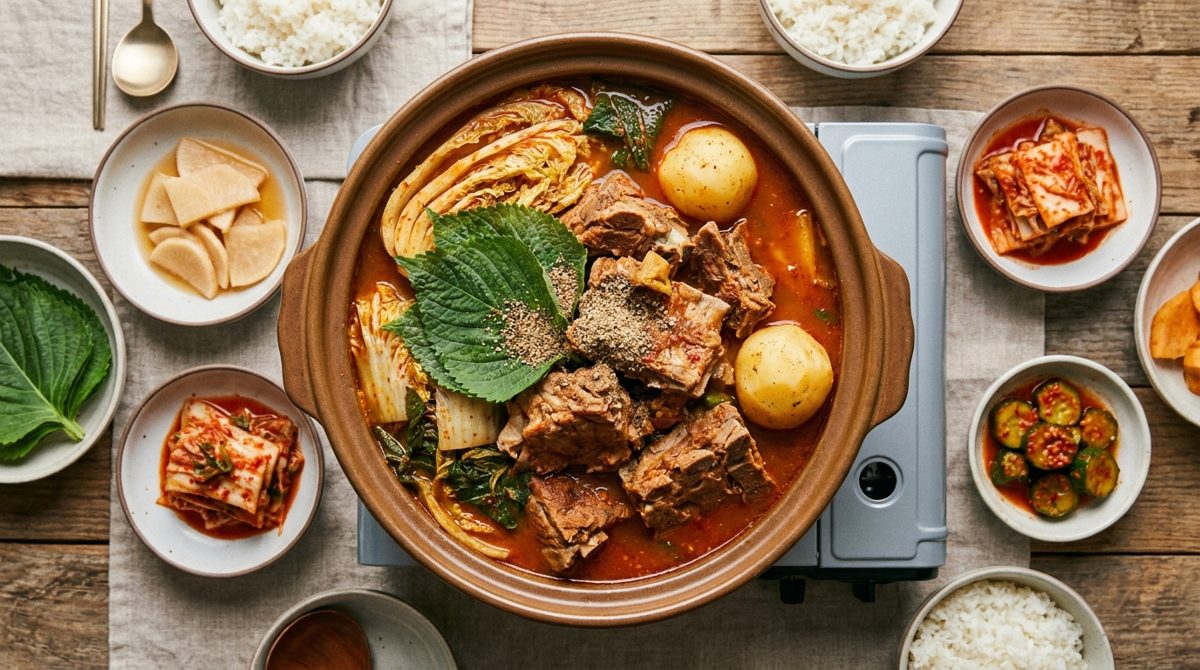
Spotted gamjatang on a late-night menu and wondering what it is? Gamjatang (감자탕) is Korea’s pork backbone and potato stew: meaty sections of pork spine simmered for hours in a spicy, deeply savory red broth with whole potatoes, wilted cabbage, perilla leaves, and a dusting of nutty wild sesame powder. It’s Korea’s most famous hangover food, served around the clock at 24-hour restaurants — hearty, primal, and criminally underrated by tourists. This decoder covers taste, spice level, allergens, halal and vegetarian answers, 2026 prices, and how to order it in Korean.
Table of Contents
- Gamjatang Quick Facts
- What Is Gamjatang, Exactly?
- What Does Gamjatang Taste Like?
- Dietary Guide: Vegetarian, Vegan, Halal & Allergens
- How to Order Gamjatang in Korean (+ 2026 Prices)
- How to Eat Gamjatang Like a Local
- Types of Gamjatang
- Where to Try Gamjatang
- Gamjatang FAQ
Gamjatang Quick Facts
| Item | Details |
|---|---|
| Korean name | 감자탕 (gamjatang) — “potato stew” (pork spine is the real star) |
| Pronunciation | GAHM-ja-tahng |
| Type | Hearty stew / hangover food; single bowls or big sharing pots |
| Spice level | 🌶️ 2–3 / 5 — warming and herbal rather than hot |
| Price (2026) | ₩9,000–₩11,000 for a single bowl (ppyeo-haejangguk); ₩28,000–₩40,000 for sharing pots |
| Vegetarian | ❌ No — pork bones ARE the broth; no modification possible |
| Vegan | ❌ No |
| Halal-friendly | ❌ No — the dish is built entirely on pork |
| Main allergens | Pork, soy, sesame/perilla (wild sesame seed powder, deulkkae) |
| Best for | Hangover mornings, cold nights, bone-picking carnivores, late-night eaters |
What Is Gamjatang, Exactly?
Gamjatang is what happens when Korean cooks apply soup logic to the cheapest, most flavorful part of the pig: the backbone. Meaty vertebrae are blanched, then simmered for hours with garlic, ginger, doenjang, and gochugaru until the broth turns rich and the meat surrenders from the bone at a touch. Whole potatoes, wilted napa cabbage, mung bean sprouts, and fragrant perilla leaves join near the end, and the pot gets a final snowfall of ground wild sesame (deulkkae) — the earthy, herbal signature that makes gamjatang taste like nothing else.
The dish grew up as working-class food. Its spiritual home is Seoul’s old industrial neighborhoods — the alleys around Cheonggyecheon and Yeongdeungpo once fed laborers big pots of it — and it never lost that identity: generous, cheap for the amount of meat, and open all night. Most gamjatang restaurants in Korea run 24 hours, because the dish’s other job is national hangover cure.
About that name: gamja means potato, but the potatoes aren’t really the point, and Koreans enjoy debating the etymology. One popular theory says gamja-ppyeo (“gamja bone”) was an old butcher’s term for a section of the pork spine, making the potato connection a coincidence of language. Whatever the truth, expect a few large potatoes and a lot of pork. There’s more on the dish at Wikipedia’s gamjatang entry.
Where it fits in the soup universe: Korean menus distinguish guk (light everyday soup), tang (long-simmered, hearty soup), and jjigae (thick, punchy stew). Gamjatang is a tang through and through — closer in spirit to seolleongtang or galbitang, the great bone soups, than to kimchi jjigae. That means the broth carries the dish, hours of work are hiding in your bowl, and the price of admission is astonishingly low for what amounts to slow food served fast.
What Does Gamjatang Taste Like?
Deep, meaty, and herbal. Hours of simmering pull gelatin and marrow flavor from the bones, so the broth is rounder and more substantial than most Korean stews — closer to a rich pork ramen broth than to kimchi jjigae’s bright tang. The gochugaru warmth sits in the background; the front of the palate gets doenjang savoriness and the unmistakable perilla note: nutty, faintly minty, almost wild. The meat itself is soft, collagen-rich, and absurdly satisfying to pull off the bone.
The potatoes, having drunk broth for an hour, might quietly be the best bite in the pot. And the perilla leaves — Korea’s beloved herb that tastes like basil’s mountain cousin — perfume everything. If you’ve only had Korean red stews, gamjatang will surprise you: less acid, less fire, more depth.
One heads-up on richness: this is a collagen-heavy, lip-sticking broth — that’s the appeal — and the meat is fattier than loin cuts, in the luscious slow-cooked way of oxtail or pork shoulder. If you love tonkotsu ramen, birria, or bone broth of any nationality, gamjatang is squarely your dish. If you prefer light, clear soups, order the smaller bowl first and see which camp you’re in.
Is Gamjatang Spicy?
Mildly — most travelers rate it 2–3 out of 5, noticeably gentler than kimchi jjigae or tteokbokki. The red color oversells the heat: gochugaru here builds warmth rather than burn, and the fatty broth plus potatoes buffer whatever heat exists. If you’re sensitive, ask “deol maepge haejuseyo” (덜 맵게 해주세요 — less spicy); if you want it hotter, every table has extra chili. For most people gamjatang is the comfortable middle of the Korean spice road — flavorful warmth without the sweat.
Gamjatang Dietary Guide: Vegetarian, Vegan, Halal & Allergens
Gamjatang is straightforward on the dietary front, in the unhelpful sense: it’s pork from the broth up. Here’s the full picture, including the allergen most guides miss — perilla.
| Ingredient concern | In standard gamjatang? | How to handle |
|---|---|---|
| Pork | Always — the broth is made from pork spine bones; meat is the centerpiece | Cannot be removed; the dish IS pork |
| Sesame / perilla | Always — ground wild sesame (deulkkae) powder and perilla leaves; often regular sesame too | Note: perilla is botanically a mint, not true sesame, but ask “deulkkae ppaego juseyo” (들깨 빼고 주세요) to skip the powder if allergic |
| Soy | Yes — doenjang (soybean paste) and soy sauce season the broth | Cannot be removed |
| Fish / seafood | Sometimes — saeujeot (salted shrimp) seasoning at some shops; kimchi on the side contains fish sauce | Ask if shellfish allergy is severe |
| Wheat / gluten | Sometimes — noodle or dumpling add-ins; trace wheat possible in pastes | Skip the sari add-ins; the base stew is mostly gluten-light |
| Egg / dairy / nuts | No | Not part of the dish |
| Alcohol | Trace at most | Some kitchens splash rice wine while blanching bones |
Is Gamjatang Vegetarian or Vegan?
No, categorically. Unlike stews where meat is an ingredient, here the pork bones are the broth itself — there is nothing to remove and nothing left if you did. No mainstream restaurant offers a vegetarian gamjatang, and we haven’t seen a convincing vegan re-creation even in Seoul’s plant-based scene. Vegetarian travelers who want the same soul-warming, herbal-stew experience should look at doenjang jjigae with vegetable broth, or temple-food restaurants where mushroom-based soups deliver comparable depth without the pig.
Is Gamjatang Halal?
No — gamjatang is not halal and cannot be adapted. It is pork broth, pork meat, and pork marrow; there is no version without it, and we’d flag any suggestion otherwise as wrong. For Muslim travelers who want the same experience — a long-simmered, meat-on-the-bone Korean soup — the closest halal-friendly equivalents are galbitang (beef short-rib soup) or samgyetang (whole chicken ginseng soup, covered in our samgyetang guide) at certified or Muslim-friendly restaurants — the Korea Tourism Organization lists them on VisitKorea. Both scratch the same bone-broth itch with beef or chicken instead.
How to Order Gamjatang in Korean (+ 2026 Prices)
Gamjatang menus are short and come in two formats: the single-serving bowl and the table pot. Knowing which to say gets you exactly what you want:
| What you want | Say this | Romanized |
|---|---|---|
| Single bowl of backbone hangover soup | 뼈해장국 하나 주세요 | ppyeo-haejangguk hana juseyo |
| Small sharing pot of gamjatang | 감자탕 소(小) 주세요 | gamjatang so juseyo |
| Less spicy, please | 덜 맵게 해주세요 | deol maepge haejuseyo |
| Extra noodles / rice cake add-in | 사리 추가해주세요 | sari chuga-haejuseyo |
| Fried rice at the end, please | 볶음밥 해주세요 | bokkeum-bap haejuseyo |
What it costs in 2026: the solo format — ppyeo-haejangguk (뼈해장국), a single bowl of the same backbone stew with rice — runs ₩9,000–₩11,000 and is one of Korea’s best meat-per-won deals. The shared gamjatang pot comes in sizes: small (2 people) around ₩28,000–₩32,000, medium and large climbing to ₩35,000–₩40,000 for a table of three or four, with noodle, rice cake, and extra-meat add-ins at ₩2,000–₩4,000. Rice, banchan, and broth top-ups are included — nobody leaves a gamjatang restaurant hungry.
Solo diners, note the beautiful loophole: order ppyeo-haejangguk and you get the full gamjatang experience — same bones, same broth, same perilla — in single-serving form, no group required. It’s the standard weekday lunch and post-drinking order, and no restaurant will blink at a foreigner asking for it.
How to Eat Gamjatang Like a Local
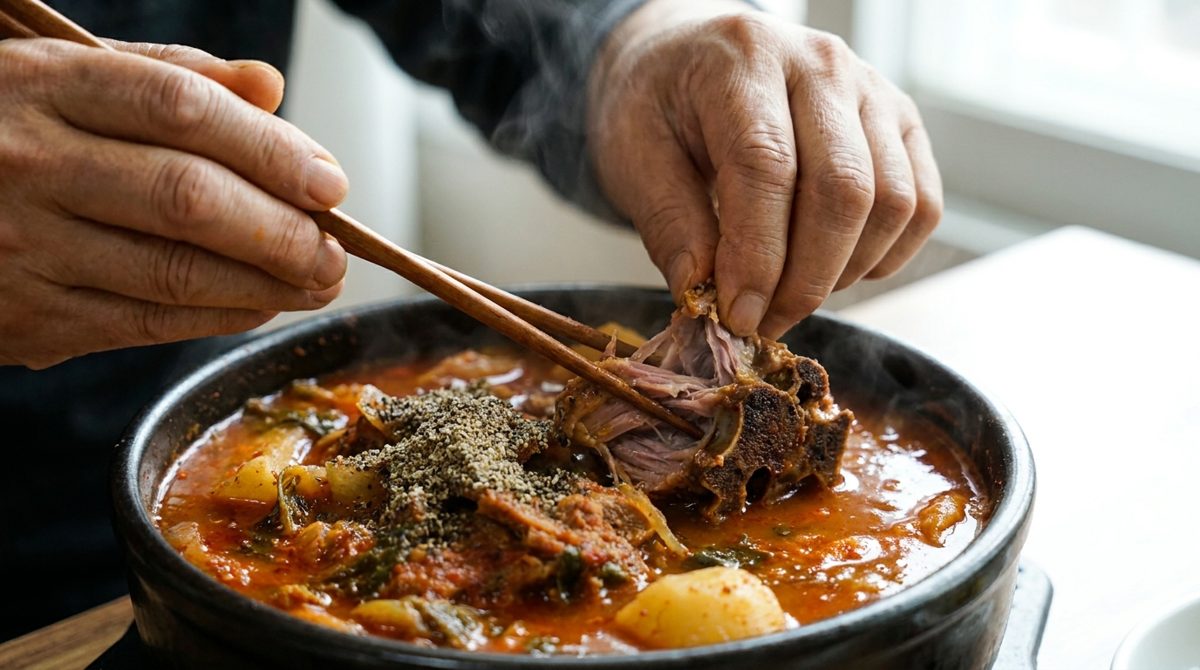
This is hands-on food. Pick up a backbone piece with your chopsticks (or fingers at rowdier hours — nobody’s judging), strip the tender meat off with chopsticks, and hunt the crevices: the best morsels hide between the vertebrae. Many restaurants supply a tin bucket for spent bones and plastic gloves on request. Dip the meat in the shrimpy or wasabi-soy sauce provided, chase it with broth-soaked potato, and repeat.
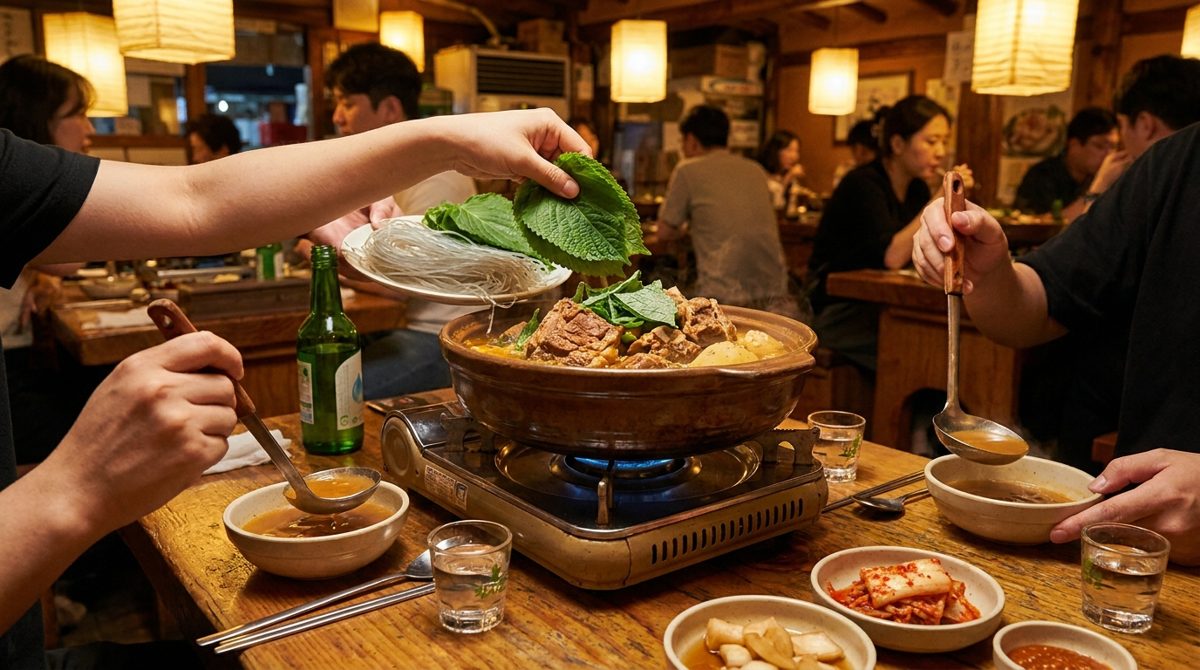
The rhythm matters: meat first, then vegetables and potato, ladling broth over your rice as you go. At a shared pot, keep the burner low so the broth reduces slowly — it gets better as it concentrates. And the ending is non-negotiable for locals: once the bones are cleared, order the bokkeumbap — fried rice with perilla powder and seaweed crisped in the remaining broth-slick — or drop in a noodle sari. For the etiquette of communal pots and bone buckets, our Korean dining etiquette guide covers the fine print.
Drinks follow the time of day. At night, gamjatang is classic soju food — the big pot, the low flame, and the slow pace are practically designed for a long conversation over green bottles. In the morning, the same restaurant serves the same broth to yesterday’s soju drinkers as medicine, no alcohol in sight, just barley tea and quiet concentration. Few dishes moonlight as both the cause and the cure — gamjatang works both shifts.
Types of Gamjatang You’ll See on Menus
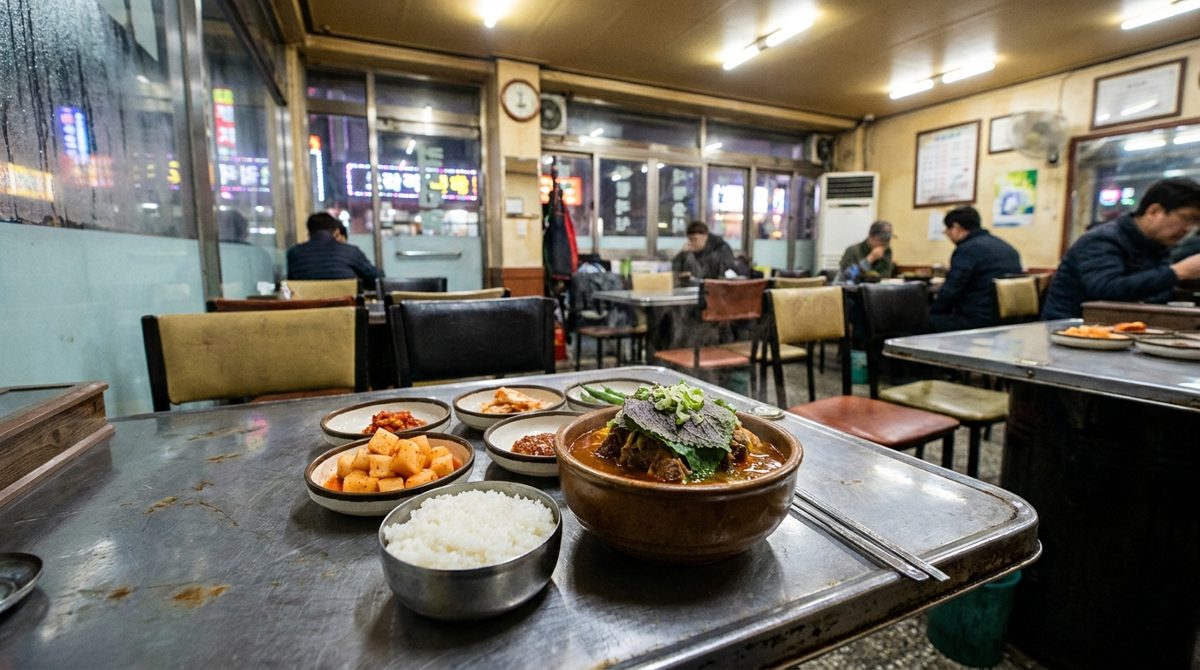
Gamjatang (감자탕) — the shared pot on a burner: a mountain of backbones, potatoes, and greens for the table; sized 소/중/대 (small/medium/large). Ppyeo-haejangguk (뼈해장국) — the single-serving bowl of the same stew, Korea’s definitive hangover breakfast; haejang literally means “relieving the intestines” after drinking. Mugeunji gamjatang (묵은지 감자탕) — with aged sour kimchi stewed in, marrying gamjatang’s depth with kimchi jjigae’s tang; spectacular. Ugeoji ppyeo-guk (우거지 뼈국) — heavier on wilted cabbage greens, slightly lighter broth. Cheese or seolleongtang-style twists exist at trendy shops, but the classic pot needs no help.
Where to Try Gamjatang
Look for the 24-hour signs — the best gamjatang tends to come from restaurants that never close, because a perpetual pot means perpetual broth. In Seoul, the areas around Yeongdeungpo, Sillim, and any university or nightlife district have decades-old specialists; Eungam-dong’s “Gamjatang Alley” in the northwest of the city is a dedicated pilgrimage strip. Any city in Korea will have a beloved local ppyeo-haejangguk spot filled at 8 am with a mix of construction workers and survivors of last night. It’s also a natural stop on a bigger eating itinerary — our Seoul food guide maps the neighborhoods where these all-night institutions cluster.
When to eat it: Koreans reach for gamjatang in three situations — the morning after drinking (the collagen-rich, electrolyte-heavy broth and gentle spice genuinely help), cold or rainy nights, and long catch-up dinners where the pot’s slow burn sets the pace. If your trip includes one hungover morning, make it a ppyeo-haejangguk morning; it’s the most authentically Korean recovery ritual there is.
Gamjatang FAQ
What does gamjatang mean in English?
Literally “potato stew” — gamja is potato, tang is a hearty soup. The name undersells it: pork backbone is the real centerpiece, and one theory says “gamja” originally referred to a cut of the pork spine rather than the potato.
Is gamjatang a hangover food?
The hangover food. Its single-bowl version is literally called ppyeo-haejangguk — “bone hangover soup” — and 24-hour gamjatang restaurants fill up every morning with people rebuilding themselves via hot collagen-rich broth, potatoes, and gentle spice.
Is gamjatang halal or vegetarian-friendly?
Neither. The broth is simmered from pork spine bones, so there’s no meat-free or pork-free version. Muslim and vegetarian travelers should look at galbitang (beef), samgyetang (chicken), or vegetable-broth doenjang jjigae for a similar comforting soup experience.
What is the powder on top of gamjatang?
Ground wild sesame — deulkkae, or perilla seed powder. Despite the English name, perilla is a mint-family plant, not true sesame; it gives gamjatang its signature nutty, herbal flavor. The green leaves in the pot are perilla leaves from the same plant.
How much does gamjatang cost in Korea in 2026?
₩9,000–₩11,000 for a single-serving ppyeo-haejangguk bowl with rice; ₩28,000–₩32,000 for a small sharing pot for two; ₩35,000–₩40,000 for larger pots, plus ₩2,000–₩4,000 for noodle or rice-cake add-ins.
The Verdict: Should You Order It?
Yes — gamjatang might be the best-value serious meal in Korea, and tourists walk past it daily because pork spine sounds intimidating. It shouldn’t: this is gentle, deeply comforting food with moderate spice and maximum payoff for anyone willing to work a bone with chopsticks. Order the solo bowl for a ₩10,000 education, or gather a group around the big pot on a cold night and finish with the fried rice. Hungry for the next dish? Decode the whole menu with our Korean Food Decoder — every major Korean dish explained with spice levels, allergens, and ordering phrases.