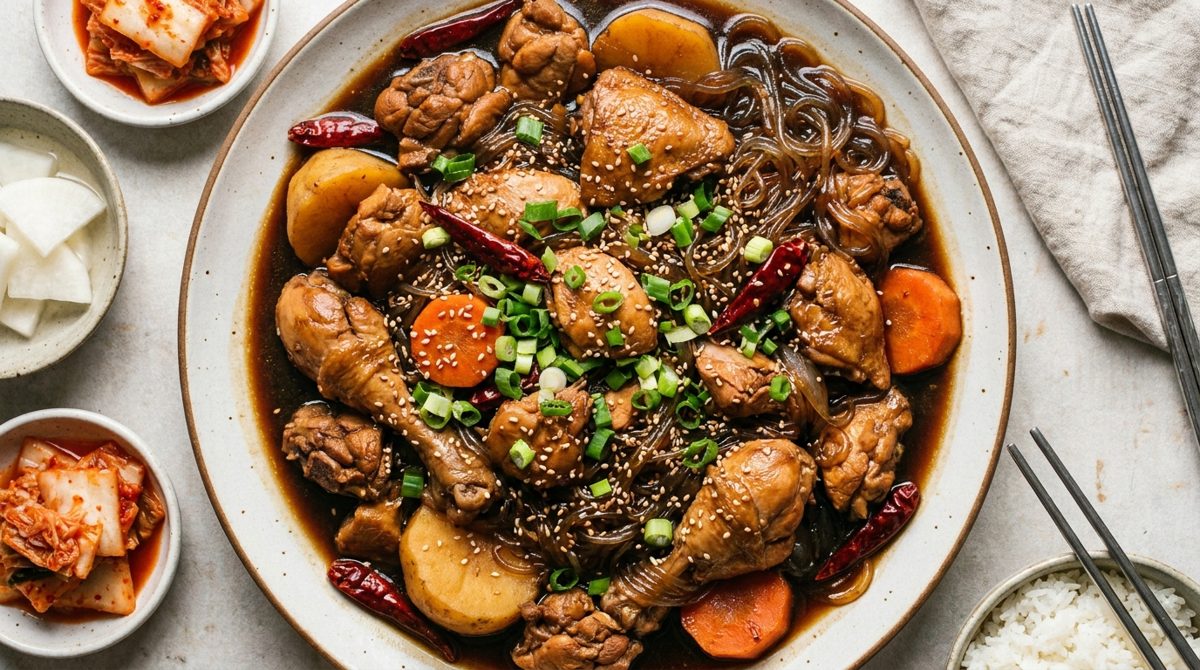
Heard friends raving about jjimdak and wondering what’s on that giant platter? Jjimdak (찜닭, “braised chicken”) is Korea’s famous soy-braised chicken from the city of Andong: bone-in chicken pieces simmered with potatoes, carrots, onions, and chewy glass noodles in a glossy sweet-savory soy sauce, spiked with dried chilies for a subtle, sneaky heat. It’s a sharing dish — one platter feeds two or three — and one of the best group meals in the country. This decoder covers taste, real spice level, allergens, halal and vegetarian answers, 2026 prices, and exactly how to order jjimdak in Korean.
Table of Contents
- Jjimdak Quick Facts
- What Is Jjimdak, Exactly?
- What Does Jjimdak Taste Like?
- Dietary Guide: Vegetarian, Vegan, Halal & Allergens
- How to Order Jjimdak in Korean (+ 2026 Prices)
- How to Eat Jjimdak Like a Local
- Types of Jjimdak
- Where to Try Jjimdak
- Jjimdak FAQ
Jjimdak Quick Facts
| Item | Details |
|---|---|
| Korean name | 찜닭 (jjimdak) — “braised/steamed chicken”; often 안동찜닭 (Andong jjimdak) |
| Pronunciation | JJIM-dak (tense “jj”, like a quick “cheem-dahk”) |
| Type | Braised chicken sharing platter — group main dish |
| Spice level | 🌶️ 2 / 5 — sweet-soy first, then a slow chili warmth; varies by restaurant, adjustable |
| Price (2026) | ₩28,000–₩38,000 per sharing platter (feeds 2–3) |
| Vegetarian | ❌ No — chicken is the dish; no meat-free version exists at jjimdak restaurants |
| Vegan | ❌ No |
| Halal-friendly | ⚠️ Chicken, no pork — relatively friendly but not certified at regular restaurants |
| Main allergens | Soy, wheat (soy sauce and seasoning), sesame, chicken |
| Best for | Groups of 2–4, glass-noodle lovers, anyone ready for one small step up in spice |
What Is Jjimdak, Exactly?
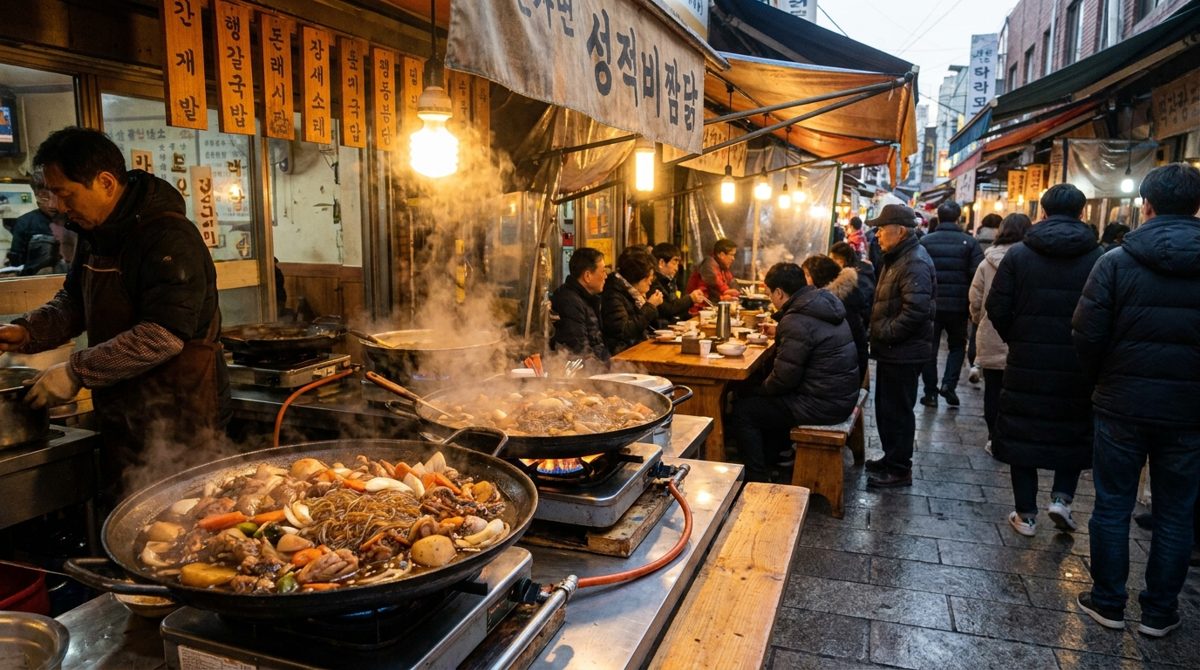
Jjimdak has one of Korean food’s best origin stories, and it’s recent. In the 1980s, in the “chicken alley” (dakgolmok) of Andong Old Market in Gyeongsangbuk-do province, chicken vendors faced a crisis: Western-style fried chicken was stealing their customers. Their counterattack was economic genius — braise the chicken in sweet soy sauce and stretch it with potatoes, carrots, and cheap glass noodles, creating a platter that fed a whole table for the price of one fried bird.
It worked spectacularly. Students spread the word, franchises carried it to Seoul in the early 2000s, and today “Andong jjimdak” is a national dish with the market alley still operating as its living shrine. The name is simple: jjim (braised or steamed) + dak (chicken). Despite the “steamed” translation you sometimes see, the dish is braised — simmered in sauce until the chicken is fall-apart tender and the noodles have drunk up everything.
What lands on your table is a mountain: a wide metal platter of bone-in chicken pieces (boneless available), thick-cut potatoes and carrots gone soft in the sauce, onions and scallions, and a tangle of dangmyeon — the same sweet potato glass noodles you’ll meet in japchae — all lacquered in dark, glossy, garlicky soy sauce with whole dried chilies lurking like little warnings.
Jjimdak’s history since then reads like a K-drama: an explosive national boom in the early 2000s, a crash when the fried-chicken-and-beer craze took over, and a steady revival through the 2010s and 2020s as chains modernized the dish with cheese, rosé sauces, and delivery-friendly formats. Today it holds a comfortable place in Korea’s “big platter” food culture — the category of meals you order when the group can’t decide and everyone is hungry.
What Does Jjimdak Taste Like?
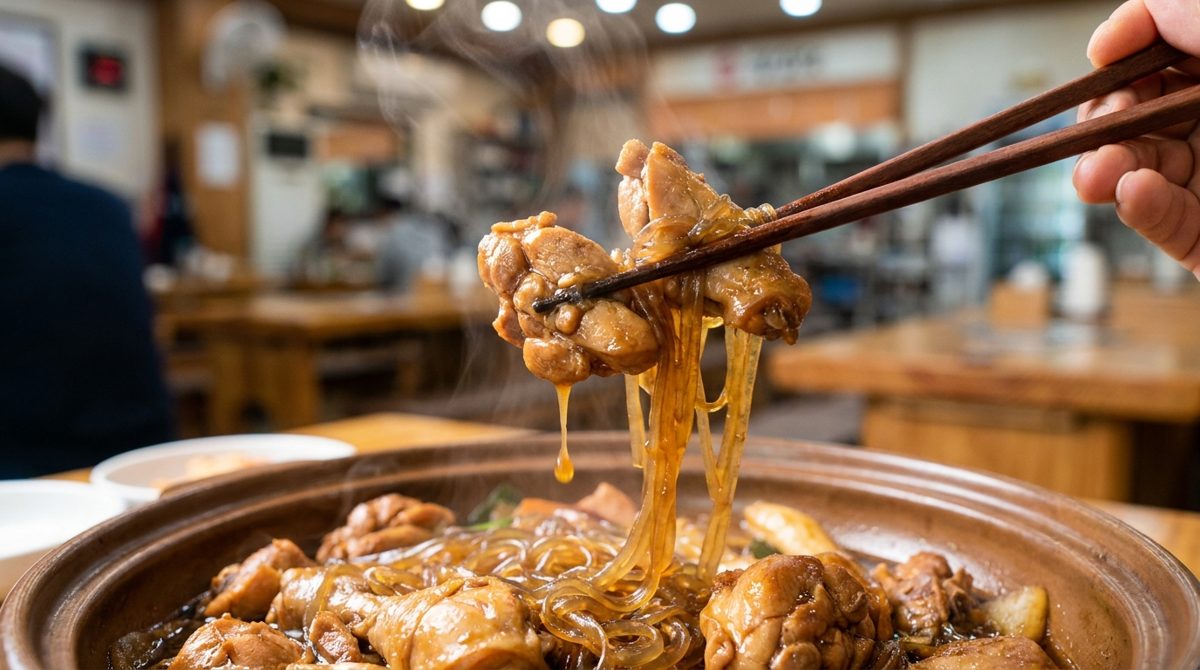
Imagine the sweet-soy-garlic flavor of bulgogi, deepened and darkened, poured over falling-apart chicken — then add a slow-building chili warmth that arrives about three bites in. Jjimdak is sweet first (caramel and sugar in the sauce), savory second (soy, garlic, ginger), and quietly spicy third. The potatoes collapse into the sauce, the carrots turn candy-sweet, and the glass noodles become the best part of the entire dish — chewy, slippery, saturated with everything.
It’s also juicier than it looks. Good jjimdak keeps a pool of sauce at the bottom of the platter, and the dish is engineered around rice: a spoonful of white rice dragged through that sauce is the bite Koreans are actually there for.
How does it compare to its cousins? Against dak-galbi (stir-fried spicy chicken), jjimdak is sweeter, saucier, and gentler — dak-galbi runs on gochujang heat while jjimdak runs on soy and sugar. Against fried chicken, it’s a completely different mood: fork-tender instead of crispy, communal platter instead of finger food. If your table includes one spice-avoider and one heat-seeker, jjimdak ordered mild with a side of chili flakes is the diplomatic solution.
Is Jjimdak Spicy?
Moderately — a genuine 2 out of 5, with an asterisk. The heat comes from dried red chilies (sometimes fierce cheongyang peppers) steeped whole in the braise, so it’s a background warmth rather than a coating of chili paste — but it builds as you eat, and restaurants vary widely. Some family places are nearly mild; some university-district joints bite hard. The good news: it’s fully adjustable. Say “an maepge haejuseyo” (안 맵게 해주세요 — not spicy, please) when ordering, or “deol maepge” (덜 맵게 — less spicy). And never eat the whole dried chilies — they’re seasoning, not garnish for the brave.
Jjimdak Dietary Guide: Vegetarian, Vegan, Halal & Allergens
Jjimdak’s ingredient list is refreshingly short — chicken, vegetables, noodles, soy sauce — but here’s the full allergen map:
| Ingredient concern | In standard jjimdak? | How to handle |
|---|---|---|
| Chicken | Yes — the entire dish | No chicken-free version exists; poultry allergies should skip it |
| Pork | No | Standard recipes contain no pork — a plus for Muslim diners |
| Soy | Yes | The braising sauce is soy-based — unavoidable |
| Wheat / gluten | Yes | Korean soy sauce contains wheat — the glass noodles themselves are gluten-free sweet potato starch |
| Sesame | Usually | Sesame oil and seeds finish the dish — ask to skip the garnish if severe |
| Chili | Yes (mild) | Dried chilies steep in the sauce; order “an maepge” for minimal heat |
| Egg / dairy / nuts | No | Classic recipes contain none — but cheese jjimdak obviously adds dairy |
| Alcohol | Sometimes | Some kitchens splash rice wine (mirim) into the braise — relevant for Muslim diners |
Is Jjimdak Vegetarian or Vegan?
No — and unlike many Korean dishes, there’s no easy workaround. Chicken isn’t a topping here; it’s the structure of the dish, braised into the sauce itself, so “jjimdak without chicken” isn’t something a restaurant can make. Vegetarians eating with a jjimdak-bound group can still do fine: most restaurants serve rice, and the group can order extra noodles and vegetables — but the noodles cook in the chicken braise, so strict vegetarians should eat beforehand or steer the group somewhere with options. For the same glossy soy-noodle satisfaction meat-free, vegetable japchae is the closest legitimate cousin.
Is Jjimdak Halal?
Jjimdak is one of the more halal-friendly mainstream Korean dishes — it’s chicken, contains no pork, and the flavor base is soy rather than anything haram by nature. The honest caveats: the chicken at regular restaurants is not halal-certified, and some kitchens add a splash of rice wine to the braise. Muslim travelers who follow a “no pork, chicken OK” standard eat jjimdak happily all over Korea; those requiring certification should look to halal-certified Korean restaurants (Itaewon in Seoul has several, some serving braised chicken dishes) and the Muslim-friendly listings on VisitKorea. Worth asking at any restaurant: “mirim deureogayo?” (미림 들어가요? — does it contain cooking wine?).
How to Order Jjimdak in Korean (+ 2026 Prices)
Jjimdak is ordered by platter size, not per person — think of it like ordering a pizza:
| What you want | Say this | Romanized |
|---|---|---|
| Medium jjimdak, please | 찜닭 중자 주세요 | jjimdak jung-ja juseyo |
| Not spicy, please | 안 맵게 해주세요 | an maepge haejuseyo |
| Less spicy, please | 덜 맵게 해주세요 | deol maepge haejuseyo |
| Boneless, please | 순살로 주세요 | sunsal-lo juseyo |
| Extra glass noodles | 당면 추가요 | dangmyeon chuga-yo |
What it costs in 2026: a sharing platter runs ₩28,000–₩38,000 and comfortably feeds 2–3 people — small (소) platters at some shops start around ₩26,000, large (대) platters for 4+ reach ₩45,000. Rice is a couple of thousand won per bowl, extra noodles ₩3,000–₩4,000, and cheese toppings ₩3,000–₩5,000. Split three ways with rice, jjimdak lands near ₩12,000 per person — solid value for the amount of food, and cheaper per head than most Korean barbecue nights.
How to Eat Jjimdak Like a Local
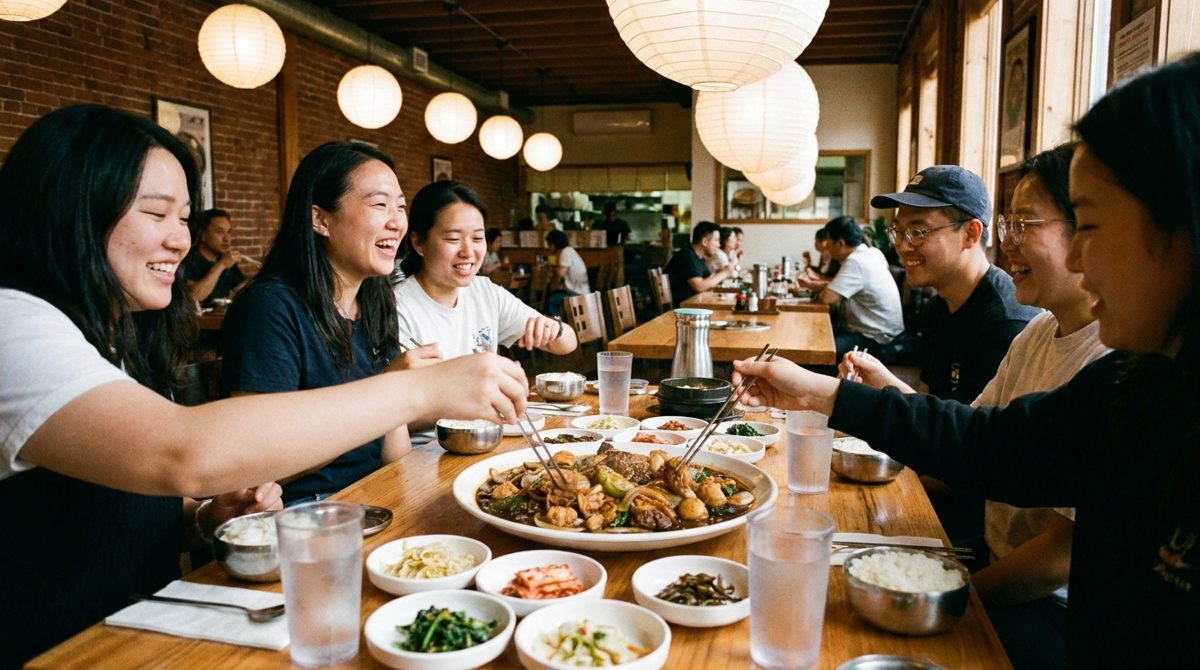
The platter lands in the middle of the table with tongs and scissors — communal dish rules apply. Someone (often staff) snips the chicken into manageable pieces; everyone serves themselves onto small plates. Go for the glass noodles early: they’re finite, they’re the best part, and they keep absorbing sauce as they sit. Leaving your share of noodles unclaimed is how friendships are tested in Korea.
Order one bowl of rice per person and treat the sauce as the point. The Korean move is a spoonful of rice dipped into the pooled sauce at the platter’s edge — or, at the end, asking for bokkeumbap if the restaurant offers it: leftover sauce fried with rice into a crusty, glorious finale. Beer or soju is the standard companion; the sweet-spicy sauce was practically designed for it.
Pace yourself and mind the bones. Traditional jjimdak is chopped bone-in — flavor-superior but chopstick-intensive — and there’s a small dish on the table for discards. If your group prefers easy eating, boneless (sunsal) costs a little more and nobody judges. For the wider rules of shared Korean tables, our dining etiquette guide has you covered.
Types of Jjimdak You’ll See on Menus
Andong jjimdak (안동찜닭) — the original: soy-sweet, bone-in, dried-chili warmth, glass noodles. What you get when the menu says only “jjimdak.” Maeun jjimdak (매운찜닭) — the spicy version, loaded with cheongyang chilies; a genuine 4/5 at aggressive shops. Cheese jjimdak (치즈찜닭) — a molten mozzarella blanket over the top; the university-district favorite, and honestly great with the sweet sauce. Sunsal jjimdak (순살찜닭) — boneless, for easy group eating. Rosé and cream variants — trendy chains stir in cream or rosé sauce; delicious, unrecognizable to an Andong grandmother. Some restaurants also braise in abalone, octopus, or perilla-seed variations. And if you love the flavor but want a solo-sized version, look for jjimdak-deopbap — a one-person rice bowl at lunch spots.
Where to Try Jjimdak
The pilgrimage is real: Andong Old Market’s jjimdak alley, where dozens of restaurants cook the dish in a steamy covered arcade, remains the definitive experience — pair it with the UNESCO-listed Hahoe Folk Village and you have one of Korea’s best day trips. In Seoul, jjimdak chains and independents cluster in every university district — Sinchon, Hongdae, Konkuk — where the platters are big and the prices student-honest. Franchises like the big Andong-style chains are reliably good, and their picture menus make ordering painless. If you’re deciding between Korea’s two great chicken experiences, the braised-vs-fried question deserves both answers — see our Korean fried chicken guide for the other side of the debate, and samgyetang for the gentle, soupy third path.
Planning the Andong trip properly: trains from Seoul’s Cheongnyangni station reach Andong in under three hours, and the market alley sits a short taxi ride from the station. Restaurants there serve the classic version — usually bigger, cheaper, and less sweet than Seoul franchise versions — and most have been run by the same families for decades. Go at lunch, order the medium platter between two people, and leave room for a walk through the old market itself, one of the province’s most atmospheric.
Final ordering wisdom: portion sizes are genuinely huge, so resist over-ordering on the first visit — a medium platter plus rice defeats most trios. If your group has a big appetite anyway, add extra noodles rather than a bigger platter; they’re the first thing to vanish and the cheapest thing to replenish.
Jjimdak FAQ
What does jjimdak mean in English?
“Braised chicken” — jjim (찜) refers to braising or steaming, dak (닭) means chicken. The full name Andong jjimdak credits the city of Andong, where market chicken vendors invented the dish in the 1980s.
Is jjimdak spicy?
Mildly — about 2 out of 5. The sauce is sweet-soy first, with a slow warmth from whole dried chilies rather than chili paste. Heat varies by restaurant and is fully adjustable: say “an maepge haejuseyo” for a non-spicy version, or order the maeun (spicy) version if you want real fire.
How many people does one jjimdak feed?
A standard platter (₩28,000–₩38,000 in 2026) feeds 2–3 people with rice. Larger platters serve 4+. It’s ordered by size like a pizza, not per person — solo diners should look for jjimdak-deopbap rice bowls instead.
Is jjimdak halal?
It’s relatively halal-friendly — chicken-based with no pork — but not certified at regular restaurants, and some kitchens add rice wine to the sauce. Muslim travelers requiring certification should choose halal-certified Korean restaurants; others commonly eat it after confirming no cooking wine.
What are the noodles in jjimdak?
Dangmyeon — Korean glass noodles made from sweet potato starch, the same noodles used in japchae. They’re naturally gluten-free (though the soy sauce isn’t) and prized for soaking up the braising sauce while staying chewy.
The Verdict: Should You Order It?
If you’re two or more people, absolutely — jjimdak might be Korea’s best-value group dinner: an enormous, glossy, sweet-savory platter with just enough chili to feel adventurous and glass noodles worth fighting over. Order it mild on your first round, claim your noodles early, and save room for sauce-fried rice. It’s also the perfect bridge dish: one step spicier than bulgogi, ten steps friendlier than fire-level Korean food. Hungry for the next dish? Decode the whole menu with our Korean Food Decoder — every major Korean dish explained with spice levels, allergens, and ordering phrases.