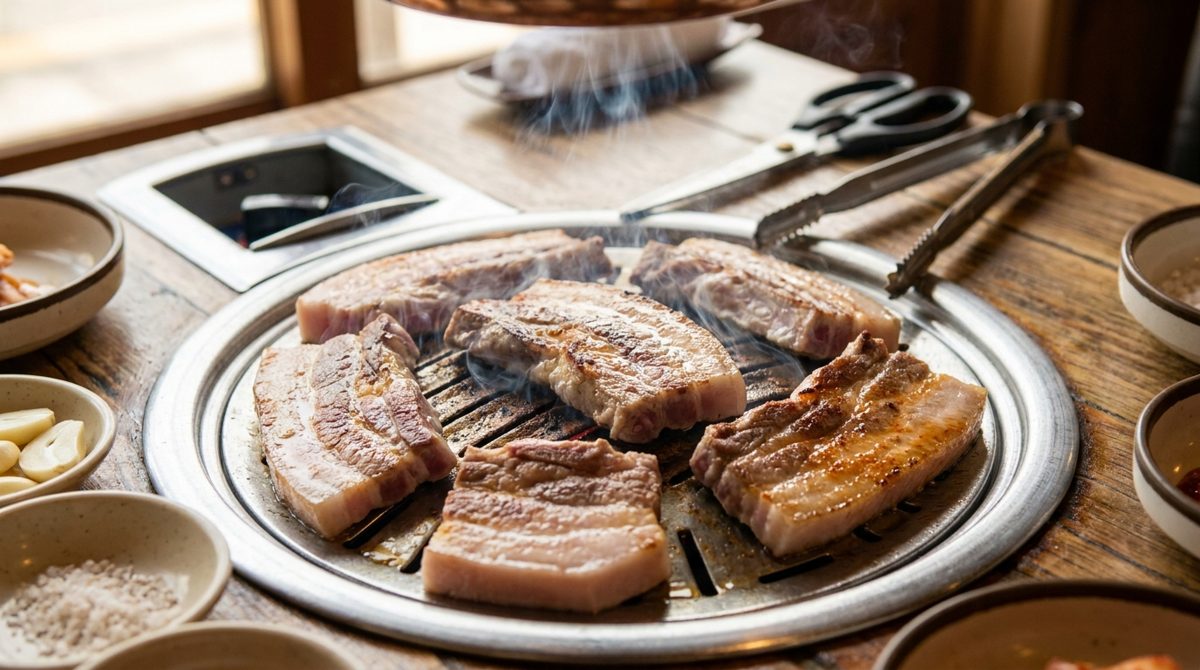
Standing in front of a smoking tabletop grill wondering what samgyeopsal actually is? Samgyeopsal (삼겹살) is Korea’s most iconic grilled dish: thick, unseasoned slices of pork belly cooked right at your table, then wrapped in lettuce with garlic, ssamjang paste, and grilled kimchi. It’s the centerpiece of Korean BBQ culture, best shared with friends over soju. This decoder page covers taste, spice level, allergens, halal and vegetarian answers, real 2026 prices, and exactly how to order it in Korean.
Table of Contents
- Samgyeopsal Quick Facts
- What Is Samgyeopsal, Exactly?
- What Does Samgyeopsal Taste Like?
- Dietary Guide: Vegetarian, Vegan, Halal & Allergens
- How to Order Samgyeopsal in Korean (+ 2026 Prices)
- How to Eat Samgyeopsal Like a Local
- Types of Samgyeopsal
- Where to Try Samgyeopsal
- Samgyeopsal FAQ
Samgyeopsal Quick Facts
| Item | Details |
|---|---|
| Korean name | 삼겹살 (samgyeopsal) — “three-layer flesh,” referring to pork belly’s alternating fat and meat layers |
| Pronunciation | sahm-gyup-sal |
| Type | Thick-cut pork belly, grilled tableside on a DIY tabletop grill |
| Spice level | 🌶️ 1/5 standard — dipping sauces (ssamjang) are mild; spicy gochujang-marinated variants run 🌶️ 3/5 |
| Price (2026) | ₩16,000–₩22,000 per 200g serving in Seoul; ₩24,000+ in touristy Hongdae or Gangnam |
| Vegetarian | ❌ No — it’s grilled pork belly, meat is the entire dish |
| Vegan | ❌ No |
| Halal-friendly | ❌ No — samgyeopsal is pork and is not halal, full stop |
| Main allergens | Soy (ssamjang), sesame, sometimes shellfish (in certain dipping sauce variants) |
| Best for | Groups, first-timers wanting classic Korean BBQ, soju-and-dinner nights out |
What Is Samgyeopsal, Exactly?
Samgyeopsal is Korea’s national comfort food for going out to eat with friends. The name literally means “three layers of flesh,” describing the way pork belly stacks fat and meat in alternating bands. Unlike thin bulgogi-style barbecue, samgyeopsal is cut thick — often 1–1.5cm — and served completely unmarinated, so the meat’s own flavor and rendered fat do all the work once it hits the grill.
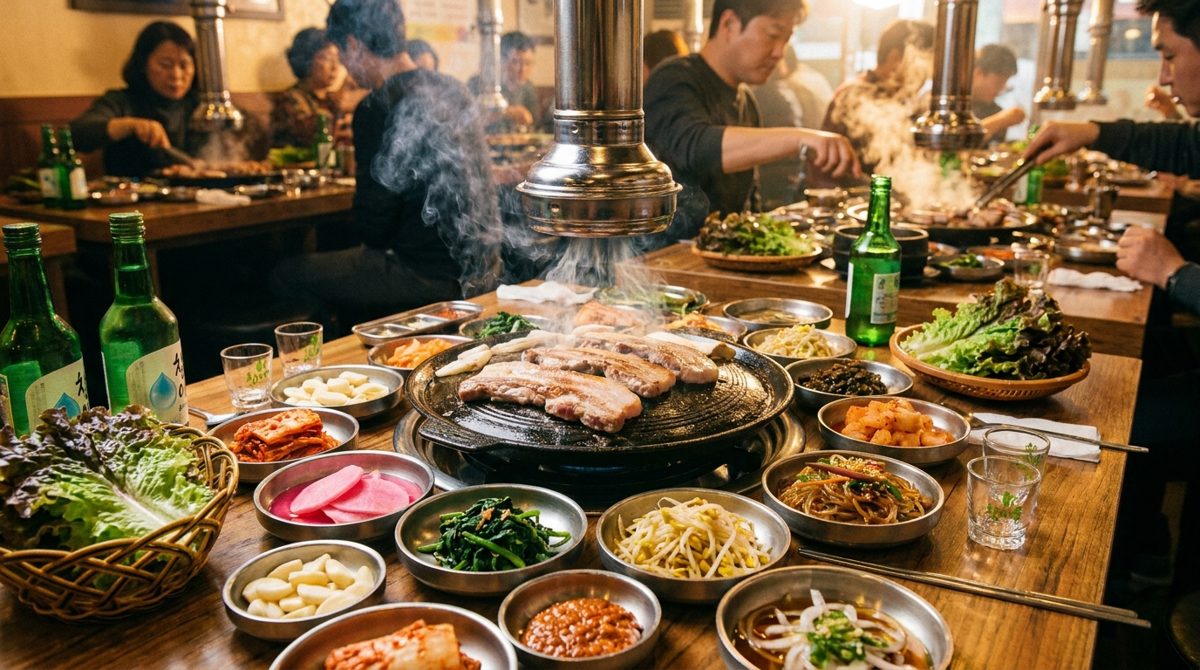
The dish exploded in popularity in Korea during the 1970s and 80s as an affordable, filling protein for factory workers and office employees, and it has stayed the default “let’s go eat meat” order ever since. Every table gets its own built-in or portable grill, usually staffed by servers who flip and cut the meat for you (though DIY grilling is completely normal too). It pairs so naturally with soju that “samgyeopsal-e-soju” (pork belly with soju) is practically its own cultural phrase in Korea.
Mapo, a district on the western side of Seoul, holds a special place in samgyeopsal history — it’s widely cited as the neighborhood where the grilled pork belly craze first took hold in the postwar decades, and streets of long-running “Mapo grilled pork belly” restaurants still draw loyal regulars today. The tabletop grill itself standardized in the 1980s, when gas and electric grills replaced older charcoal braziers and let restaurants seat and serve far more tables at once — a shift that turned samgyeopsal from a working-class staple into the default night-out meal for office teams, friend groups, and families alike.
Today samgyeopsal restaurants — samgyeopsal-jip — line nearly every commercial street in the country, from ₩16,000 neighborhood joints to upscale hanwoo-adjacent grill houses. It’s also the go-to dish for hoesik, the Korean tradition of company dinners, where teams gather after work to grill, drink, and bond over a shared table. For more on the wider genre this dish anchors, see the Korea Tourism Organization’s overview of Korean barbecue culture, or read up on the broader dish family on Wikipedia’s Korean barbecue page.
What Does Samgyeopsal Taste Like?
Plain grilled samgyeopsal tastes rich, savory, and faintly sweet from caramelized fat — closer to good bacon than to a lean pork chop, but with a crisper, more charred exterior and a juicier interior. The fat renders as it grills, basting the meat and turning the edges deeply golden and slightly crackling. On its own it’s simple and a little heavy; wrapped in lettuce with garlic, ssamjang, and a scrap of grilled kimchi, it becomes a full flavor bomb — salty, savory, garlicky, and bright all at once.
Texture is half the appeal. A well-grilled slice has three distinct layers in one bite: a crisp, almost cracklinglike edge, a tender fatty middle that nearly melts, and a firmer meaty band underneath. This is a genuinely fatty, calorie-dense dish — closer to indulgent comfort food than a light meal — so don’t expect a lean protein experience. Diners who prefer less fat can ask for moksal (pork shoulder) instead, grilled on the same table alongside the belly.
Is Samgyeopsal Spicy?
Not by default. Plain samgyeopsal has zero built-in heat — the meat itself carries no chili at all, and ssamjang, the standard dipping paste, is savory and only mildly spicy (mostly soybean and gochujang blended together, more umami than fire). Most travelers rate a standard samgyeopsal meal about 1 out of 5 on spice. That said, many restaurants also offer a gochujang-marinated version (called maeun samgyeopsal or gochujang samgyeopsal), which is genuinely spicy — around 3 out of 5 — and pairs the same fatty pork belly with a fiery red chili glaze. If you want zero heat, just order the plain version and skip the ssamjang.
Samgyeopsal Dietary Guide: Vegetarian, Vegan, Halal & Allergens
Samgyeopsal is one of the least flexible dishes on the Korean menu for dietary restrictions — it’s built entirely around one ingredient, and that ingredient is pork. It’s also genuinely rich: a full serving is high in fat and calories, so travelers watching those numbers should treat it as an occasional indulgence rather than a daily meal.
| Ingredient concern | In standard samgyeopsal? | How to handle |
|---|---|---|
| Pork | Yes — it’s the entire dish | No substitution exists; this is not a dish you can “order around” |
| Beef | No | N/A — some grill houses offer beef options on the same menu, ordered separately |
| Soy | Yes, in ssamjang | Ask for the meat without sauce: “ssamjang ppaego juseyo” (쌈장 빼고 주세요) |
| Sesame | Yes | Sesame oil and seeds appear in ssamjang and salt-oil dips |
| Shellfish / fish | Occasionally | Some restaurants’ dipping sauces include shrimp paste or anchovy; ask staff if unsure |
| Wheat / gluten | Sometimes | Commercial ssamjang and some marinades may contain wheat; ask for sauce on the side |
| Alcohol | Not in the food itself | Soju is a cultural pairing, not an ingredient — you can decline it entirely |
| Dairy / nuts | No | Traditional samgyeopsal contains neither |
Is Samgyeopsal Vegetarian or Vegan?
No, and there’s no workaround. Samgyeopsal isn’t a meat-topped dish you can ask to have “without the meat” — the pork belly is the entire point, and removing it leaves nothing. Vegetarian and vegan travelers should skip this dish entirely rather than try to modify it. If you’re at a Korean BBQ restaurant with a mixed group, ask about grilled mushrooms, tofu, or grilled vegetable side plates, which many samgyeopsal-jip offer as accompaniments — but treat those as separate orders, not substitutes. For a genuinely vegetarian-friendly Korean classic instead, bibimbap can be made meat-free with one simple request.
Is Samgyeopsal Halal?
No. Samgyeopsal is pork, and pork is not halal under any interpretation — there is no halal version of this dish, no substitution, and no workaround. Be direct with yourself about this if you’re keeping halal: skip samgyeopsal entirely rather than looking for a “halal-friendly” angle, because none exists for a pork-belly dish.
If you came to Korea wanting the tabletop-grill, wrap-it-in-lettuce experience without pork, the closest cultural equivalents are chicken-based: dak-galbi (spicy stir-grilled chicken) or samgyetang (ginseng chicken soup) both deliver a similar communal, meat-forward Korean meal. Neither is automatically halal-certified either — standard Korean chicken isn’t slaughtered under halal procedure by default — so for genuinely halal-certified Korean food, seek out one of the certified Korean or Korean-Muslim restaurants concentrated in Seoul’s Itaewon district, and check current certification listings via the Korea Tourism Organization’s Muslim-friendly travel resources before you go.
How to Order Samgyeopsal in Korean (+ 2026 Prices)
Ordering samgyeopsal is easy even with zero Korean — most grill houses have photo menus and staff who are used to foreign guests. But a few phrases go a long way, especially since servers often grill the first batch for you.
| What you want | Say this | Romanized |
|---|---|---|
| Samgyeopsal for two, please | 삼겹살 이인분 주세요 | samgyeopsal i-in-bun juseyo |
| Spicy marinated version | 매운 삼겹살 주세요 | maeun samgyeopsal juseyo |
| Can you grill it for us? | 구워 주세요 | guwo juseyo |
| Sauce on the side / no sauce | 쌈장 빼고 주세요 | ssamjang ppaego juseyo |
| More lettuce, please | 상추 더 주세요 | sangchu deo juseyo |
What it costs in 2026: a standard 200g serving of samgyeopsal runs ₩16,000–₩22,000 at a typical Seoul grill house, usually ordered in units (“in-bun”) per person. Tourist-heavy neighborhoods like Hongdae, Myeongdong, or Gangnam frequently charge ₩24,000 or more per serving. Rice, soup, and banchan side dishes are usually included or come as free, refillable extras — see our Korean dining etiquette guide for how the shared side-dish system works.
How to Eat Samgyeopsal Like a Local
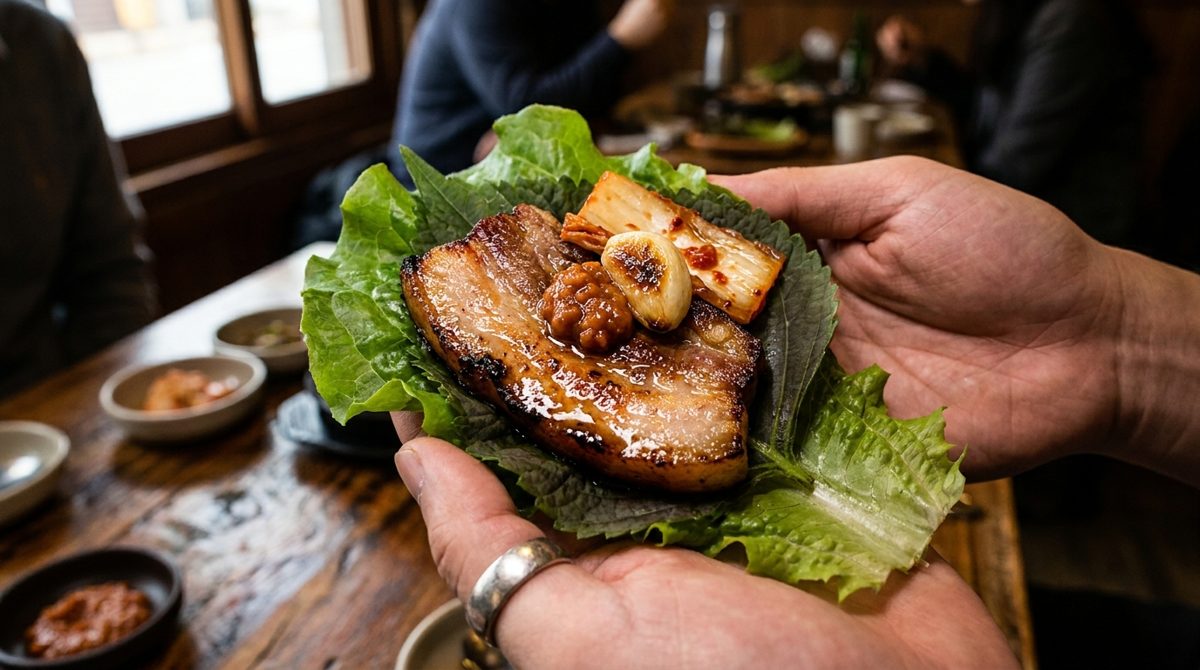
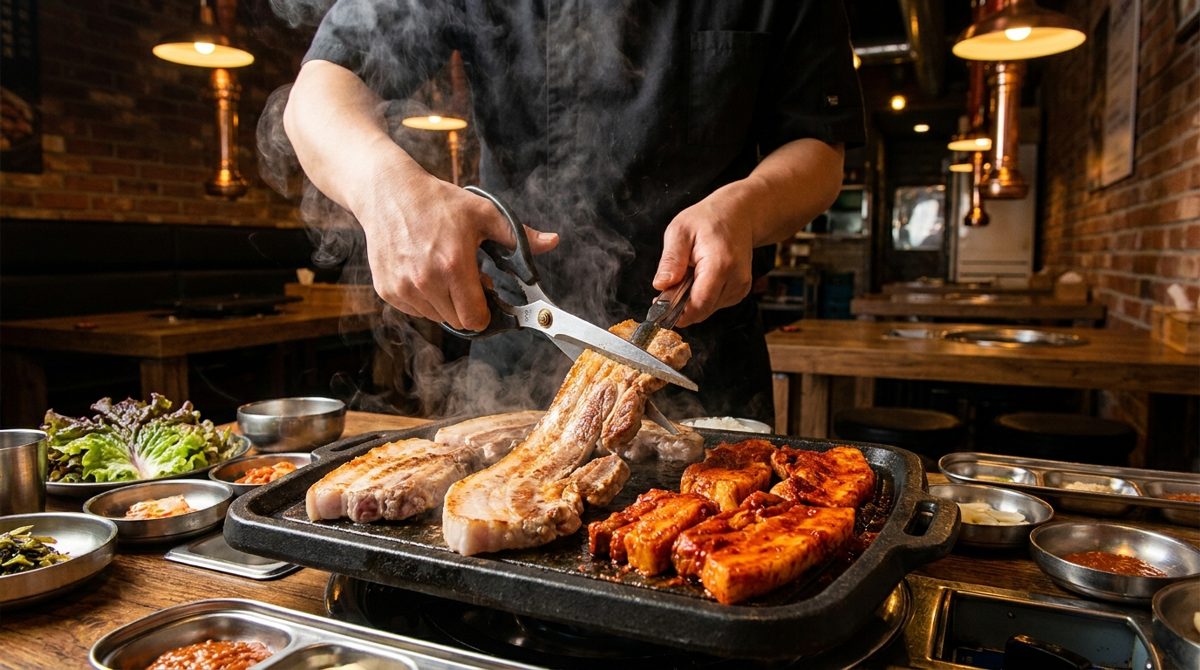
Don’t touch the grill or flip the meat yourself if a server is doing it — that’s their job, and they’ll cut it into bite-sized pieces with scissors once it’s cooked through (pork must be fully cooked, never pink in the middle). Once a piece is ready, grab a lettuce or perilla leaf, add a slice of meat, a smear of ssamjang, a sliver of raw garlic, and a piece of grilled kimchi or onion, then fold it into a single bite — this bundle is called ssam, meaning “wrapped.”
Eat the whole ssam in one bite; it’s considered normal (even expected) to open your mouth wide rather than nibble it apart. Pace yourself — meat keeps coming in batches, and the grill stays hot the whole meal. Soju is the traditional pairing, but plenty of locals order it with beer, makgeolli, or just water. At the end, many restaurants fry rice directly in the leftover pork fat on the same grill (bokkeumbap) — always say yes if it’s offered; it’s often the best part of the meal.
A few small habits mark you as someone who’s done this before. Don’t pile too much raw meat on the grill at once — order and cook in smaller batches so nothing overcooks while you eat. Let the server (or the most experienced person at your table) handle flipping and cutting if they offer; it’s a courtesy, not a judgment of your grilling skills. And don’t be shy about asking staff to swap the grill plate if it gets too charred and black — a fresh plate is a normal, expected request, not an imposition.
Types of Samgyeopsal You’ll See on Menus
Saeng-samgyeopsal (생삼겹살) — the classic plain, unmarinated version; the default order and the best way to judge quality. Maeun / gochujang samgyeopsal (매운/고추장 삼겹살) — the same cut marinated in a spicy gochujang glaze before grilling, noticeably hotter and slightly sweet. Ogyeopsal (오겹살) — a five-layer cut that includes the skin, chewier and fattier, popular with locals who want extra texture. Moksal (목살) — pork shoulder/neck, leaner than belly and often grilled alongside samgyeopsal as a lighter option. Wine or herb-marinated samgyeopsal — a milder, slightly sweet variant found at higher-end grill houses, sometimes aged in wine or fruit juice to tenderize the meat.
Two more distinctions worth knowing before you order. Fresh (생) versus frozen (냉동): better restaurants advertise “saeng-gogi” (fresh, never-frozen meat), which is thicker-cut and noticeably juicier than the thinner frozen pork belly served at budget chains — expect to pay a bit more for it. Charcoal versus gas grilling: charcoal-grilled samgyeopsal (숯불구이) adds a smoky depth that gas grills can’t replicate and is often marketed as a specialty; it typically costs a few thousand won more per serving but is worth seeking out at least once.
Where to Try Samgyeopsal
Samgyeopsal is everywhere, and quality is remarkably consistent because it’s such a well-understood dish — but neighborhood grill houses away from major tourist strips generally offer the best value and thicker cuts. Look for restaurants where locals are eating (a packed room at 7pm is a good sign) rather than the flashiest storefront on a main tourist street. Seoul neighborhoods like Mapo, Yeonnam-dong, and the areas around Konkuk University are known locally for dense clusters of long-running grill houses, often cheaper and better than the big tourist-district branches near Hongdae or Myeongdong.
If you’re new to the tabletop-grill mechanics — how to work the grill, what to order alongside the meat, timing your batches — our Korean BBQ samgyeopsal beginner’s guide walks through the whole process step by step, and the broader Korean BBQ guide covers other cuts and restaurant etiquette worth knowing before your first visit.
Samgyeopsal FAQ
What does samgyeopsal mean in English?
“Three-layer flesh.” It describes the visible alternating bands of fat and meat in pork belly, which is exactly the cut used for this dish.
Is samgyeopsal the same as bacon?
Related but different. Both come from pork belly, but samgyeopsal is cut much thicker (1–1.5cm vs. bacon’s thin slices), served unsmoked and unmarinated, and grilled fresh at the table rather than cured or fried in advance.
Is samgyeopsal spicy?
No, not by default. Standard grilled samgyeopsal carries zero built-in heat, and the usual ssamjang dip is mild and savory rather than fiery. A separate gochujang-marinated version exists for those who want spice, rated around 3 out of 5.
Is samgyeopsal halal?
No. Samgyeopsal is pork belly, and pork is never halal under any circumstance. There is no halal version of this specific dish — Muslim travelers should choose a different Korean dish entirely, such as dak-galbi or samgyetang, ideally from a certified halal restaurant.
How much does samgyeopsal cost in Korea in 2026?
₩16,000–₩22,000 per 200g serving at a typical Seoul grill house, with tourist-district restaurants in areas like Hongdae or Gangnam often charging ₩24,000 or more for the same portion.
The Verdict: Should You Order It?
Yes — if you eat pork, samgyeopsal is close to mandatory for a first Korean trip. It’s social, interactive, affordable for what you get, and delivers the full tabletop-grill experience that defines Korean dining out. Bring a group, order a round of soju, and don’t skip the fried rice at the end. Hungry for the next dish? Decode the whole menu with our Korean Food Decoder — every major Korean dish explained with spice levels, allergens, and ordering phrases.