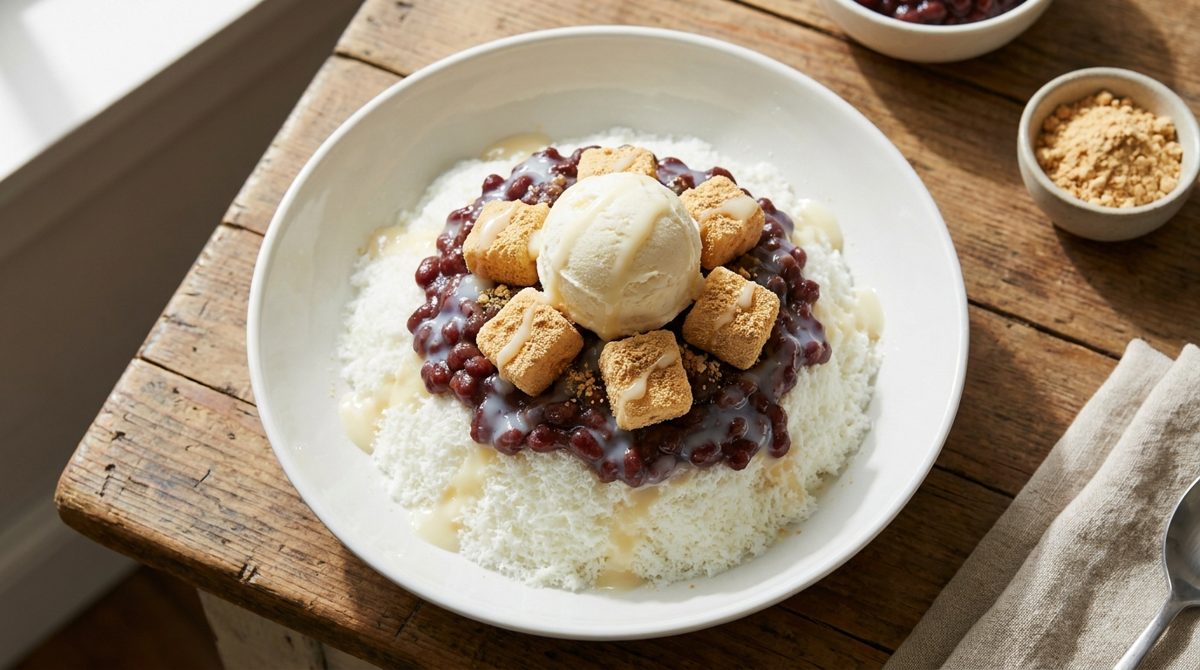
Sweating through a Seoul summer and wondering what bingsu actually is? Bingsu (빙수) is Korea’s signature shaved ice dessert: a mountain of ultra-fine, milk-based shaved ice topped with condensed milk, sweet red beans, chewy rice cake, and often fresh fruit — built to be shared with a spoon by two or three people. It’s cold, creamy, only mildly sweet, and the single best answer to Korean humidity. This decoder page covers taste, price, dietary rules, halal status, and exactly how to order it in Korean.
Table of Contents
- Bingsu Quick Facts
- What Is Bingsu, Exactly?
- What Does Bingsu Taste Like?
- Dietary Guide: Vegetarian, Vegan, Halal & Allergens
- How to Order Bingsu in Korean (+ 2026 Prices)
- How to Eat Bingsu Like a Local
- Types of Bingsu
- Where to Try Bingsu
- Bingsu FAQ
Bingsu Quick Facts
| Item | Details |
|---|---|
| Korean name | 빙수 (bingsu) — “ice water”; classic version is 팥빙수 (patbingsu, “red bean shaved ice”) |
| Pronunciation | BEENG-soo (pat-BEENG-soo for the red bean version) |
| Type | Shared shaved-ice dessert |
| Spice level | 🌶️ 0 / 5 — not spicy at all |
| Price (2026) | ₩9,000–₩18,000 depending on toppings and size; trendy fruit bingsu at specialty cafes ₩22,000+ (usually built for 2–3 people to share) |
| Vegetarian | ✅ Most versions are fully vegetarian |
| Vegan | ⚠️ Classic bingsu ice and condensed milk are dairy-based — ask for a fruit-only or non-dairy version |
| Halal-friendly | ✅ Generally halal-friendly — the only caution is rare trendy cafes adding alcohol-based liqueur toppings |
| Main allergens | Dairy (milk ice, condensed milk), gluten (injeolmi rice cake, cookie toppings), nuts (some topping mixes) |
| Best for | Sharing, hot summer afternoons, dessert after a spicy meal or Korean BBQ |
What Is Bingsu, Exactly?
Bingsu literally means “ice water” — bing (ice) + su (water) — but modern bingsu is nothing like a snow cone. Korean cafes freeze milk into blocks, then shave it into snow-fine ribbons so light and airy they almost melt on contact. That milk-ice base is the real innovation: it’s what makes Korean bingsu creamier and less icy than shaved-ice desserts elsewhere in Asia.
The dessert has roots going back to the Joseon Dynasty, when palace ice houses stored winter ice for royal use in summer — early bingsu was simply shaved ice with fruit for the elite. The modern patbingsu (red bean version) took shape in the 20th century and became a nationwide summer ritual, sold everywhere from convenience stores to five-star hotel lobbies.
Today’s bingsu scene has split into two worlds: the nostalgic classic (patbingsu with red beans and rice cake) and an explosion of trendy variations — mango, injeolmi, chocolate, cheesecake, even coffee bingsu — competing for Instagram attention in Seoul’s cafe districts. If you want the full rundown of every popular style and where locals rank them, our Korean bingsu guide goes deeper on flavor trends; this page is your quick-reference decoder.
The machinery matters more than you’d think. Proper bingsu shops use dedicated ice-shaving machines that shear a frozen milk block into ribbons thinner than shredded paper — far finer than the crushed ice used in slushies or Southeast Asian shaved-ice desserts. This is why a good bowl of bingsu looks like fresh snow rather than an icy gravel pile, and why the best versions barely need chewing before they dissolve. Cafes that skip the milk-ice step and just shave frozen water are considered a lesser, budget version by most Koreans.
Bingsu also has a clear seasonal identity. It used to be a strictly summer-only treat, appearing on menus around May and vanishing by September. That’s changed — specialty dessert cafes and hotel lounges now serve bingsu year-round, and winter bingsu (often paired with hot tea) has become its own small trend. Still, peak bingsu season in Korea runs June through August, when lines form outside popular cafes on the hottest afternoons.
What Does Bingsu Taste Like?
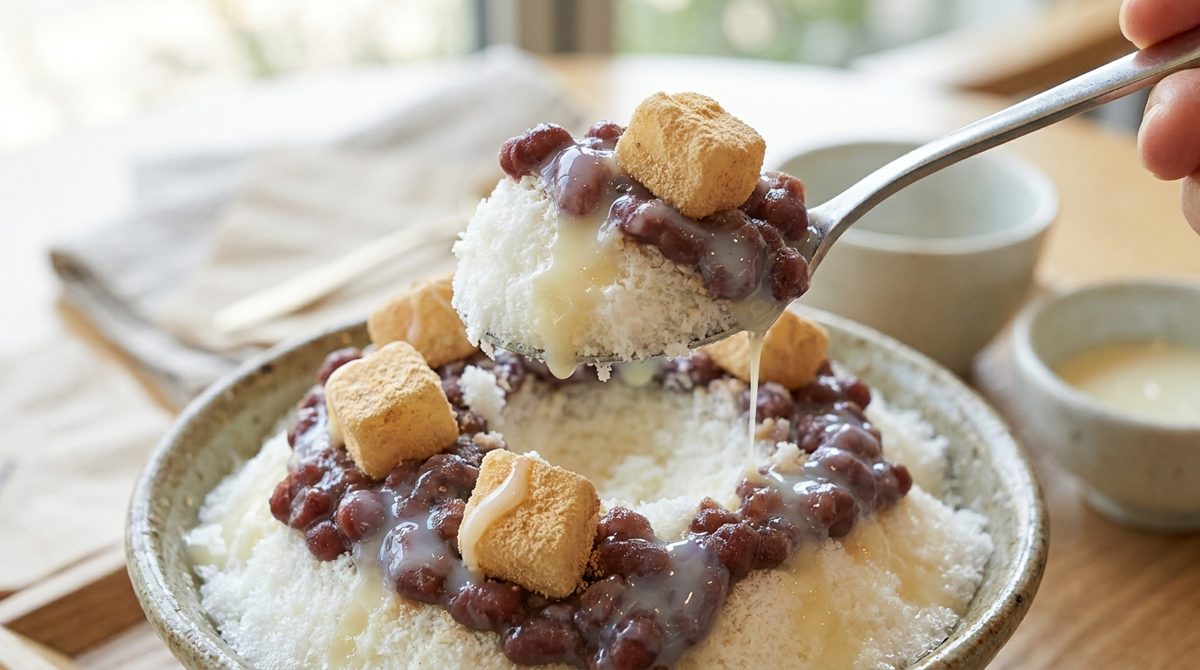
Bingsu tastes gently sweet, milky, and cold — never sharp or icy the way a slushie is. The shaved milk ice practically dissolves on the tongue, condensed milk adds rich sweetness, and red beans bring a mild, earthy sweetness with a slightly grainy bite. Injeolmi rice cake cubes add a chewy contrast, and toasted soybean powder (if included) tastes nutty, almost like roasted grain. Nothing about it is intense — it’s a dessert built for balance, not sugar shock.
Texture is really the point of the whole experience. A single spoonful can carry four or five different sensations at once: the near-instant melt of the ice, the soft give of a red bean, the stretchy chew of rice cake, and a light crunch if cereal, nuts, or cookie crumble are part of the topping mix. Trendy versions push this further — mango bingsu adds juicy fruit bursts, cheese bingsu adds a light savory tang against the sweetness, and choco bingsu leans into fudgy richness. Whatever the flavor, the shaved ice base stays the unifying constant.
Is Bingsu Spicy?
No — bingsu has zero spice. It’s one of the mildest, most universally likable dishes in this whole decoder series, which is exactly why it’s the go-to dessert after a fiery bowl of tteokbokki or a smoky night of Korean BBQ. If anything, bingsu can feel almost too subtle to travelers used to heavily sweetened Western desserts — Koreans generally prefer their sweets restrained rather than sugary.
Bingsu Dietary Guide: Vegetarian, Vegan, Halal & Allergens
Bingsu is one of the easiest Korean dishes for travelers with dietary restrictions — no meat, no seafood, no spice — but dairy and gluten need a second look. Compared to meat-heavy Korean staples like samgyeopsal or seafood dishes, bingsu is refreshingly low-risk, and most restrictions come down to just two ingredients: milk and rice cake.
| Ingredient concern | In standard bingsu? | How to handle |
|---|---|---|
| Meat / poultry | Never in standard recipes | No action needed |
| Seafood | Never | No action needed |
| Egg | Rarely (some cake-topped versions) | Check toppings if cake or custard is added |
| Dairy | Yes — the ice itself is frozen milk, plus condensed milk drizzle | Ask for “uyu ppaego” (milk-free) fruit-ice versions, though these are less common |
| Gluten / wheat | Often, via injeolmi rice cake and cookie toppings | Injeolmi is rice-based but some brands add wheat starch; ask staff or choose fruit-only bingsu |
| Nuts | Sometimes, in granola or nut-topping mixes | “Gyeonkwaryu ppaego juseyo” (no nuts) — always double-check specialty toppings |
| Soy | Yes, in toasted soybean powder (injeolmi coating) | Ask for it on the side or skip the powder |
| Alcohol | Rare — only at trendy specialty cafes with liqueur-infused toppings | Ask “sul deureoganayo?” (does this contain alcohol?) if trying a novelty flavor |
Is Bingsu Vegetarian or Vegan?
Bingsu is vegetarian-friendly by default — there’s no meat, fish, or animal-derived seasoning in any standard recipe, classic or trendy. Vegans need to plan a little more: the shaved ice itself is usually a frozen milk base, and condensed milk is a core topping, so most bingsu on a menu is not vegan as served. Some cafes now offer oat-milk or fruit-puree-based ice specifically for vegan customers — ask “biegan beoljeoni isseoyo?” (do you have a vegan version?) before ordering, or choose a pure fruit bingsu (mango or strawberry) and request no condensed milk drizzle.
Is Bingsu Halal?
Bingsu is generally halal-friendly. The base ingredients — milk, ice, red beans, rice cake, and fruit — contain no pork and no alcohol in the standard recipe, making it one of the safer dessert choices for Muslim travelers in Korea. The one thing to watch for: a small number of trendy dessert cafes add liqueur-soaked fruit or alcohol-based syrup to specialty bingsu flavors (rum-raisin or wine-fruit varieties occasionally show up on seasonal menus). When in doubt, ask “i-geo sul deureoisseoyo?” (does this have alcohol in it?) before ordering an unfamiliar flavor, or stick to classic patbingsu and mango bingsu, which are almost never alcohol-adjacent. For halal-certified cafe recommendations, check the Korea Tourism Organization’s listings at VisitKorea.
How to Order Bingsu in Korean (+ 2026 Prices)
Bingsu menus are usually picture-heavy and tourist-friendly, but knowing a few phrases helps, especially since bingsu is almost always meant for a table, not a solo order.
| What you want | Say this | Romanized |
|---|---|---|
| One patbingsu, please | 팥빙수 하나 주세요 | patbingsu hana juseyo |
| Mango bingsu, please | 망고빙수 주세요 | manggo-bingsu juseyo |
| Two spoons, please | 숟가락 두 개 주세요 | sutgarak du gae juseyo |
| Is this for sharing? | 이거 나눠 먹는 거예요? | igeo nanwo meokneun geoyeyo? |
| Does this have alcohol? | 이거 술 들어있어요? | igeo sul deureoisseoyo? |
What it costs in 2026: classic patbingsu at a neighborhood cafe or department store food hall runs ₩9,000–₩13,000, usually sized for two people. Fruit-forward and specialty versions (mango, cheese, choco-injeolmi) at trendy cafes run ₩13,000–₩18,000, and premium seasonal fruit bingsu (fresh melon, rare mango varieties) at hotel cafes or destination dessert spots can hit ₩22,000 or more — usually built to share among 2–3 people, so split the bill accordingly. It pairs perfectly as a cooldown after Korean BBQ or a spicy street food crawl.
How to Eat Bingsu Like a Local
Bingsu is a group dessert, not a personal one — Koreans order one big bowl for the table and dig in with multiple spoons at once. Don’t stir it into soup like naengmyeon; instead, scoop from the top down, mixing in condensed milk and toppings gradually as you go so the bottom stays icy longer.
Eat quickly. Bingsu melts fast, especially in summer heat, and the textures you paid for — feathery ice, chewy rice cake — degrade within 15–20 minutes. If you’re with friends, this is part of the fun: bingsu turns into a small friendly race against the clock. Order it as the finale to a meal, never as a starter, since Koreans treat it strictly as dessert.
Splitting the bill is simple etiquette here: since one bowl serves the table, the group usually splits the cost evenly rather than one person paying for a “personal” dessert. If you’re dining solo, check the menu for a single-serving mini bingsu — most trendy cafes now offer a smaller size specifically for one, since the full-size bowl really is built for a group. And don’t be shy about asking staff for extra condensed milk or spoons; refills of both are standard and free at most cafes.

Types of Bingsu You’ll See on Menus
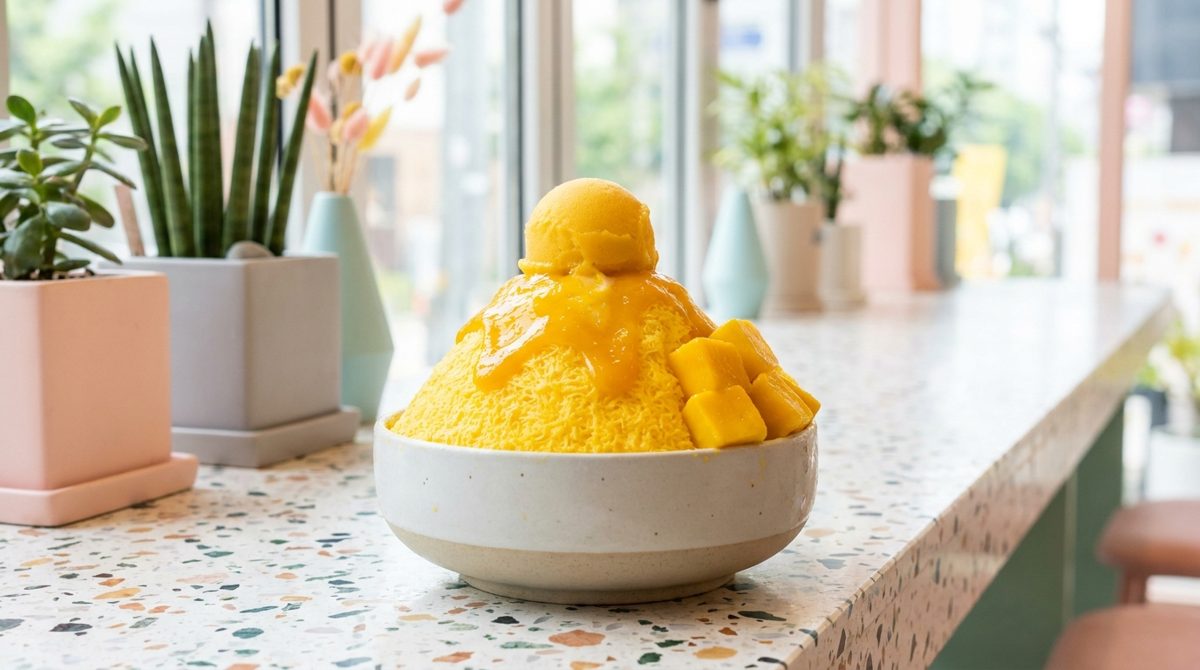
Patbingsu (팥빙수) — the original: red beans, injeolmi rice cake, condensed milk, sometimes a scoop of vanilla ice cream. Mango bingsu (망고빙수) — mango-flavored milk ice topped with fresh mango cubes and mango puree; the most popular modern flavor. Injeolmi bingsu (인절미빙수) — extra rice cake and toasted soybean powder for a nutty, less-sweet profile. Cheese bingsu (치즈빙수) — cream cheese foam and cheesecake crumbles, a trendy cafe favorite. Choco bingsu (초코빙수) — chocolate ice with brownie bites and chocolate syrup, popular with kids and chocolate lovers. Seasonal cafes also rotate melon, strawberry, and yuja (citron) bingsu depending on what fruit is in season.
A few more worth knowing: eoreum bingsu variations at hotel dessert lounges sometimes use pure fruit purée frozen and shaved instead of milk, giving an intensely fruity, dairy-light result closer to sorbet. Green tea (nokcha) bingsu pairs matcha-flavored ice with red bean and a light dusting of powdered tea — a favorite among visitors who find classic patbingsu too sweet. And large chain dessert cafes (a category Korea has plenty of) standardize their bingsu menus nationwide, so the mango bingsu you try in Busan will taste nearly identical to the one in Seoul — useful if you find a flavor you love early in your trip.
Where to Try Bingsu
Bingsu is everywhere in summer — department store food halls, hotel lobby cafes, and neighborhood dessert shops all serve it, and quality is generally reliable no matter where you go. For the classic red bean version, hotel cafes (like those in major Seoul hotels) are famous for their patbingsu, often considered the gold standard by locals — some hotel versions use premium ingredients like Hokkaido red beans and run well above the ₩22,000 mark, positioned as a small luxury rather than a casual snack. For trendy fruit and cheese varieties, look to Seoul’s cafe-dense neighborhoods such as Seongsu, Hongdae, and Garosu-gil, where new flavors debut every season and cafes compete on presentation as much as taste.
Traditional market areas offer a different, cheaper angle: old-school bingsu stalls in places like Gwangjang Market or Namdaemun serve a no-frills version for a fraction of cafe prices, closer to how Koreans ate it decades ago. Convenience stores and ice cream chains also sell mini bingsu cups for under ₩5,000 if you want a quick taste without committing to a full sharing bowl — see our convenience store food guide for picks. For a deeper dive into flavor rankings and specific cafe recommendations across the city, our Korean bingsu guide covers the full 2026 scene in more detail than this decoder page.
Bingsu FAQ
What does bingsu mean in English?
“Ice water” or “shaved ice.” Bing means ice, su means water. The classic version, patbingsu, adds pat (red bean) to the name.
Is bingsu spicy?
No, not at all. Bingsu has zero spice — it’s one of the mildest, most universally easy desserts in Korean cuisine, and a popular cooldown after spicy meals.
Is bingsu vegan?
Not by default. Classic bingsu uses milk-based shaved ice and condensed milk, both dairy. Some cafes offer oat-milk or fruit-only versions on request — ask before ordering if you’re strictly vegan.
Is bingsu halal?
Generally yes. Standard bingsu contains no pork and no alcohol. The only caution is a small number of trendy cafes that add liqueur-based syrups to specialty flavors — ask before ordering an unusual variety, and classic patbingsu or mango bingsu are safe defaults.
How much does bingsu cost in Korea in 2026?
₩9,000–₩13,000 for classic patbingsu at a regular cafe, ₩13,000–₩18,000 for trendy fruit or specialty versions, and ₩22,000+ for premium seasonal fruit bingsu at hotel or destination cafes — most bowls are sized for 2–3 people to share.
The Verdict: Should You Order It?
Yes — bingsu is one of the most refreshing, low-risk desserts you’ll find in Korea. It’s not spicy, not overly sweet, easy to share, and available everywhere from convenience stores to five-star hotels. Bring a friend, order the classic patbingsu first, and eat fast before the magic melts away. Ready to decode more of the menu? Explore the full Korean Food Decoder for every major dish explained with spice levels, allergens, and ordering phrases.