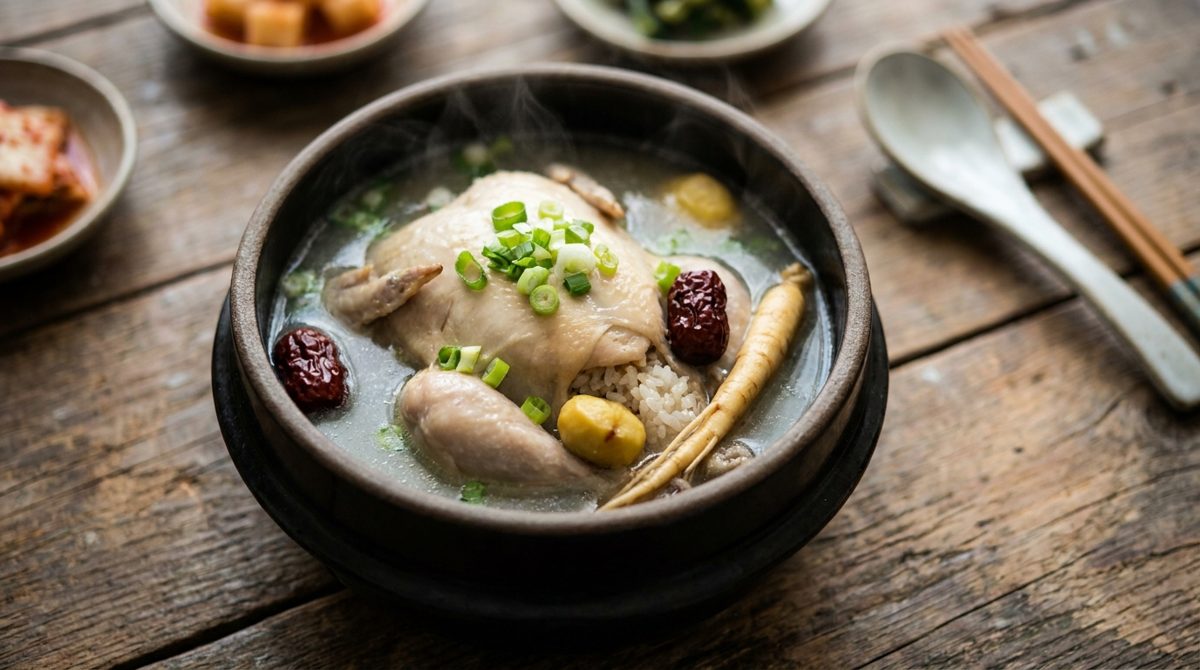
Ordered a whole chicken in a bubbling stone pot and wondering what you just got yourself into? Samgyetang (삼계탕) is Korea’s ginseng chicken soup: a young whole chicken stuffed with glutinous rice, ginseng root, garlic, and jujube, then simmered until the meat falls off the bone in a clear, mild broth. It’s served bubbling-hot in an individual stone pot, and Koreans famously eat it on the hottest days of summer to “fight heat with heat.” This decoder page covers taste, spice level, allergens, halal and vegetarian answers, real 2026 prices, and exactly how to order it in Korean.
Table of Contents
- Samgyetang Quick Facts
- What Is Samgyetang, Exactly?
- What Does Samgyetang Taste Like?
- Dietary Guide: Vegetarian, Vegan, Halal & Allergens
- How to Order Samgyetang in Korean (+ 2026 Prices)
- How to Eat Samgyetang Like a Local
- Types of Samgyetang
- Where to Try Samgyetang
- Samgyetang FAQ
Samgyetang Quick Facts
| Item | Details |
|---|---|
| Korean name | 삼계탕 (samgyetang) — “ginseng chicken soup” |
| Pronunciation | SAHM-gye-tang |
| Type | Whole-chicken soup, individual stone/clay pot, single serving |
| Spice level | 🌶️ 0 / 5 — completely mild; you add your own salt-pepper dip |
| Price (2026) | ₩17,000–₩25,000 in Seoul; ₩27,000+ near Gyeongbokgung or Myeongdong |
| Vegetarian | ❌ No — built around a whole chicken, no meat-free version exists |
| Vegan | ❌ No |
| Halal-friendly | ⚠️ Chicken-based in principle, but most restaurants aren’t halal-certified; a handful of certified spots exist in Itaewon/Myeongdong |
| Main allergens | Rice, tree nuts (jujube/pine nuts often garnish), garlic |
| Best for | Hot summer days, solo diners, first-timers who want zero spice |
What Is Samgyetang, Exactly?
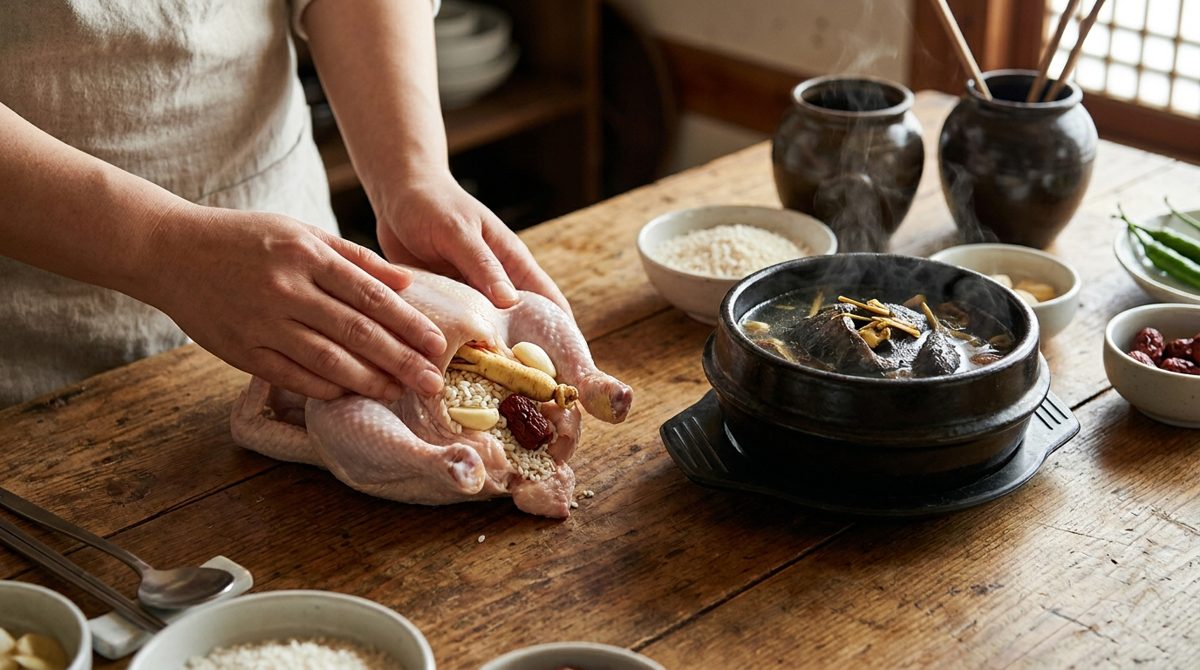
Samgyetang is built around one whole young chicken (poussin-sized, called yeonggye) that’s cleaned, stuffed with soaked glutinous rice, a knot of fresh ginseng root, garlic cloves, and jujube (Korean red dates), then trussed and simmered for over an hour in water until the broth turns milky-clear and deeply savory. It arrives at your table still boiling inside an individual stone or clay pot — no sharing, no splitting a pot with friends. Each diner gets their own whole bird.
The name breaks down simply: sam refers to insam (ginseng), gye means chicken, tang means soup. Ginseng has been prized in Korean and East Asian medicine for centuries as a tonic root believed to restore energy, and pairing it with chicken, rice, and jujube turns the soup into a one-pot meal that’s simultaneously food and folk medicine. It isn’t a peasant dish or a street snack — it’s closer to a restorative ritual meal, eaten with intention.
The dish is most associated with bok-nal, the three hottest days of the Korean lunar summer calendar (chobok, jungbok, malbok), when queues form outside famous samgyetang restaurants from morning. The logic is iyeolchiyeol — “fight heat with heat” — the idea that eating a scalding hot, nutrient-dense soup in extreme heat replenishes what your body sweats out. Today Koreans eat it year-round, but summer remains its cultural moment, and tourists visiting Seoul in July or August will see it everywhere.
What Does Samgyetang Taste Like?
Samgyetang tastes clean, savory, and gently earthy rather than bold or complex. The broth is close to a very good chicken stock — light, slightly gelatinous from slow-simmered bones, with a faint bitter-sweet undertone from the ginseng that’s noticeable but never overpowering. The chicken itself is fall-apart tender, almost falling off the bone by the time it reaches you, and the glutinous rice inside soaks up the broth to become soft and savory. Garlic cloves cooked whole inside the chicken turn mellow and sweet rather than sharp.
Is Samgyetang Spicy?
No — samgyetang is one of the mildest well-known Korean dishes, full stop. There’s no chili in the pot at all. The only heat you add yourself comes from a small side dish of salt mixed with black pepper, which you dip pieces of chicken into if you want extra seasoning. If you’ve been nervous about Korean food being universally fiery, samgyetang is the safest possible entry point — it’s essentially a comforting, ginseng-scented chicken soup that happens to look dramatic arriving at your table.
Samgyetang Dietary Guide: Vegetarian, Vegan, Halal & Allergens
Samgyetang is one of the more restrictive dishes on this list for dietary needs — there’s no getting around the whole chicken at its center. Here’s exactly what to know before you order.
| Ingredient concern | In standard samgyetang? | How to handle |
|---|---|---|
| Chicken / meat | Yes — always, it’s the entire dish | No substitution exists; this is not adaptable to meat-free |
| Rice / gluten | Yes, glutinous rice stuffing | Rice itself is gluten-free, but check if thickened broths use wheat starch |
| Tree nuts | Often — jujube and sometimes pine nuts as garnish | “Jat ppaego juseyo” (잣 빼고 주세요) = no pine nuts, if allergic |
| Garlic | Yes — whole cloves cooked inside the chicken | Hard to remove; ask staff if garlic-sensitive |
| Soy / sesame | Usually minimal in the broth itself | The accompanying kimchi and dipping sauces may contain both |
| Alcohol | No, in the soup itself | Restaurants sometimes offer ginseng liquor (insamju) as a side order — optional, easy to decline |
| Shellfish / fish / dairy | No | Traditional recipes contain neither |
Is Samgyetang Vegetarian or Vegan?
No, and there’s no practical workaround. Samgyetang’s entire identity is the whole chicken — the rice, ginseng, and jujube are stuffing inside it, not the point of the dish. Unlike bibimbap or japchae, there’s no “just remove the meat” version, because removing the chicken leaves you with a bowl of broth and rice that isn’t really samgyetang anymore. Vegetarian and vegan travelers should skip this one entirely and look toward dishes like Korean street food options or vegetable-forward dishes such as bibimbap instead.
Is Samgyetang Halal?
Here’s the honest answer: chicken is halal-friendly in principle, and samgyetang contains no pork and no alcohol in the base recipe, which sounds promising. But in practice, the vast majority of samgyetang restaurants in Korea are not halal-certified — the chicken isn’t slaughtered according to halal methods, and kitchens aren’t set up to guarantee no cross-contact with pork-based stocks or seasonings used elsewhere in the kitchen. Muslim travelers shouldn’t assume any random samgyetang restaurant is safe by default.
The good news: a small number of certified or Muslim-friendly halal Korean restaurants serving samgyetang do exist, concentrated in Itaewon and parts of Myeongdong where demand from Muslim tourists and residents is higher. Check the Korea Tourism Organization’s Muslim-friendly restaurant listings on VisitKorea before you go, and don’t rely on a restaurant simply serving chicken as proof of halal status — always ask directly or look for certification signage.
How to Order Samgyetang in Korean (+ 2026 Prices)
Samgyetang restaurants are almost always specialists — the whole menu revolves around this one dish and its variants, so ordering is refreshingly simple.
| What you want | Say this | Romanized |
|---|---|---|
| One samgyetang, please | 삼계탕 하나 주세요 | samgyetang hana juseyo |
| Black chicken version | 흑임자삼계탕 주세요 | heugimja-samgyetang / ogolgye-samgyetang juseyo |
| Abalone samgyetang | 전복삼계탕 주세요 | jeonbok-samgyetang juseyo |
| Extra salt-pepper dip, please | 소금후추 더 주세요 | sogeum-huchu deo juseyo |
| Is this halal / does this contain pork? | 이거 돼지고기 들어가요? | igeo dwaejigogi deuragayo? |
What it costs in 2026: a standard samgyetang in Seoul runs ₩17,000–₩25,000, noticeably pricier than everyday rice or noodle dishes because you’re getting a whole chicken plus ginseng, a genuinely expensive ingredient. Near major tourist zones like Gyeongbokgung Palace or Myeongdong, prices frequently climb past ₩27,000. Premium versions with abalone, black chicken, or extra ginseng root can run higher still. It’s one of the few Korean meals where a solo diner regularly pays a similar amount to a full meat-based meal elsewhere — check our Korean dining etiquette guide for tipping norms and table manners before you go.
How to Eat Samgyetang Like a Local
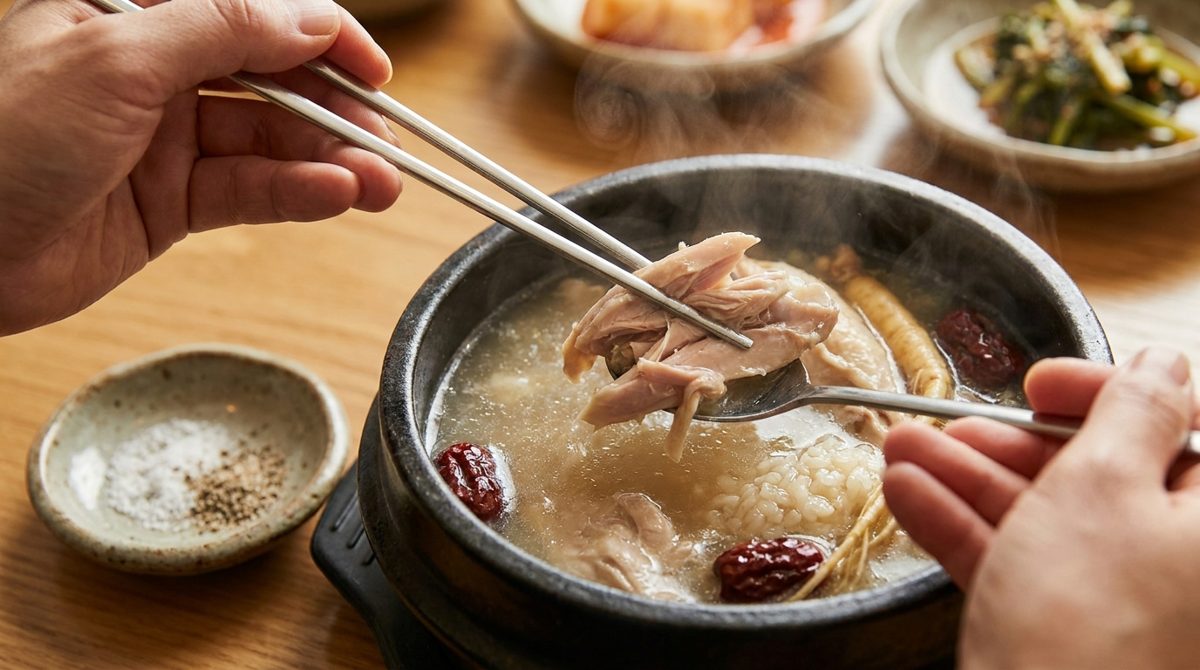
Start by using your spoon to scoop out a bit of the glutinous rice stuffing from inside the chicken cavity — it’s often the most flavorful bite, having absorbed broth and ginseng for over an hour. Then use chopsticks to pull the meat away from the bone; the chicken is cooked so long it should separate with almost no effort, no knife needed.
Dip pieces into the small salt-and-pepper saucer as you go — this is the only seasoning most locals add, since the broth itself is already well-balanced. Some diners pour a little broth over their rice bowl at the end, treating the leftover liquid like a final course. Kimchi and radish kimchi (kkakdugi) served alongside cut through the richness and are meant to be eaten between bites, not saved for last.
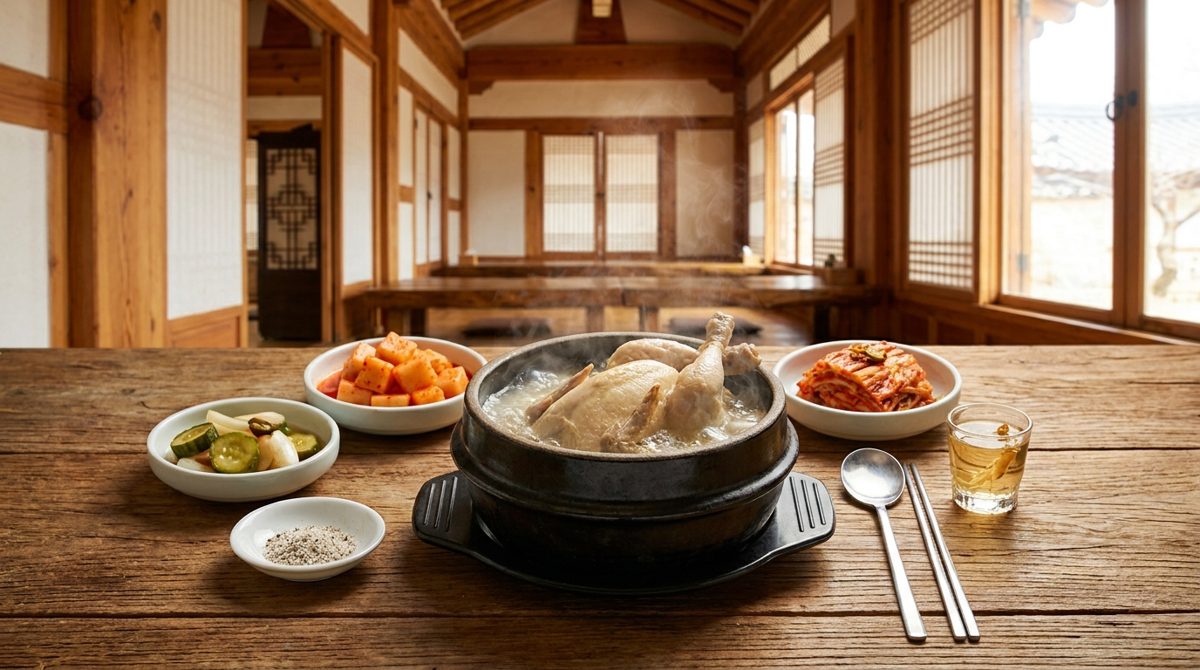
Many restaurants offer a small shot of insamju (ginseng liquor) as a paired drink or optional add-on — it’s traditional but entirely skippable if you don’t drink alcohol. Expect to sweat a little partway through; that’s the “fight heat with heat” effect working as intended, even in air-conditioned restaurants.
Types of Samgyetang You’ll See on Menus
Standard samgyetang (삼계탕) — the classic version with rice, garlic, jujube, and ginseng; what you’ll get by default almost everywhere. Ogolgye-samgyetang / heugimja-samgyetang (오골계삼계탕) — made with ogolgye, a black-boned, black-skinned Korean chicken breed believed to have extra tonic properties; the broth and meat both take on a darker, richer color and deeper flavor. Jeonbok-samgyetang (전복삼계탕) — a premium version with abalone added to the pot, popular at higher-end specialists. Yeolmu or insam-ju pairing sets — some restaurants bundle a small ginseng liquor shot or extra ginseng root on the side as a set menu upgrade. Portion size stays consistent across types — it’s always a whole individual bird, just with different add-ins.
Where to Try Samgyetang
Seoul has several samgyetang specialists with decades of history, some famous enough to have lines out the door during bok-nal, particularly around Jongno and near Gyeongbokgung Palace. These well-known spots are convenient for tourists but sit at the higher end of the price range noted above. Neighborhood samgyetang restaurants outside the main tourist strips serve the same quality of soup for less and are worth seeking out if you’re staying more than a day or two. For a broader sense of where good Korean cooking clusters in the capital, our Seoul food guide covers market and restaurant districts worth exploring beyond just this one dish. If you want a deeper dive purely on samgyetang — history, more restaurant picks, and seasonal timing — see our dedicated Samgyetang guide.
Samgyetang FAQ
What does samgyetang mean in English?
“Ginseng chicken soup.” Sam comes from insam (ginseng), gye means chicken, and tang means soup — a literal, accurate description of what’s in the pot.
Is samgyetang spicy?
No. It contains no chili at all and is one of the mildest famous Korean dishes. The only seasoning you add yourself is a small side dish of salt mixed with black pepper for dipping.
Is samgyetang halal?
Chicken-based dishes are halal-friendly in principle, but most Korean samgyetang restaurants are not halal-certified, so the chicken isn’t slaughtered to halal standards and kitchens can’t guarantee no cross-contact. A handful of certified or Muslim-friendly halal Korean restaurants serving samgyetang exist in areas like Itaewon and Myeongdong — check VisitKorea’s listings rather than assuming any restaurant qualifies.
Can vegetarians eat samgyetang?
No. The dish is built entirely around a whole chicken with no meat-free version or practical substitution — removing the chicken leaves you with rice and broth that isn’t recognizably samgyetang. Vegetarians should choose a different dish entirely.
Why do Koreans eat samgyetang in summer?
It follows the tradition of iyeolchiyeol, “fight heat with heat” — eating a hot, nutrient-dense soup during the hottest days of summer (bok-nal) is believed to replenish energy lost to sweating. Long lines form at famous samgyetang restaurants on these specific dates each year.
The Verdict: Should You Order It?
Yes — if you eat meat and want zero spice, samgyetang is one of the most comforting, restorative meals in Korea, especially on a brutally hot Seoul afternoon. It’s pricier than a typical rice or noodle dish and completely off-limits for vegetarians, vegans, and most halal diners without careful checking, but for everyone else it delivers a genuinely unique format: your own whole chicken, your own pot, your own pace. Hungry for the next dish? Decode the whole menu with our Korean Food Decoder — every major Korean dish explained with spice levels, allergens, and ordering phrases.