Korean convenience stores are not just snack shops — they’re tourist survival infrastructure. The convenience store services Korea offers go far beyond food: T-money card top-ups, ATMs that take foreign cards, package shipping, phone charging, umbrellas, even 24/7 basic medicine. Open around the clock on practically every block, a GS25 or CU can solve most small travel emergencies in about three minutes. Here’s every non-food service worth knowing, with prices, phrases, and the fine print nobody tells you.
Table of Contents
- Services Quick Facts
- T-money Top-Up (Cash Only — Here’s How)
- ATMs: Getting Cash with a Foreign Card
- Package Delivery & Pickup
- More Counter Tricks Most Tourists Never Discover
- The Tourist SOS Shelf: Chargers, Meds, Umbrellas
- Eating Counters, Microwaves & Trash Rules
- Why the 24/7 Konbini Is Your Safety Net
- Convenience Store Services FAQ
Services Quick Facts
| Item | Details |
|---|---|
| What it is | Non-food services at GS25, CU, 7-Eleven & emart24: transit top-up, ATM, shipping, charging, OTC basics |
| Where to find it | ≈55,000 stores nationwide — GS25 ≈18,800, CU ≈18,700; most open 24/7 |
| T-money top-up (2026) | ₩1,000–₩90,000 per top-up, cash only, max ₩500,000 stored per day |
| ATM fees (2026) | Typically ₩3,000–₩4,000 per foreign-card withdrawal + your bank’s fee |
| Package services | Send/receive parcels at the counter or kiosk; GS25 and CU run budget store-to-store delivery |
| Emergency meds | 13 government-approved OTC basics (painkillers, cold tablets, digestive aids) sold 24/7 |
| Payment | Visa/Mastercard accepted everywhere — except T-money top-up, which is cash only |
| Best for | Late-night problems, transit refills, rainy days, jet-lagged 3 a.m. errands |
T-money Top-Up: Cash Only — Here’s Exactly How
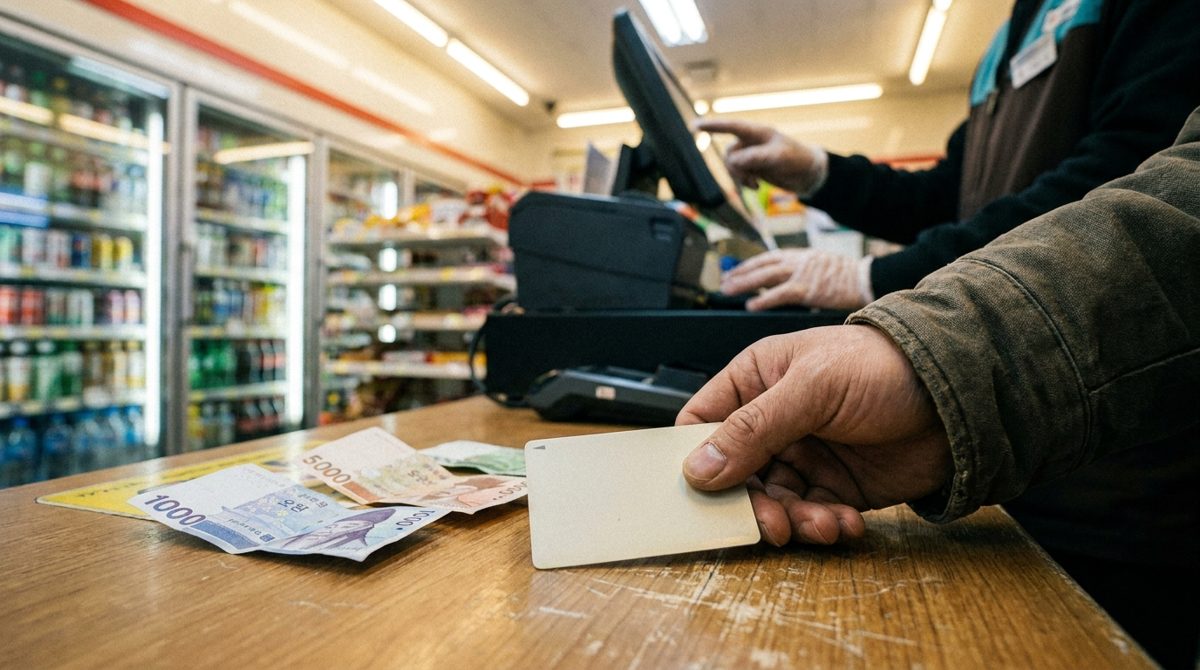
This is the service every tourist uses within 48 hours of landing. Your T-money transit card — the one that runs Seoul’s subways and buses — gets topped up at any convenience store counter. The one rule that catches everyone: top-ups are cash only. No Visa, no Mastercard, no exceptions. It’s a national quirk of the transit-card system, not the store being difficult.
The process takes twenty seconds. Hand the cashier your card, say how much, pay in cash. Amounts run from ₩1,000 to ₩90,000 per top-up (in ₩1,000 units), and a card can hold at most ₩500,000 with a daily charge cap of the same. For a few days in Seoul, ₩10,000–₩20,000 at a time is the sweet spot.
| What you want | Say this | Romanized |
|---|---|---|
| Please top up my card | 충전해 주세요 | chung-jeon hae juseyo |
| ₩10,000 please | 만원이요 | man-won-iyo |
| Can I check the balance? | 잔액 확인해 주세요 | jan-aek hwagin hae juseyo |
| One T-money card, please | 티머니 카드 하나 주세요 | T-money kadeu hana juseyo |
You can also buy the card itself here (₩2,500–₩3,000, design-dependent, also cash for the top-up part), and many stores let you pay for regular shopping with T-money balance — a neat way to burn leftover won at the airport. For official transit details, the Korea Tourism Organization keeps an up-to-date transportation guide.
ATMs: Getting Cash with a Foreign Card
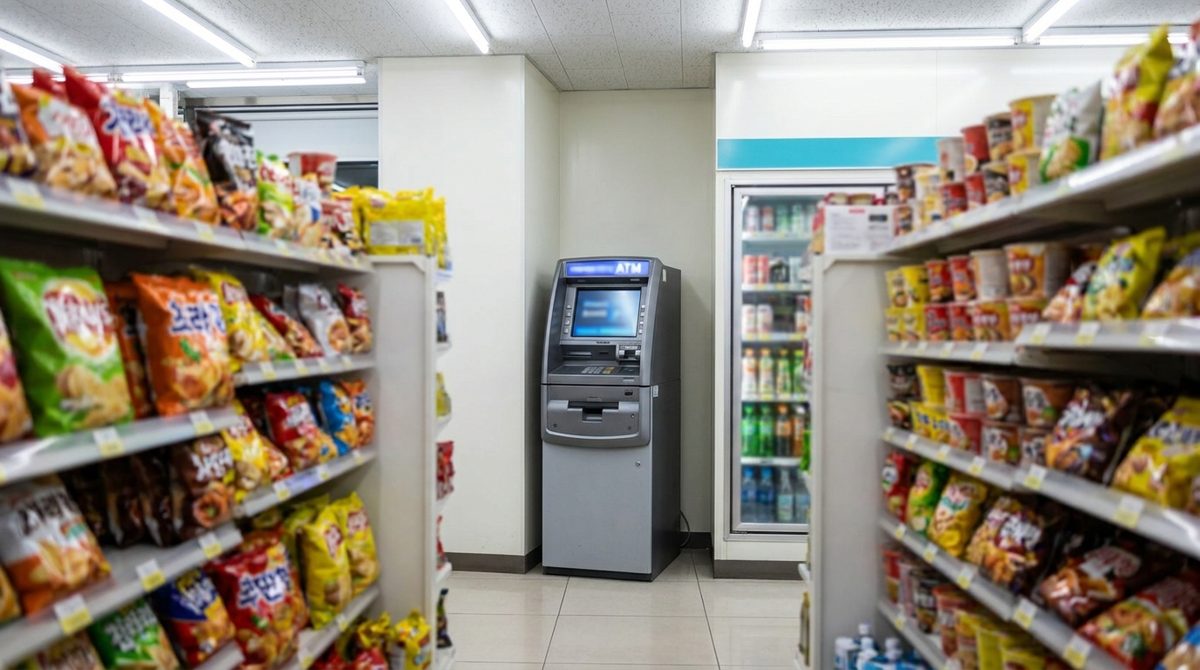
Nearly every Korean convenience store hosts an ATM, and unlike many bank ATMs, the convenience store machines are reliably foreign-card friendly. Look for the “Global ATM” sticker or just check the screen for an English option — Visa, Mastercard, Cirrus, PLUS, UnionPay and Maestro logos mean you’re in business.
What it costs in 2026: the machine typically charges ₩3,000–₩4,000 per withdrawal, on top of whatever your home bank adds. Three tips shave real money off:
1. Decline dynamic currency conversion. If the screen offers to charge you in your home currency, always choose KRW — the “convenient” home-currency option hides a 3–7% markup.
2. Withdraw bigger, less often. The flat machine fee makes one ₩300,000 withdrawal far cheaper than six ₩50,000 ones. You’ll want some of that as cash anyway — see T-money above.
3. Know the ceiling. Most machines cap foreign-card withdrawals around ₩1,000,000 per transaction, and dispense ₩50,000 and ₩10,000 notes. If a machine rejects your card, don’t panic — walk to the next chain’s store; different stores host different ATM operators.
Package Delivery & Pickup
Here’s a service most tourists never realize exists: Korean convenience stores are full parcel offices. At GS25 and CU you can send packages domestically from a self-service kiosk (weigh, print label, drop) and receive deliveries addressed to the store — the standard workaround when your accommodation can’t accept parcels.
Both big chains also run famously cheap store-to-store delivery — GS25’s half-price service (반값택배) and CU’s equivalent (CU끼리 택배) move a parcel from any branch to any other branch for roughly ₩1,800–₩2,600, a couple of days slower than door-to-door courier but about half the price. Locals use it constantly for secondhand-market deals.
When is this useful for a visitor? Three real cases: shipping souvenirs to a friend elsewhere in Korea; forwarding luggage-overflow to your last-stop city’s store; and receiving online purchases (many Korean shopping sites offer “convenience store pickup” at checkout — you collect with the pickup code sent to your phone). You’ll need a Korean-reachable phone number for most of it, so travelers on Korean eSIMs with numbers have the edge. And if you went shopping hard enough to need this, check our Korea tax refund calculator to claim your VAT back before flying out.
More Counter Tricks Most Tourists Never Discover
Beyond the headline services, the counter itself hides a few gems. Prepaid SIM and data vouchers: convenience stores sell top-up vouchers for Korean prepaid phone plans, and several chains sell tourist SIM/eSIM starter packs outright — handy if your airport pickup fell through. Gift cards: racks near the register carry Google Play, game, and mobile gift cards, a favorite souvenir for gamer friends back home.
Official trash bags: if you’re in an Airbnb, you’ll discover Korean garbage must go in district-specific paid bags (종량제 봉투) — and the convenience store is exactly where you buy them. Tell the staff your neighborhood and the size (10L or 20L) and they’ll hand you the right one. It’s the most local errand you’ll ever run.
Self-checkout and translation help: self-checkout kiosks are spreading fast and most have an English mode; CU has gone further, rolling out AI translation kiosks at roughly 70 tourist-area stores that let you ask questions in your own language. And ordinary staff, even without English, are famously patient with phone-translator conversations — this is a country where the konbini counter doubles as an information desk.
The ₩100 bag rule: plastic bags aren’t free (environmental law). Say “bongtu juseyo” (봉투 주세요) and expect ₩100–₩200 on the bill, or do as locals do and pack your pockets.
The Tourist SOS Shelf: Chargers, Meds, Umbrellas, Toiletries
Every convenience store keeps a quiet corner that functions as a tiny emergency department for travelers. Commit this list to memory:
| Emergency | What the store has | Price (2026) |
|---|---|---|
| Dead phone | Charging cables, plug adapters, power banks; many stores rent or sell cheap chargers, and the eating counter usually has outlets | ₩5,000–₩20,000 |
| Sudden rain | Umbrellas by the door the moment clouds appear | ₩5,000–₩12,000 |
| Headache / fever | 13 approved “safety medicines” (안전상비의약품): Tylenol-type painkillers, cold tablets, digestive aids, pain patches — 24/7, no pharmacy needed | ₩2,000–₩5,000 |
| Forgot toiletries | Toothbrush kits, razors, contact solution, sunscreen, face masks, feminine products | ₩1,500–₩8,000 |
| Blisters / small cuts | Band-aids, disinfectant swabs | ₩1,500–₩3,000 |
| Hangover | Korea’s famous hangover-relief drinks and jelly sticks, stocked by the register | ₩3,000–₩6,000 |
The medicine point deserves emphasis because it surprises people from countries where all medication means finding a pharmacy: since 2012, Korean law allows convenience stores to sell a fixed list of 13 basic OTC medicines around the clock. It’s deliberately limited — anything stronger genuinely requires a pharmacy (약국) — but for a 2 a.m. headache it’s a lifesaver. Dosage labels are in Korean, so translate before you swallow.
A few phrases make SOS runs frictionless:
| What you need | Say this | Romanized |
|---|---|---|
| Do you have painkillers? | 진통제 있어요? | jintongje isseoyo? |
| Do you have phone chargers? | 충전기 있어요? | chungjeongi isseoyo? |
| Is there an outlet? | 콘센트 있어요? | konsenteu isseoyo? |
| Do you have umbrellas? | 우산 있어요? | usan isseoyo? |
| A bag, please | 봉투 주세요 | bongtu juseyo |
Eating Counters, Microwaves & Trash Rules
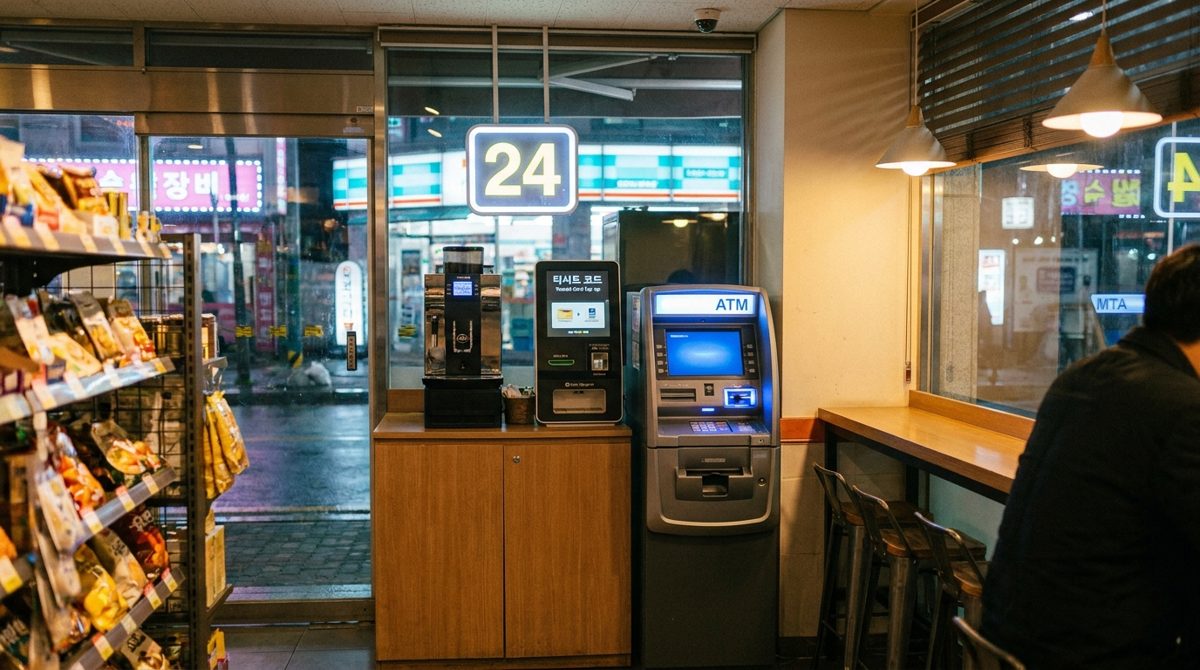
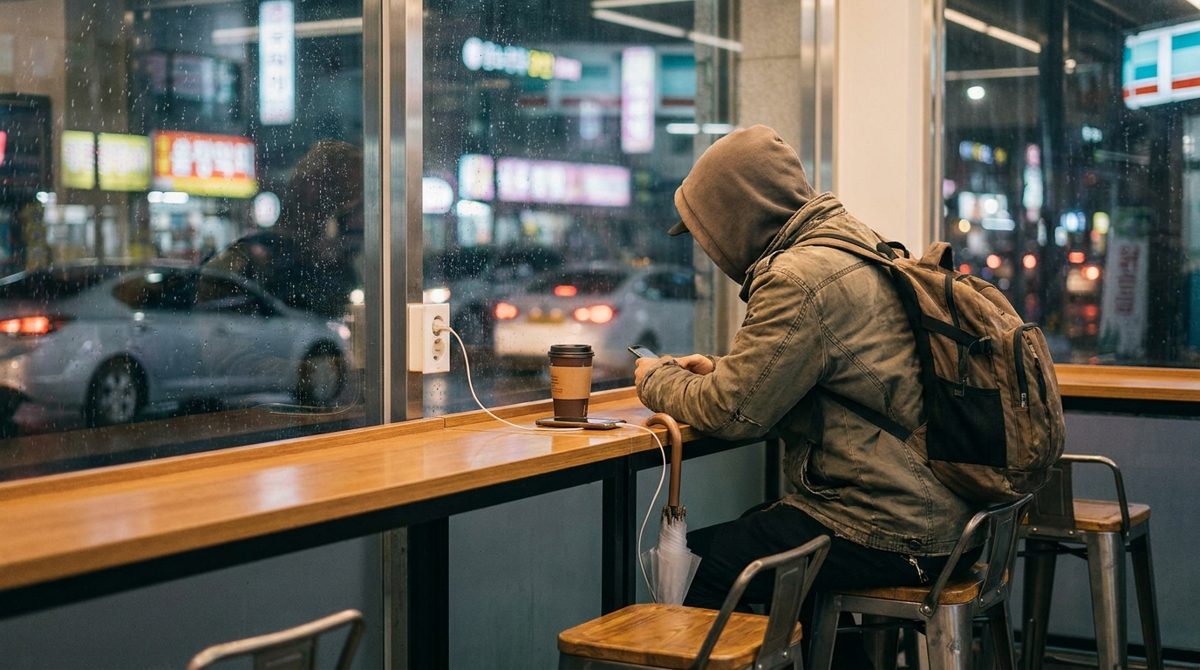
The services extend to the furniture. Every store has a microwave and hot-water dispenser (free with purchase), an eating counter — window bar, standing table, or the beloved outdoor plastic set — and usually a phone-friendly outlet. Staff fully expect you to buy, heat, and eat on the spot; it’s the national way to eat convenience store food, and the dedicated ramyeon machines get their own how-to in our ramyeon machine guide.
The etiquette is simple but real. Sort your trash at the store’s bins — separate slots for general waste, plastics, cans, and crucially a bucket for leftover ramyeon broth (never pour soup in the general bin). Wipe your spot if you splashed, return baskets, and don’t camp at the counter for an hour at lunch rush. Korea has almost no public street bins, which makes the store bins genuinely precious — but they’re for things you bought there, not a dumping point for the day’s trash. More unwritten rules in our Korean dining etiquette guide.
Why the 24/7 Konbini Is Your Safety Net
Put it together and a pattern emerges: whatever goes mildly wrong in Korea, the answer is usually “walk to the nearest convenience store” — and the nearest one is rarely more than two minutes away. With ≈55,000 stores for 51 million people, Korea has the densest convenience store network on earth, denser than Japan’s per capita. The overwhelming majority run 24/7, staffed, lit, and safe — which is why solo travelers treat them as informal waypoints on late walks home.
They’re also weirdly good at being cheap: fixed nationwide pricing means no tourist markup ever, and the monthly 1+1 and 2+1 deals actively subsidize your snacks. Which chain does what best — GS25’s kimbap, CU’s desserts and their AI translation kiosks at ~70 tourist-area stores — is a rabbit hole we’ve mapped in GS25 vs CU vs 7-Eleven.
Our honest advice: on day one in Korea, walk into the store nearest your hotel and spend ten minutes just looking. Find the ATM, the microwave, the umbrella rack, the medicine shelf. You’re not shopping — you’re memorizing where the safety net hangs.
A worthwhile first-hour ritual: many travelers’ very first Korean purchase happens at the convenience store inside the airport arrivals hall — a T-money card, a cash top-up, and a banana milk for the train ride into the city. Every service in this guide works identically there, so you can settle the boring logistics before you’ve even seen daylight. The store by your hotel then becomes the daily branch office of your trip.
Know the limits too, so you don’t waste a walk. Convenience stores don’t exchange currency (banks and licensed booths only), can’t sell prescription medicine, and don’t handle international shipping — domestic parcels only. Immediate tax refunds happen at dedicated downtown kiosks and the airport, not the konbini counter. And while staff will cheerfully microwave, top up, and point you to the subway, they’re not a left-luggage service: use station lockers for bags. Everything else — genuinely, almost everything else — they’ve got.
Convenience Store Services FAQ
Can I top up T-money with a credit card at a convenience store?
No — T-money top-ups at convenience stores are cash only, nationwide, at every chain. Top-ups run ₩1,000–₩90,000 per transaction. Everything else in the store can go on your foreign Visa or Mastercard; only the transit top-up demands cash.
Do Korean convenience store ATMs accept foreign cards?
Yes — most convenience store ATMs are “Global ATMs” with English menus accepting Visa, Mastercard, Cirrus and PLUS cards. Expect a ₩3,000–₩4,000 machine fee plus your bank’s charges, and always choose to be billed in KRW, never your home currency.
Can I buy medicine at a Korean convenience store?
Yes, within limits. Stores sell 13 government-approved basic medicines 24/7 — acetaminophen painkillers, cold tablets, digestive aids and pain-relief patches. Anything beyond that list requires a pharmacy (약국), which keeps normal daytime hours.
Can I ship or receive packages at a convenience store in Korea?
Yes. GS25 and CU counters and kiosks handle domestic parcel sending, and both run cheap store-to-store delivery (about ₩1,800–₩2,600). You can also have online orders delivered to a store for pickup — you’ll generally need a Korean-reachable phone number for the pickup code.
Are Korean convenience stores really open 24 hours?
The large majority are, especially in cities — it’s the default. A minority in office districts or inside buildings close overnight; the sign on the door and the lit interior tell you instantly. In tourist areas, assume yes.
The Verdict: Learn the Store, Relax the Trip
Food gets the Instagram posts, but the services are why Koreans can’t imagine life without konbini — and why you’ll travel calmer once you internalize them. Cash for T-money, KRW at the ATM, medicine after midnight, an umbrella before the downpour: that’s four saved days right there. Keep exploring everything these stores can do in our Korean Convenience Store Explorer — the full map of Korea’s greatest everyday institution.