Wondering what those yellow “1+1” tags mean all over Korean convenience stores? A 1+1 Korea deal means buy one, get an identical item free — and 2+1 means buy two, get a third free. The discount applies automatically at checkout, the free item rings up as ₩0, and promotions rotate every month. Master this one system and you’ll cut your snack-and-drink budget in Korea by 30–50% without trying. This guide shows you exactly how it works, how to read the tags, and the mistakes that make tourists miss their free stuff.
Table of Contents
- 1+1 Deals Quick Facts
- How 1+1 and 2+1 Deals Actually Work
- How to Spot the Tags on the Shelf
- What’s Usually on Deal (Real Examples + 2026 Prices)
- Store Apps: 우리동네GS and 포켓CU
- Tourist Strategy: Where the Real Value Is
- Common Confusions (Don’t Miss Your Free Item)
- 1+1 Korea FAQ
1+1 Deals Quick Facts
| Item | Details |
|---|---|
| What it is | 1+1 = buy one, get one free; 2+1 = buy two, get a third free (same item only) |
| Where to find it | Shelf-edge tags in every GS25, CU, 7-Eleven and emart24 — drinks fridge is the jackpot zone |
| How it applies | Automatically at checkout — free item scans as ₩0 on the receipt |
| Rotation | Deals change on the 1st of every month, chain-wide |
| Typical savings (2026) | 30–50% on drinks, snacks, coffee, ramyeon; prices uniform nationwide |
| Best chains for it | All four run them; GS25 and CU have the widest monthly lists (each ≈18,700–18,800 stores) |
| Apps | GS25 “우리동네GS” (Woori Dongne GS), CU “포켓CU” (Pocket CU) — extra coupons and stamps |
| Best for | Budget travelers, snack hoarders, anyone buying drinks in Korean summer |
How 1+1 and 2+1 Deals Actually Work
Korean convenience store promotions are refreshingly honest. When a product carries a 1+1 tag, you take two identical items to the register, the cashier scans both, and the second one rings up at ₩0. No coupon, no membership, no asking. A 2+1 tag works the same way: bring three identical items, pay for two.
Three rules define the whole system. First, same item only — two of the exact same product, same flavor, same size. You can’t mix a peach iced tea with a lemon one, even from the same brand, unless the tag explicitly says so. Second, you must physically take the free item during that same transaction (a few app-based exceptions exist — more below). Third, deals are chain-wide and nationwide: a 1+1 banana milk at a GS25 in Seoul is 1+1 at every GS25 in Busan too, at the same price.
The promotions rotate on the first of each month. Brands pay the chains to feature products, which is why the lists are huge — a typical month has hundreds of items on 1+1 or 2+1 across drinks, snacks, ramyeon, coffee, and even toiletries. It’s also why the deals are real discounts rather than inflated-price tricks: the base prices are the same fixed nationwide prices you’d pay any other month.
If you’re new to Korean convenience stores entirely, start with our 12 best convenience store eats guide, then come back here to get them cheaper.
Why does Korea do this? With roughly 55,000 convenience stores packed into one country — often two rival stores on the same block — chains compete ferociously for daily foot traffic, and brands compete for shelf attention. The 1+1 lists are the front line of that war, refreshed monthly like a magazine issue. Koreans genuinely plan purchases around them; there are entire online communities and app sections dedicated to each month’s list. As a visitor, you’re simply stepping into a discount ecosystem locals have optimized for decades.
One more practical note: payment doesn’t matter. Cash, foreign Visa or Mastercard, T-money — the deal applies identically. There’s no minimum purchase and no limit on how many deal pairs you can buy in one transaction. Six bottles of a 1+1 tea? You pay for three. The receipt will show every free unit as its own ₩0 line, which makes it the easiest receipt-check in the world.
How to Spot the Tags on the Shelf
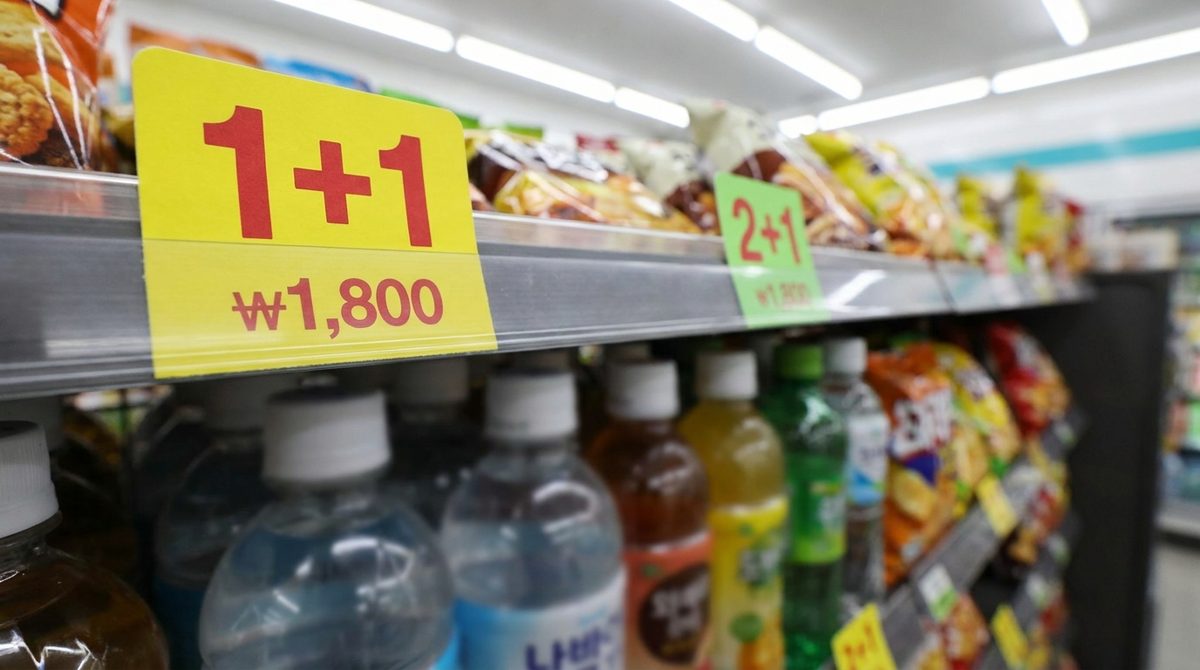
The tags are small paper or plastic cards clipped to the shelf edge directly under the product. You don’t need to read any Korean — the “1+1” or “2+1” is printed in huge type. What the colors mean varies slightly by chain, but the pattern is consistent:
| Tag look | Meaning | Where you’ll see it |
|---|---|---|
| Bright yellow tag, red “1+1” | Buy one get one free | GS25, CU — the most common style |
| Green or blue tag, “2+1” | Buy two get one free | All chains; very common on coffee drinks and snacks |
| “덤” or “증정” sticker on the product itself | A bonus item is taped/banded to the package | Drinks with a free mini-item attached |
| Red “할인” or a slashed price | Straight price discount, not a freebie | Clearance and app-coupon items |
Two habits will serve you well. Check that the tag sits directly beneath the exact flavor you’re grabbing — shelves get messy and a tag one slot over doesn’t count. And glance at the tag’s fine print for the month (e.g., “7월” = July): staff occasionally miss removing expired tags on the 1st, and the register price wins, not the tag.
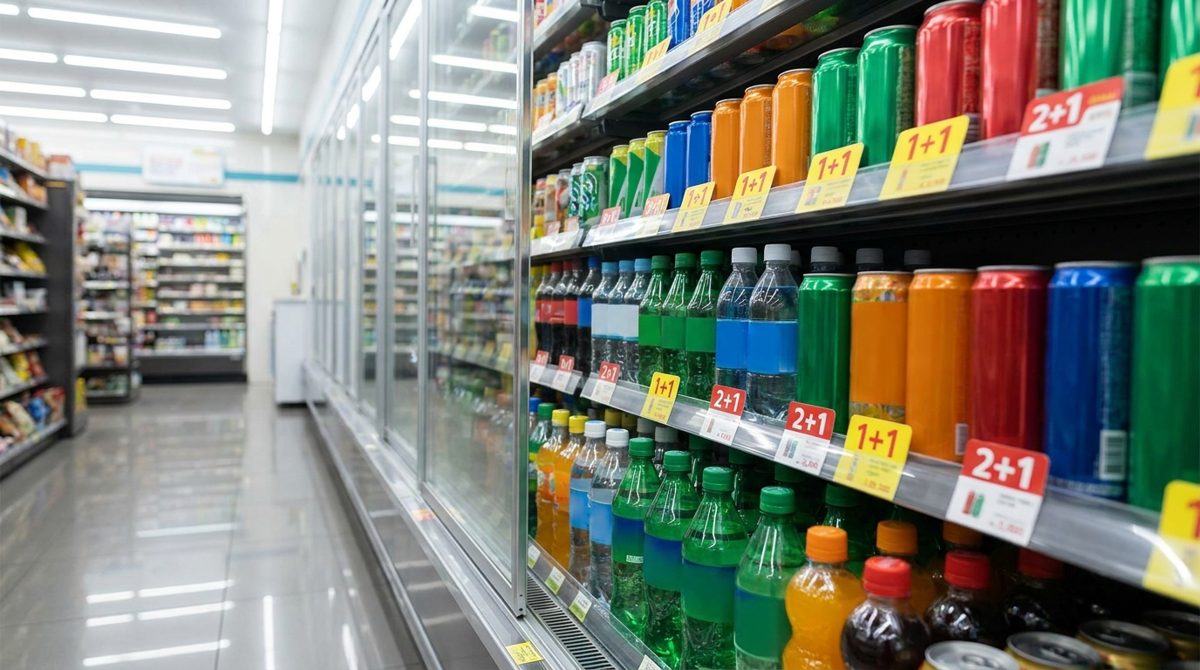
The single best hunting ground is the drinks wall. In any given month, a big share of the fridge — teas, vitamin drinks, iced coffees, sodas, sports drinks — carries a tag. Snack aisles and the pouch-coffee section come next.
What’s Usually on Deal (Real Examples + 2026 Prices)
Exact items change monthly, but the categories are stable year-round. Here’s what a typical 2026 month looks like, with the fixed nationwide base prices you’ll pay:
| Category | Typical 1+1 / 2+1 examples | Base price (2026) | Effective price with deal |
|---|---|---|---|
| Bottled tea & ade | Convenience-store PB teas, vitamin drinks, sparkling ades | ₩1,800–2,500 | ₩900–1,250 each (1+1) |
| Canned/bottled coffee | Cold brew bottles, latte cans — 2+1 is standard here | ₩2,000–2,800 | ≈33% off (2+1) |
| Snacks & chips | Major Korean chip and cookie lines rotate in constantly | ₩1,500–2,500 | Half price in 1+1 months |
| Cup ramyeon | Select cups join 2+1 lists some months (Shin cup base ₩1,500, Chapagetti cup ₩1,800) | ₩1,500–2,500 | ≈33% off (2+1) |
| Milk drinks & yogurt | Flavored milks, drinkable yogurts (banana milk itself, ₩1,700–1,800, rarely goes 1+1) | ₩1,500–2,000 | Half price when featured |
| Toiletries & misc | Wet wipes, razors, masks, batteries | ₩2,000–5,000 | Half price when featured |
Notice what’s not on the list: fresh food. Samgak kimbap (₩1,100–1,500), sandwiches, and dosirak lunchboxes almost never run 1+1 because of short shelf lives — their discount world is the separate “expiring soon” markdown stickers. Alcohol runs its own promos too (think 4-cans-for-₩11,000 beer deals rather than 1+1) — our convenience store alcohol guide covers those.
For a full tour of what’s worth eating at each chain, see GS25 vs CU vs 7-Eleven — the monthly deal lists differ between chains, so the “best” store can literally change with the calendar.
Store Apps: 우리동네GS and 포켓CU
Each chain has a membership app that stacks extra savings on top of shelf deals. GS25 uses 우리동네GS (“Woori Dongne GS” — our neighborhood GS), and CU uses 포켓CU (“Pocket CU”). Both are free, and both work with foreign phone numbers or email sign-ups, though the interfaces are mostly Korean.
What they give you: app-only coupons (often a welcome coupon plus weekly discount coupons), points on every purchase, and a genuinely useful feature for deal-hunters — the full monthly 1+1/2+1 list, browsable and searchable, so you can check whether your favorite drink is on deal before you walk in. The apps also let you keep a free item as a “gift credit” (덤 교환권) to redeem later instead of carrying both items out — handy when you don’t want two cold bottles at 9 a.m.
Should a short-stay tourist bother? Honest answer: only if you’re in Korea a week or more and near the same chain daily. The shelf deals apply with zero app involvement — the app is a bonus layer, not a requirement. If your trip is three days, skip the sign-up friction and just follow the yellow tags.
Tourist Strategy: Where the Real Value Is
For travelers, the math is simple: drinks and snacks are where 1+1 shines. Korea in summer means constant hydration, and paying ₩900 effective per bottle instead of ₩1,800 adds up fast over a week. Convenience store culture is so central to Korean travel that even the Korea Tourism Organization features konbini food runs as an experience in their own right. Here’s the playbook:
1. Buy your day’s drinks in one go. Morning stop: grab a 1+1 tea pair — drink one now, bag one for the afternoon. Two people traveling together are the perfect 1+1 unit: one purchase, one each.
2. Snack-stack for travel days. Stocking up for a KTX ride or a flight home? Build your haul entirely from tagged items. A 2+1 coffee trio plus two 1+1 snack pairs is a full travel kit for around ₩8,000.
3. Use deals to try things risk-free. A 1+1 tag makes experimenting free: try a weird Korean drink flavor, and if you hate it, you still have the “safe” second item… of the same flavor. (Okay, choose wisely.) Pair your finds with the classics in our Korean convenience store snacks guide.
4. Don’t detour for it. Prices and deals are uniform nationwide, so never cross the street for a “better” branch of the same chain. A different chain, though, has a different deal list — if you’re between a GS25 and a CU, 30 seconds of shelf-scanning in each is legitimate strategy.
5. Combine with food hacks. The famous convenience store meal builds — ramyeon plus samgak kimbap plus cheese — get even cheaper when a component is on deal. Our food combos and hacks guide shows the full ₩5,000-meal architecture.
Common Confusions (Don’t Miss Your Free Item)
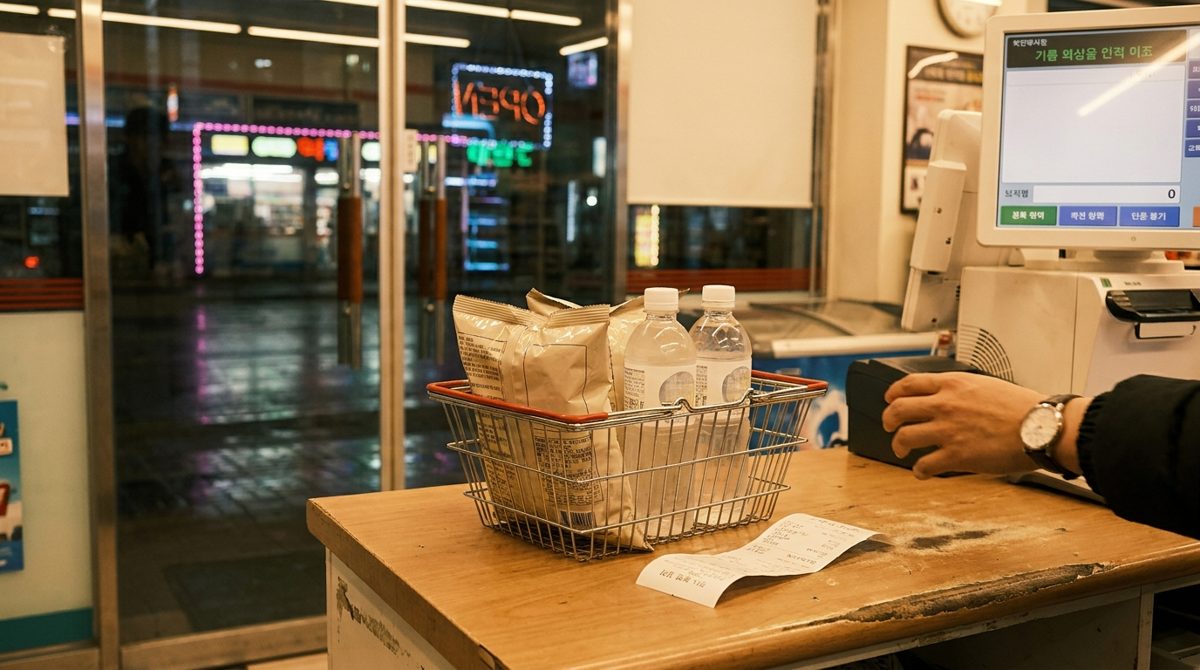
The #1 tourist mistake: paying for one item and leaving. The register doesn’t stop you. If you scan one 1+1 drink and pay, you simply paid full price for something that had a free twin — no refund prompt, no alert in English. The cashier may say “hana deo gajyeo-oseyo” (grab one more), but in a busy store they may not. Always carry both items to the counter yourself.
Mixing flavors doesn’t work. 1+1 means two identical barcodes. Grape ade + peach ade from the same line will ring up as two full-price drinks unless the tag specifically marks the whole line.
Check your receipt. The free item appears as a line item at ₩0 (or with a matching minus line). It takes two seconds to verify. If it charged you double, show the shelf tag — staff fix it without fuss.
Expired tags happen. On the 1st and 2nd of the month, last month’s tags occasionally linger. The system price is the truth; the paper tag is decoration.
Don’t confuse 1+1 with the “덤” bonus packs. Some drinks come with a small freebie physically taped or shrink-wrapped to the bottle — that’s a bonus pack (덤 증정), not a shelf deal, and you only take what’s attached. Grabbing a second loose bottle because the package “said free” is a classic mix-up.
Self-checkout works fine. More and more stores run self-checkout kiosks, and the 1+1 logic applies automatically there too — scan both items and watch the second line drop to ₩0 on screen. If it doesn’t, flag the (always nearby) staff member rather than paying and hoping.
1+1 is not haggling material. There’s no “can I get a discount instead of the second item?” Konbini pricing is fixed — that predictability is exactly what makes it tourist-friendly. For what else these stores can do for you (T-money top-ups, ATMs, package pickup), see our convenience store services guide.
1+1 Korea FAQ
What does 1+1 mean in Korea?
“Buy one, get one free.” Take two identical items to the register; the second scans at ₩0. 2+1 means buy two identical items and get a third free. The deals are marked with shelf tags and apply automatically — no coupon needed.
Do I need to ask the cashier for the 1+1 deal?
No, but you must bring both items to the counter yourself. The discount applies automatically when both identical items are scanned in one transaction. If you only bring one, you pay full price with no warning.
Can I mix two different flavors in a 1+1 deal?
Usually not. 1+1 applies to the exact same product — same flavor, same size, same barcode. Occasionally a tag covers a whole product line, but assume identical-only unless the tag clearly says otherwise.
How often do Korean convenience store 1+1 deals change?
Monthly. New 1+1 and 2+1 lists start on the 1st of each month, chain-wide and nationwide. GS25’s and CU’s apps (우리동네GS and 포켓CU) publish the full monthly lists so you can check before shopping.
Are 1+1 deals the same at every store in Korea?
Within a chain, yes — prices and promotions are uniform nationwide, so a deal in Seoul exists in Busan too. Between chains, no: GS25, CU, 7-Eleven and emart24 each run different monthly lists.
The Verdict: Free Stuff, Zero Effort
The 1+1 system is the easiest money you’ll save in Korea: no haggling, no coupons, no language barrier — just yellow tags and a habit of grabbing two. Scan the drinks fridge, verify the ₩0 on your receipt, and let the brands subsidize your snack budget. Ready to go deeper down the konbini rabbit hole? Our Korean Convenience Store Explorer decodes every shelf, machine, and midnight meal these stores have to offer.