Need caffeine in Korea without paying cafe prices? Convenience store coffee is Korea’s best-kept morning secret: a full iced americano for ₩1,500–2,500 using the brilliant ice-cup-plus-pouch system, fresh machine espresso from ₩1,200, and a wall of canned brews — versus ₩4,500+ at a cafe. Here’s exactly how the system works, what to buy, and how to caffeinate like a local.
Table of Contents
- Convenience Store Coffee Quick Facts
- The Ice Cup + Pouch System: Korea’s Genius Coffee Hack
- Fresh Machine Coffee: Cafe25, GET & Seven Cafe
- The Canned & Bottled Coffee Lineup (2026 Prices)
- Convenience Store vs Cafe: The Price Math
- Iced Even in Winter: Korea’s “Eoljuka” Culture
- Morning Coffee Culture & Pro Hacks
- Convenience Store Coffee FAQ
Convenience Store Coffee Quick Facts
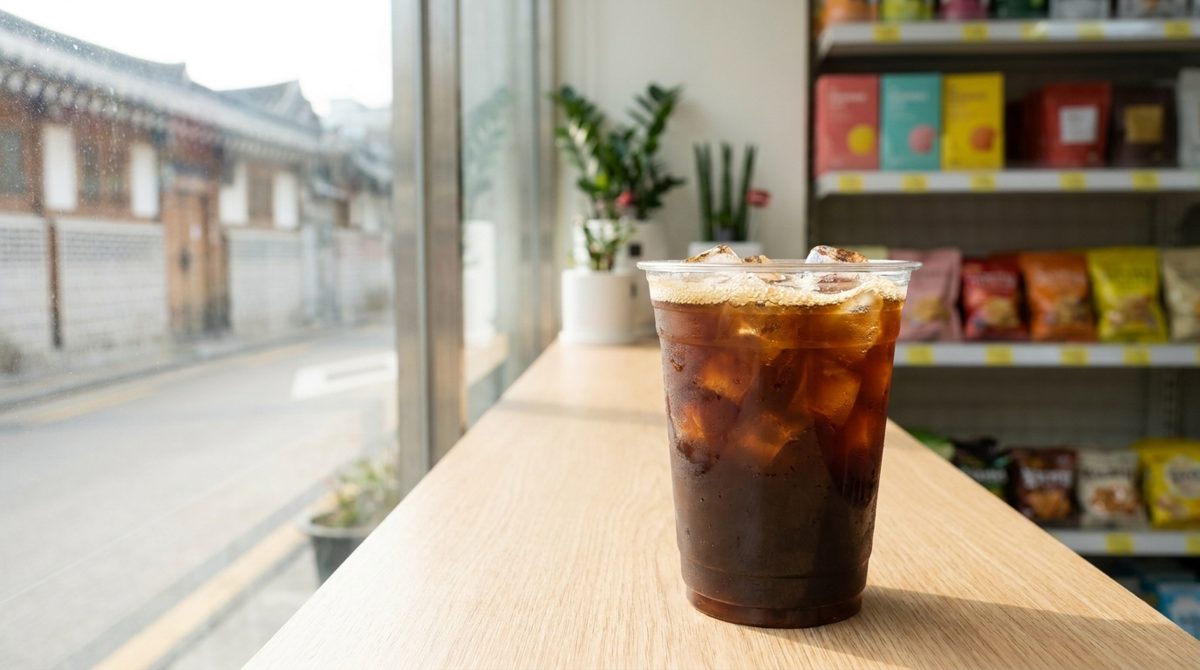
| Item | Details |
|---|---|
| What it is | Three coffee systems in one store: ice cup + pouch, fresh machine espresso, and canned/bottled coffee |
| Where in the store | Ice cups in the freezer chest, pouches in the chilled fridge beside them, cans in the beverage fridge, machine near the counter |
| Price range (2026) | ₩1,200–2,500 all-in — canned from ₩1,200, ice cup + pouch ₩1,500–2,500, machine americano ₩1,200–2,000 |
| Best chains for it | All four — GS25 (Cafe25 machines), CU (GET Coffee), 7-Eleven (Seven Cafe), emart24 |
| Dietary notes | Black coffee is vegan; lattes contain dairy; sugar levels vary wildly — check for “블랙” (black) or “무가당” (no added sugar) |
| Best for | Budget travelers, early risers (cafes open late in Korea), anyone doing a ₩5,000 breakfast run |
The Ice Cup + Pouch System: Korea’s Genius Coffee Hack
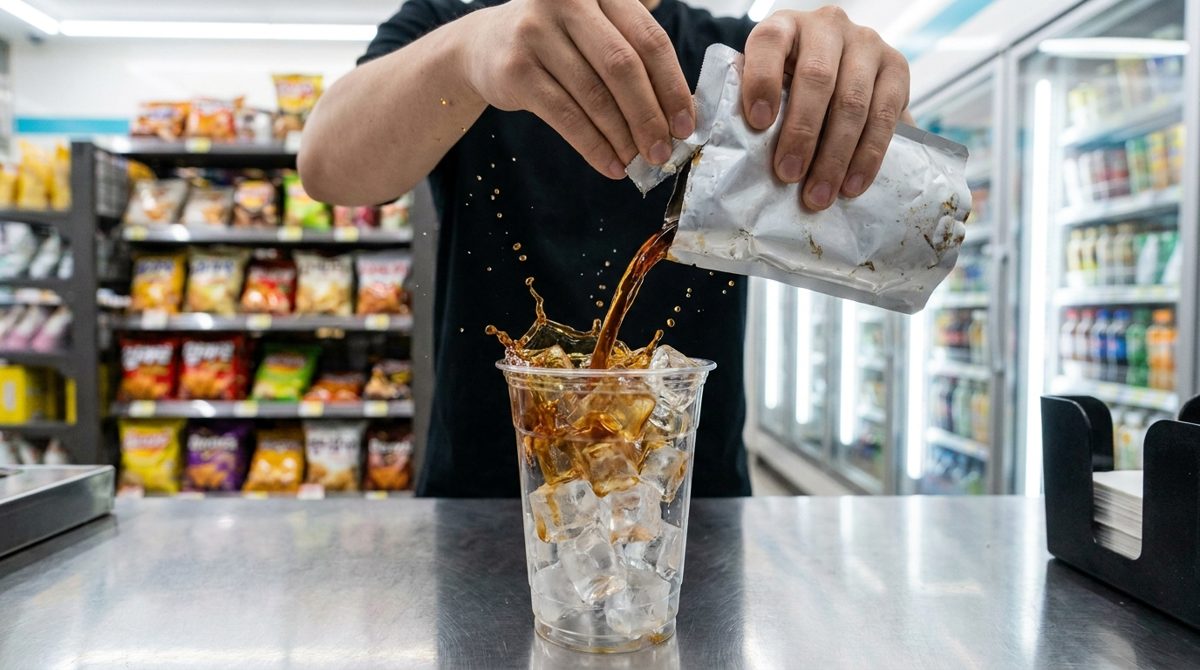
This is the one to master. Korea solved iced coffee logistics with a two-part system so simple it feels like cheating: the store sells you a sealed cup of ice and, separately, a pouch of concentrated coffee. You combine them yourself. Here’s the full walkthrough:
- Grab an ice cup from the freezer chest — the waist-high freezer near the drinks, stacked with clear plastic cups of ice sealed with film. Sizes run small to jumbo (₩500–1,000).
- Pick your pouch from the fridge next to it. Foil pouches of ready-to-drink coffee — americano, latte, vanilla latte, dolce latte, hazelnut — usually ₩1,000–1,800. Juice, tea and ade pouches live there too.
- Pay for both at the counter. Cashiers see this combo hundreds of times a day; no explanation needed.
- Peel the film off the ice cup, tear the pouch corner, pour. The straw slot on the lid is ready to go. Straws and cup carriers are by the counter.
- Total: ₩1,500–2,500 for a large iced coffee that would cost ₩4,500–6,000 at a cafe chain.
Why pouches instead of just selling bottled iced coffee? Freshness economics: the ice stays frozen until the second you pour, so nothing arrives watered down — a genuinely better iced americano than one that’s been sitting on melting ice in a display fridge. In summer, Koreans buy ice cups by the millions per week; it’s a national reflex.
Pro move: the ice cup works with anything. Locals pour in banana milk, canned highballs, juice pouches — the ice cup is a platform, not a product. Welcome to the hack economy of the Korean convenience store.
Fresh Machine Coffee: Cafe25, GET & Seven Cafe
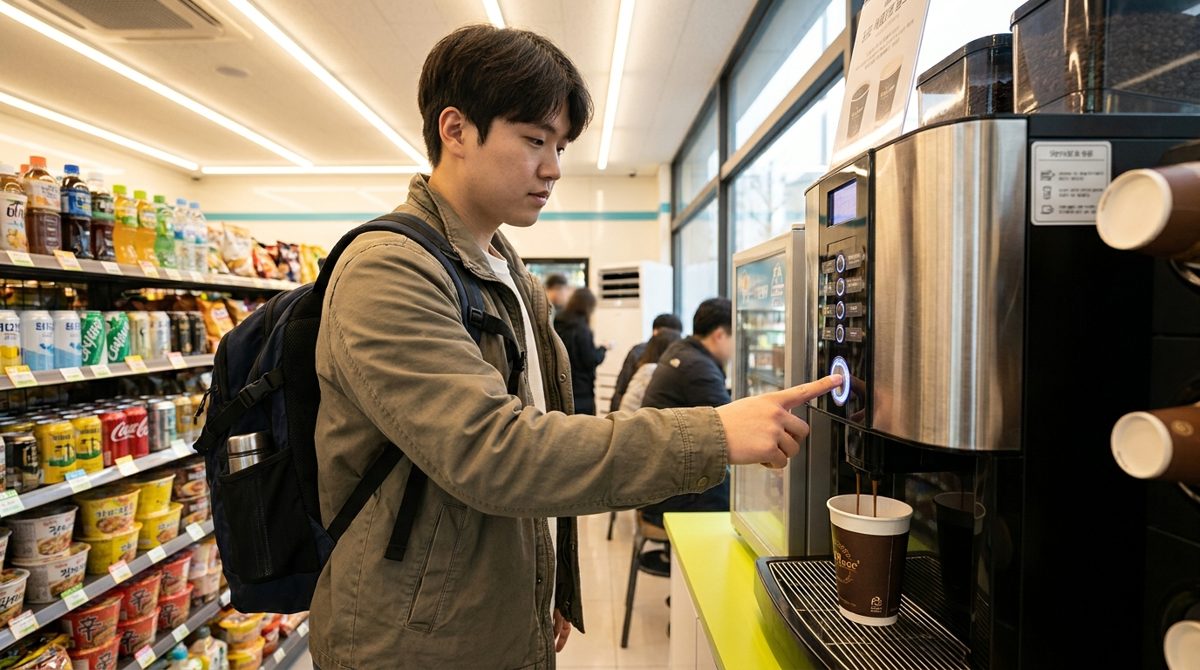
Every major chain now runs its own in-store cafe brand with proper bean-to-cup espresso machines: Cafe25 at GS25, GET Coffee at CU, and Seven Cafe at 7-Eleven. These aren’t sad office-style dispensers — they grind whole beans per cup, and blind taste tests in Korean media regularly rank them shockingly close to budget cafe chains.
How it works: tell the cashier what you want (or tap it on a self-serve kiosk at newer stores), pay, take your cup to the machine, press the button. Hot americano runs ₩1,200–1,500, iced americano ₩1,500–2,000, lattes around ₩2,000–2,500. In tourist-heavy areas, CU’s app and signage even walk you through it in English — about 70 tourist-area CU stores now have AI multilingual translation screens at the counter.
The machine coffee is the move when you want it hot, or when you want the freshest possible cup at 6 a.m. — hours before most Korean cafes open their doors (a real problem for jet-lagged early risers; more on that below).
Which Chain Makes the Best Machine Coffee?
Honest answer: they’re close, and Korean coffee YouTubers argue about it endlessly. The rough consensus in 2026: Cafe25 (GS25) edges ahead on americano balance and store coverage, GET Coffee (CU) wins on latte smoothness and fun seasonal flavors, and Seven Cafe (7-Eleven) is the dark-roast pick. emart24 stores increasingly carry their own machines too, often with the lowest sticker price in the neighborhood.
Practical reality for travelers: the best machine coffee is the one in the store nearest your hotel at 6 a.m. All four chains are within throwing distance of each other in any Korean city block, so taste-test across a few mornings and pick your team. Choosing a chain allegiance is a legitimate Korean pastime — see our GS25 vs CU vs 7-Eleven showdown for the full rivalry.
How to Order Machine Coffee in Korean
Pointing at the menu board works everywhere, but these five phrases make the counter moment effortless:
| What you want | Say this | Romanized |
|---|---|---|
| One iced americano, please | 아이스 아메리카노 하나 주세요 | a-i-seu a-me-ri-ka-no hana juseyo |
| One hot americano, please | 따뜻한 아메리카노 하나 주세요 | tta-tteut-han a-me-ri-ka-no hana juseyo |
| One latte, please | 라떼 하나 주세요 | la-tte hana juseyo |
| Where is the coffee machine? | 커피 기계 어디예요? | keo-pi gi-gye eodi-yeyo? |
| A straw, please | 빨대 주세요 | ppal-dae juseyo |
Bonus vocabulary for the fridge: 아아 (ah-ah) is the beloved national abbreviation for iced americano, and 따아 (tta-ah) is its hot sibling. Drop “아아 하나 주세요” at the counter and you’ll get a grin — it’s like ordering a “flat white, skim” in Melbourne. You’ve signaled you know the culture.
The Canned & Bottled Coffee Lineup (2026 Prices)
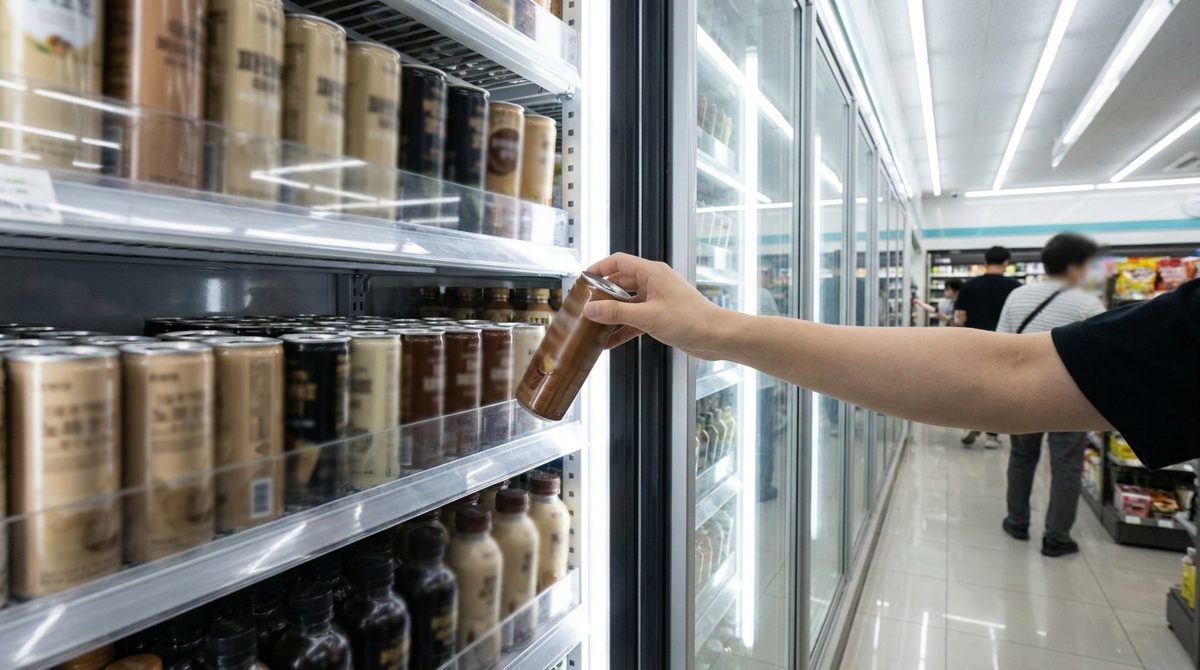
Zero-assembly options fill an entire fridge door. Real names, real 2026 prices:
| Product | What it is | Price (2026) |
|---|---|---|
| Lotte Let’s Be (레쓰비) | The classic sweet-milky small can since 1991 — taxi driver fuel | ₩1,200–1,500 |
| Maxim T.O.P | Sweetish espresso-style cans, master blend and black | ₩1,800–2,200 |
| Lotte Cantata | Smoother premium can and bottle range, decent black options | ₩1,800–2,500 |
| Coca-Cola Georgia (조지아) | Craft-style cans and bottles, max and original lattes | ₩1,800–2,300 |
| Starbucks bottled (파스퇴르 라이선스) | Frappuccino bottles and doubleshot cans — cafe brand, fridge price | ₩2,800–3,500 |
| Cold brew bottles (콜드브루) | Maeil Barista Rules, store-brand cold brews — the connoisseur pick | ₩2,500–3,300 |
| Coffee pouches (파우치) | For the ice cup system — americano to dolce latte | ₩1,000–1,800 |
| Instant sticks (Maxim Mocha Gold) | The yellow stick that fuels the nation — buy a box as a souvenir | ₩100–200 per stick (boxes from ₩5,000) |
Reading the fridge: 블랙 (black) means unsweetened, 라떼 (latte) means milk and usually sugar, 무가당 means no added sugar. Korean canned coffee skews sweet by default — if you’re a black coffee person, Cantata black, Georgia black or any cold brew bottle is your lane. Cans and pouches rotate through 1+1 and 2+1 promotions constantly, so check the shelf tags before you pay.
Convenience Store vs Cafe: The Price Math
Korea is one of the most caffeinated countries on earth — Seoul has more coffee shops than any city its size — but cafe prices climbed hard. In 2026 a basic iced americano runs ₩4,500–5,500 at major chains like Starbucks or Twosome Place, and ₩2,000–3,000 even at budget chains like Mega Coffee. The convenience store undercuts everyone:
| Option | Iced americano price (2026) | Verdict |
|---|---|---|
| Specialty cafe | ₩5,000–7,000 | For the experience, not the caffeine |
| Starbucks / Twosome Place | ₩4,500–5,500 | You’re paying for the seat and the logo |
| Budget chains (Mega, Compose) | ₩2,000–3,000 | Solid, when they’re open |
| CVS machine coffee | ₩1,500–2,000 | Freshly ground, open 24/7 |
| CVS ice cup + pouch | ₩1,500–2,500 | The people’s champion |
| CVS can (Let’s Be) | ₩1,200–1,500 | Cheapest caffeine in the country |
Over a week-long trip with two coffees a day, the convenience store route saves you roughly ₩40,000–60,000 — that’s a whole Korean barbecue dinner recovered from your caffeine budget.
Iced Even in Winter: Korea’s “Eoljuka” Culture
One more phenomenon you’ll witness at the ice cup freezer: it’s minus 10 outside, everyone is wrapped in padded coats, and the person ahead of you is buying a jumbo cup of ice for their americano. This is eoljuka (얼죽아) — short for “I’d rather freeze to death than give up iced americano” — a genuine national identity that Koreans claim with total pride.
Surveys regularly find that a majority of young Koreans drink iced coffee year-round, and convenience stores keep the ice cup freezers fully stocked through January accordingly. Nobody will blink if you join in. If you’d rather not test your cold tolerance, the heated cabinet (온장고) by the register holds warm cans of coffee, tea and honey-citron drinks all winter — the exact opposite philosophy, one meter away.
Either way, the window counter is your reward: coffee in hand, watching Seoul wake up through the glass. It costs a fifth of a cafe and honestly beats most of them for people-watching.
Morning Coffee Culture & Pro Hacks
Here’s the thing nobody tells first-time visitors: Korean cafes open late. Outside office districts, many don’t unlock until 9, 10, even 11 a.m. — brutal when jet lag has you wide awake at dawn. The convenience store is the answer: open 24/7, machine coffee flowing at 5 a.m., window counter seat included. Morning commuters grabbing a machine americano plus a triangle kimbap or sandwich is the true Korean breakfast rush — join it.
Local hacks worth stealing:
- The ₩5,000 breakfast set: machine americano + triangle kimbap + banana milk for dessert. See our full convenience store food guide for the best pairings.
- Hot in one hand, hack in the other: in winter, locals buy a hot can from the heated cabinet (온장고) near the register — warm hands, then dessert.
- Eat-in etiquette: the window counter is fair game for as long as you like, but bus your own trash. Sort it: cups and cans in recycling, liquid in the liquid bin. Ice cup film and straws go in general waste.
- Decaf exists: look for 디카페인 (decaf) on Cantata and Starbucks bottles — a 2020s addition that’s now standard in bigger stores.
- Caffeine warning labels: Korean law requires total caffeine content printed on every can — handy if you’re pacing yourself. High-caffeine drinks carry a red 고카페인 badge.
And no, you don’t need to buy anything else to sit there, there’s no tipping, and no one will move you along — convenience store counters are Korea’s most democratic seating. Students cram for exams at them, office workers take calls, and delivery riders warm up between runs. As a traveler, it’s also the single best place to plan your day: free Wi-Fi in most stores, a power outlet if you’re lucky, and a ₩2,000 americano instead of a ₩5,500 one buying you the seat.
Cultural footnote: Korea’s love affair with accessible coffee started with the humble instant Maxim stick and the office vending machine — the ₩300 “자판기 커피” of the 1990s. The convenience store systems of today are the direct descendants: coffee as a fast, cheap, democratic ritual rather than a luxury. The Korea Tourism Organization’s VisitKorea site even lists cafe culture itineraries if you want the fancy end of the spectrum too.
Convenience Store Coffee FAQ
How does the ice cup and coffee pouch system work?
Buy a sealed cup of ice from the freezer chest and a foil pouch of coffee from the fridge beside it, pay for both, then peel the film, pour the pouch over the ice, and drink through the lid’s straw slot. Total cost is ₩1,500–2,500 for a large iced coffee.
How much is convenience store coffee in Korea in 2026?
Canned coffee starts at ₩1,200, fresh machine americanos run ₩1,200–2,000, and the ice cup + pouch combo costs ₩1,500–2,500. Compare that with ₩4,500–5,500 for an iced americano at major cafe chains, and the savings add up fast.
Is Korean convenience store machine coffee any good?
Genuinely yes. GS25’s Cafe25, CU’s GET Coffee and 7-Eleven’s Seven Cafe machines grind whole beans per cup, and Korean media taste tests rank them close to budget cafe chains. It won’t beat a specialty pour-over, but at a third of the price and available 24/7, it doesn’t need to.
Can I get unsweetened black coffee at a Korean convenience store?
Easily. Look for 블랙 (black) or 무가당 (no added sugar) on cans and pouches — Cantata Black, Georgia Black and cold brew bottles are reliable picks — or order a plain americano from the in-store machine, which comes unsweetened by default.
Why do Koreans buy cups of ice at convenience stores?
The sealed ice cup keeps drinks undiluted until the moment you pour, works with any beverage (coffee pouches, juice, banana milk, even canned highballs), and turns every convenience store into a self-serve iced-drink bar. In summer, Korean chains sell millions of ice cups per week.
Verdict: The Best Cheap Coffee in Korea Isn’t at a Cafe
Convenience store coffee is one of those systems that makes you wonder why the rest of the world hasn’t copied it yet. Fresh machine espresso from ₩1,200, the gloriously satisfying ice-cup-and-pouch ritual, and a canned lineup deep enough to fuel a semester of studying — all open 24 hours, all a one-minute walk from wherever you’re standing in Korea. Master it on day one and put the savings toward dinner. For everything else worth grabbing while you’re in the store, dive into the full Korean Convenience Store Explorer.