Scrolling through fiery-food videos and wondering what dakbal actually is? Dakbal (닭발) is Korea’s famously fiery chicken feet dish — chicken feet grilled or braised in an intensely spicy gochujang-and-gochugaru glaze, then eaten off the bone (or boneless) as a late-night bar snack. It’s chewy, gelatinous, addictive, and considered one of the spiciest common dishes in the country. This decoder page covers taste, spice level, allergens, halal status, real 2026 prices, and exactly how to order it.
Table of Contents
- Dakbal Quick Facts
- What Is Dakbal, Exactly?
- What Does Dakbal Taste Like?
- Dietary Guide: Vegetarian, Vegan, Halal & Allergens
- How to Order Dakbal in Korean (+ 2026 Prices)
- How to Eat Dakbal Like a Local
- Types of Dakbal
- Where to Try Dakbal
- Dakbal FAQ
Dakbal Quick Facts

| Item | Details |
|---|---|
| Korean name | 닭발 (dakbal) — “chicken feet”; boneless version: 무뼈닭발 (mu-ppyeo dakbal) |
| Pronunciation | DAHK-bahl |
| Type | Chicken feet, grilled or braised in spicy glaze — bar snack / anju (drinking food) |
| Spice level | 🌶️ 4–5 / 5 — one of the spiciest widely-eaten Korean dishes |
| Price (2026) | ₩13,000–₩18,000 per plate in Seoul |
| Vegetarian | ❌ No — 100% chicken |
| Vegan | ❌ No |
| Halal-friendly | ⚠️ Chicken-based (no pork, no alcohol in the dish itself), but rarely halal-certified in Korea and almost always served alongside soju/beer as bar food |
| Main allergens | Soy, sesame |
| Best for | Spice-challenge seekers, adventurous eaters, late-night drinking-culture food, social media “fire food” content |
What Is Dakbal, Exactly?
Dakbal is exactly what it sounds like: dak (chicken) + bal (feet). Chicken feet — cleaned, boiled, and either left bone-in or deboned — are marinated and cooked in a blazing marinade built from gochujang (fermented chili paste), gochugaru (chili flakes), garlic, ginger, and often a splash of soju or sugar for balance. The result is a sticky, glossy, deep-red glaze clinging to skin and cartilage that Koreans consider one of the ultimate “anju” — food built specifically to pair with alcohol.
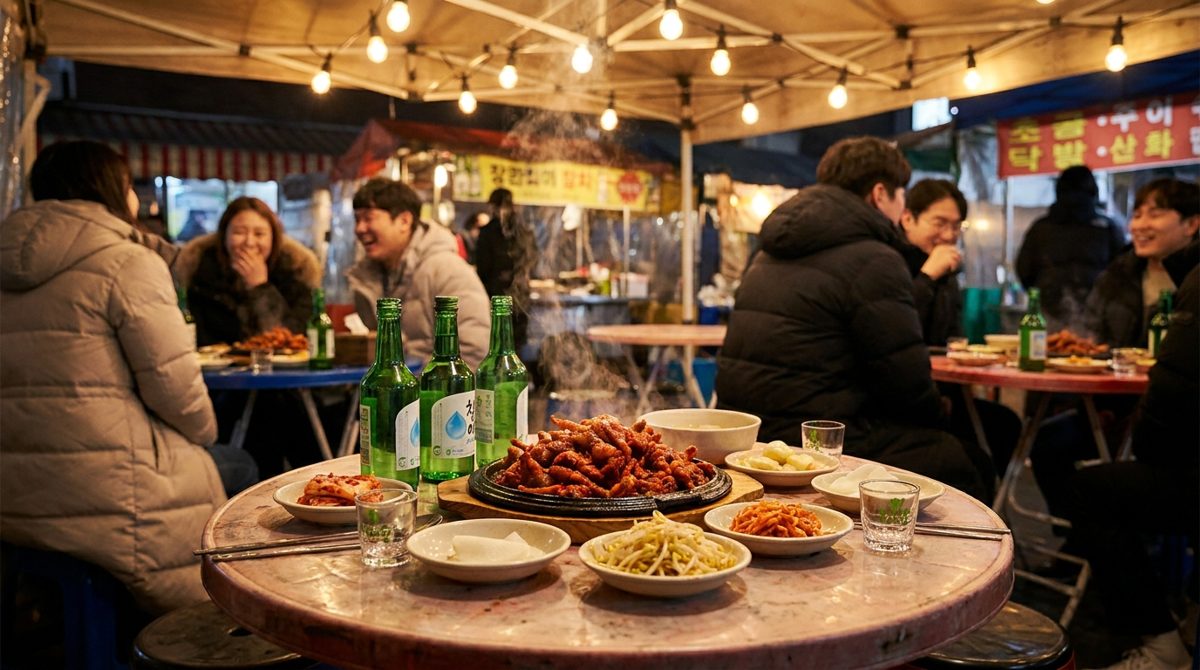
The dish grew out of Korea’s postwar food culture, when no part of the chicken went to waste, and it thrived in the pojangmacha (street tent bars) and dakbal-specialist restaurants that still define the genre today. Unlike fried chicken, dakbal isn’t really a meal on its own — it’s a shared plate ordered specifically because it’s spicy, chewy, and demands a cold drink alongside it.
In the last decade, dakbal has become internet-famous well beyond Korea thanks to “spice challenge” videos: foreign YouTubers and mukbang creators filming their reactions to the heat. That online fame is now part of why curious travelers seek it out — it’s less a comfort food and more a dare, a badge of honor, and genuinely delicious if you can handle chili heat.
Locally, dakbal carries a slightly different reputation: it’s considered a hangover-adjacent comfort food as much as a challenge dish. Office workers order it after a long week specifically because the intense heat, the collagen-rich texture, and the ritual of picking meat off small bones force you to slow down and focus on eating rather than talking, which pairs oddly well with a long night of drinking. It’s social food in the truest sense — nobody orders a single serving of dakbal alone.
What Does Dakbal Taste Like?
Dakbal tastes intensely spicy, sweet-savory, and deeply garlicky, with a smoky char if grilled. The texture is the real surprise for first-timers: chicken feet are mostly skin, cartilage, and collagen rather than meat, so the bite is chewy, sticky, and slightly gelatinous — closer to eating a well-cooked chicken wing tip than a drumstick. Bone-in versions require gnawing and sucking the bones clean; boneless (mu-ppyeo) versions are softer and easier to eat quickly.
Is Dakbal Spicy?
Yes — dakbal is genuinely one of the spiciest common dishes in Korea, rated 4 to 5 out of 5 by most travelers. The heat comes from a concentrated blend of gochugaru and gochujang cooked down into a thick glaze that coats every piece, so unlike bibimbap, there’s no way to “add less” once it’s served. If you’re spice-sensitive, ask for “deol-maepge” (덜 맵게, “less spicy”) when ordering, though many small bar kitchens only make one fire level. Have milk, yogurt drink (Yakult), or rice ready — water won’t help with capsaicin.
What makes dakbal’s heat distinct from, say, buldak instant noodles or fire chicken chains is that it isn’t a one-note burn. The sauce is layered: sweetness from sugar or corn syrup upfront, garlic and ginger in the middle, and a slow-building chili heat that intensifies over several bites rather than hitting all at once. First-timers often say the second and third pieces feel hotter than the first — that’s the capsaicin building up on your tongue, not the food itself getting spicier.

Dakbal Dietary Guide: Vegetarian, Vegan, Halal & Allergens
Dakbal is a straightforward “no” for most dietary restrictions except spice tolerance — here’s the full picture.
| Ingredient concern | In standard dakbal? | How to handle |
|---|---|---|
| Chicken | Yes — it’s the entire dish (feet) | No substitution exists; this is not a dish you can “order without” the main ingredient |
| Pork | No | Not a concern |
| Alcohol (in the dish) | Sometimes a splash of soju in the marinade or cooking liquid | Ask “sul an neoko juseyo” (술 안 넣고 주세요, “please don’t add alcohol”) — not guaranteed to be honored at every stall |
| Soy | Yes | Soy sauce is a base seasoning; unavoidable |
| Sesame | Yes | Sesame oil and seeds are standard garnish; hard to remove |
| Wheat / gluten | Sometimes, via gochujang | Most commercial gochujang contains wheat flour |
| Shellfish / fish | Occasionally, via fish sauce or shrimp paste in the marinade | Ask if concerned; varies by kitchen |
| Dairy / nuts | No | Not part of traditional recipes |
Is Dakbal Vegetarian or Vegan?
No. Dakbal is chicken feet — there is no meaningful way to make it vegetarian or vegan, since the dish’s entire identity is the collagen-rich texture of the feet themselves. Skip it entirely if you don’t eat meat; there’s no “hold the chicken” version. If you want the same fiery gochujang flavor profile without meat, look for spicy tteokbokki (rice cakes) instead, which shares the sauce style but is fully vegetarian at most stalls.
On the nutrition side, dakbal is low in actual muscle protein but notably high in collagen, which is part of why it’s marketed in Korea as a beauty-and-skin food alongside its role as a drinking snack. It’s relatively low-calorie for a bar food — most of the weight is skin, cartilage, and sauce rather than dense meat — but the sauce itself is high in sodium and sugar, so it’s best treated as an occasional indulgence rather than a health dish.
Is Dakbal Halal?
In principle, chicken is halal-friendly — dakbal contains no pork, and the base recipe doesn’t require alcohol. In practice, dakbal is rarely halal-certified in Korea: most restaurants serving it are drinking-culture bar-food specialists (dakbal-jip and pojangmacha) rather than halal-certified kitchens, some marinades include a splash of soju or mirin during cooking, and the dish is culturally inseparable from soju-and-beer bar culture, which matters for some Muslim travelers even beyond the ingredients. If halal certification matters to you, ask directly before ordering, or check the Korea Tourism Organization’s Muslim-friendly restaurant listings on VisitKorea rather than assuming any given dakbal restaurant qualifies.
How to Order Dakbal in Korean (+ 2026 Prices)
Dakbal restaurants are usually small, local, and not particularly tourist-oriented, so a few key phrases go a long way:
| What you want | Say this | Romanized |
|---|---|---|
| One order of dakbal, please | 닭발 하나 주세요 | dakbal hana juseyo |
| Boneless version | 무뼈닭발 주세요 | mu-ppyeo dakbal juseyo |
| Bone-in version | 뼈닭발 주세요 | ppyeo-dakbal juseyo |
| Less spicy, please | 덜 맵게 해주세요 | deol-maepge haejuseyo |
| Extra spicy (for the brave) | 더 맵게 해주세요 | deo-maepge haejuseyo |
What it costs in 2026: a standard plate of dakbal runs ₩13,000–₩18,000 in Seoul, usually sized for 2–3 people to share alongside drinks. Boneless (mu-ppyeo) versions sometimes run slightly higher due to the extra prep labor. Most dakbal spots are casual, cash-friendly bars rather than sit-down restaurants — see our Korean dining etiquette guide for how ordering and sharing work at this kind of table.
How to Eat Dakbal Like a Local
Dakbal is drinking food first, and eating it solo without a drink is unusual — order it as anju alongside soju or beer, the way locals do. If it’s bone-in, use your fingers (disposable gloves are often provided) and gnaw the meat and cartilage directly off the small bones; there’s no elegant way to do this, and that’s part of the fun. Keep something cooling nearby — a glass of milk, a Yakult yogurt drink, or plain rice — because the heat builds with each piece rather than fading.
Many dakbal restaurants offer a bokkeum-bap (볶음밥, fried rice) finish: after most of the meat is gone, staff will fry rice directly in the leftover spicy sauce at your table, turning the fiery glaze into a second course. Always say yes to this if offered — it’s often the best part of the meal.
A few practical tips locals take for granted but visitors don’t: wet wipes or a hand-washing sink are essential since bone-in dakbal is a hands-on food, and most restaurants provide disposable gloves — use them, since the chili oil stains and lingers on skin for hours. Order a side of plain rice or extra banchan cucumber slices to break up the heat between bites. And don’t be surprised if the table next to you orders a second and third round; dakbal is often eaten slowly over a two-hour drinking session rather than as a quick meal.
Types of Dakbal You’ll See on Menus
Ppyeo-dakbal (뼈닭발) is the traditional bone-in version, and it’s the one most older dakbal-jip restaurants still specialize in. The small bones stay in, which means more work per bite but also more flavor, since the cartilage and marrow-adjacent tissue soak up the sauce during cooking. This is the version to order if you want the “full” experience and don’t mind eating with your hands.
Mu-ppyeo dakbal (무뼈닭발) is the boneless version, deboned by hand before cooking so the whole piece can be eaten in one or two bites with chopsticks. It’s become the more popular choice at newer restaurants and delivery apps because it’s faster, less messy, and easier for first-time visitors to manage without feeling intimidated by small chicken bones.
Grilled dakbal (dakbal gui, 닭발구이) is cooked directly over open flame or on a hot grill plate, giving the glaze a lightly smoky, slightly charred edge that balances the sweetness of the sauce. Braised or stewed dakbal (dakbal jjim, 닭발찜) is simmered in the spicy sauce rather than grilled, producing a softer texture and a wetter, saucier dish often served bubbling in a shallow pot at the table — this version is generally milder to eat because the sauce coats more gently than a hard-grilled glaze. Some restaurants also list a “buldak-style” dakbal, which pushes the chili oil and gochugaru even further for diners chasing maximum heat.
Where to Try Dakbal
Dakbal is a neighborhood-bar dish rather than a tourist-restaurant one, which means the best versions are often found at unassuming, decades-old spots with plastic stools and no English menu. Dedicated dakbal-jip (chicken feet specialist restaurants) exist throughout Seoul, especially in nightlife-heavy areas near university districts and office districts where after-work drinking culture is strongest — look for hole-in-the-wall places with red signage, a menu that’s almost entirely chicken feet variations, and a crowd that skews local rather than tourist.
Traditional markets and Korean street food alleys sometimes have grilled skewered versions as well, usually the boneless mu-ppyeo style since it’s faster to serve to walk-up customers. If a restaurant’s menu lists both bone-in and boneless dakbal alongside a fried rice finishing option, that’s usually a sign of a specialist kitchen worth trusting. If you’re building out a broader spicy-food crawl, pair a dakbal visit with our tteokbokki spot guide for a full gochujang-heat tour of the city, or read up on Korean drinking food more broadly through the Korean street food guide. Pairing it with a full Korean BBQ night is also common, since many grill restaurants serve dakbal as a side order alongside the main meat course.

Dakbal FAQ
What is dakbal made of?
Dakbal is made from chicken feet — cleaned, boiled, then grilled or braised in a marinade of gochujang, gochugaru, garlic, ginger, and soy sauce. It’s served bone-in or deboned (mu-ppyeo).
Is dakbal actually spicy?
Yes, very. Dakbal is rated 4 to 5 out of 5 on the spice scale by most travelers and is considered one of the hottest widely-available Korean dishes, thanks to a concentrated gochujang-gochugaru glaze that coats every bite.
Is dakbal just chicken skin, or is there meat?
There’s very little actual meat. Chicken feet are mostly skin, cartilage, tendon, and collagen, giving dakbal its distinctive chewy, sticky texture rather than a meaty one — similar in mouthfeel to chicken wing tips.
Is dakbal halal?
Chicken itself is halal-friendly and dakbal contains no pork, but it’s rarely halal-certified in Korea, some marinades include a splash of soju, and it’s overwhelmingly served as bar food alongside alcohol. Confirm with the restaurant directly or check Korea Tourism Organization’s Muslim-friendly listings rather than assuming.
How much does dakbal cost in Korea in 2026?
A shareable plate of dakbal costs ₩13,000–₩18,000 in Seoul in 2026, typically sized for two to three people to split alongside drinks.
The Verdict: Should You Order It?
If you like spicy food and want a genuinely local, off-the-tourist-trail experience, dakbal is worth seeking out — just go in knowing it’s a drinking-culture dare dish, not a polite dinner order. Bring a drink, bring tolerance for chili heat, and order the boneless version if it’s your first time. Curious what else belongs on your must-try list? Explore the rest of our Korean Food Decoder — every major Korean dish explained with spice levels, allergens, and ordering phrases.