Wondering what soju actually is before your first night out in Korea? Soju (소주) is Korea’s iconic clear distilled spirit — a smooth, faintly sweet liquor historically made from rice but now more often distilled from sweet potato, tapioca, or other starches, then diluted down to 16–25% ABV. It’s the world’s best-selling liquor by volume and the social glue behind Korean dining, from cheap plastic-cup bar tables to fine-dining pairings. This decoder covers taste, alcohol content, dietary status, real 2026 prices, and exactly how to drink it like a local.
Table of Contents
- Soju Quick Facts
- What Is Soju, Exactly?
- What Does Soju Taste Like? (And How Strong Is It?)
- Dietary Guide: Vegetarian, Vegan, Halal & Allergens
- How to Order & Buy Soju (+ 2026 Prices)
- How to Drink Soju Like a Local
- Types of Soju: Brands & Variants
- Where to Try & Buy Soju
- Soju FAQ
Soju Quick Facts
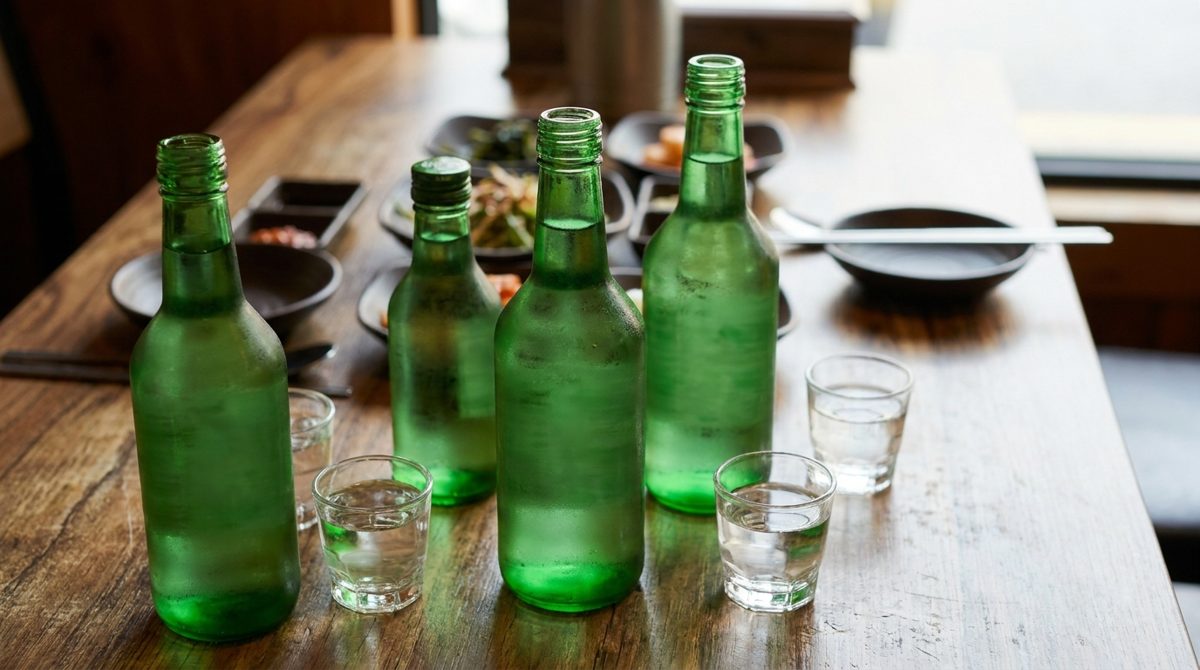
| Item | Details |
|---|---|
| Korean name | 소주 (soju) — “burned liquor,” from its distilled origins |
| Pronunciation | SO-joo |
| Type | Clear distilled spirit, traditionally rice-based; most modern mass-market brands use diluted distillate from sweet potato, tapioca, or grain |
| Alcohol content | 16–25% ABV — mainstream brands have trended down to a “clean,” lower-ABV 16–17% in recent years |
| Price (2026) | ₩4,000–₩6,000 per 360ml bottle at restaurants; ₩1,800–₩2,500 retail at convenience stores and marts |
| Vegetarian | ✅ Typically — grain/starch-based with no animal ingredients |
| Vegan | ✅ Typically — check flavored variants for honey or unclear sweeteners |
| Halal-friendly | ❌ No — it’s alcohol. Not halal regardless of base ingredient |
| Main allergens | Minimal, since distillation removes protein; flavored sojus add sugar, fruit extract, or artificial sweeteners |
| Best for | Chimaek and anju drinking culture, budget nightlife, somaek mixing, understanding Korean drinking etiquette |
What Is Soju, Exactly?
Soju is Korea’s national spirit: a clear, neutral-tasting liquor that shows up on almost every restaurant table in the country. The name literally means “burned liquor” (소 = burn/distill, 주 = alcohol), a reference to the distillation process. Historically, soju was made by distilling fermented rice — the same basic technique behind Chinese baijiu and Japanese shochu, all tracing back to distillation methods that arrived in Korea with Mongol forces in the 13th century, who set up distilleries around the city of Andong.
For centuries soju stayed a strong, rice-based spirit. That changed in 1965, when a national rice shortage led the government to ban using rice for alcohol production. Distillers switched to sweet potatoes, tapioca, and other starches, and — more importantly — started diluting the distillate with water instead of relying on full distillation alone. This “diluted soju” (희석식 소주) became the mass-market standard and is what almost every bottle of Chamisul, Chum Churum, or Jinro contains today, even though rice restrictions have since been lifted.
The past two decades brought another shift: ABV has crept steadily downward. Bottles that were once 25%+ now commonly sit around 16–17%, marketed as “clean” or smoother soju to match changing drinking habits. Meanwhile, small-batch distillers have revived traditional, higher-proof rice soju (like Andong soju, some bottled near 45% ABV) for drinkers chasing the original style. Today soju is the best-selling liquor on earth by volume, driven almost entirely by domestic Korean consumption.
What Does Soju Taste Like? (And How Strong Is It?)
Mainstream diluted soju tastes clean, faintly sweet, and mild compared to Western spirits — closer to a soft vodka than whiskey or tequila. There’s a light alcohol burn on the way down, a subtle starchy sweetness, and almost no strong aroma. It’s designed to be easy to drink quickly and to pair with food rather than to be sipped and savored like a fine spirit. Flavored versions (grapefruit, peach, yogurt) taste like a mild alcoholic soda and go down even easier, which is exactly why they’re popular with first-time drinkers.
How Strong Is Soju?
Standard soju runs 16–25% ABV, with most major convenience-store brands now sitting around 16–17% — roughly a third the strength of vodka or whiskey (40% ABV) but far stronger than beer (4–5%) or wine (12–14%). Traditional Andong-style rice soju and some premium bottles run much higher, 40–45% ABV, closer to a Western spirit. Because mainstream soju tastes so mild, it’s easy to underestimate how quickly it adds up — a full 360ml bottle at 16% ABV contains roughly the same total alcohol as four to five standard beers.
Soju Dietary Guide: Vegetarian, Vegan, Halal & Allergens
As a distilled spirit, soju is simpler on the dietary front than most Korean dishes — but alcohol itself is the one dealbreaker that no amount of substitution fixes.
| Concern | In standard soju? | Notes |
|---|---|---|
| Alcohol | Yes, always | 16–25% ABV; this alone makes soju off-limits for anyone avoiding alcohol for religious, health, or personal reasons |
| Animal products | No | Base ingredients are rice, sweet potato, tapioca, or grain — no dairy, egg, or meat involved |
| Gluten / wheat | Minimal to none | Distillation generally removes gluten proteins; most modern soju is starch-based (sweet potato/tapioca) rather than wheat-based anyway |
| Added sugar | Only in flavored versions | Plain soju has little to no added sugar; fruit-flavored soju (grapefruit, peach, yogurt) adds real sugar or sweeteners |
| Common allergens (nuts, soy, shellfish) | No | Not present in the distillation process |
| Calories | ~300 kcal per 360ml bottle | Comparable to 2–3 beers; flavored versions add more from sugar |
Is Soju Vegetarian or Vegan?
Yes, typically. Standard soju is distilled from plant starches — rice, sweet potato, tapioca, or grain — with no animal-derived ingredients in the production process, making it vegetarian and vegan-friendly by default. The one thing to watch is flavored soju: some fruit or “milk/yogurt”-flavored variants use dairy-derived flavoring or unclear sweetener sourcing, so if you’re strictly vegan, stick to plain (original) soju or check the label for the flavored kind.
Is Soju Halal?
No. Soju is an alcoholic beverage, and alcohol is not halal under Islamic dietary law — this is true regardless of what the soju is distilled from, how “clean” or low-ABV the marketing claims it is, or whether it’s a traditional or modern style. There’s no version of soju, flavored or otherwise, that changes this. Muslim travelers visiting Korea can still fully enjoy Korean food culture: order non-alcoholic drinks alongside the same anju (drinking snacks) — many restaurants happily serve soda, juice, or barley tea instead, and no one will pressure you to drink.
How to Order & Buy Soju in Korea (+ 2026 Prices)
Soju is sold everywhere, and ordering it is simple even with zero Korean. These phrases help at restaurants and bars:
| What you want | Say this | Romanized |
|---|---|---|
| One bottle of soju, please | 소주 한 병 주세요 | soju han byeong juseyo |
| Chamisul, please (brand request) | 참이슬 주세요 | chamisul juseyo |
| Another bottle, please | 한 병 더 주세요 | han byeong deo juseyo |
| A somaek (soju-beer mix), please | 소맥 주세요 | somaek juseyo |
| Cheers! | 건배! | geonbae! |
What it costs in 2026: a standard 360ml bottle of soju runs ₩4,000–₩6,000 at restaurants and pubs in Seoul (pojangmacha tents and neighborhood joints trend cheaper; trendy bars in Hongdae or Itaewon trend higher). At convenience stores and marts like GS25, CU, or E-Mart, the same bottle is a budget-friendly ₩1,800–₩2,500 — one of the cheapest ways to drink in the country. Bottles are almost always 360ml; some brands also sell smaller 200ml “mini” bottles and larger multi-serving formats for groups. See our Korean convenience store food guide for what to pair it with on a budget night in.
How to Drink Soju Like a Local
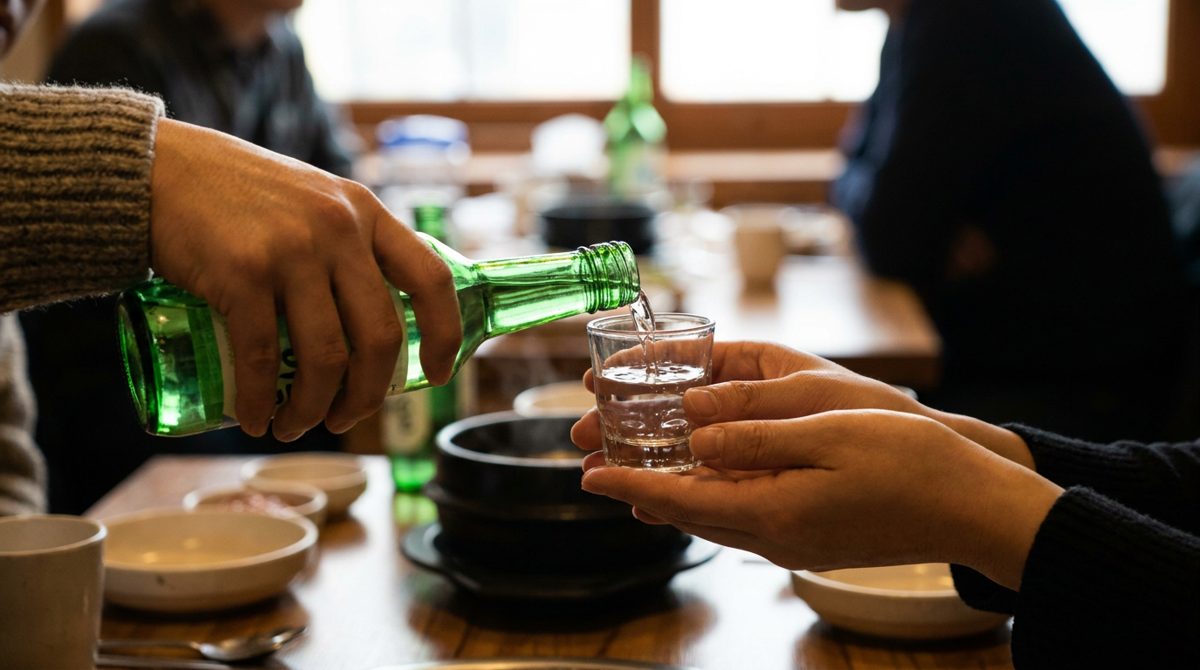
Korean drinking culture runs on a few unspoken rules, and following them will earn you real goodwill. First: never pour your own glass. Drinking is communal — you pour for others, and they pour for you. Keep an eye on your neighbors’ glasses and offer a refill before they ask.
Second, the two-hands rule: when pouring for someone older or more senior, or receiving a pour from them, use two hands (one hand holding the bottle or glass, the other supporting your forearm or resting on your chest) as a sign of respect. Pouring or receiving with one hand toward an elder is considered casual to the point of rude.
Third, if you’re drinking in front of an elder or superior and it’s your first drink together, turn your head and body slightly away as you take the sip, covering your glass with your free hand. This custom, sometimes called “elder-facing etiquette,” still matters at traditional dinners even though younger Koreans relax it among friends.
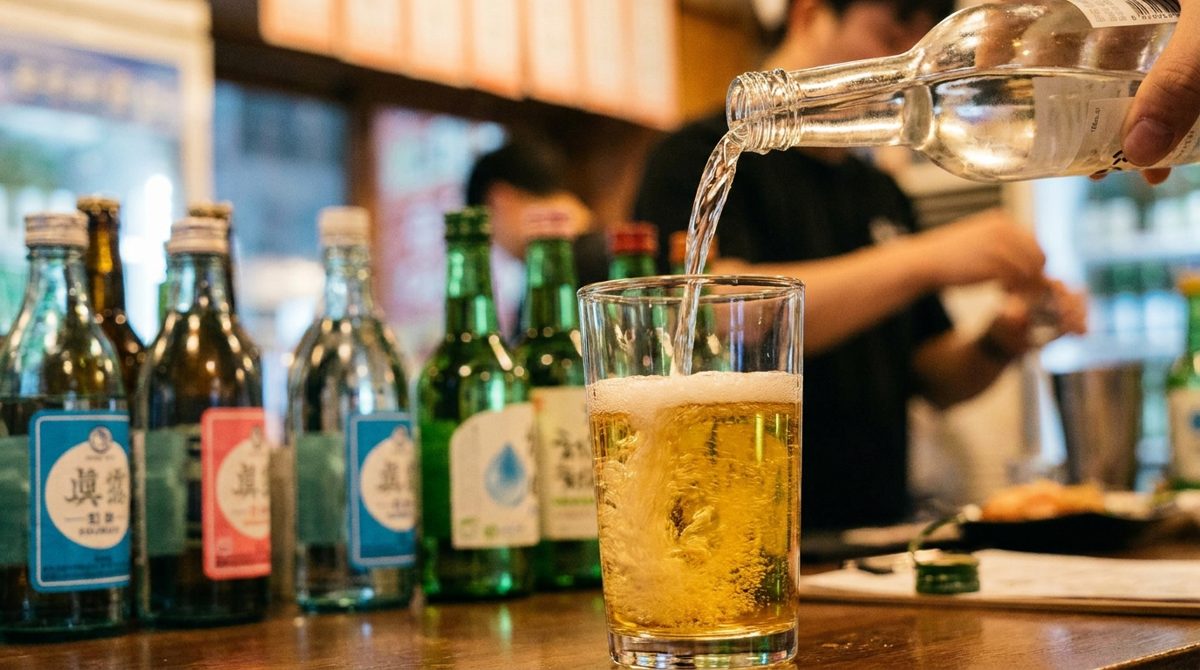
Finally, don’t skip somaek (소맥) — a mix of soju and beer, typically built with a ratio anywhere from 1:3 to 1:7 soju-to-beer depending on preference, often stirred with a spoon or by tapping the table to create a fizzy head. It’s the single most popular way Koreans drink soju at group dinners, and ordering it correctly (“somaek juseyo”) is an instant local-culture win.
Types of Soju: Brands & Variants
Chamisul (참이슬) — HiteJinro’s flagship, the best-selling soju in Korea; the green bottle you’ll see everywhere. Chum Churum (처음처럼) — Lotte’s rival brand, marketed as extra-smooth and “clean” tasting; the two brands have a friendly, near-nationwide rivalry. Jinro (진로) — the historic blue-bottle original, relaunched in a retro design that became a viral hit with younger drinkers. Andong soju (안동소주) — traditional, higher-proof rice soju from Andong, often 40–45% ABV, sold in ceramic bottles as a cultural, sipping-style spirit rather than a fast-drinking one.
Flavored soju has exploded in popularity: grapefruit (자몽), peach, green grape, yogurt, and other fruit flavors run 12–14% ABV and taste closer to an alcoholic soda than a spirit — a common gateway for visitors who find plain soju too sharp. Premium and craft soju, like Hwayo (화요) or Ilpoom Jinro, use traditional rice distillation without dilution, cost several times more than mass-market bottles, and are aimed at sipping, gifting, or pairing with fine dining rather than group drinking games.
Where to Try & Buy Soju
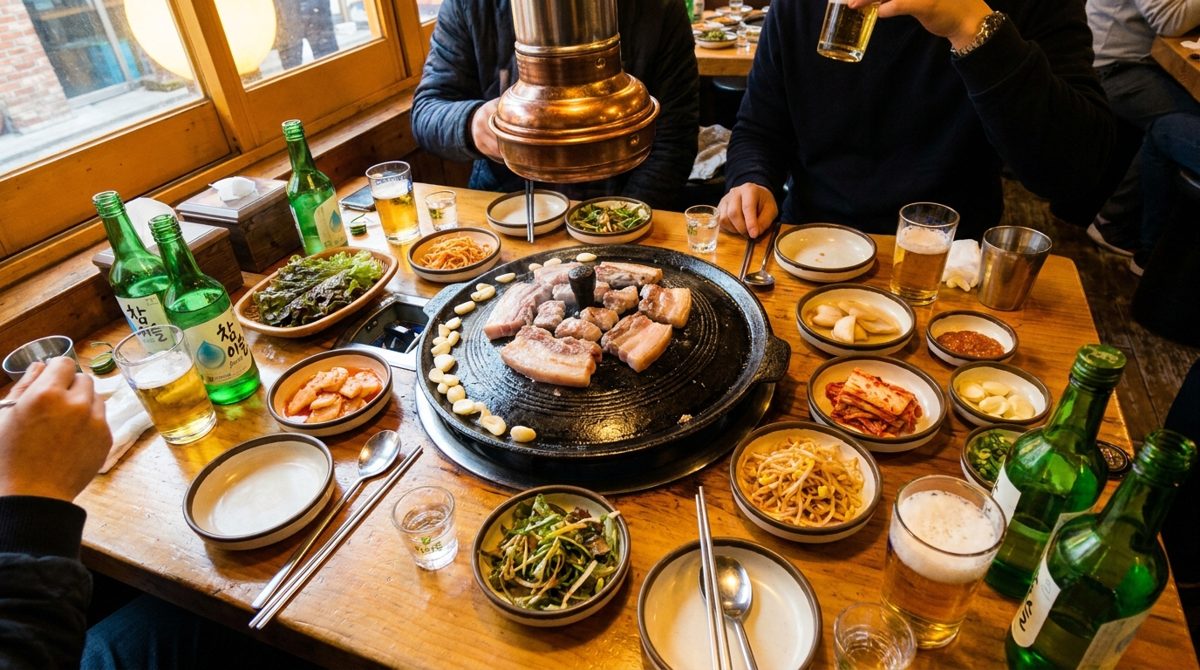
You don’t need to seek soju out — it finds you. Any Korean BBQ restaurant serving samgyeopsal or galbi will have it on the table, and it’s the default pairing for anju (drinking food) like fried chicken, dried squid, or kimchi jjigae. For an authentic night out, look for a pojangmacha (orange tent bar) or a neighborhood hof (pub); for the full etiquette experience — pouring, toasting, and the two-hands rule in action — a group dinner with Korean coworkers or friends is the real classroom. Convenience stores sell it 24/7 for drinking at a hangang (riverside park) picnic, a beloved Seoul tradition. If you want to compare soju against Korea’s other traditional drink, our sibling guide on what makgeolli is covers the milky rice-wine alternative. And for the food pairing question everyone asks, see our decoder pages on samgyeopsal and jokbal — Korea’s two most iconic soju anju.
Soju FAQ
What does soju taste like?
Clean, faintly sweet, and mild compared to Western spirits — closer to a soft vodka than whiskey. There’s a light alcohol burn but almost no strong aroma, which is why it goes down easily and pairs well with food.
How strong is soju compared to beer or vodka?
Standard soju is 16–25% ABV, roughly three to four times stronger than beer (4–5%) but less than half the strength of vodka or whiskey (40% ABV). Traditional rice soju like Andong soju can reach 40–45% ABV.
Is soju gluten-free?
Generally yes — distillation removes gluten proteins, and most modern mass-market soju is distilled from sweet potato or tapioca rather than wheat. If you have celiac disease, it’s still worth checking with sensitive-diet resources, since trace cross-contamination policies vary by producer.
What is somaek?
Somaek (소맥) is a mix of soju and beer, one of the most common ways Koreans drink at group dinners. Ratios vary from about 1:3 to 1:7 soju-to-beer, and it’s often ceremonially stirred or given a frothy pour before the first “geonbae” (cheers).
Is soju halal?
No. Soju is alcohol, and alcohol is not halal under Islamic dietary law, regardless of the base ingredient or ABV. There is no halal version of soju.
The Verdict: Should You Try It?
If you’re eating Korean BBQ, fried chicken, or pretty much any dinner with local friends, you’ll be offered soju — and trying at least one round, poured properly with two hands and a “geonbae,” is one of the most authentic cultural experiences Korea offers. Stick to plain soju or a flavored bottle if the sharpness surprises you, pace yourself against its deceptively mild taste, and never feel pressured if you’d rather skip it — Koreans are used to guests who don’t drink. Hungry for what to eat alongside it? Explore the rest of our Korean Food Decoder for every major dish explained with allergens, prices, and ordering phrases.