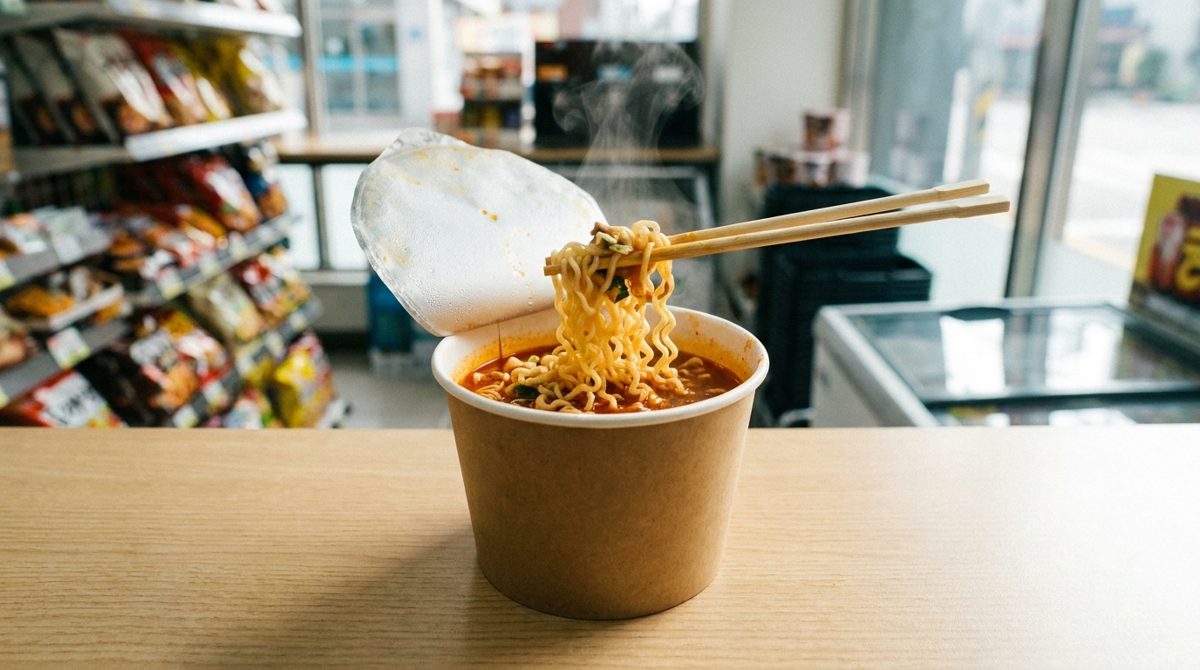
Wondering which cup to grab from the wall of convenience store ramyeon in Korea? Convenience store ramyeon is instant noodles bought in-store (₩1,500–₩2,500 a cup), cooked on the spot with free hot water or the store’s ramyeon machine, and eaten at the counter — a full Korean cultural experience for under ₩3,000. This guide ranks the 2026 cup lineup by spice, names the mild escapes, and shows you the cheese-and-egg upgrades locals actually use.
Table of Contents
- Convenience Store Ramyeon Quick Facts
- Why the Ramyeon Aisle Is a Tourist Destination
- The 2026 Cup Lineup (Real Names + Prices)
- How to Cook Cup Ramyeon In-Store (Step-by-Step)
- Spice Ranking: Every Major Cup, 1–5
- Mild Options for Spice-Shy Travelers
- Cheese, Egg & the Upgrades Locals Swear By
- Vegetarian & Dietary Reality Check
- Convenience Store Ramyeon FAQ
Convenience Store Ramyeon Quick Facts
| Item | Details |
|---|---|
| What it is | Cup instant noodles (컵라면) cooked and eaten inside the store |
| Where in the store | Dry-goods noodle aisle; hot water station or ramyeon machine near the counter |
| Price (2026) | ₩1,500–₩2,500 per cup, uniform nationwide |
| Hot water | Free at every store; dedicated cooking machines at many GS25/CU |
| Best chains for it | All four (GS25, CU, 7-Eleven, emart24) — biggest stores have counter seating |
| Spice range | 🌶️ 0/5 (Chapagetti) to 🌶️ 5/5 (Buldak 2x — genuine warning) |
| Vegetarian | ❌ Mostly not — nearly all broths are meat or seafood based |
| Halal-friendly | ⚠️ A few exported Buldak cups are halal-certified; most Korean cups aren’t |
| Main allergens | Wheat, soy, often beef/pork/seafood extract, sometimes egg and milk |
| Best for | Late-night meals, spice bucket lists, the kimbap + ramyeon combo |
Why the Ramyeon Aisle Is a Tourist Destination
Koreans eat more instant noodles per person than any other country on earth — roughly 75–80 servings a year each. The convenience store is where that statistic becomes visible: an entire aisle of cups and packets, a free hot-water dispenser, and increasingly a proper ramyeon cooking machine that boils packet noodles for you at the push of a button.
What makes it special for visitors isn’t just the noodles — it’s the format. You buy a cup, cook it yourself ten steps from the register, and eat it at a window counter watching Seoul go by. It’s interactive, it’s cheap, it’s open at 3 am, and the selection includes flavors that never get exported. Korean students call the counter meal “pyeonmaek culture’s little sibling” — the sober, noodle-based version of the beloved convenience store beer table.
One aisle over you’ll find the perfect partners: triangle kimbap (the classic pairing — see our triangle kimbap guide), boiled eggs sold in twin packs, and string cheese destined to melt into your broth. This is a full meal system disguised as a snack run, and it’s a core stop in our 12 best Korean convenience store eats.
There’s also a romance to it that K-dramas have exported worldwide: the late-night counter scene, two characters over steaming cups, the city glowing outside. Real life delivers the same shot nightly. And the format has a famous outdoor cousin — the Han River park ramyeon machines, where boiling noodles at a riverside store at sunset is a certified Seoul bucket-list item. Same noodles, better view, identical price.
The 2026 Cup Lineup (Real Names + Prices)

Every store stocks the national icons plus rotating specials. These are the cups you’ll actually see, with April 2026 prices (identical nationwide — no tourist markup possible):
| Cup (Korean) | What it is | Price 2026 |
|---|---|---|
| Shin Ramyun cup (신라면) | The national standard: beefy, garlicky, properly spicy red broth | ₩1,500 |
| Jin Ramen cup (진라면) | The friendly rival — comes in mild (순한맛) and spicy (매운맛) | ₩1,400–₩1,500 |
| Chapagetti cup (짜파게티) | Black bean noodles, no soup, basically zero spice — the Parasite noodle’s sibling | ₩1,800 |
| Buldak original cup (불닭볶음면) | The fire chicken challenge noodle: sweet, then scorching | ₩2,000–₩2,200 |
| Buldak carbonara cup (까르보불닭) | Creamy pink version — TikTok’s favorite, slightly tamer | ₩2,200–₩2,500 |
| Buldak 2x spicy cup (핵불닭) | Double-strength capsaicin. Not food; a dare | ₩2,200–₩2,500 |
| Yukgaejang sabalmyeon (육개장 사발면) | The retro small bowl — mild-medium, beloved since 1982 | ₩1,200–₩1,400 |
| Neoguri cup (너구리) | Thick chewy noodles, seafood-kelp broth, medium heat | ₩1,500–₩1,700 |
Cups come in two sizes — the small sabalmyeon bowls (snack) and the big cups (meal). If you’re hungry, buy the big cup plus a triangle kimbap; that’s the canonical ₩3,000 combo. And check shelf tags for 2+1 promotions — ramyeon cups are frequent flyers, and the free cup rings up at ₩0 automatically.
Beyond the icons, the aisle rewards curiosity. Chains commission exclusive cups you won’t find anywhere else — collaboration flavors with famous restaurants, viral street-food brands, even idol groups — and discontinue them without warning. Seasonal logic applies too: budae-jjigae and cheese cups spike in winter, while cold bibim noodle cups take over the shelf every summer. A reliable strategy is one national icon plus one wild card per visit; at ₩1,500 a cup, a failed experiment costs less than a subway ride. And Koreans read this shelf like a market index: any new cup that earns a permanent slot has survived the most competitive instant noodle market on earth. If it’s still there in six months, it’s good. If it’s stacked at the register too, it’s great.
How to Cook Cup Ramyeon In-Store (Step-by-Step)
Nobody will explain this to you, and everybody assumes you know it. Here’s the whole ritual:
- Pay first. Take the cup to the register (or self-checkout) before opening anything. Grab your upgrades — cheese, egg, kimbap — in the same transaction.
- Find the hot water station. It’s a stainless dispenser near the eating counter, usually beside a microwave. Free chopsticks and sometimes napkins live in a box next to it.
- Prep the cup. Peel the lid halfway to the marked line. Empty the soup powder onto the dry noodles first; hold any oil or flake sachets marked “후첨” (add after) for the end.
- Fill to the inner line. There’s a ridge or printed line inside the cup — stop there. Overfilling makes weak broth; it’s the most common beginner mistake.
- Close and wait 3–4 minutes. Rest your chopsticks on the lid to hold it down — the traditional Korean timer. Chapagetti is the exception: after 4 minutes, drain most of the water through the lid gap, then stir in the paste.
- Eat at the counter, then clean up. Pour leftover broth into the marked liquid-waste bin (음식물 or the sink drain by the station), stack the cup, done.
Total time from register to first slurp: about five minutes. If your store has the automatic cooker for packet noodles instead, that’s a different (better) machine — full walkthrough in the ramyeon machine guide.
Spice Ranking: Every Major Cup, 1–5
Korean “spicy” runs hotter than most countries’ “spicy.” Calibrate with this table before you commit — 3/5 here means most visitors are sniffling but happy, and 5/5 means genuine pain:
| Cup | Spice | What that feels like |
|---|---|---|
| Chapagetti | 🌶️ 0.5/5 | Savory black bean, barely a tingle |
| Jin Ramen mild (순한맛) | 🌶️ 1/5 | Warm, comforting, safe for almost anyone |
| Yukgaejang sabalmyeon | 🌶️ 2/5 | Gentle warmth, mildest of the “red” broths |
| Neoguri | 🌶️ 2.5/5 | Noticeable but seafood-sweet |
| Jin Ramen spicy (매운맛) | 🌶️ 2.5/5 | A step below Shin — beginner “real” spice |
| Shin Ramyun | 🌶️ 3/5 | The benchmark: hot enough to feel, mild enough to finish |
| Buldak carbonara | 🌶️ 3.5/5 | Cream softens it, then the burn arrives anyway |
| Buldak original | 🌶️ 4/5 | Sustained burn; keep dairy within reach |
| Buldak 2x spicy (핵불닭) | 🌶️ 5/5 | Genuine warning: ~8,000+ Scoville in sauce form. Buy banana milk first, not after |
If you’re chasing the viral challenge, do it with the carbonara or original version and a dairy backup. The 2x cup regularly defeats people who eat spicy food for a living; there is no shame in stopping. Water makes capsaicin worse — milk, cheese, or ice cream is the exit ramp.
Mild Options for Spice-Shy Travelers
You can absolutely enjoy the ramyeon counter without suffering. Chapagetti is the star mild pick — chewy noodles in a savory-sweet black bean coating with no broth at all (drain most of the water, stir the paste through, add the oil packet last). Jin Ramen mild is the best true soup option: the full Korean ramyeon experience minus the pain. Yukgaejang sabalmyeon is the nostalgia pick — small, gentle, and the cup every Korean remembers from school trips.
Also scan the shelf for non-spicy specialists: udon cups with dashi broth, kalguksu (knife-noodle) cups, and cheese-flavored editions that dial everything down. If the label is fire-red with a crying chicken mascot, that’s your cue to keep browsing — the fire chicken (buldak) branding never bluffs.
Two more calibration tips. First, “mild” on a Korean label (순한맛) genuinely means mild — brands don’t play games with that word because Korean parents buy those cups for children. Second, if you’re caught mid-cup and it’s too hot, the rescue is on the next shelf: a cheese slice into the broth, or a banana milk chaser. Sugar and dairy both blunt capsaicin; suffering through it is optional and slightly less Korean than fixing it.
Cheese, Egg & the Upgrades Locals Swear By
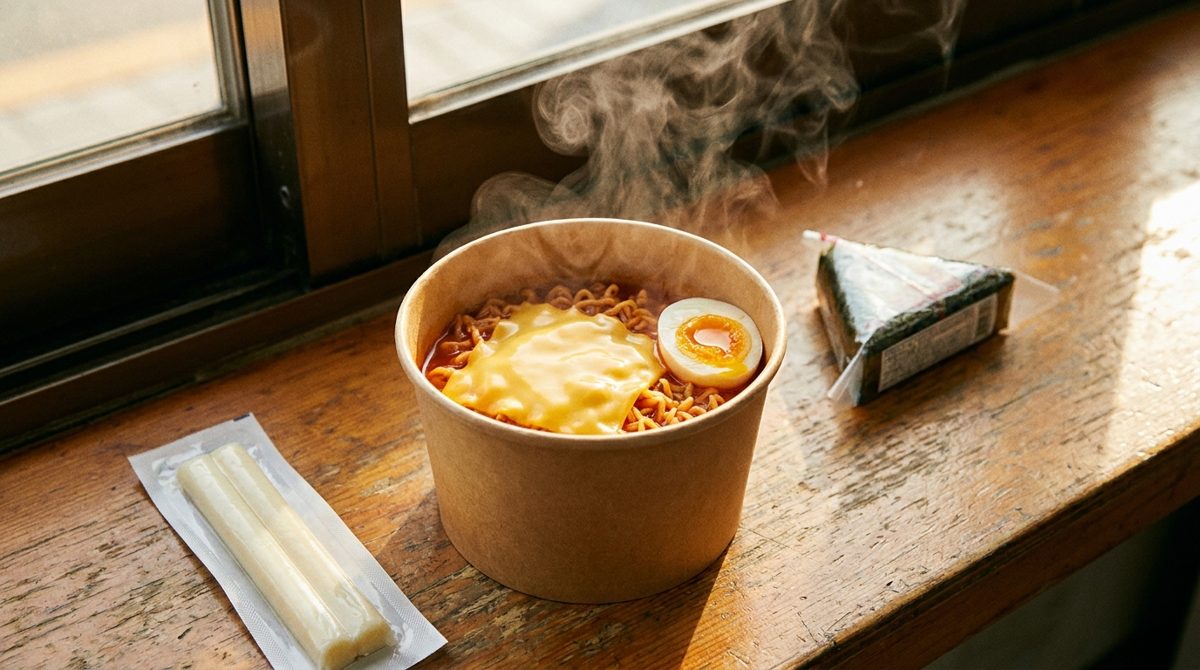
Koreans rarely eat cup ramyeon plain. The store itself sells every upgrade, all within arm’s reach:
- Cheese slice (₩500–₩800): lay it over the hot noodles, lid back on for 30 seconds. It melts into the broth, tames spice, and makes Buldak survivable. The single most-used hack in Korea.
- Boiled egg (₩1,500–₩2,000 for two): convenience stores sell ready-peeled eggs and smoked “maekbanseok” eggs. Halve one into your cup for instant protein.
- String cheese: tear into strips, drop in, stir — fondue ramyeon.
- Triangle kimbap: alternate bites, or drop chunks of tuna mayo kimbap straight into the broth at the end for a rice-soup finale.
- Danmuji (pickled radish) or kimchi: small packs near the chilled case; the acidic crunch resets your palate between spicy slurps.
- Dumplings: microwave a pack of mandu and float two on top — instant manduguk energy.
If your store has the cooking machine, packet ramyeon (₩1,000–₩1,600) beats cup ramyeon on both price and texture — the machine boils it properly in a foil bowl. Full button-by-button walkthrough in our ramyeon machine guide. And if you love the sweet-spicy direction, graduate to rabokki — ramyeon cooked into tteokbokki sauce — decoded in our tteokbokki guide.
Counter etiquette in one breath: eat at the counter or outside tables, drain leftover broth into the marked disposal (not the trash bag), stack your cup, wipe your spot. Do that and you’re an honorary regular.

Vegetarian & Dietary Reality Check
The honest news: almost no mainstream Korean cup ramyeon is vegetarian. Shin Ramyun and Jin Ramen use beef-based broth; Neoguri and most “udon” cups use seafood stock; even Chapagetti — which looks vegetarian — contains meat-derived seasoning in the standard version. Broth powder is where the animals hide, and the label is in Korean. This catches a lot of travelers off guard because the noodles themselves are plain wheat — it’s the sachet that decides everything.
Workable options: Shin Ramyun Green (베지 신라면), the vegan version of the national icon, appears in larger stores and marts; a handful of vegan-labeled cups (look for 비건 certification marks) rotate through the aisle; and Buldak sauce itself is chicken-flavored but several exported Buldak varieties carry halal certification — the domestic cups usually don’t, so check for a certification logo rather than assuming. Muslim travelers can cross-check Korea’s Muslim-friendly food info on VisitKorea. Allergy-wise, assume wheat and soy always, and beef, pork, seafood, egg, or milk depending on the cup — the allergen line (알레르기) is printed under the ingredients, and the instant noodle format worldwide leans hard on wheat.
Convenience Store Ramyeon FAQ
How do you make cup ramyeon at a Korean convenience store?
Pay at the register first, peel the lid to the marked line, add any powder sachets, fill with hot water to the inner line at the free hot-water station, close the lid for 3–4 minutes, then eat at the counter. Chopsticks are free next to the machine.
How spicy is Buldak 2x compared to Shin Ramyun?
It’s several times hotter — Shin Ramyun is a 3/5 benchmark most visitors finish comfortably, while Buldak 2x is a 5/5 challenge item that defeats experienced chili eaters. Buy milk or cheese before you open it, not after.
What is the best non-spicy Korean cup ramyeon?
Chapagetti (black bean, no broth, near-zero heat) and Jin Ramen mild (순한맛) are the two safest widely available picks. Udon and kalguksu cups are also gentle.
Is Korean convenience store ramyeon vegetarian?
Mostly no — nearly all broths are beef or seafood based, including cups that look meat-free. Look for Shin Ramyun Green or cups with explicit vegan (비건) certification, which larger stores increasingly stock.
How much does convenience store ramyeon cost in 2026?
₩1,500–₩2,500 per cup nationwide: Shin Ramyun ₩1,500, Chapagetti ₩1,800, Buldak variants ₩2,000–₩2,500. Add a cheese slice and an egg and a full hot meal still lands under ₩4,000.
The Verdict: Should You Do the Ramyeon Counter?
Yes — twice. Once safe, once brave. Round one: Shin Ramyun or Jin Ramen with a cheese slice, an egg, and a triangle kimbap at the window counter, the complete ₩4,000 Korean experience. Round two: whatever Buldak variant your pride demands, with banana milk standing by. Either way you’ll understand why an entire nation treats a convenience store aisle as comfort food headquarters. Then keep going: our Korean Convenience Store Explorer decodes every other shelf in the store.