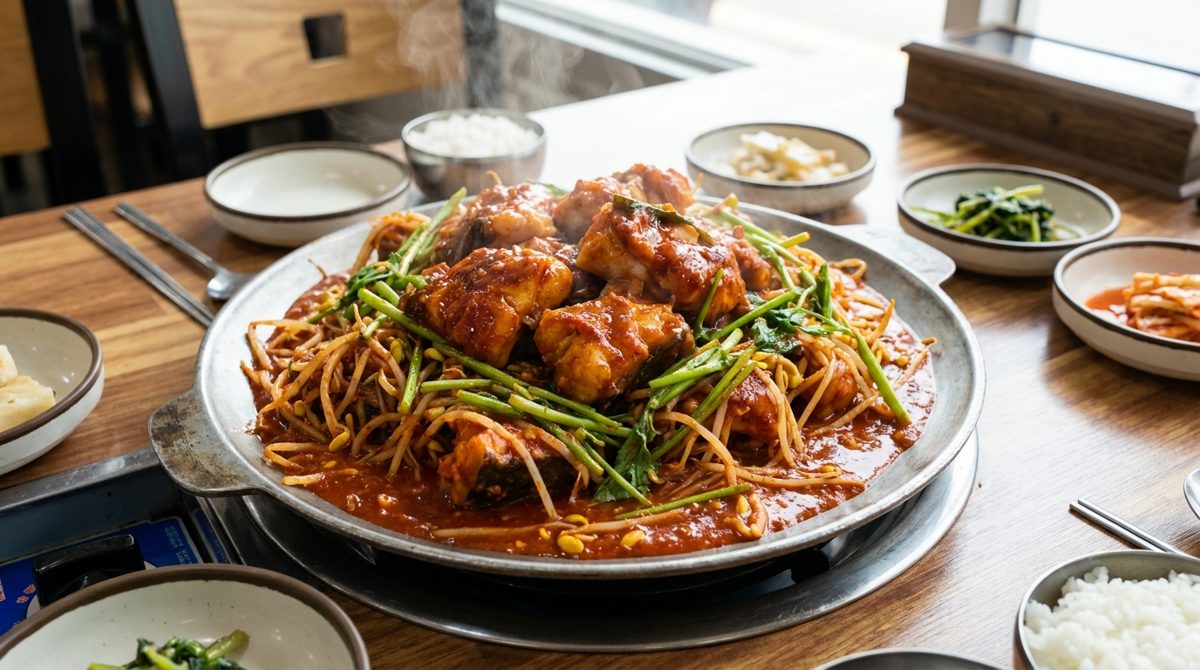
Wondering what agujjim is on a Korean seafood menu? Agujjim (아귀찜) is a fiery braised dish of monkfish and bean sprouts smothered in a thick, chili-red gochujang-gochugaru sauce, often studded with minari (water dropwort) and served on a huge sharing platter. It’s one of Korea’s spiciest famous dishes and a genuine local favorite that most tourists never try. This decoder page covers taste, spice level, allergens, halal status, real 2026 prices, and exactly how to order it in Korean.
Table of Contents
- Agujjim Quick Facts
- What Is Agujjim, Exactly?
- What Does Agujjim Taste Like?
- Dietary Guide: Vegetarian, Vegan, Halal & Allergens
- How to Order Agujjim in Korean (+ 2026 Prices)
- How to Eat Agujjim Like a Local
- Types of Agujjim
- Where to Try Agujjim
- Agujjim FAQ
Agujjim Quick Facts
| Item | Details |
|---|---|
| Korean name | 아귀찜 (agujjim) — “braised/steamed monkfish” |
| Pronunciation | ah-GWI-jjim |
| Type | Braised spicy monkfish sharing dish (seafood main) |
| Spice level | 🌶️ 4/5 — genuinely fiery, not a beginner dish |
| Price (2026) | ₩38,000–₩55,000 for a medium platter in Seoul, serves 2–3 people |
| Vegetarian | ❌ No — monkfish is the entire point of the dish |
| Vegan | ❌ No — fish-based, and the sauce often contains fish or shellfish stock |
| Halal-friendly | ✅ Generally — monkfish-based, but check the sauce isn’t finished with mirin/cheongju cooking wine |
| Main allergens | Fish (monkfish), shellfish (mussels/shrimp in some versions), soy, sesame |
| Best for | Seafood lovers who want extreme spice, groups sharing a platter, halal-friendly seafood seekers, hidden-gem hunters |
What Is Agujjim, Exactly?
Agujjim is monkfish — a large, oddly ugly bottom-dwelling fish with famously firm, gelatin-rich flesh — braised low and slow with bean sprouts, radish, and often minari (water dropwort) in a sauce built from gochugaru (chili flakes), gochujang (chili paste), garlic, and soy. The result looks intimidating: a mountain of glossy, deep-red sauce clinging to white fish chunks and translucent sprouts, served family-style on a huge metal or ceramic platter meant for the whole table.
The dish has an unusual origin story. Monkfish was long considered a “trash fish” by Korean fishermen — so ugly that it was reportedly once thrown back or given away for free. That changed in the port city of Masan (now part of Changwon) in the 1960s, where local cooks started braising it in fiery sauce to sell cheaply. The dish caught on, spread nationwide, and Masan is still regarded as the spiritual home of agujjim — the city even runs an annual Masan Agujjim Festival celebrating it.
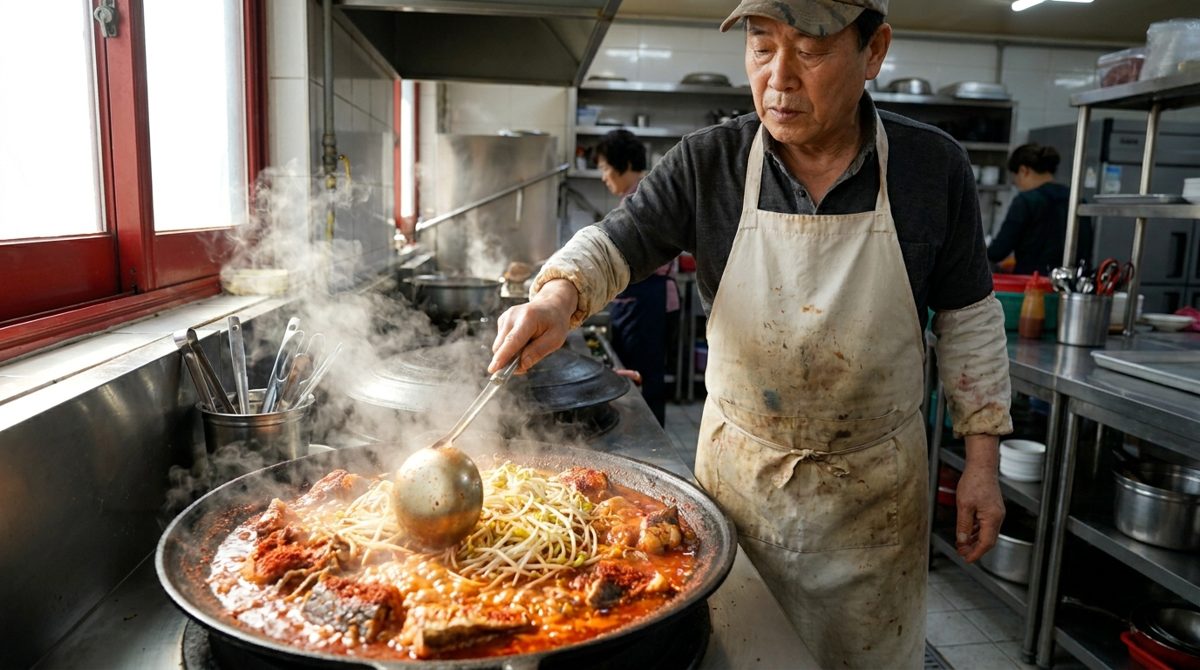
The classic preparation is a two-step process: the monkfish is first lightly boiled or blanched to firm up the flesh and remove any lingering odor, then finished by braising in the chili sauce with vegetables until the sauce reduces to a thick, clinging glaze. Some kitchens thicken the sauce further with a cornstarch slurry, giving agujjim its signature glossy, almost lacquered look. Doenjang (fermented soybean paste) sometimes joins the gochujang and gochugaru for extra savory depth, which is part of why the sauce tastes more complex than a simple chili glaze.
Today agujjim sits in an interesting spot on Korea’s food map: it’s beloved by locals, features constantly on domestic food TV shows, and is a go-to order for groups drinking soju — but it barely registers on tourist itineraries compared to bulgogi or bibimbap. That makes it a genuine “hidden gem” pick for visitors who want to eat like an actual Korean rather than order the usual highlight-reel dishes.
What Does Agujjim Taste Like?
Monkfish itself is mild, dense, and almost meaty — often compared to lobster or a firm white fish rather than anything “fishy.” The real flavor of agujjim comes from the sauce: deeply savory, garlicky, and intensely spicy, with a thick, sticky texture that coats every bite. Bean sprouts stay crunchy and slightly sweet underneath the heat, balancing the richness. Minari, when included, adds a clean, herbal, almost peppery freshness that cuts through the chili. It’s a bold, layered dish — heat first, then umami, then a green snap at the finish.
Texture matters as much as flavor here. Good monkfish should be firm and slightly springy, never mushy — overcooked agujjim turns the fish soft and forgettable, so the best restaurants are careful about timing. The radish, when included, goes soft and sauce-soaked, almost melting into the dish, while the bean sprouts are deliberately left with some bite. That contrast between tender fish, soft radish, crisp sprouts, and sticky sauce is what makes a well-made agujjim memorable rather than just “spicy fish.”
Is Agujjim Spicy?
Yes — agujjim is one of the spicier dishes on any Korean menu, typically landing around 4 out of 5 on the heat scale. Unlike bibimbap or bulgogi, the chili is cooked directly into the sauce, so you can’t easily dial it down at the table. Some restaurants offer a “less spicy” (deolmaepge, 덜맵게) option on request, and pairing it with rice and cold water helps. If you have a low spice tolerance, this is not the dish to start your Korean food journey with — save it for after you’ve built up some tolerance with milder dishes.

Agujjim Dietary Guide: Vegetarian, Vegan, Halal & Allergens
Agujjim is a straightforward dish for meat-avoiders in one sense (no beef, pork, or chicken) but it is fundamentally a seafood dish, so it doesn’t work for vegetarians or vegans. Here’s the full breakdown.
| Ingredient concern | In standard agujjim? | How to handle |
|---|---|---|
| Beef / pork / chicken | No | Not used in traditional recipes |
| Fish | Yes — monkfish is the main ingredient | Cannot be removed; this is the dish |
| Shellfish | Sometimes (mussels, shrimp added for flavor) | Ask “haemul eopsi” (해물 없이) = without added seafood extras |
| Soy | Yes | Soy sauce and soybean sprouts are core ingredients |
| Sesame | Yes | Sesame oil and seeds are used as garnish and seasoning |
| Wheat / gluten | Occasionally, via gochujang or thickened sauce | Most commercial gochujang contains wheat flour |
| Alcohol (cooking wine) | Sometimes — small amounts of mirin or cheongju in the braise | Ask “sul eopsi mandeureo juseyo” (술 없이 만들어 주세요) = please make without cooking wine |
| Dairy / nuts | No | Traditional agujjim contains neither |
Is Agujjim Vegetarian or Vegan?
No. Agujjim is built entirely around monkfish, and the sauce itself is frequently made with fish or anchovy-based stock even before the fish goes in. There is no meaningful vegetarian or vegan version of this specific dish — the bean sprouts and minari are supporting players, not the point. If you’re vegetarian or vegan and craving Korea’s spicy-sauce flavor profile without seafood, dishes like tteokbokki (spicy rice cakes) are a better match; agujjim should be skipped entirely rather than modified.
Is Agujjim Halal?
Agujjim is generally halal-friendly because monkfish is a fish, and fish is permissible in Islamic dietary law without requiring special slaughter. This makes agujjim a genuinely useful “yes” option for Muslim travelers craving Korean seafood — a category where good halal-friendly choices can be surprisingly thin on the ground. The honest caveat: some restaurant recipes finish the braising liquid with a small amount of mirin or cheongju (Korean cooking wine) for depth of flavor, so it isn’t automatically alcohol-free at every kitchen. Ask directly — “sul deureoganayo?” (술 들어가나요? — “does it contain alcohol?”) — or request it be made without, using the phrase above. For a guaranteed answer, look for restaurants near mosque areas like Itaewon, or check the Korea Tourism Organization’s Muslim-friendly restaurant listings on VisitKorea before you go.
How to Order Agujjim in Korean (+ 2026 Prices)
Agujjim is ordered by size, not by individual portion, since it’s built for sharing. Staff will usually ask what size you want before cooking starts.
| What you want | Say this | Romanized |
|---|---|---|
| Agujjim, please | 아귀찜 주세요 | agujjim juseyo |
| Small size (2 people) | 소자로 주세요 | sojaro juseyo |
| Medium size (2–3 people) | 중자로 주세요 | jungjaro juseyo |
| Large size (4+ people) | 대자로 주세요 | daejaro juseyo |
| Less spicy, please | 덜 맵게 해주세요 | deol maepge haejuseyo |
| Without cooking wine (alcohol) | 술 없이 만들어 주세요 | sul eopsi mandeureo juseyo |
What it costs in 2026: a small agujjim runs around ₩38,000–₩42,000, a medium (the standard order for 2–3 people) is ₩45,000–₩50,000, and large sharing platters for bigger groups reach ₩50,000–₩55,000 in Seoul. Prices are usually a bit lower outside the capital, especially in Masan/Changwon where the dish originated. Most restaurants automatically add a bowl of rice, and side dishes (banchan) are free and refillable — see our Korean dining etiquette guide if the banchan table catches you off guard.
How to Eat Agujjim Like a Local
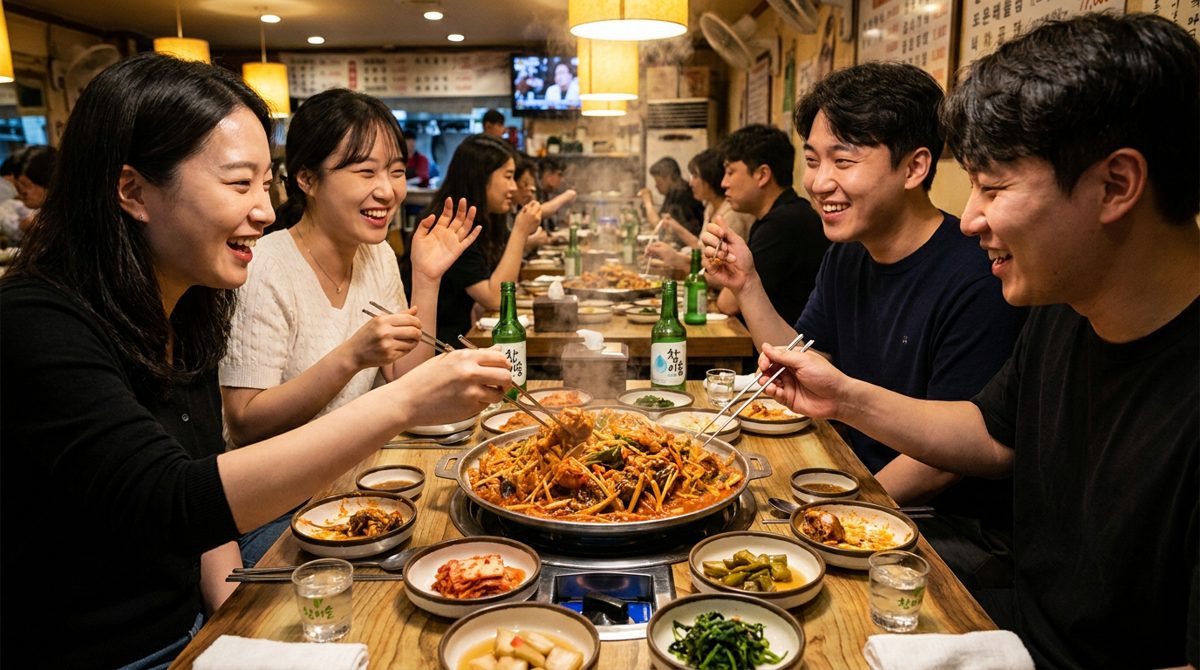
Agujjim is a shared, slow meal, not a quick solo lunch. It arrives on one big platter in the center of the table, and everyone eats directly from it with chopsticks — there’s no individual plating expected. Grab a piece of fish, dip or drag it through extra sauce if you want more heat, and eat it with rice to balance the spice. Locals almost always order this with soju or beer; the alcohol is considered a natural pairing for the chili heat, though it’s entirely optional.
Monkfish has a firm, almost boneless-feeling texture in most cuts, but small bones and cartilage can appear, especially near the head end of the fish — eat slowly and pick around anything hard rather than rushing through it. Once the fish is gone, many tables order bokkeumbap (fried rice) mixed into the leftover sauce — ask your server “bap bokka juseyo” (밥 볶아 주세요, “please fry rice in this”) for one of the best last bites in Korean dining.
Drink pairing is part of the ritual. Soju is the default choice — its clean, neutral burn resets your palate between spicy bites, and locals consider agujjim one of the best “anju” (안주, food eaten alongside alcohol) in the country. Some tables prefer makgeolli instead for a milder, slightly sweet contrast to the heat. Neither is required — plenty of diners just order extra rice and water — but if you want the full local experience, ordering a bottle of soju to share is the move.
Types of Agujjim You’ll See on Menus
Agujjim (아귀찜) — the standard braised version with a thick, sticky, intensely spicy sauce; the default order at any dedicated agujjim restaurant. Agu-tang (아구탕) — the soupier, milder cousin: the same monkfish and bean sprouts, but in a clear or lightly spicy broth rather than a thick sauce, closer to a hot pot or stew. It’s the better starting point if 4/5 spice sounds like too much. Haemul agujjim (해물아귀찜) — a version loaded with extra seafood like mussels, shrimp, and squid alongside the monkfish, common at coastal restaurants. Masan-style agujjim — the original regional style from Changwon’s Masan district, often considered the most authentic, sometimes made with dried monkfish (kkomajang-eo) for a chewier texture and deeper flavor. Agu-suyuk (아귀수육) — a lighter alternative where the monkfish is simply boiled and served with a dipping sauce on the side instead of being braised in it, letting the fish’s natural texture shine through for anyone who wants less chili overall.
Where to Try Agujjim
Agujjim restaurants tend to specialize — look for signs reading 아귀찜 rather than general seafood restaurants, since the dish takes real skill to braise correctly. Seoul has agujjim-focused alleys in neighborhoods like Sindang-dong and near Yeouido, where multi-generation family restaurants compete on their sauce recipes. For the most authentic version, Masan (in Changwon, a short KTX-adjacent trip from Busan) is the dish’s hometown and holds an annual agujjim festival. If you’re building out a broader seafood-and-spice food crawl, pair an agujjim night with a stop for gamjatang, another famously fiery Korean stew, or browse our Seoul food guide for market and restaurant picks near you.
A practical tip: agujjim restaurants are usually dinner-focused and can get busy on weekend evenings, especially in agujjim-specialist alleys, so arriving right at opening time or booking ahead for larger groups helps avoid a wait. Menus are often Korean-only at neighborhood spots, but photos of the platter sizes are usually posted near the door or on the table, making it easy to point and confirm the size you want even without shared language.
Agujjim FAQ
What does agujjim mean in English?
Agujjim (아귀찜) translates roughly to “braised/steamed monkfish.” Agu refers to the monkfish, and jjim means a dish braised or steamed in sauce rather than grilled or fried.
Is agujjim very spicy?
Yes — it’s one of the spicier dishes on Korean menus, typically rated around 4 out of 5. The chili sauce is cooked directly into the dish rather than added at the table, so you can’t fully control the heat yourself. Ask for “deol maepge” (덜맵게, less spicy) if needed.
Is agujjim halal?
Generally yes — monkfish is halal, and fish requires no special slaughter under Islamic dietary law. The one caveat is that some kitchens add a small amount of mirin or cheongju cooking wine to the braise, so it’s worth asking the restaurant to leave alcohol out or checking with a Muslim-friendly certified restaurant to be certain.
What does monkfish taste like in agujjim?
Monkfish is mild, firm, and dense — often compared to lobster or a very meaty white fish rather than anything strongly “fishy.” Most of the bold flavor in agujjim comes from the thick chili sauce, not the fish itself.
How much does agujjim cost in Korea in 2026?
A medium platter (serving 2–3 people) runs ₩45,000–₩50,000 in Seoul, with small sizes from ₩38,000 and large group platters up to ₩55,000. Prices are typically a little lower outside Seoul, especially in Masan where the dish originated.
The Verdict: Should You Order It?
If you love seafood and can handle real heat, agujjim is one of the most rewarding “hidden gem” orders in Korea — a dish locals genuinely love that most visitors never discover. Bring friends to share the platter, order soju if you drink, and finish with fried rice in the leftover sauce. If 4/5 spice feels risky, start with the milder agu-tang soup version instead. Hungry for more dishes to decode before your trip? Explore our full Korean Food Decoder — every major Korean dish explained with spice levels, allergens, and ordering phrases.