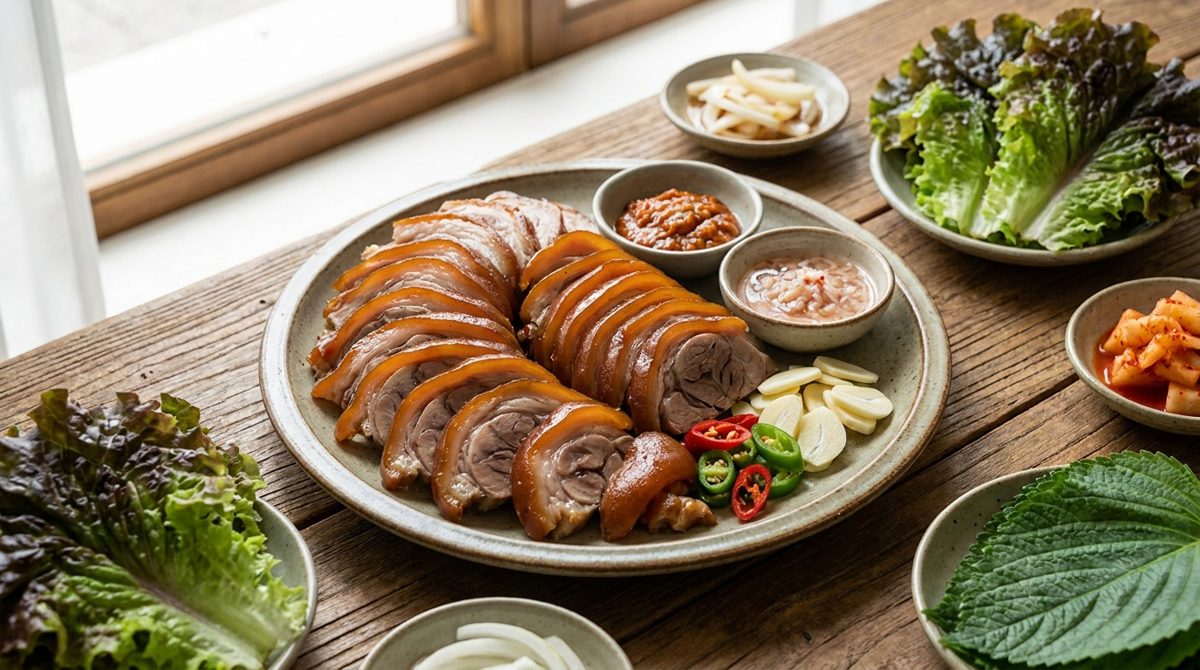
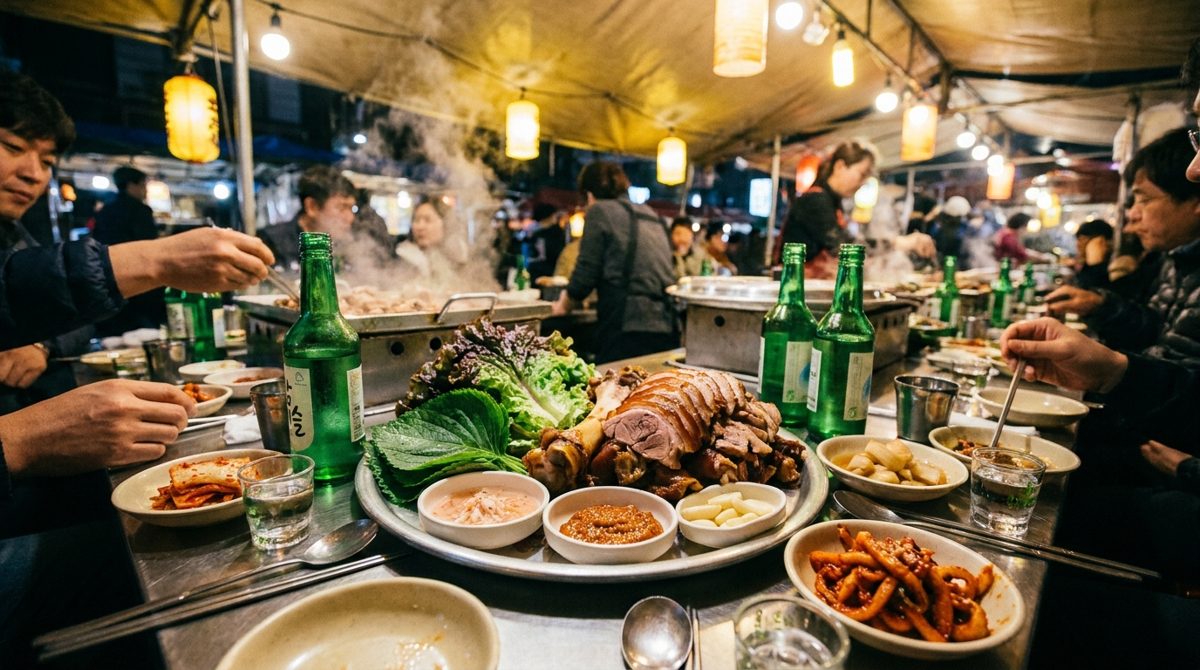
Jokbal (족발) is a Korean dish of pig’s trotters — the whole foot and lower leg — simmered for hours in a soy-sauce broth with garlic, ginger, and spices until the skin turns dark and gelatinous and the meat falls off the bone. It’s served sliced, cold or warm, wrapped in lettuce with garlic, ssamjang, and salted shrimp sauce. Jokbal is Korea’s favorite late-night drinking food, sold at pojangmacha tents and dedicated jokbal restaurants that stay open past midnight for the soju crowd.
Table of Contents
- Jokbal Quick Facts
- What Is Jokbal, Exactly?
- What Does Jokbal Taste Like?
- Dietary Guide: Vegetarian, Vegan, Halal & Allergens
- How to Order Jokbal in Korean (+ 2026 Prices)
- How to Eat Jokbal Like a Local
- Types of Jokbal
- Where to Try Jokbal
- Jokbal FAQ
Jokbal Quick Facts
| Item | Details |
|---|---|
| Korean name | 족발 (jokbal) — “pig’s foot” |
| Pronunciation | JOKE-bahl |
| Type | Braised pork dish / sharing anju (drinking food) |
| Spice level | 🌶️ 0–1 / 5 standard; 🌶️ 4 / 5 for the spicy “maekbal” (매운족발) version |
| Price (2026) | ₩30,000–₩40,000 for a medium platter (feeds 2–3 people) |
| Vegetarian | ❌ No — it is pig’s trotter meat and skin, no substitute exists on the menu |
| Vegan | ❌ No |
| Halal-friendly | ❌ No — pork, not halal under any circumstances |
| Main allergens | Soy, sesame, shellfish (saeujeot salted shrimp dip) |
| Best for | Late-night drinking food, groups, adventurous eaters wanting an authentic local dish |
What Is Jokbal, Exactly?
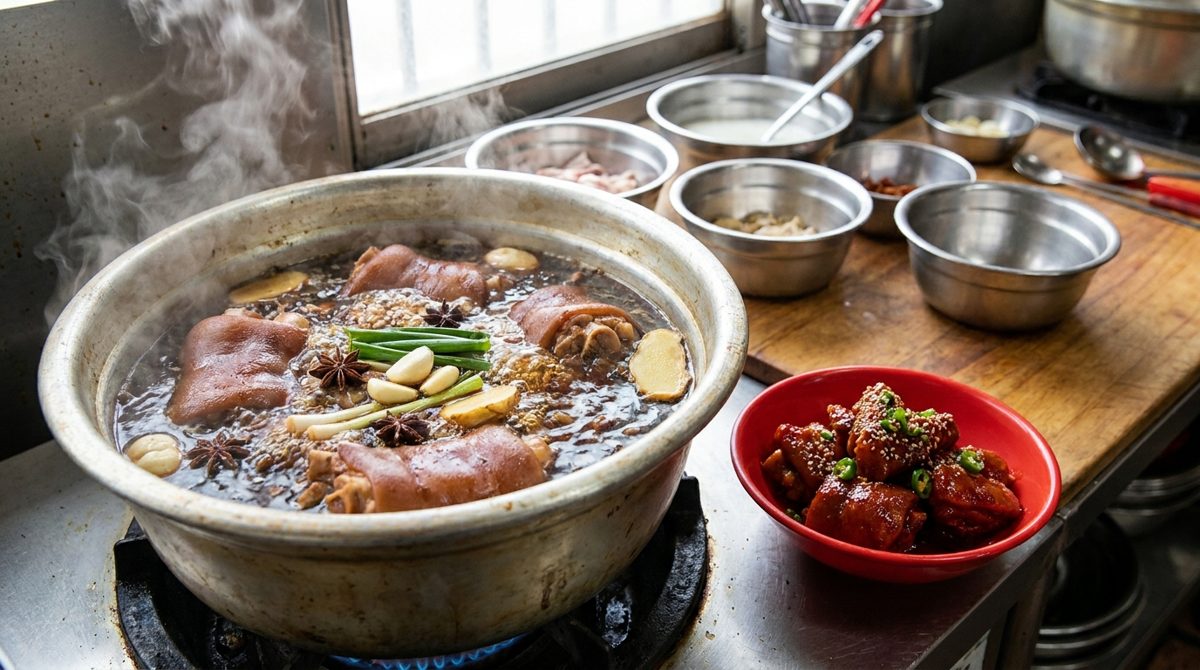
Jokbal literally means “pig’s foot” — jok (foot/leg) plus bal (foot). The dish uses the whole trotter, skin, tendon, and meat included, simmered for three to six hours in a dark broth built from soy sauce, garlic, ginger, scallion, and a mix of spices that often includes star anise, cinnamon, and sometimes coffee or cola to tenderize the collagen-heavy skin. The long braise breaks the connective tissue down into a soft, almost jelly-like texture while the meat itself stays tender enough to pull apart with chopsticks.
The dish has working-class, drinking-culture roots. It became popular in Seoul in the mid-20th century as an affordable, filling dish that paired perfectly with soju, and neighborhoods like Jangchung-dong near Dongdaemun grew a reputation as “jokbal alley,” lined with restaurants that have specialized in the dish for generations, several tracing their family recipes back to the 1960s and 70s. Rival shops there still guard their exact spice blends as trade secrets, the way a barbecue joint might guard a rub recipe.
Don’t confuse jokbal with samgyeopsal or bo-ssam — both are pork wrapped in lettuce, but jokbal is defined by its braising method and its use of the trotter specifically, which gives it a springy, gelatinous texture that grilled or boiled pork belly doesn’t have. That texture is the whole point of the dish, not a flaw. First-timers who expect a “regular” cut of meat are sometimes thrown off; approaching it more like a terrine or a rich braised dish, rather than a steak, sets the right expectation.
Jokbal has also become one of Korea’s most popular late-night delivery orders. Apps built entire late-night business models around it, since it travels well cold and doesn’t lose much texture in transit — unlike fried chicken or grilled meat, which suffer on the way. It’s common for groups to order jokbal delivered directly to a park, a dorm room, or a hotel room for an impromptu drinking session, no restaurant required.
What Does Jokbal Taste Like?
Jokbal tastes savory and mildly sweet from the soy-based braising liquid, with a deep, almost smoky background note from the long simmer. The skin and connective tissue are soft and slightly springy rather than chewy in a tough way — closer to the texture of a well-made pork terrine or head cheese than to regular sliced meat. The lean meat portions are tender and mild, picking up the braise’s seasoning without tasting overly salty.
Texture, more than flavor, is what surprises first-time eaters. Expect layers: a thin outer skin with a slight bounce, a middle layer of soft collagen and fat, and threads of lean meat running through. Garlic and ssamjang cut through the richness, and the accompanying saeujeot (salted shrimp) adds a briny, umami punch that Koreans consider essential — it’s specifically paired with pork dishes across Korean cuisine, not just jokbal, because the salt and enzymes are believed to help digest fatty pork.
Is Jokbal Spicy?
Standard jokbal isn’t spicy at all — most restaurants rate it 0 to 1 out of 5, since the braising liquid is soy-and-spice based, not chili based. If you want heat, order maekbal (매운족발), sometimes called maekjeok, a version tossed or glazed in a hot gochujang-based sauce after braising. Maekbal runs closer to 4 out of 5 and is genuinely spicy — order it only if you already handle Korean chili heat well, and ask for it “half-and-half” (반반, banban) with regular jokbal if you want to hedge your bets.
Jokbal Dietary Guide: Vegetarian, Vegan, Halal & Allergens
Jokbal is one of the least flexible dishes in this decoder series for dietary restrictions. Be clear-eyed about it before you order.
| Ingredient concern | In standard jokbal? | How to handle |
|---|---|---|
| Pork | Yes — it is the entire dish (pig’s trotter) | No substitute exists; this dish cannot be made pork-free |
| Beef | No | Not applicable |
| Shellfish | Yes, via saeujeot (salted fermented shrimp) dip | Skip the shrimp sauce; use only ssamjang or salt-and-sesame-oil dip instead |
| Soy | Yes — core braising ingredient | Cannot be removed; the dish is defined by its soy braise |
| Sesame | Yes — sesame oil in dipping sauces and garnish | Ask for sauces on the side if you need to control amount |
| Wheat / gluten | Sometimes, in ssamjang or soy sauce | Ask if gluten-free soy sauce is used; usually not accommodated |
| Alcohol | No (in the food itself) | Almost always ordered alongside soju/beer, but the dish itself is alcohol-free |
| Dairy / nuts | No | Traditional jokbal contains neither |
Is Jokbal Vegetarian or Vegan?
No, and there’s no workaround. Jokbal is, by definition, braised pig’s trotter — skin, tendon, and meat. There is no vegetable or tofu version on any traditional menu, unlike bibimbap or japchae, which can be ordered meat-free. If you’re vegetarian or vegan, skip this dish entirely rather than asking for modifications; a “no meat” jokbal simply doesn’t exist because the meat is the dish itself, not a topping added to something else.
Is Jokbal Halal?
No. Jokbal is pork, full stop — it is not halal under any interpretation, and there is no halal-certified or substitute version served anywhere in Korea. Muslim travelers should avoid this dish entirely rather than looking for a workaround, and should also be cautious of shared side dishes or banchan at jokbal restaurants, since kitchens handling pork on a daily basis rarely maintain separate halal prep areas. If you want a similar communal, lettuce-wrap, late-night drinking-food experience, look instead for dakbal (닭발, spicy chicken feet) or jjimdak (braised chicken) — both are chicken-based and closer in spirit to jokbal’s texture and social role, though note that even these need halal-certified sourcing and preparation to be truly halal-compliant; a chicken dish at a non-certified Korean restaurant isn’t automatically halal. Check the Korea Tourism Organization’s Muslim-friendly restaurant listings at VisitKorea before committing to any restaurant on halal grounds.
How to Order Jokbal in Korean (+ 2026 Prices)
Jokbal restaurants are used to walk-in groups late at night, and most have laminated menus with photos. These phrases help:
| What you want | Say this | Romanized |
|---|---|---|
| Jokbal (medium size), please | 족발 중자 주세요 | jokbal jungja juseyo |
| Spicy jokbal | 매운족발 주세요 | maeun-jokbal juseyo |
| Half regular, half spicy | 반반 주세요 | banban juseyo |
| No shrimp sauce (shellfish) | 새우젓 빼고 주세요 | saeujeot ppaego juseyo |
| Lettuce wraps, please | 상추 좀 더 주세요 | sangchu jom deo juseyo |
What it costs in 2026: a medium (jungja) jokbal platter — enough for 2–3 people — runs ₩30,000–₩40,000 in Seoul. Small (sojja) sizes for one or two people start around ₩22,000–₩28,000, while large (daeja) platters for bigger groups run ₩45,000 and up. Prices are similar in Jangchung-dong’s historic jokbal alley and slightly lower outside central Seoul. Rice, lettuce, and basic banchan are usually included; naengmyeon (cold noodles) as a side dish to finish the meal often costs an extra ₩3,000–₩5,000. Delivery adds a service fee but rarely changes the base menu price. See our Korean dining etiquette guide for how sharing dishes like this typically work at the table.
How to Eat Jokbal Like a Local
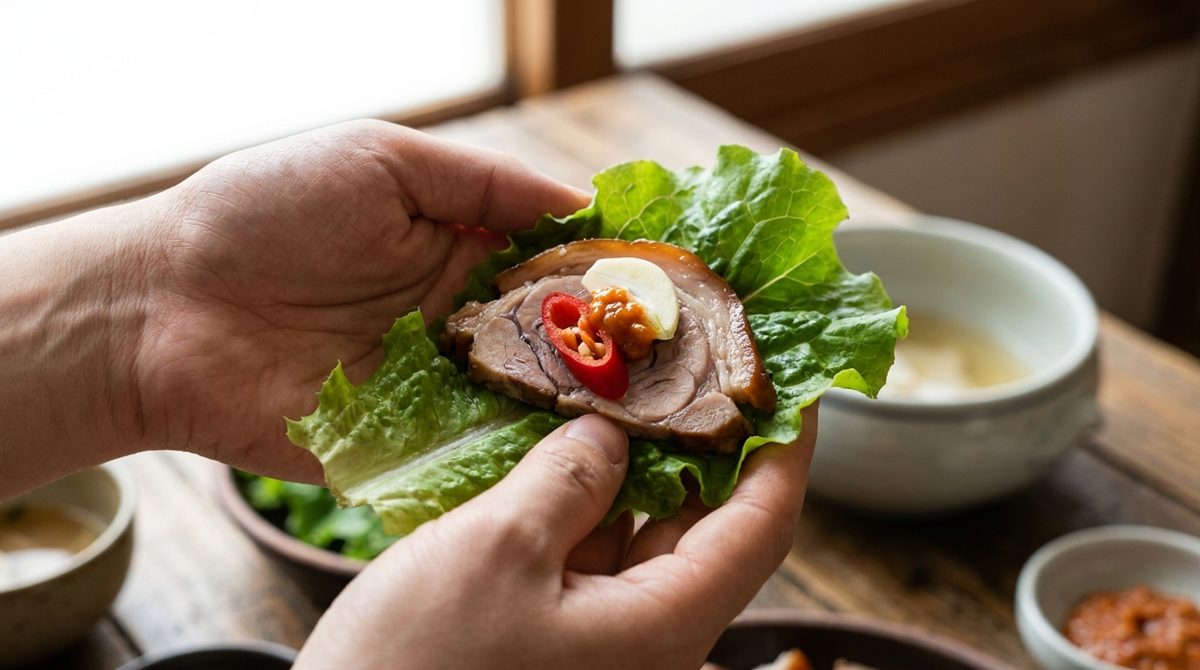
Take a lettuce or perilla leaf, add a slice of jokbal, a sliver of raw garlic, a dab of ssamjang, and — if you like — a touch of saeujeot (salted shrimp sauce, the traditional dipping condiment specifically for pork). Fold it into a small wrap and eat it in one bite. Locals eat jokbal slowly over conversation and drinks rather than as a fast meal, so pace yourself and expect the platter to last an hour or more.
Most orders come with a side of naengmyeon (cold buckwheat noodles) or a light soup to finish the meal — order it once you’re most of the way through the platter, since it’s meant as a palate-cleansing final course, not a starter. Some tables also order “bossam mu” (pickled radish) or raw garlic and green chilies dipped in ssamjang as a palate reset between bites of the rich meat.
Jokbal is almost never eaten alone; it’s a shared, social dish meant for a table of two or more, ideally with soju or beer. If you’re squeamish about the gelatinous texture, start with a slice from the leaner meat section near the shank rather than the skin-heavy portions closest to the joint — most restaurants slice the platter so both textures are available, and nobody will judge you for picking your favorite parts.
Types of Jokbal You’ll See on Menus
Jokbal (족발) — the standard version, soy-braised, served warm or at room temperature, mild and savory. Naengchae jokbal (냉채족발) — a cold, refreshing variation with julienned vegetables and a tangy mustard-vinegar sauce, popular in summer and lighter-feeling than the standard version despite being the same base meat. Maekbal / maeun-jokbal (매운족발) — the spicy version, coated in a hot gochujang glaze, roughly 4/5 heat, often sold alongside regular jokbal as a half-and-half combo.
Wangjokbal (왕족발) — “king jokbal,” an oversized portion aimed at bigger groups, common at delivery-focused restaurants. Boneless jokbal (무뼈족발, mu-ppyeo jokbal) — the meat and skin deboned and reassembled into a neat roll before slicing, easier to eat with chopsticks and popular for delivery since it avoids bone mess. Jokbal bokkeum (족발볶음) — leftover-style stir-fried jokbal with vegetables and gochujang sauce, a heartier, hot-pan variation some restaurants offer as a late-course option after the cold platter.
Where to Try Jokbal
The single best-known destination is Jangchung-dong near Dongdaemun in Seoul, often called “jokbal alley” (족발골목) — a cluster of restaurants, several open since the 1960s–70s, that built their entire reputation on this dish. It’s touristy by local standards but genuinely the historic home of the dish, and most shops there offer English menus given the steady stream of visitors. Beyond Jangchung-dong, jokbal restaurants are common in nightlife districts across Seoul and every other major Korean city, usually recognizable by illuminated red signage and late closing hours (many stay open until 2–4 a.m.).
Neighborhoods dense with student and office nightlife — Hongdae, Konkuk University area, and Sinchon — all have reliable jokbal spots that see heavy foreign-visitor traffic without dumbing down the dish. For a broader night-food crawl that pairs well with a jokbal stop, see our Korean street food guide, and if you want jokbal alongside other classic anju, our Korean BBQ guide covers the wider grilled-and-braised-meat landscape.
Jokbal FAQ
What does jokbal mean in English?
“Pig’s foot” or “pig’s trotter.” Jok means foot/leg, bal means foot. The name describes the cut of meat directly — the whole trotter, braised for hours in soy sauce until the skin turns dark and gelatinous.
Is jokbal the same as bo-ssam?
No. Both are pork wrapped in lettuce, but bo-ssam uses boiled pork belly or shoulder, while jokbal specifically uses the pig’s trotter, braised in soy sauce for hours until gelatinous. The textures are noticeably different — jokbal is springier and skin-heavy, bo-ssam is a firmer, fattier meat slice, and the two are often served side by side at combination restaurants for comparison.
Is jokbal healthy?
It’s rich — the trotter’s skin and collagen content mean it’s higher in fat and gelatin than leaner Korean dishes, though the collagen is often marketed locally as good for skin health. Portion size matters more than any single nutrient: a shared medium platter across 2–3 people, with lettuce and vegetables, is a reasonably balanced night out, but it isn’t a light or low-fat meal, and it’s rarely eaten as a standalone healthy dinner.
Do you eat jokbal hot or cold?
Both exist. Standard jokbal is served warm to room temperature. Naengchae jokbal is a specifically cold, vinegar-dressed variation popular in summer months. Either way, it isn’t served piping hot the way a soup would be — the braise happens in the kitchen well before it reaches your table.
Can vegetarians or Muslims eat jokbal?
No, in both cases, without exception. Jokbal is entirely pig’s trotter — there’s no vegetarian version and no way to make it halal, since pork itself is the dish. Vegetarians should skip it entirely; Muslim travelers should look instead at chicken-based alternatives like dakbal or jjimdak, and even then should confirm halal-certified sourcing rather than assuming a chicken dish qualifies automatically.
The Verdict: Should You Order It?
If you eat pork and want one of the most authentically local, unpretentious drinking-food experiences in Korea, yes — order jokbal with a group, get a side of maekbal for the adventurous, and let the platter anchor a long night with soju. It’s not for vegetarians, vegans, or Muslim travelers, and there’s no version of this dish that changes that. For everyone else, it’s a genuinely rewarding, textural, and social dish that repays a bit of patience and an open mind. Ready to decode more of the menu? Browse the full Korean Food Decoder for every major dish explained with spice levels, allergens, and ordering phrases.