Why is Korea talking about Southeast Asia today — and why are millions of Southeast Asians boycotting Korean products? A controversy that began with a K-pop concert in Kuala Lumpur has snowballed into one of the most significant anti-Korean backlash movements in Southeast Asia in recent memory. The #SEAblings movement has targeted Samsung, Olive Young, K-dramas, and Korean tourism. Here’s everything you need to understand.

Table of Contents
- What’s Happening in Korea Right Now?
- The Background: How It All Started
- What Are Koreans and Southeast Asians Actually Saying?
- What This Reveals About Korean Culture and Hallyu
- How Does This Compare Internationally?
- Conclusion
What’s Happening in Korea Right Now?
The SEAblings movement — a portmanteau of “Southeast Asian siblings” — represents a coordinated wave of online backlash against Korea across Malaysia, Indonesia, Thailand, Vietnam, and the Philippines. Users across these countries have been calling for boycotts of Korean companies including Samsung and Olive Young, discouraging travel to Korea, and refusing to stream Korean content. The Korea Creative Content Agency has noted drops in Southeast Asian streaming engagement during peak periods of the dispute.
The economic stakes are enormous. Korea’s cultural exports reached US$10.3 billion by late 2025, with full-year 2026 exports expected to surpass $15 billion. Southeast Asia is one of Hallyu’s largest and most loyal markets. The SEAblings movement represents the first serious organized attempt to weaponize that consumer power against Korea.
The Background: How It All Started
The controversy traces back to a Day6 concert in Kuala Lumpur in January 2026. A Korean fan was filmed using a professional telephoto camera at the venue — violating explicit venue rules that all fans, including local Malaysian fans, had been required to follow. When Malaysian fans complained, Korean netizens rallied to defend the fan online rather than acknowledging the venue’s rules.
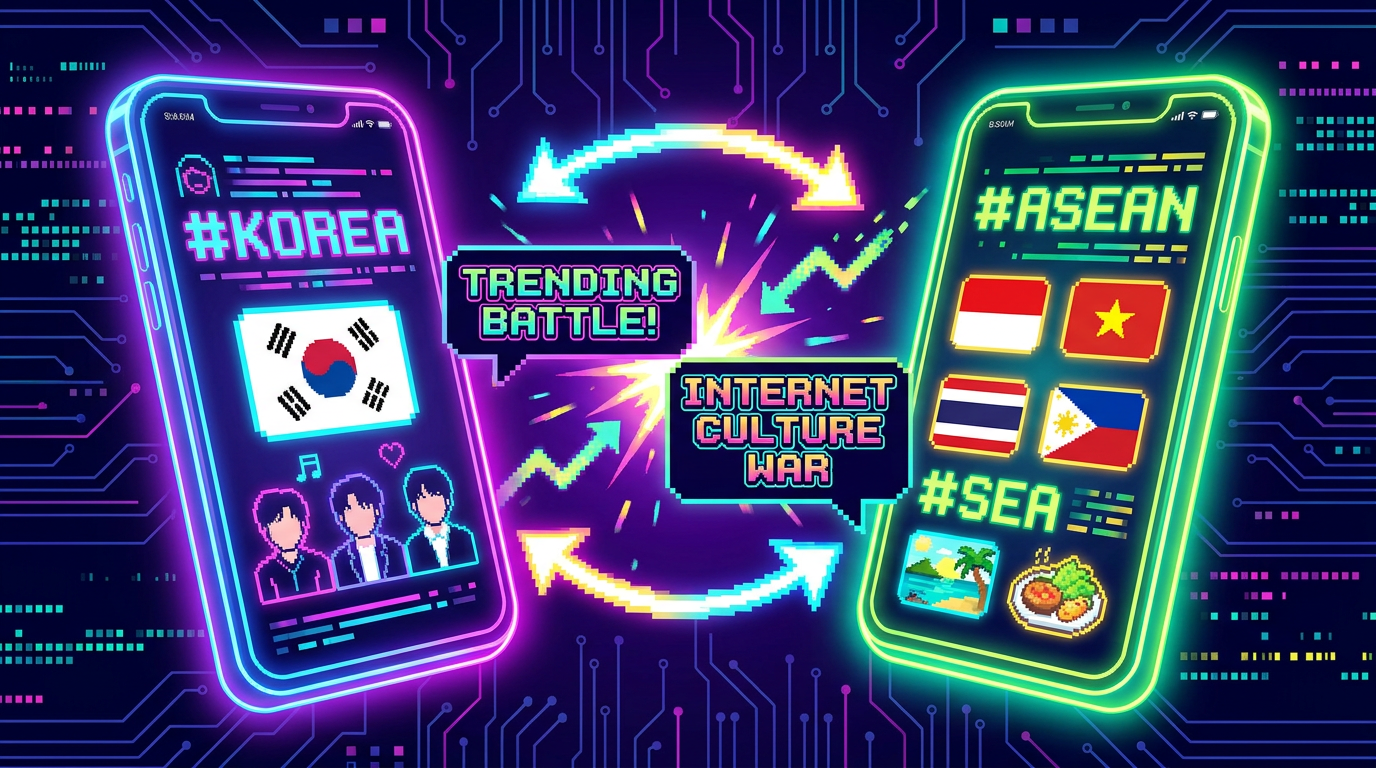
This was the spark. What followed was an escalation unlike anything seen in K-pop fandom history. Korean netizens responded with racial slurs, economic insults comparing Southeast Asian economies negatively to Korea, and images that many in Southeast Asia found dehumanizing. Southeast Asian users retaliated with posts targeting Korea’s plastic surgery rates, mental health statistics, and cultural practices. What started as a concert etiquette dispute had become a full regional culture war.
The situation was worsened by comments from public figures. A Korean provincial governor’s suggestion that young Vietnamese women be brought to rural Korea to marry local men drew fierce criticism across Southeast Asia. President Lee Jae-myung posted a social media message in Korean and Khmer reading “Those who mess with Koreans will face ruin” — intended as a warning to online scammers in Cambodia, but widely interpreted as aggressive and dismissive across the region.
What Are Koreans and Southeast Asians Actually Saying?
Reactions inside Korea have been mixed. Many Koreans expressed embarrassment at the behavior of their fellow netizens online, with Korean social media showing significant self-critical commentary. Korean media broadly condemned the racial slurs and insults. However, a vocal minority of Korean internet users doubled down, framing the entire dispute as Southeast Asian ingratitude toward a country that gave them Hallyu.
In Southeast Asia, the #SEAblings movement found a unifying identity that cut across national lines. Users from Malaysia, Indonesia, Thailand, and beyond found common ground in shared experiences of what they described as condescension from Korean fans and online communities. The Jakarta Post ran an editorial titled “SEAblings Power” that framed the movement as a long-overdue assertion of regional dignity. The South China Morning Post covered the boycott movement in depth, noting how Southeast Asians were “uniting in digital boycott.”
What This Reveals About Korean Culture and Hallyu
The SEAblings controversy exposes a tension that has been building quietly beneath the surface of Hallyu’s global success. Korea has exported its culture — K-pop, K-dramas, K-beauty, K-food — with extraordinary success. But this cultural export has sometimes been accompanied by an implicit hierarchy: Korean cultural producers and some fans have historically treated Southeast Asian consumers as fans to be pleased rather than partners to be respected.
Korean internet culture is also notoriously intense. Online fan communities in Korea are known for their fierce loyalty and rapid mobilization — these same qualities that make K-pop fandoms so powerful can become destructive when directed at perceived criticism. The ability of a single viral post to mobilize hundreds of thousands of Korean netizens in hours is both Hallyu’s greatest strength and, in this case, its biggest liability.
There’s also a broader question about Korean national identity. Korea has transformed itself from a developing country to a global cultural powerhouse in just a few decades. This rapid rise has generated immense national pride — but also, for some, a sensitivity to criticism that can tip into defensiveness. If you want to experience Korean culture firsthand and understand the pride behind it, Korean street food culture is a great window into everyday Korean life and identity. And the neighborhoods where Koreans live and play are just as revealing — check our Seoul neighborhood guides.
How Does This Compare Internationally?
Online cultural conflicts between exporting and importing cultures are not unique to Korea. Japanese anime fandom has seen similar tensions between Japanese creators and overseas fans. American pop culture’s global dominance has generated its own backlash movements. But the SEAblings situation has a particular edge because Southeast Asia is both a massive consumer of Korean culture and a region with its own complex historical relationship with East Asian cultural hierarchies.
The economic interdependence makes resolution urgent. According to The Korea Times and South China Morning Post, the movement threatens to erode decades of goodwill built through K-pop, K-dramas, and Korean food culture. Korean companies with major Southeast Asian presences have been caught in the middle, watching consumer sentiment shift in real time.
The fastest path to resolution may be through genuine mutual respect — Korean cultural industries acknowledging Southeast Asian fans as equal partners rather than passive consumers. Several Korean entertainment companies have already issued statements emphasizing diversity and global respect.
Conclusion
The #SEAblings movement is not just a fandom dispute. It’s a mirror held up to the complexities of Hallyu — showing the beauty of Korean culture’s global reach and the fault lines that emerge when cultural power dynamics go unexamined. Korea’s relationship with Southeast Asia will be shaped significantly by how both sides navigate this moment.
What do you think about this? Have you experienced any changes in your feelings toward Korean culture because of this controversy? Are you from Southeast Asia and want to share your perspective? Leave a comment below — all voices are welcome.