Smelled caramelized sugar on a cold Korean street and wondered what hotteok is? Hotteok (호떡) is Korea’s beloved sweet griddle pancake: a disc of chewy yeasted dough stuffed with brown sugar, cinnamon, and crushed nuts, pressed flat on an oiled griddle until crisp outside and molten inside. It costs pocket change, appears everywhere in winter, and is arguably the country’s greatest street dessert. This decoder covers taste, allergens — including an important nut warning — vegetarian, vegan and halal answers, 2026 prices, and how to order it in Korean.
Table of Contents
- Hotteok Quick Facts
- What Is Hotteok, Exactly?
- What Does Hotteok Taste Like?
- Dietary Guide: Vegetarian, Vegan, Halal & Allergens
- How to Order Hotteok in Korean (+ 2026 Prices)
- How to Eat Hotteok Like a Local
- Types of Hotteok
- Where to Try Hotteok
- Hotteok FAQ
Hotteok Quick Facts
| Item | Details |
|---|---|
| Korean name | 호떡 (hotteok) — roughly “foreign-style rice cake/pancake” |
| Pronunciation | HOH-ttuk |
| Type | Sweet street-food pancake / snack, dessert |
| Spice level | 🌶️ 0 / 5 — sweet, zero spice |
| Price (2026) | ₩1,500–₩3,000 each at street stalls; premium versions ₩3,000–₩4,000 |
| Vegetarian | ✅ Mostly — dough, sugar, nuts, fried in vegetable oil or margarine; worth a quick check |
| Vegan | ⚠️ Often in practice — some doughs use milk or butter/margarine; many stalls are incidentally vegan, but ask |
| Halal-friendly | ✅ Mostly — no meat, no alcohol; only concern is margarine/shortening sourcing at some stalls |
| Main allergens | Wheat, nuts and seeds (peanut, sunflower — serious allergen), sometimes dairy in dough |
| Best for | Cold-weather wandering, dessert lovers, budget travelers, kids |
What Is Hotteok, Exactly?
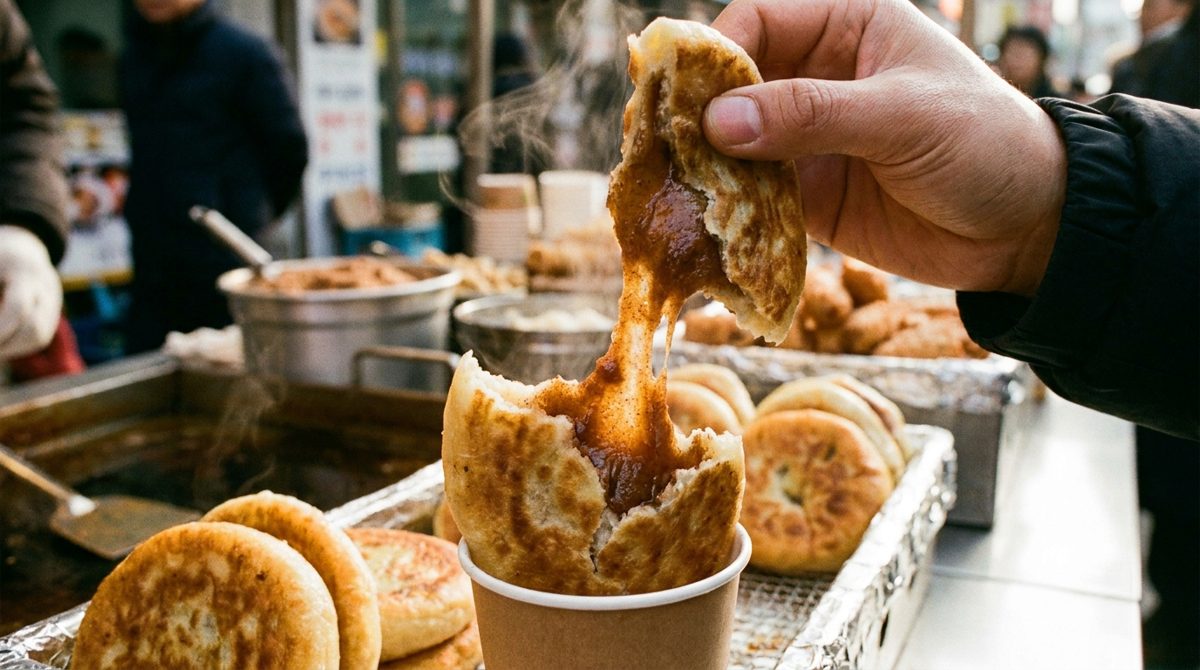
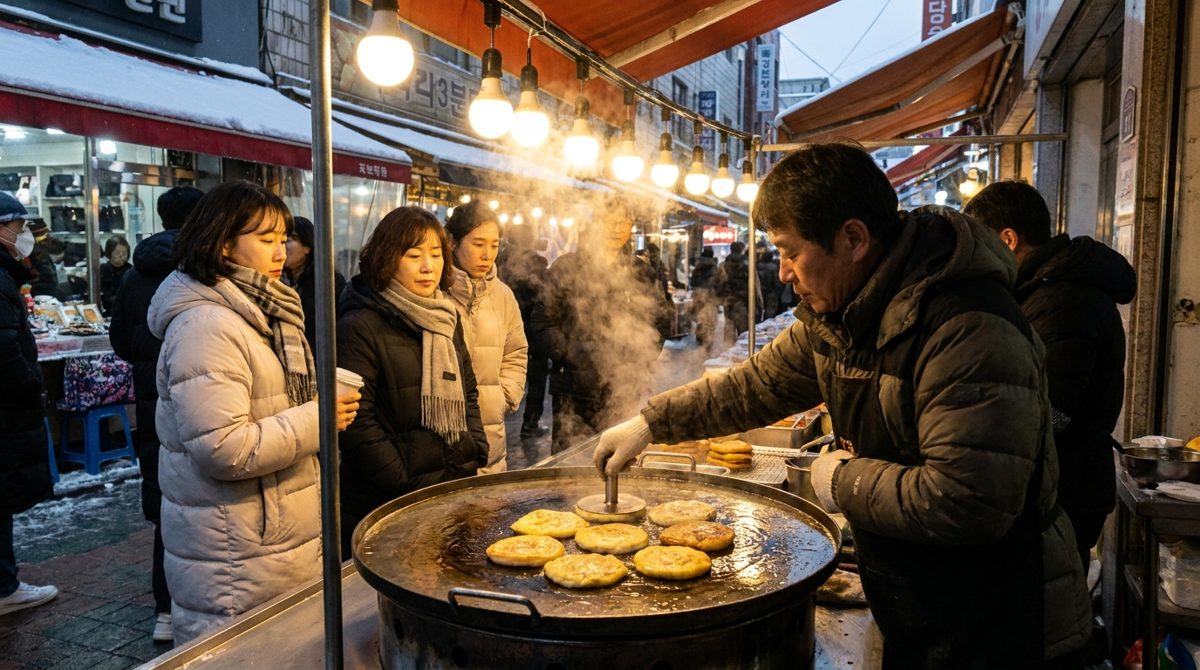
Hotteok is what happens when a bread meets a doughnut on a Korean griddle. A ball of soft yeasted dough is wrapped around a spoonful of brown sugar, cinnamon, and chopped nuts, laid on a hot oiled plate, then flattened with a purpose-built steel press into a golden disc. The heat melts the filling into syrup; the press crisps both faces; the vendor slides it into a folded paper cup and warns you — always — that it’s hot. It always is. Nobody waits anyway.
The name tells its immigration story: ho (胡) historically referred to foreign — originally Chinese — origins, and tteok means rice cake or, loosely, cake. Chinese merchants who settled in Korea in the late 1800s sold savory stuffed pancakes; Korean tastes gradually swapped the filling for brown sugar, and by the mid-20th century hotteok had become a fully Korean institution, as tied to winter as roasted chestnuts and steamed buns from the same carts. You can read the longer history on Wikipedia’s hotteok entry.
Seasonality is part of its charm. Hotteok stalls multiply from October, peak in the freezing months, and thin out by late spring — though famous market vendors now fry year-round for the tourist trade. For Koreans, the first hotteok of the season is a small ceremony: the smell of caramelizing sugar on cold air announces that winter has properly arrived. It regularly tops surveys of the street food Koreans miss most when living abroad.
Hotteok belongs to a whole cast of Korean winter street characters: bungeoppang (fish-shaped pastries filled with red bean), gyeranppang (egg bread), roasted sweet potatoes in steel drums, and paper cups of steaming odeng broth. Stalls cluster together, so one good corner can feed you a full progressive dessert course for a few thousand won. Among them, hotteok is the undisputed headliner — the one with the longest queue and the most theatrical cooking process.
What Does Hotteok Taste Like?
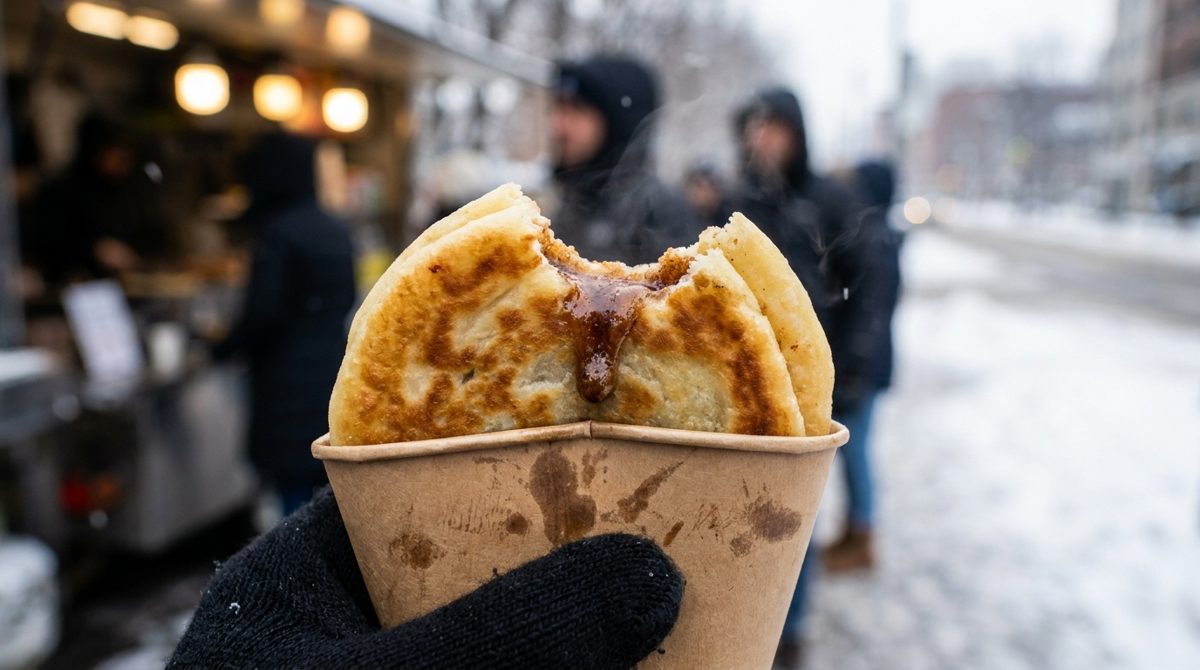
Like a cinnamon roll that went to finishing school on a griddle. The outside is crisp and faintly savory from the oil — closer to a pan-fried doughnut than a pancake — while the inside is stretchy, chewy dough giving way to a rush of hot, liquid brown-sugar-cinnamon syrup with the crunch of crushed peanuts or walnuts. The contrast is everything: crackly then soft, salty-oil edge then deep caramel sweetness, cold air on your face and molten filling in your mouth.
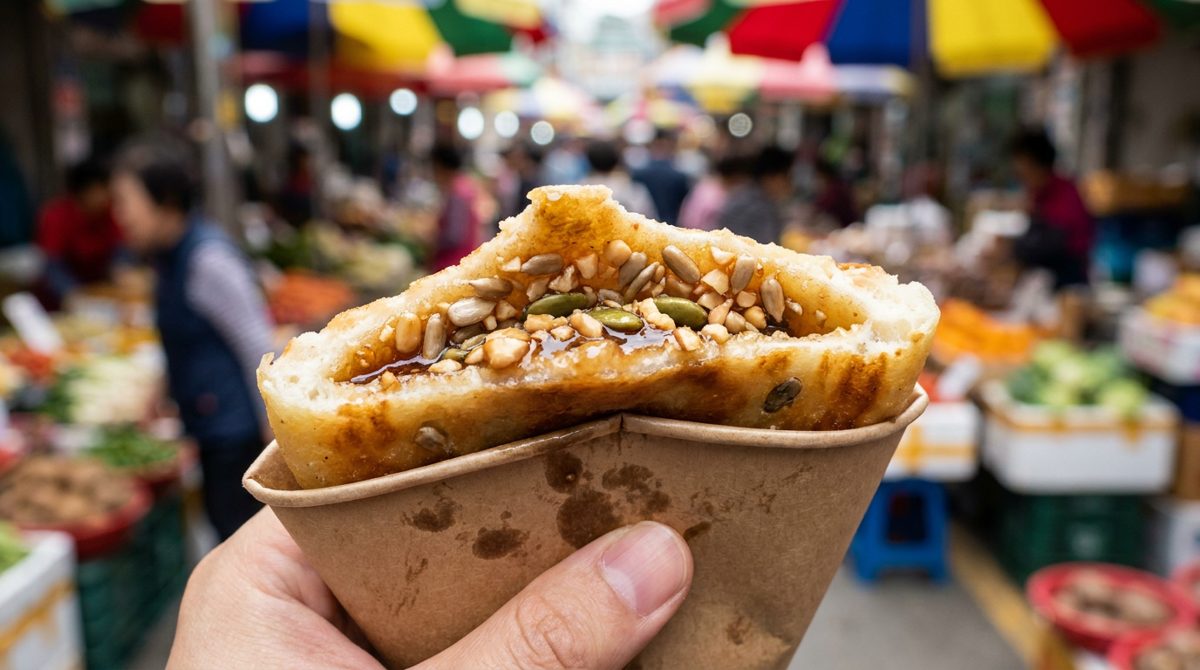
Busan’s famous ssiat (seed) hotteok plays a different tune: after frying, the vendor scissors the pancake open and stuffs the pocket with a scoop of sunflower seeds, pumpkin seeds, peanuts, and sometimes black sesame — turning a sweet snack into something nutty, textured, and dangerously rewatchable. Most travelers who try both develop a firm allegiance within the day.
Is Hotteok Spicy?
Zero out of five, without asterisks. Hotteok is a dessert — the cinnamon is warm-sweet, not hot, and no chili comes anywhere near the griddle. It’s one of the very few famous Korean street foods with literally no spicy variant, which makes it the perfect palate refuge after you’ve overestimated yourself at a tteokbokki stall. (If that’s already happened, our tteokbokki guide will help you calibrate next time.)
Hotteok Dietary Guide: Vegetarian, Vegan, Halal & Allergens
Hotteok is one of Korea’s friendliest street foods for restricted diets — with one serious exception that needs bold letters.
| Ingredient concern | In standard hotteok? | How to handle |
|---|---|---|
| Nuts & seeds (peanut, walnut, sunflower) | Yes — in the filling of most versions | Nut allergy? Treat every hotteok as containing peanuts unless proven otherwise — fillings are pre-mixed and cross-contact is universal at stalls |
| Wheat / gluten | Yes — the dough is wheat (often with rice flour blended in) | No gluten-free street version; some packaged mixes offer alternatives |
| Dairy | Sometimes — some doughs include milk; margarine or butter on the griddle at some stalls | Ask “uyu deureogayo?” (우유 들어가요? — is there milk?); many stalls use water dough and vegetable oil |
| Egg | Rarely | Traditional dough is flour, water/milk, yeast, sugar — egg is uncommon |
| Meat / seafood | No | Sweet hotteok contains neither; rare savory japchae-filled versions contain vegetables and glass noodles |
| Soy | Minor | Frying oil is often soybean oil; japchae versions include soy sauce |
| Alcohol | No | Nothing fermented beyond the yeast in the dough |
Is Hotteok Vegetarian or Vegan?
Vegetarian: yes, almost always — the standard hotteok is dough, sugar, cinnamon, and nuts fried in vegetable oil or margarine, with no meat products anywhere in the process. It’s one of the safest street-food picks for vegetarians in Korea. Vegan: often in practice, but not guaranteed — some vendors enrich the dough with milk, and some griddle with butter or dairy-based margarine. Stalls using plain water-yeast dough and vegetable oil (very common) are incidentally vegan. If it matters, ask about milk and butter; if the vendor is mid-rush and you can’t communicate, packaged hotteok mixes at supermarkets list ingredients clearly and several are vegan-friendly.
Is Hotteok Halal?
Mostly yes — and that’s rarer than it sounds in Korean street food. Hotteok contains no pork, no meat, and no alcohol; the ingredients are flour, sugar, yeast, cinnamon, nuts, and frying oil. The only points Muslim travelers typically verify are the frying fat (vegetable oil is standard; occasional stalls use margarine or shortening of uncertain sourcing) and cross-contact at stalls that also fry non-halal items — uncommon, since hotteok carts usually sell only hotteok. Among Korean street snacks, it sits comfortably in the “generally fine” category; the Korea Tourism Organization’s Muslim-friendly travel resources on VisitKorea flag it the same way.
How to Order Hotteok in Korean (+ 2026 Prices)
Hotteok ordering is gloriously simple — point, hold up fingers, pay in cash or by card. But these phrases make it smoother:
| What you want | Say this | Romanized |
|---|---|---|
| One hotteok, please | 호떡 하나 주세요 | hotteok hana juseyo |
| Two, please | 두 개 주세요 | du gae juseyo |
| Seed hotteok, please (Busan) | 씨앗호떡 주세요 | ssiat-hotteok juseyo |
| Does it have nuts? | 땅콩 들어가요? | ttangkong deureogayo? (peanuts?) |
| Is there milk in the dough? | 우유 들어가요? | uyu deureogayo? |
What it costs in 2026: a standard hotteok runs ₩1,500–₩3,000 depending on the neighborhood — tourist markets sit at the top of that range, residential street carts at the bottom. Busan ssiat hotteok and premium versions (green tea dough, cheese, japchae) run ₩3,000–₩4,000. It remains one of the best price-to-joy ratios in Korean food: a two-person dessert crawl through a market costs less than a single café latte. Most stalls take cards now, but small cash is still the fastest way to keep a queue moving.
How to Eat Hotteok Like a Local
Rule one: respect the lava. The syrup inside a fresh hotteok is genuinely scalding, and every Korean has a childhood memory of burning the roof of their mouth on the first bite of winter. Take the paper cup, wait thirty seconds (the hardest part), then bite from the edge, not the fat center where the syrup pools. Tilt the cup slightly as you eat so escaping syrup drips into the paper, not down your sleeve.
Rule two: eat it standing there. Hotteok doesn’t travel — the crisp faces steam themselves soft within minutes, and a cooled hotteok is a decent snack where a fresh one is an event. Locals eat within arm’s reach of the griddle, and vendors time their pressing so each customer gets one straight off the steel. Watching the vendor work the press — flatten, flip, press again, stack — is half the pleasure; a skilled hotteok hand at a busy market moves with real showmanship.
A naming note that saves confusion: hotteok is not hoppang, the fluffy steamed bun sold warm at convenience stores all winter, and it’s not a Western pancake either — no syrup bottle, no fork. If you want to drink something alongside, Koreans pair it with instant-machine coffee (₩500 from the stall-side vending machine, an experience in itself), sikhye rice punch, or simply nothing: hotteok is self-saucing by design. One more insider move — some vendors will split one hotteok into two paper cups for sharing if you ask nicely and the queue is short.
Types of Hotteok You’ll See in Korea
Classic hotteok (호떡) — brown sugar, cinnamon, crushed peanuts; the default everywhere. Ssiat hotteok (씨앗호떡) — Busan’s pride: fried in a deeper pool of oil, snipped open, and stuffed with sunflower and pumpkin seeds; born in the BIFF Square stalls of Nampo-dong. Nokcha hotteok (녹차호떡) — green tea dough, usually the same sweet core. Chapssal hotteok (찹쌀호떡) — glutinous rice flour blended in for extra chew. Japchae hotteok (잡채호떡) — the savory rebel filled with stir-fried glass noodles and vegetables. Cheese hotteok — a modern market invention aimed squarely at teenagers, and it works. Winter markets sometimes add corn, Nutella, or ice-cream-topped versions; purists grumble and queue anyway.
Where to Try Hotteok
In winter, you barely need directions — follow the smell of caramelizing sugar near any subway exit, market gate, or university district. For guaranteed excellence: Seoul’s Gwangjang and Namdaemun markets have decades-old stalls with permanent queues, and Insadong’s main street fries the famous green-tea version. The pilgrimage destination is Busan: the original ssiat hotteok stalls in BIFF Square, Nampo-dong, where the seed-stuffed style was invented — build it into a wider eating day with our Busan restaurant travelogue. For the full national tour of carts and markets, our Korean street food guide maps hotteok alongside its savory cousins. Off-season or homesick later? Korean supermarkets sell hotteok mix kits that reproduce the real thing surprisingly well — a frying pan, ten minutes, and your kitchen smells like a Seoul street corner in January. It’s the rare souvenir that actually tastes like the trip.
Cafés and department-store food halls have also gentrified the hotteok in recent years — you’ll find versions with ice cream, injeolmi powder, or a knife and fork in trendy neighborhoods like Seongsu and Yeonnam. They’re genuinely good, and genuinely three times the price. Try the ₩2,000 street original first; the café remix makes more sense once you know what it’s remixing.
Hotteok FAQ
What is hotteok filled with?
Classically: brown sugar, cinnamon, and crushed peanuts or walnuts, which melt into syrup on the griddle. Busan’s ssiat version adds a scoop of sunflower and pumpkin seeds; modern variants include japchae glass noodles, cheese, and green tea dough.
Is hotteok vegan?
Often in practice — many stalls use a plain water-yeast dough fried in vegetable oil. But some doughs contain milk and some griddles use butter or margarine, so strict vegans should ask. Vegetarians can eat standard hotteok with confidence.
Does hotteok contain nuts?
Almost always — peanuts or walnuts in the classic filling, and ssiat hotteok is loaded with seeds and peanuts by design. Travelers with nut or seed allergies should treat all street hotteok as unsafe; fillings are pre-mixed and cross-contact is unavoidable.
When is hotteok season in Korea?
Roughly October through March. Stalls peak in the coldest months, when a hot hotteok in a paper cup is Korea’s definitive winter street snack — though famous market vendors in Seoul and Busan now sell year-round.
How much does hotteok cost in Korea in 2026?
₩1,500–₩3,000 for a classic hotteok at street stalls, and ₩3,000–₩4,000 for Busan ssiat hotteok or premium variants. It’s one of the cheapest beloved foods in the country.
The Verdict: Should You Order It?
Without hesitation — hotteok might be the single highest-reward, lowest-risk food experience in Korea. It’s cheap, it’s non-spicy, it’s vegetarian-friendly and largely halal-safe, and eating one fresh off the press on a cold night is a core Korean memory available to anyone with pocket change. The only travelers who must abstain are those with nut and seed allergies — for everyone else, the correct order is one classic now and one ssiat hotteok when you get to Busan — then a third, because two was never going to be enough. Still decoding the menu? Every major Korean dish — spice levels, allergens, prices, phrases — lives in our Korean Food Decoder.