Let’s clear this up immediately: Korean sundae (순대) is not ice cream. Sundae is Korean blood sausage — steamed pork intestine casing stuffed with glass noodles, pork blood, and seasonings, sliced into rounds and eaten with a seasoned dipping salt. The name is pure coincidence: it’s pronounced “SOON-dae,” and it has been a beloved Korean street food for centuries, long before anyone put a cherry on frozen dessert. This decoder page gives you the full picture: what’s actually inside, how it tastes, honest halal and vegetarian answers, real 2026 prices, and how to order it without pointing and praying.
Table of Contents
- Korean Sundae Quick Facts
- What Is Korean Sundae, Exactly?
- What Does Sundae Taste Like?
- Dietary Guide: Vegetarian, Vegan, Halal & Allergens
- How to Order Sundae in Korean (+ 2026 Prices)
- How to Eat Sundae Like a Local
- Types of Sundae & Regional Variants
- Where to Try Sundae
- Korean Sundae FAQ
Korean Sundae Quick Facts
| Item | Details |
|---|---|
| Korean name | 순대 (sundae) — Korean blood sausage |
| Pronunciation | SOON-dae (not “sun-day” — and definitely not ice cream) |
| Type | Street food snack / soup ingredient (sundae-guk) |
| Spice level | 🌶️ 0 / 5 — completely mild; dipped in seasoned salt or ssamjang |
| Price (2026) | ₩4,000–₩6,000 for a street portion; sundae-guk soup ₩9,000–₩11,000 |
| Vegetarian | ❌ No — pork blood and pork intestine are the dish |
| Vegan | ❌ No |
| Halal-friendly | ❌ Absolutely not — pork blood in pork intestine; both are prohibited |
| Main allergens | Pork, wheat (in some fillings/dips), soy |
| Best for | Adventurous eaters, street food crawlers, tteokbokki fans |
What Is Korean Sundae, Exactly?
Here’s the thirty-second version before we go deep. Sundae is a steamed sausage, not a grilled or fried one, which is why it looks glossy and dark rather than browned. It’s sold by the portion, pre-sliced, and eaten as a snack rather than a meal — think of it as Korea’s between-meals protein hit, occupying the same cultural slot as a hot dog in New York or a currywurst in Berlin, but older than both.
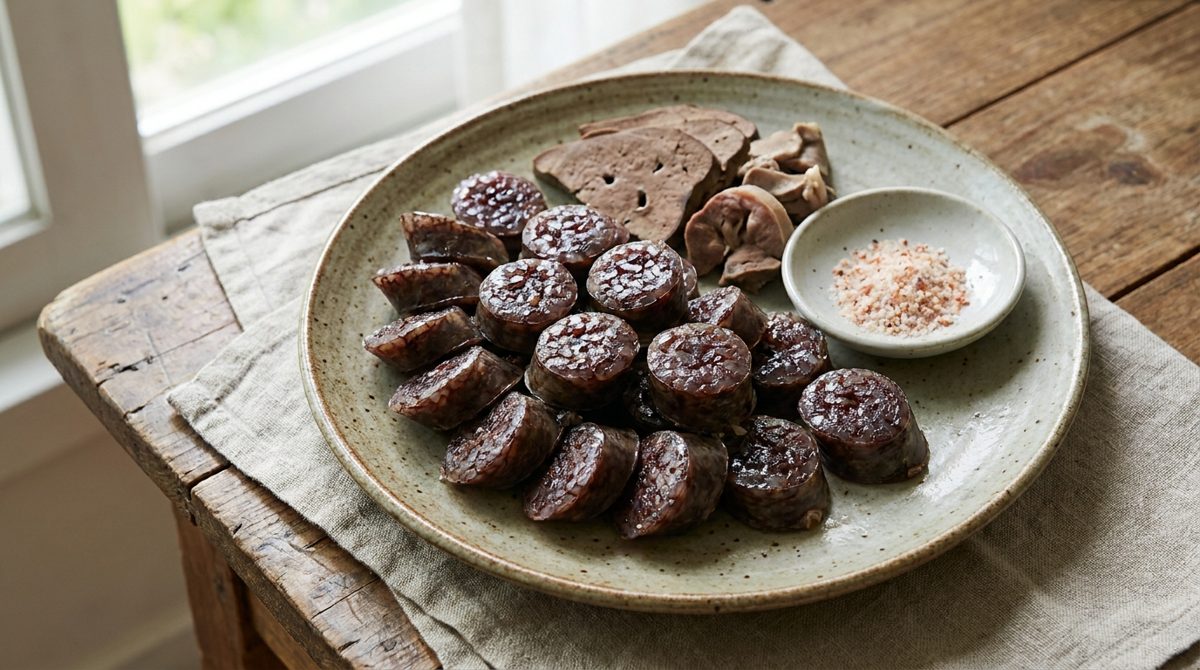
Sundae is Korea’s answer to blood sausage — cousin to British black pudding, Spanish morcilla, and French boudin noir, but with a texture all its own. The standard street version stuffs pork intestine casing with dangmyeon (sweet potato glass noodles), pork blood, glutinous rice, and aromatics like garlic and scallion, then steams the whole thing until the filling sets into a soft, springy log. It’s sliced into coins and served warm, usually alongside steamed slices of liver (gan) and lung (heopa).
The dish goes back centuries — recipes for stuffed intestine appear in Joseon-era cookbooks, and older versions used more meat and vegetables. The noodle-heavy street version is actually a post-Korean War adaptation, when pork blood and cheap glass noodles stretched scarce ingredients into something filling. That thrifty snack became a national obsession: today sundae is a fixture of every street market, bunsik (snack bar) menu, and late-night drinking table in the country.
And about that name. It’s a romanization coincidence — 순대 was “sundae” long before English spelling conventions got involved. Korean kids find the ice cream confusion just as funny as you do. If you search “Korean sundae” and get dessert results, add the word “blood sausage” and welcome to the savory side. (For the deep history, the Wikipedia entry on sundae traces stuffed-intestine recipes back to 19th-century Korean cookbooks and beyond.)
What makes sundae culturally interesting is its double life. At street stalls it’s a ₩5,000 after-school snack, sold beside tteokbokki and fish cakes. At soup restaurants it becomes sundae-guk, a milky pork-bone broth loaded with sundae and offal that Koreans treat as serious comfort food — a working-lunch staple, a hangover cure, a cold-morning ritual. Same sausage, two completely different meals. Most travelers meet the street version first, and that’s the right order.
What Does Sundae Taste Like?
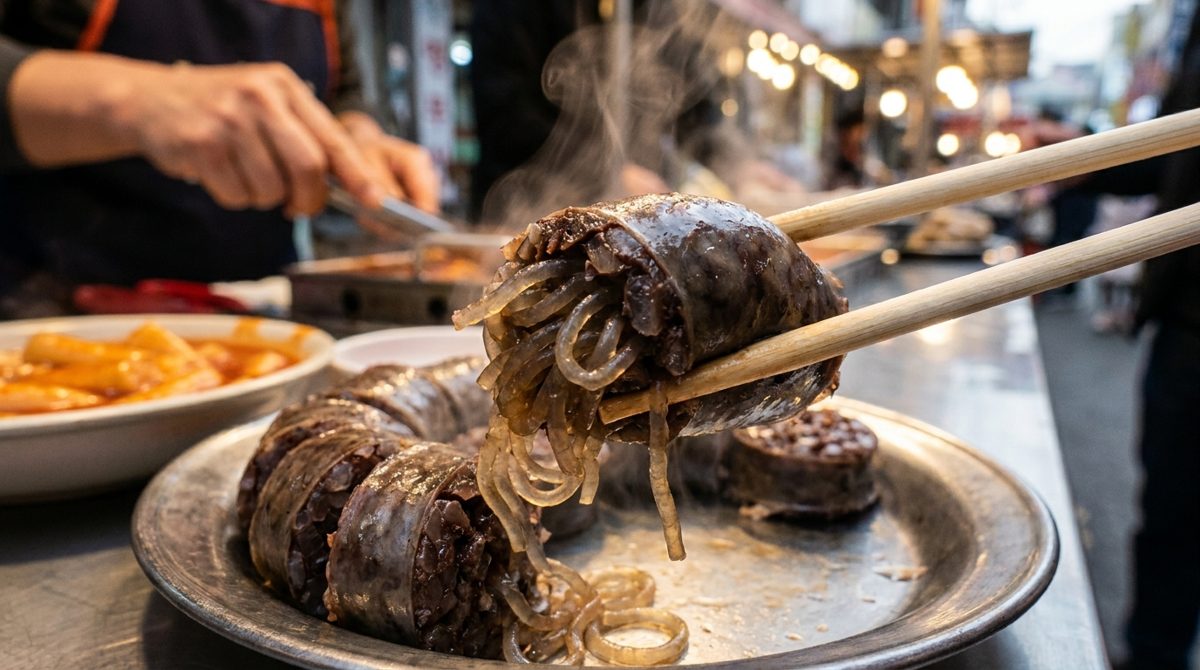
Milder than you’re bracing for. The word “blood sausage” promises intensity, but Korean sundae is gentle: the glass noodles dominate, giving a soft, bouncy, almost mochi-like chew, while the blood contributes a subtle iron-rich savoriness and a dark color rather than a strong flavor. There’s garlic, a whisper of ginger, and steam-cooked mellowness throughout. Most first-timers describe it as “way less scary than expected” — the texture is the adventure, not the taste.
The liver and lung slices served alongside are more assertive — liver is dense and mineral, lung is springy and mild. They’re optional; locals often eat them first while hot, but no one will blink if you stick to the sausage. If you want a benchmark: if you can handle a mild pâté or a well-made black pudding, sundae will feel easy. If offal in general makes you nervous, order “naejang ppaego” (no innards) and judge the sausage on its own terms.
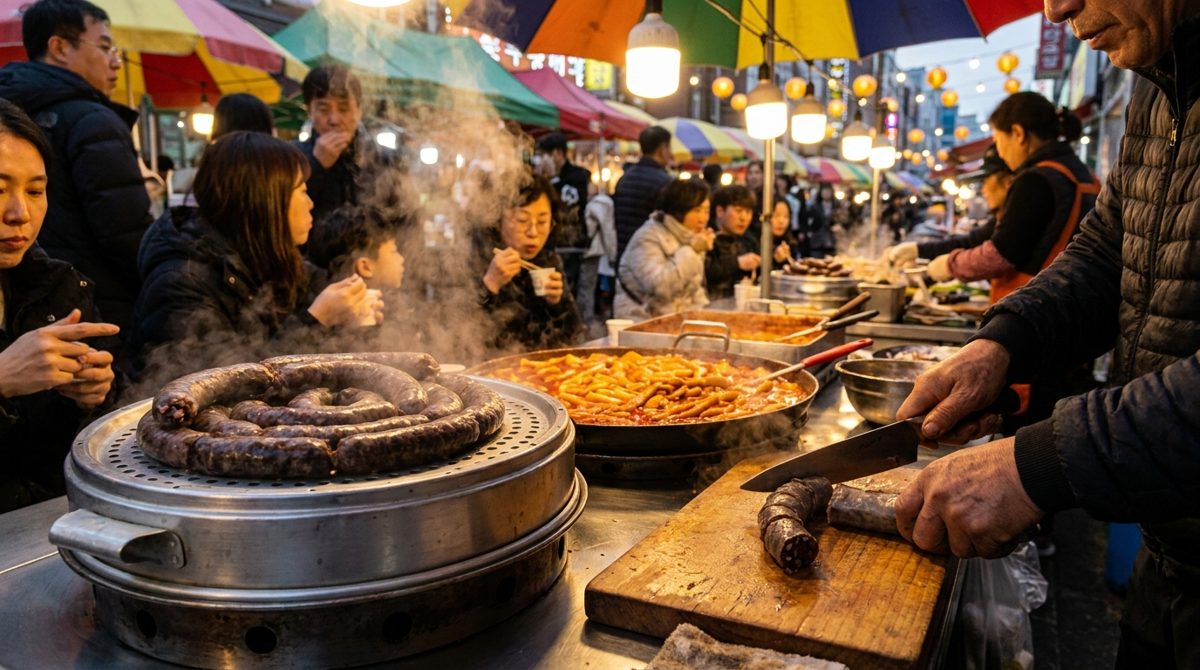
Temperature matters more than most guides admit. Fresh from the steamer, sundae is soft, aromatic, and at its best; once it cools, the casing toughens and the iron note grows louder. Buy it where turnover is fast — a busy market stall beats a quiet one every time — and eat it standing there, the way it’s meant to be eaten.
Is Sundae Spicy?
Not at all — sundae itself is a 0 out of 5. It’s steamed and unseasoned beyond its filling, then dipped in whatever you choose: seasoned salt (salt, pepper, sometimes sesame or dried shrimp powder, depending on the region) or ssamjang-style dipping paste. The only way sundae gets spicy is by association — when it’s dunked into tteokbokki sauce (highly recommended, and covered below) or stir-fried as spicy sundae-bokkeum. On its own, it’s one of the mildest things at the entire street stall.
Sundae Dietary Guide: Vegetarian, Vegan, Halal & Allergens
Sundae is one of the most restrictive dishes on the Korean street food circuit — there’s no polite way to soften that, so here’s the honest breakdown. If you follow any dietary rule involving pork, blood, or animal products, this dish is out; if allergies are your concern, the table below covers what’s actually inside.
| Ingredient concern | In standard sundae? | Notes |
|---|---|---|
| Pork | Yes — fundamental | Pork blood, pork intestine casing, plus liver and lung sides |
| Beef | No | Standard sundae is pork-based throughout |
| Wheat / gluten | Sometimes | Some fillings add barley or wheat-based binders; dipping pastes often contain wheat. Glass noodles themselves are sweet potato starch (gluten-free) |
| Soy | Yes | Soy sauce seasoning in the filling and most dipping pastes |
| Sesame | Often | Common in dipping salts and pastes |
| Egg / dairy / nuts | No | Not part of traditional sundae |
| Seafood | Rarely | Some regional dipping salts use dried shrimp powder; Sokcho’s squid sundae uses squid casing |
| Alcohol | No | None in the dish (though Koreans love pairing it with soju) |
Is Sundae Vegetarian or Vegan?
No, with no workaround. Unlike bibimbap, where you can subtract the meat, sundae is the meat — the casing is pork intestine and the filling is bound with pork blood. There is no vegetarian version at any normal stall or restaurant. If you’re vegetarian and craving that chewy glass-noodle texture, order japchae (stir-fried glass noodles) instead, or browse our Korean street food guide for meat-free stall options like hotteok and roasted sweet potato.
Is Sundae Halal?
No — and this one isn’t conditional. Sundae contains pork blood inside a pork intestine casing: both pork and blood are explicitly prohibited, so no preparation method or restaurant certification can make sundae halal. This is a hard skip for Muslim travelers, full stop. Good news: Korean street food has plenty of alternatives. Tteokbokki (check for fish cake), hotteok, and grilled corn are common Muslim-traveler picks, and the Korea Tourism Organization maintains Muslim-friendly restaurant listings on VisitKorea. For a sit-down meal, chicken dishes like dakgalbi are far more workable.
How to Order Sundae in Korean (+ 2026 Prices)
Sundae stalls are point-and-order friendly, but a few phrases help — especially for controlling the offal situation. The most useful thing to know in advance: when you order a portion, the vendor will often ask what mix you want, and pointing at just the sausage is a perfectly acceptable answer. At bunsik snack bars, sundae also appears in combo sets with tteokbokki and fried snacks (twigim) — usually the best-value way to try everything at once.
| What you want | Say this | Romanized |
|---|---|---|
| One portion of sundae, please | 순대 일인분 주세요 | sundae il-in-bun juseyo |
| No liver or lung, please | 내장 빼고 주세요 | naejang ppaego juseyo |
| Extra liver, please | 간 많이 주세요 | gan mani juseyo |
| Sundae soup, please | 순대국 하나 주세요 | sundae-guk hana juseyo |
| With tteokbokki sauce on it | 떡볶이 국물에 주세요 | tteokbokki gungmul-e juseyo |
What it costs in 2026: a street or market portion of sliced sundae runs ₩4,000–₩6,000 — one of the cheapest filling snacks in Korea. A bowl of sundae-guk (sundae soup with rice, a full meal) costs ₩9,000–₩11,000 at specialist soup restaurants. Spicy stir-fried sundae-bokkeum at sit-down places runs ₩15,000–₩20,000 for a sharing pan. Street stalls are cash-friendly but nearly all take cards now.
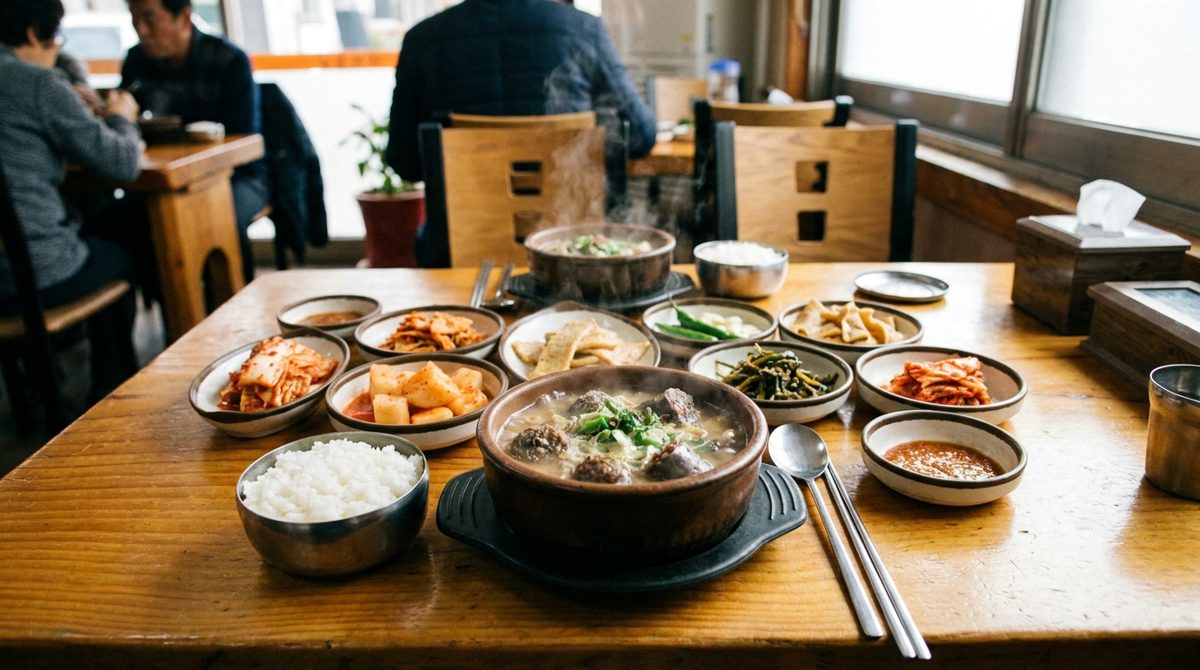
A note on sundae-guk ordering: the bowl arrives deliberately under-seasoned. Your table will have salted shrimp paste (saeujeot), chopped chili, and perilla seed powder — season the broth yourself, a spoonful at a time. Many shops ask “다 넣어드려요?” (everything in?) meaning all the offal varieties; answer “네” (yes) for the full experience or point at just the sundae if you’re easing in. Rice comes in the bowl or on the side depending on the shop — both are correct.
How to Eat Sundae Like a Local
Grab a slice with a toothpick or chopsticks, dip one edge into the seasoned salt, and eat it in one bite while it’s still steaming. Don’t drown it — the salt is a seasoning, not a sauce. If liver and lung came on the plate, they’re eaten the same way; liver especially benefits from a generous dip. Regional trivia worth knowing: Seoul dips in salt, much of the southeast (Busan, Daegu) dips in makjang or ssamjang-style fermented paste, and Jeolla province reaches for chogochujang. If your stall hands you something that isn’t salt, you’re getting a regional education for free.
The true local move, though, is the tteokbokki combo. At any bunsik stall, order both and dunk your sundae slices into the sweet-spicy tteokbokki sauce — the mild sausage soaking up gochujang gravy is one of Korean street food’s great pairings. Some stalls will ladle sauce over your sundae if you ask (see the phrase table above). Planning a dedicated pilgrimage? Our top tteokbokki spots in Seoul all serve sundae on the side.
Types of Sundae & Regional Variants
Street sundae (당면순대) — the glass-noodle version described above; what you’ll find at 95% of stalls and markets. Abai sundae (아바이순대) — the North Korean-style original from Sokcho’s Abai Village, settled by wartime refugees: a fatter sausage packed with rice, vegetables, and more blood, richer and meatier than the street version. Squid sundae (오징어순대) — Sokcho’s other specialty: a whole squid body stuffed with sundae-style filling, steamed, sliced, and often pan-fried in egg batter. No intestine involved, but still not vegetarian. Baekam sundae (백암순대) — from Yongin, a premium rice-and-vegetable style served in famous soup houses. Sundae-bokkeum (순대볶음) — sundae stir-fried with cabbage, perilla leaves, and spicy sauce on a hot plate, a drinking-table favorite in university districts. Pisundae (피순대) — the blood-forward Jeonju style with little to no noodle filler; darker, denser, and the one for committed blood sausage fans.
The Sokcho variants deserve a word more. Abai Village was settled by refugees from Hamgyong Province during the Korean War, and “abai” is Hamgyong dialect for “father” or “old man.” The sundae they brought south is the pre-war original — rice-and-blood rich, no glass noodles — and eating it there, a short boat-pull (gaetbae) across the harbor from central Sokcho, is as close as street food gets to edible history.
Where to Try Sundae
Every traditional market has a sundae stall — at Seoul’s Gwangjang or Mangwon markets you’ll spot the steamers from across the aisle, and our Seoul food guide maps the best market picks. For sundae-guk soup, look for restaurants with 순대국 or 순댓국 on the sign — Sillim-dong in Seoul is famous for an entire sundae town of specialists. For the pilgrimage version, head to Sokcho’s Abai Village on the east coast for Abai sundae and squid sundae eaten within sight of the harbor. And if you’re building a full street food day, sundae belongs on any street food crawl between the hotteok stand and the fish cake pot.
Worried about eating steamed offal from a street cart? Don’t be, within reason. Sundae is fully cooked and held in a hot steamer, and Korean market stalls operate under real hygiene enforcement — food safety incidents are rare. The same rule from the taste section applies doubly here: pick the busy stall. High turnover means the sundae in that steamer went in this morning, not yesterday. Fellow adventurous eaters usually rank sundae alongside grilled intestines — if this page has you curious, gopchang is your logical next dare.
Korean Sundae FAQ
Is Korean sundae ice cream?
No. Korean sundae (순대, pronounced SOON-dae) is savory blood sausage — pork intestine stuffed with glass noodles and pork blood. The identical spelling to the ice cream sundae is pure coincidence in romanization. Korea has excellent ice cream too; this isn’t it. If a Korean friend offers to buy you sundae, clarify which one you’re getting before you build up an appetite for either.
Is sundae the same as black pudding?
Same family, different personality. Both are blood sausages, but black pudding is fried, crumbly, and oat-based, while Korean sundae is steamed, chewy, and noodle-based. Sundae tastes noticeably milder — the blood is a binder more than a flavor — and it’s eaten with dipping salt as a snack rather than as part of a fried breakfast.
What is Korean sundae made of?
Pork intestine casing filled with sweet potato glass noodles, pork blood, glutinous rice, garlic, and scallions, then steamed. It’s typically served with steamed pork liver and lung slices and a seasoned dipping salt.
Does sundae taste like blood?
Barely. The glass noodles dominate, so the flavor is mild, garlicky, and gently savory with a faint iron note. It’s considerably milder than European blood sausages like black pudding — the texture (soft and chewy) is more memorable than the taste.
Is sundae halal?
No, categorically. Sundae contains both pork and blood — two explicitly prohibited ingredients — so it cannot be halal in any form. Muslim travelers should skip it entirely and choose chicken dishes or verified Muslim-friendly restaurants instead.
How much does sundae cost in Korea in 2026?
A street or market portion costs ₩4,000–₩6,000. A full meal of sundae-guk (sundae soup with rice) runs ₩9,000–₩11,000 at specialist restaurants.
The Verdict: Should You Order It?
If you’re even slightly adventurous — yes. Sundae is the perfect “sounds scary, tastes gentle” gateway into Korean street food: cheap, filling, zero spice, and far milder than the words “blood sausage” suggest. Order a mixed portion at a market stall, dip it in the salt, dunk a slice in tteokbokki sauce, and decide for yourself. Skip it only if pork or offal are off your list. Ready for the next dish? Decode the whole menu with our Korean Food Decoder — every major Korean dish explained with spice levels, allergens, and ordering phrases.