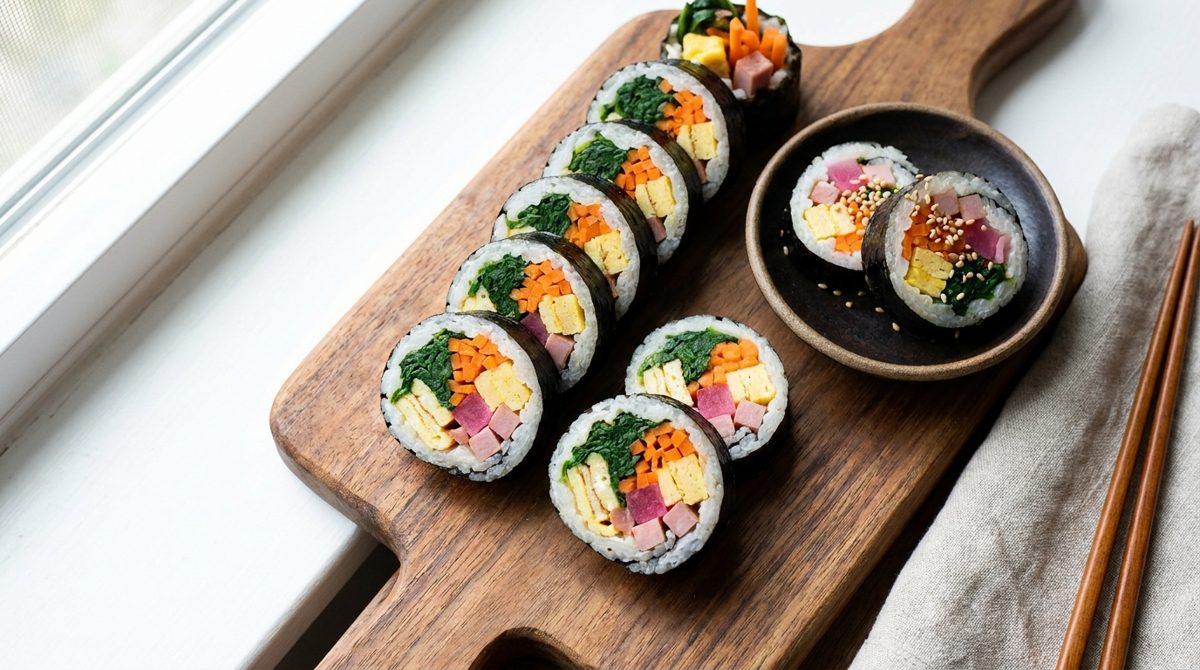
Wondering what kimbap is and whether it’s just “Korean sushi”? Kimbap (김밥, “seaweed rice”) is Korea’s beloved rice roll: cooked rice seasoned with sesame oil, rolled in roasted seaweed around colorful fillings like pickled radish, egg, carrot, spinach, and ham or tuna, then sliced into bite-size rounds. No raw fish, zero spice, and rarely more than a few thousand won — it’s the single best budget meal in Korea. This decoder covers taste, the sushi question, allergens, vegetarian and halal answers, real 2026 prices, and exactly how to order kimbap in Korean.
Table of Contents
- Kimbap Quick Facts
- What Is Kimbap, Exactly?
- What Does Kimbap Taste Like? (+ Kimbap vs Sushi)
- Dietary Guide: Vegetarian, Vegan, Halal & Allergens
- How to Order Kimbap in Korean (+ 2026 Prices)
- How to Eat Kimbap Like a Local
- Types of Kimbap
- Where to Try Kimbap
- Kimbap FAQ
Kimbap Quick Facts
| Item | Details |
|---|---|
| Korean name | 김밥 (kimbap / gimbap) — “seaweed rice” |
| Pronunciation | KEEM-bap (also romanized gimbap) |
| Type | Rice roll — snack, picnic food, or light meal |
| Spice level | 🌶️ 0 / 5 — completely mild, kid-safe |
| Price (2026) | ₩3,500–₩6,000 per roll at kimbap shops; specialty rolls slightly more |
| Vegetarian | ⚠️ Classic rolls contain ham, egg, and fish cake — but yachae (vegetable) kimbap is easy to find |
| Vegan | ⚠️ Yachae kimbap minus egg gets close — confirm no fish cake or crab stick |
| Halal-friendly | ⚠️ Ham is common — order tuna (chamchi) or vegetable kimbap instead |
| Main allergens | Egg, fish (crab stick, fish cake), soy, sesame, wheat (imitation crab), sometimes dairy (cheese rolls) |
| Best for | Budget travelers, picky eaters, picnics, train and hiking days |
What Is Kimbap, Exactly?
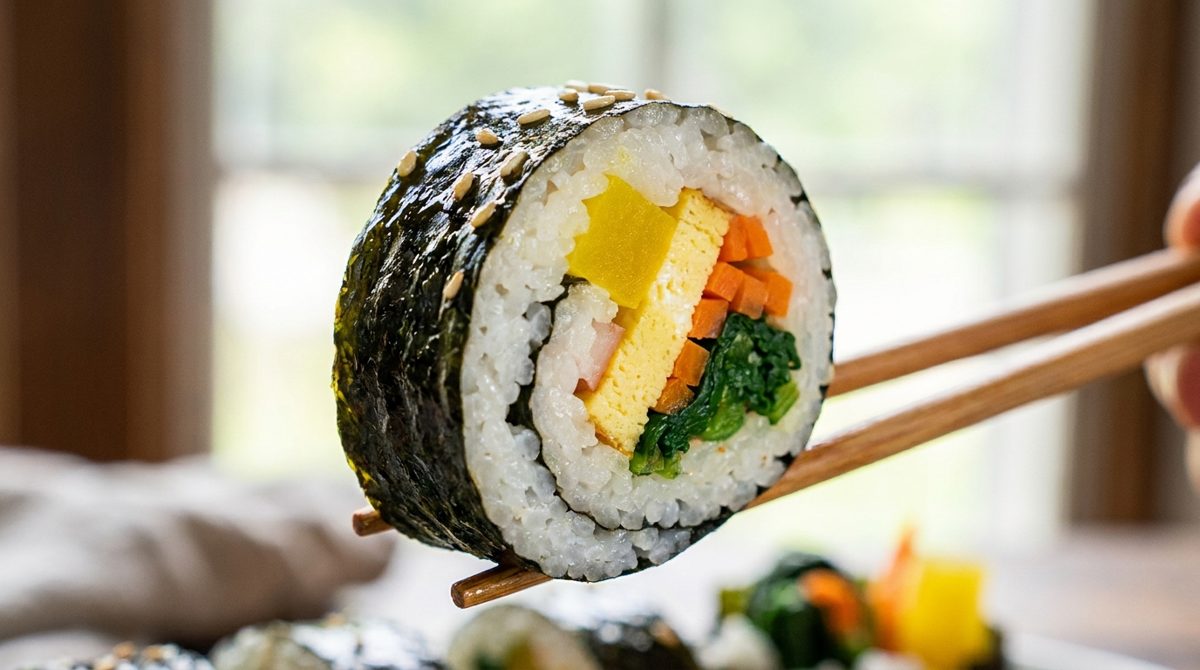
Kimbap is the food Korea packs when it goes somewhere. The name is simple arithmetic: gim (roasted seaweed) + bap (rice). Inside the roll, a rainbow of fillings — yellow pickled radish (danmuji), egg strips, carrot, spinach, burdock root, ham, crab stick — gets wrapped tight, brushed with sesame oil, and sliced into coins.
Every Korean has kimbap memories: school field trips, mountain hikes, sports days. Mothers wake up early to roll it fresh because kimbap is picnic food first and restaurant food second. That heritage explains its superpower — it’s engineered to be eaten at room temperature, hours after rolling, with one hand, anywhere. For travelers, that makes it the perfect KTX train meal, hiking fuel, and airport-morning breakfast.
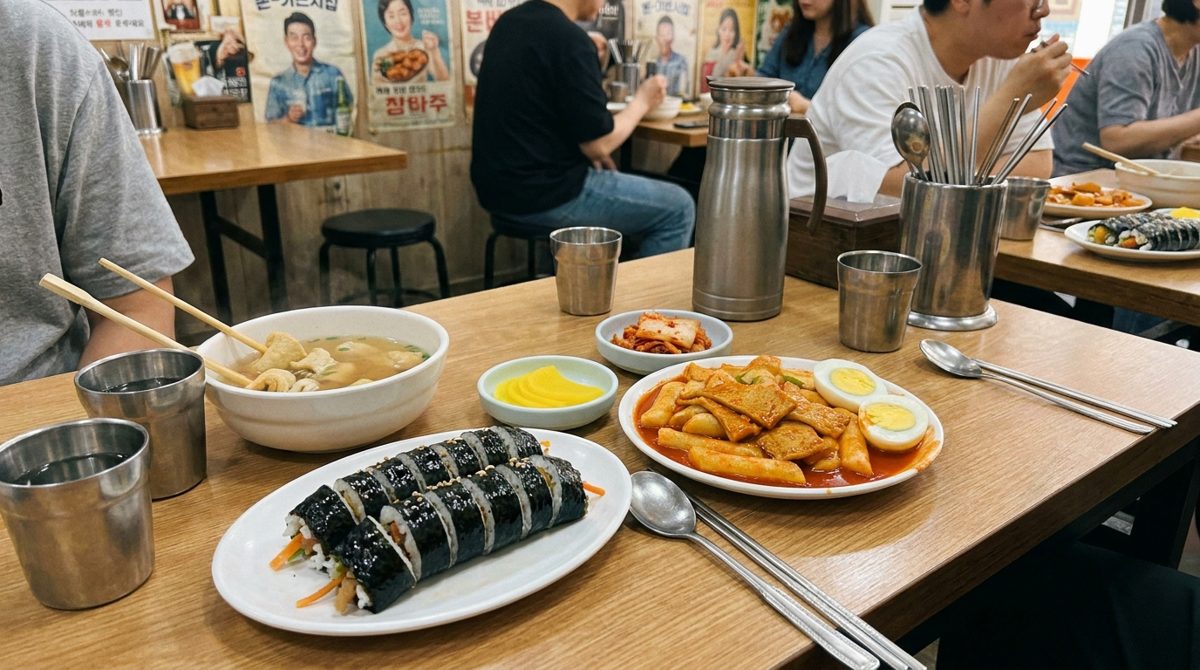
It’s also the backbone of Korea’s budget food scene. Kimbap shops — often open 24 hours, with names like Kimbap Cheonguk (“Kimbap Heaven”) — anchor every neighborhood, selling rolls from about ₩3,500 alongside ramyeon and tteokbokki. In an era of rising restaurant prices, kimbap remains the great equalizer: students, taxi drivers, and office workers all eat the same roll.
Kimbap is also having a global moment. Frozen Korean kimbap went viral internationally in the mid-2020s, selling out in supermarkets from the US to Europe, and the dish now rides the K-food wave alongside tteokbokki and corn dogs. Eating it in Korea, though, remains a different experience: rolled minutes before you eat it, seaweed still crisp, rice still slightly warm. If your only kimbap has been frozen or from a mall food court abroad, the real thing will recalibrate your expectations.
What Does Kimbap Taste Like? (+ Kimbap vs Sushi)
Mild, nutty, and quietly addictive. The dominant notes are toasted seaweed and sesame oil, over slightly sweet rice and the crunch-tang of pickled radish. Each slice is a balanced bite: soft rice, crisp vegetables, savory ham or tuna, sweet egg. Nothing shouts — which is exactly why you can eat an entire roll without noticing.
Now the eternal question: is kimbap just Korean sushi? No — and the differences matter. Sushi rice is seasoned with vinegar; kimbap rice is seasoned with sesame oil and salt, giving a nutty rather than tangy base. Sushi centers on raw fish; kimbap virtually never contains raw fish — its fillings are cooked, pickled, or cured. Sushi is dipped in soy sauce and wasabi; kimbap is eaten as-is, no dipping. They share a seaweed wrapper and a rolling mat, and the modern roll form did evolve during the Japanese colonial era from norimaki — but a century of Korean lunchboxes turned it into something entirely its own (the Wikipedia entry on gimbap covers the history debate).
Texture is half the pleasure. A good roll is wrapped tight enough that each coin holds together but loose enough that the rice stays fluffy rather than compressed. The seaweed should still have snap, the danmuji should crunch audibly, and the sesame-oil sheen on the outside should perfume your fingers. Day-old kimbap loses all of this — which is why Koreans treat it as a “made today, eaten today” food.
Is Kimbap Spicy?
Not at all — kimbap is a true 0 out of 5, one of the very few famous Korean foods with no chili anywhere in the standard recipe. Even kimchi kimbap is mild, since the kimchi is usually stir-fried sweet. The only heat risk is what you eat alongside it: Koreans love dunking kimbap into spicy tteokbokki sauce. That part is strictly optional.
Kimbap Dietary Guide: Vegetarian, Vegan, Halal & Allergens
Kimbap looks innocent, but the classic roll quietly stacks several allergens. Here’s the honest map:
| Ingredient concern | In standard kimbap? | How to handle |
|---|---|---|
| Ham / processed pork | Usually | “Haem ppaego juseyo” (햄 빼고 주세요) = no ham; or order tuna/vegetable rolls |
| Egg | Almost always | “Gyeran ppaego juseyo” (계란 빼고 주세요) = no egg |
| Fish / shellfish | Often | Crab stick (imitation crab) and fish cake are common; tuna rolls obviously contain fish |
| Wheat / gluten | Often | Imitation crab and fish cake contain wheat starch; ham may too |
| Soy | Yes | Seasonings and processed fillings routinely include soy |
| Sesame | Yes | Sesame oil brushed on rice and seaweed — essentially unavoidable |
| Dairy | Sometimes | Cheese kimbap is a popular variant — skip it if dairy-free |
| Nuts / alcohol | No | Standard rolls contain neither |
Is Kimbap Vegetarian or Vegan?
The classic roll is not — ham, egg, and often crab stick or fish cake come standard. But kimbap is one of the easiest Korean foods to get meat-free, because yachae kimbap (야채김밥, vegetable kimbap) is a normal menu item at nearly every kimbap shop, not a special request. It’s typically radish, carrot, spinach, burdock, and egg. Vegans should ask for it without egg and confirm there’s no fish cake hiding inside; the seaweed, rice, and vegetables themselves are plant-based. At premium kimbap chains you’ll even find avocado and salad rolls designed for exactly this crowd.
Is Kimbap Halal?
Standard kimbap usually contains ham — processed pork — so the default roll is not halal. The workaround is easy and doesn’t require a specialty restaurant: order chamchi kimbap (참치김밥, tuna) or yachae kimbap (vegetable), both ubiquitous and ham-free. Double-check that the shop doesn’t add ham to tuna rolls (a few do) with a simple “haem deureogayo?” (햄 들어가요? — does it contain ham?). For fully certified options, Muslim-friendly restaurants listed on VisitKorea are the safer route, but as street-level Korean food goes, a vegetable kimbap is one of the lowest-risk choices in the country.
How to Order Kimbap in Korean (+ 2026 Prices)
Kimbap is counted in “lines” (줄, jul) — one jul is one whole roll, sliced. Menus are usually wall posters with pictures, and ordering takes ten seconds:
| What you want | Say this | Romanized |
|---|---|---|
| One roll of kimbap, please | 김밥 한 줄 주세요 | kimbap han jul juseyo |
| Tuna kimbap | 참치김밥 주세요 | chamchi kimbap juseyo |
| Vegetable kimbap | 야채김밥 주세요 | yachae kimbap juseyo |
| No ham, please | 햄 빼고 주세요 | haem ppaego juseyo |
| To go / takeout | 포장해 주세요 | pojang-hae juseyo |
Ordering etiquette is minimal: at old-school shops you order at the counter or just call out your rolls; at chains you may get a paper slip to tick boxes. Most shops will happily customize — no ham, extra egg, no radish — because they’re assembling each roll by hand anyway. If there’s a line, know your order before you reach the front; kimbap shops run on speed. And “han jul” (one line) versus “du jul” (two lines) is the only counting you’ll need: one roll is a snack, two rolls is lunch.
What it costs in 2026: a basic roll at a neighborhood kimbap shop runs ₩3,500–₩4,500, with tuna, cheese, and bulgogi versions at ₩5,000–₩6,000. Premium kimbap specialists in Seoul charge ₩6,000–₩8,000 for gourmet rolls (avocado, grilled hanwoo). Convenience stores sell triangle kimbap — the onigiri-shaped single-serving cousin — for ₩1,200–₩2,000; our Korean convenience store food guide ranks the flavors worth grabbing. Two rolls plus a drink is a full meal for under ₩10,000 — unbeatable in 2026 Seoul.
How to Eat Kimbap Like a Local
There’s no ceremony — that’s the charm. Chopsticks at a table, fingers on a hiking trail, toothpicks from a convenience store pack. Kimbap is eaten at room temperature and never dipped; if a shop gives you a little cup of soup or sliced danmuji on the side, that’s your palate cleanser between bites.
The most Korean move of all: order kimbap at a bunsik (snack) restaurant alongside a plate of tteokbokki, and dip the kimbap coins into the sweet-spicy tteokbokki sauce. This combination — plus maybe fried mandu — is the national comfort meal of students everywhere. If you’re spice-curious but cautious, this is the perfect dosage system: you control every dunk. Find the best spots in our Seoul tteokbokki guide.
And lean into the picnic heritage. Some of the best kimbap moments happen nowhere near a table: on a Bukhansan hiking trail where every Korean around you unpacks identical foil-wrapped rolls, on the grass along the Han River at sunset, or in a KTX seat watching rice fields blur past. Grab rolls, a couple of drinks, and go — Korea’s parks, riversides, and mountains are furnished with the assumption that you brought kimbap.
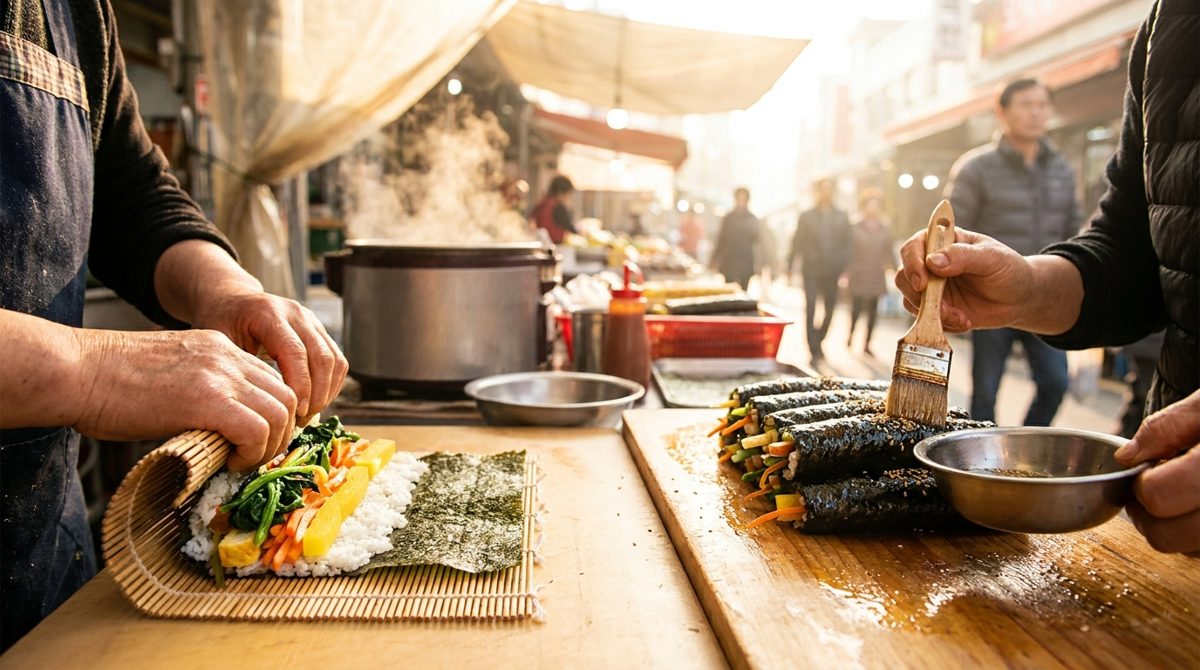
One practical warning: kimbap is fresh food, not shelf food. Shops roll it to order or in small batches; eat it within a few hours, especially in summer. That’s also the sign of a good shop — if the rolls are made in front of you, you’re in the right place.
Types of Kimbap You’ll See on Menus
Yachae kimbap (야채김밥) — the vegetable baseline, and the vegetarian’s friend. Chamchi kimbap (참치김밥) — tuna mixed with mayo; the most popular upgrade and the pork-free workhorse. Chijeu kimbap (치즈김밥) — with cheese; kids’ favorite. Kimchi kimbap (김치김밥) — stir-fried kimchi filling, tangy but mild. Sogogi / bulgogi kimbap (불고기김밥) — with sweet marinated beef; see our bulgogi decoder for why that filling works so well. Nude kimbap (누드김밥) — rice on the outside, seaweed inside. Mayak kimbap (마약김밥) — Gwangjang Market’s famous mini rolls, nicknamed “narcotic kimbap” because you can’t stop; served with a mustard dipping sauce. Samgak kimbap (삼각김밥) — the triangle convenience store version, a different animal entirely but the same seaweed-rice DNA. Newer trends keep arriving: gyeran (egg-wrapped) kimbap and low-carb “keto kimbap” swap rice for egg, and premium shops roll seasonal specials like shrimp tempura or spicy squid. A reliable strategy: order one classic roll plus one adventurous one — at these prices, experimentation costs almost nothing.
Where to Try Kimbap
Start anywhere — that’s the point. The 24-hour kimbap shop near your accommodation will feed you well for pocket change, and watching the ajumma roll your order in fifteen seconds flat is free entertainment. For the iconic experience, head to Gwangjang Market in Seoul and join the line at the mayak kimbap alley — then explore the rest of the market with our Seoul food guide. Premium kimbap chains around Gangnam and Seongsu show how far the humble roll has climbed — some now have lines out the door and Instagram followings. And for transit days, grab two rolls to go: kimbap was born to be eaten on the move, and a KTX window seat is its natural habitat.
Budget travelers can build an entire eating day around the seaweed-rice economy: triangle kimbap and banana milk for breakfast (₩3,000), a tuna roll for lunch (₩5,000), and a proper restaurant dinner with the savings. It’s also the answer to Korea’s late-night hunger problem — when everything else is closed, the 24-hour kimbap shop’s fluorescent glow is waiting, and a hot bowl of ramyeon with a roll on the side is a rite of passage.
Kimbap FAQ
What’s the difference between kimbap and sushi?
Rice seasoning and fillings. Kimbap rice is seasoned with sesame oil and salt (nutty), sushi rice with vinegar (tangy). Kimbap uses cooked or pickled fillings — never raw fish — and is eaten without soy sauce or wasabi. They share the seaweed-roll format but taste completely different.
What does kimbap mean in English?
“Seaweed rice.” Gim is roasted seaweed (laver), bap is cooked rice. It’s also romanized as gimbap — same dish, same pronunciation.
Is kimbap vegetarian?
The classic roll isn’t — it typically contains ham, egg, and crab stick. But yachae (vegetable) kimbap is a standard menu item at virtually every kimbap shop, and you can ask for any roll without ham or egg.
How much does kimbap cost in Korea in 2026?
₩3,500–₩4,500 for a basic roll, ₩5,000–₩6,000 for tuna, cheese, or bulgogi versions, and ₩6,000–₩8,000 at premium specialists. Convenience store triangle kimbap runs ₩1,200–₩2,000.
Do you eat kimbap hot or cold?
Room temperature — it’s designed for lunchboxes and picnics, never served hot or refrigerator-cold. Eat it within a few hours of rolling; fresh kimbap doesn’t keep well, especially in summer.
The Verdict: Should You Order It?
Every single day of your trip, honestly. Kimbap is Korea’s best food-per-won ratio: fresh, balanced, zero-spice, endlessly varied, and available on every block at any hour. Use it as breakfast, train fuel, a midnight snack, or a tteokbokki-dipping vehicle — then work your way through the filling variations like a checklist. Hungry for the next dish? Decode the whole menu with our Korean Food Decoder — every major Korean dish explained with spice levels, allergens, and ordering phrases.