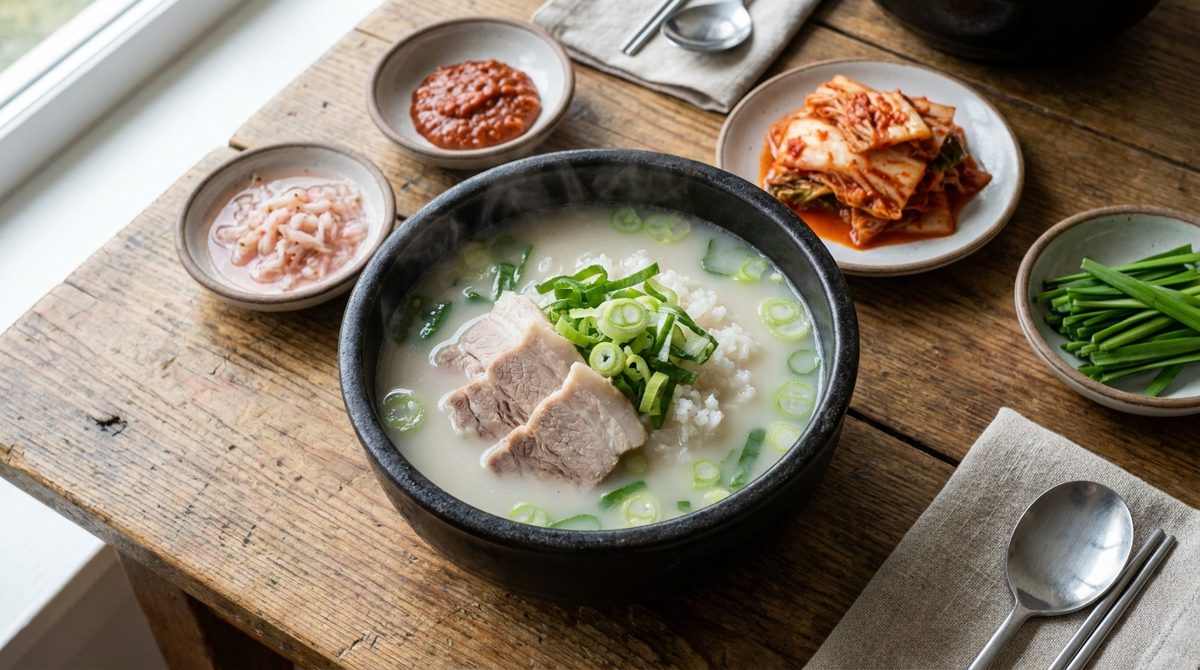
Seen steaming bowls on every corner in Busan and wondered what dwaeji gukbap is? Dwaeji gukbap (돼지국밥, “pork soup rice”) is Busan’s signature dish: a milky, deeply savory broth made from long-simmered pork bones, filled with slices of tender boiled pork and served with rice — which locals drop straight into the bowl. It arrives almost unseasoned; you finish it yourself with salted shrimp and chili paste. This decoder covers taste, spice, allergens, the honest halal and vegetarian answers, 2026 prices, and how to order it like a Busan native.
Table of Contents
- Dwaeji Gukbap Quick Facts
- What Is Dwaeji Gukbap, Exactly?
- What Does Dwaeji Gukbap Taste Like?
- Dietary Guide: Vegetarian, Vegan, Halal & Allergens
- How to Order Dwaeji Gukbap in Korean (+ 2026 Prices)
- How to Eat Dwaeji Gukbap Like a Local
- Types & Menu Variations
- Where to Try Dwaeji Gukbap
- Dwaeji Gukbap FAQ
Dwaeji Gukbap Quick Facts
| Item | Details |
|---|---|
| Korean name | 돼지국밥 (dwaeji gukbap) — pork + soup-rice |
| Pronunciation | DWEH-jee GOOK-bap |
| Type | Hot soup with rice / one-bowl main meal |
| Spice level | 🌶️ 0–1 / 5 as served — you add the heat yourself (dadaegi chili paste) |
| Price (2026) | ₩9,000–₩12,000 at Busan gukbap houses; suyuk-baekban sets ₩13,000–₩16,000 |
| Vegetarian | ❌ No — the entire dish is pork, from broth to topping |
| Vegan | ❌ No — same reason, no plant-based version exists in the tradition |
| Halal-friendly | ❌ No — pork-based throughout; no workaround. See alternatives below |
| Main allergens | Pork, shrimp (saeujeot condiment), soy; chives and garlic throughout |
| Best for | Busan visitors, comfort-food lovers, hangover mornings, cold days |
What Is Dwaeji Gukbap, Exactly?
Dwaeji gukbap is to Busan what ramen is to Fukuoka or pho is to Hanoi: not just a dish, but the city’s identity ladled into a bowl. Pork leg and neck bones simmer for hours until the broth turns opaque and ivory — the same principle as Japanese tonkotsu, decades before tonkotsu was cool abroad. Into that broth go slices of boiled pork, then rice, then you, armed with a caddy of condiments. It’s blue-collar food: fast, cheap, scalding, and served from morning until late night.
Its modern form was forged in tragedy. During the Korean War, Busan swelled with refugees who had fled south with nothing; they built a cuisine from what was cheap and available, and pork bones — often cast off from other trades — became survival food. The same wartime kitchen produced Busan’s milmyeon noodles. Dwaeji gukbap carried that generation through, and the film Ode to My Father (2014) — Korea’s tear-soaked epic of a war refugee’s life set around Busan’s Gukje Market — cemented the dish’s place in the national memory. For many older Busanites, a bowl of gukbap simply is the taste of surviving.
That history explains the fierce local pride. Busan people will tell you, unprompted, that Seoul’s versions are imitations; entire “gukbap alleys” compete over broth clarity and pork tenderness; and the question “which gukbap house?” can start a genuine argument. When Busan natives return home from Seoul, the first meal is famously not with family — it’s gukbap.
What Does Dwaeji Gukbap Taste Like?
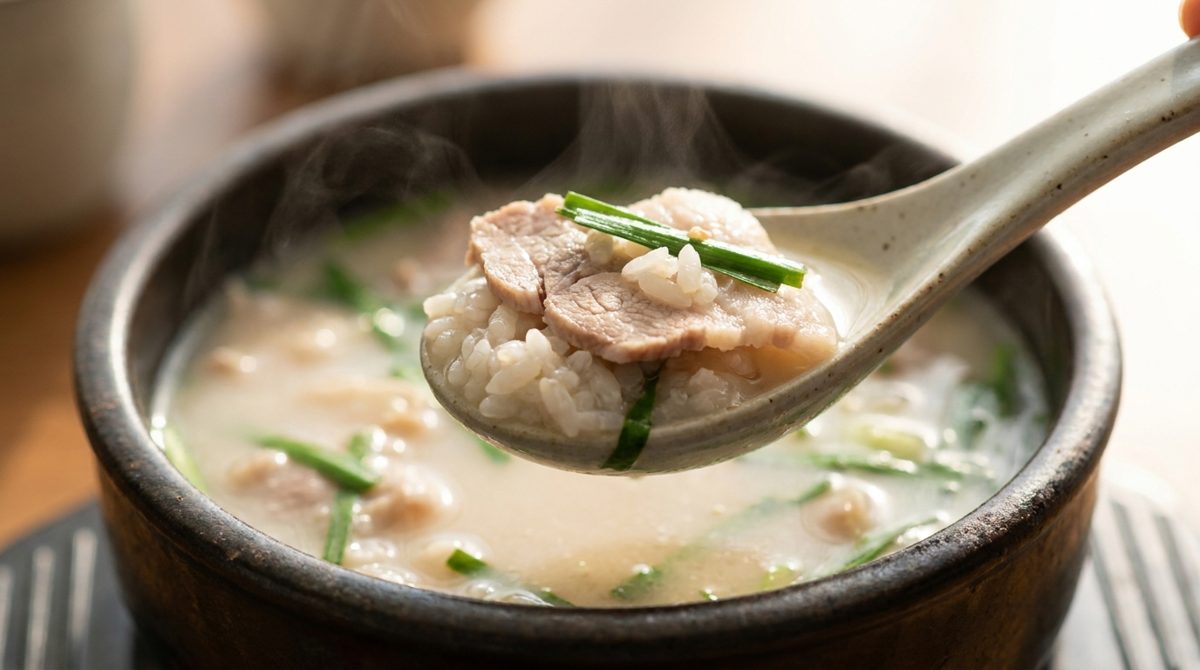
Rich, porky, and cleaner than you’d expect. A good bowl is milky and deeply savory but not greasy — closer to a refined tonkotsu than to heavy stew. The boiled pork is tender and mild, the rice soaks up the broth into comforting porridge territory, and the aromatics stay quiet until you start seasoning. That’s the key: dwaeji gukbap arrives as a canvas. Salted shrimp adds saline depth, dadaegi chili paste adds warmth, chives add bite, and within three spoonfuls you’ve built a bowl that’s precisely yours.
Texture-wise, expect variety across the meat: lean slices, softer belly-ish pieces, occasionally skin or offal in the “everything” versions. If uniform lean meat matters to you, order the sal-gogi (pure meat) version — more on that below.
Is Dwaeji Gukbap Spicy?
Not as served — a genuine 0 to 1 out of 5. The broth itself contains no chili; the only heat in the bowl is whatever you add from the red dadaegi paste on your table, teaspoon by teaspoon, entirely under your control. This makes gukbap one of the best hot Korean soups for spice-averse travelers: skip the dadaegi and it’s completely mild. Add the whole lump and you’ve built yourself a 3 out of 5 — your call, your consequences.

Dwaeji Gukbap Dietary Guide: Vegetarian, Vegan, Halal & Allergens
This section is short on loopholes — dwaeji gukbap is the least negotiable dish in this decoder series. Here’s the honest picture.
| Ingredient concern | In standard dwaeji gukbap? | How to handle |
|---|---|---|
| Pork | Yes — the broth, the meat, the entire identity of the dish | Cannot be removed or substituted; if pork is off your list, order a different dish entirely |
| Shrimp (saeujeot) | On every table, sometimes pre-added | Shellfish allergy? Say “saeujeot ppaego juseyo” and confirm the kitchen didn’t season with it — some do by default |
| Soy | Yes — seasoning pastes and side dishes | Minor presence; hard to fully exclude |
| Wheat / gluten | Minor | Dadaegi and some condiments may contain wheat-based elements; the core soup and rice are naturally gluten-light |
| Egg / dairy / nuts | No | Not part of the tradition |
| Beef / seafood (other) | No | This is a pork-only broth; no fish stock involved |
| Garlic / chives / onion | Yes, throughout | Aromatics are core to the seasoning and side dishes |
Is Dwaeji Gukbap Vegetarian or Vegan?
No — and there is no workaround, polite or otherwise. The broth is pork bones, the protein is pork meat, and even the kimchi and condiments at gukbap houses are seasoned with saeujeot (salted shrimp). Asking for a meat-free version would be like asking a steakhouse for beefless steak. Vegetarian travelers in Busan have excellent alternatives within walking distance of any gukbap alley: temple food restaurants (Busan’s Beomeosa temple area is famous for them), vegetarian bibimbap, or kong-guksu in summer. Treat gukbap houses as a cultural spectacle to walk past, not a menu to negotiate with.
Is Dwaeji Gukbap Halal?
No — plainly and completely. Dwaeji gukbap is pork from the first bone to the last slice, and no seafood or beef version of this specific dish exists in the tradition. Muslim travelers wanting the same experience — a hot, restorative Korean soup-rice — have genuinely satisfying halal-compatible cousins: samgyetang (whole chicken ginseng soup — see our samgyetang guide), beef-based seolleongtang at trusted restaurants, or dishes at Busan’s certified restaurants listed by the Korea Tourism Organization on VisitKorea. The soup-rice ritual translates perfectly; only the animal changes.
How to Order Dwaeji Gukbap in Korean (+ 2026 Prices)
Gukbap houses are brisk, loud, and wonderfully democratic — you’ll share tables at busy hours and have soup in front of you within five minutes. The menu board holds a few words worth learning:
| What you want | Say this | Romanized |
|---|---|---|
| One pork gukbap, please | 돼지국밥 하나 주세요 | dwaeji-gukbap hana juseyo |
| Rice served separately | 따로국밥 주세요 | ttaro-gukbap juseyo |
| Pure meat only (no offal) | 살코기로 주세요 | salkogi-ro juseyo |
| No salted shrimp, please | 새우젓 빼고 주세요 | saeujeot ppaego juseyo |
| Boiled pork platter + soup set | 수육백반 주세요 | suyuk-baekban juseyo |
What it costs in 2026: a standard bowl runs ₩9,000–₩12,000 in Busan — one of the best value hot meals in Korea, banchan and rice included. The suyuk-baekban set (a plate of boiled pork plus soup and rice) runs ₩13,000–₩16,000 and is the move for two people. Seoul’s Busan-style gukbap restaurants charge ₩1,000–₩2,000 more for the same bowl and, per any Busan native, deliver less soul. Most houses open early and many run 24 hours — gukbap is a legendary breakfast and an even more legendary hangover cure.
How to Eat Dwaeji Gukbap Like a Local
Step one: season. Taste the plain broth once (respect), then add a teaspoon of saeujeot — salted shrimp is the traditional salt source here, rounder and deeper than plain salt. Stir, taste, adjust. Add dadaegi chili paste if you want warmth, a handful of chives (buchu) from the communal plate, and black pepper if you like. Step two: commit the rice. If it didn’t come pre-dropped in the bowl, tip it in — gukbap literally means soup-rice as one word, and eating them separately misses the point (though the ttaro option exists for purists who like control).
Step three: pace yourself like a local. Spoon in the right hand, working steadily while it’s hot; dip the pork slices into the tiny saucer of shrimp sauce or ssamjang; bite of kimchi between spoonfuls. Busan style also encourages wrapping pork in the raw chives with a dab of sauce. At lunch rush, the whole transaction — sit, order, eat, pay — takes twenty minutes, and lingering over an empty bowl while the queue watches is the only real faux pas. For the broader rules of the Korean table, our dining etiquette guide has you covered.
One more Busan-specific habit: the soju question. Gukbap houses double as working-class drinking dens, and a green bottle of soju alongside the bowl is a common local sight, especially in the evening — the hot broth and cold soju loop is a Busan institution. It’s entirely optional; at breakfast hours the same tables hold coffee and newspapers instead. Solo diners are the norm here at every hour, making gukbap houses among the most comfortable places in Korea to eat alone.
Types & Menu Variations You’ll See
Dwaeji gukbap (돼지국밥) — the standard: broth, pork, rice in. Ttaro gukbap (따로국밥) — rice served separately. Suyuk-baekban (수육백반) — soup plus a separate plate of boiled pork; the generous option. Naejang gukbap (내장국밥) — offal version for the adventurous; intestines and organs, beloved by regulars. Seokkeo gukbap (섞어국밥) — “mixed”: meat and offal together. Sundae gukbap (순대국밥) — with Korean blood sausage; technically a cousin, present on many of the same menus. Milk-white broth or clearer style varies by house lineage — Miryang-style houses serve a clearer broth, and locals debate the difference with theological seriousness.
Where to Try Dwaeji Gukbap
Busan, obviously — and ideally in one of its gukbap alleys. Seomyeon’s famous gukbap street packs a dozen decades-old specialists side by side, steam pouring from cauldrons in open kitchens; the area around Busan Station and the Nampo-dong/Gukje Market district (where Ode to My Father is set) hides more legends. Most famous houses have queues at lunch that move fast. Many travelers build a full Busan eating day around it — our Busan restaurant travelogue maps gukbap alongside the city’s other essentials, and if you need dessert after, Busan’s ssiat hotteok is ten minutes away (hotteok decoder here). In Seoul, Busan-style gukbap houses cluster near Yeongdeungpo and university districts — good, if never quite home. If your itinerary only allows one Busan meal, locals will tell you without hesitation: make it this one, at a Seomyeon alley house, at whatever hour you happen to be hungry.
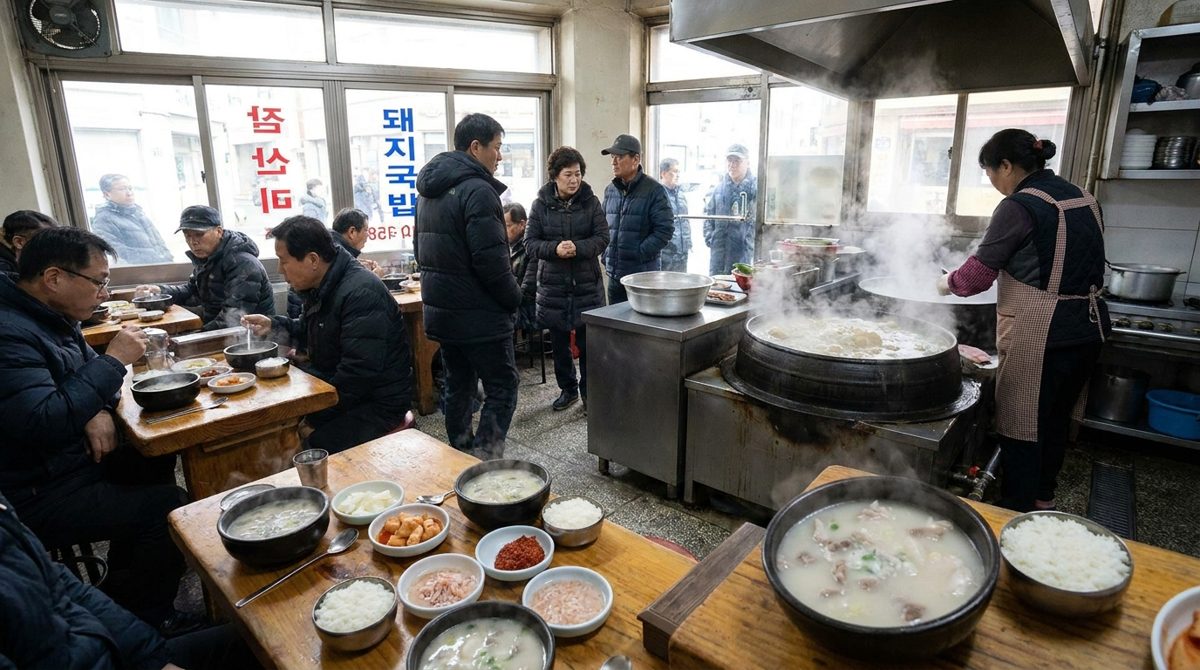
Timing tips: the famous houses hit peak queue between noon and 1pm, but because gukbap is ladled, not cooked to order, even a long line moves startlingly fast — rarely more than fifteen minutes. Early morning (7–9am) is the connoisseur’s window: the broth has been simmering all night, the room is full of regulars, and you’ll experience the dish in its natural habitat as a working breakfast. Night owls are covered too — several Seomyeon institutions run 24 hours, which is why gukbap doubles as Busan’s official hangover treatment.
Dwaeji Gukbap FAQ
What does dwaeji gukbap mean in English?
“Pork soup rice.” Dwaeji is pork, guk is soup, bap is rice — one word because the rice goes into the soup. It’s Busan’s signature dish.
Is dwaeji gukbap the same as Japanese tonkotsu?
Same principle — pork bones simmered until milky — but a different animal of a meal: gukbap has rice instead of noodles, arrives unseasoned for you to finish with salted shrimp and chili paste, and comes with Korean banchan. Busan was doing milky pork broth long before tonkotsu went global.
Is dwaeji gukbap halal or vegetarian-friendly?
No to both, with no workaround — the broth and meat are entirely pork, and condiments contain shrimp. Halal-seeking travelers should try samgyetang (chicken ginseng soup) for the same hot soup-rice comfort; vegetarians should look to temple food or bibimbap.
Why is dwaeji gukbap famous in Busan?
It’s Korean War refugee food that became the city’s soul dish — cheap pork bones turned into survival meals in wartime Busan. The hit film Ode to My Father, set around Busan’s Gukje Market, made that history vivid for a new generation. Locals treat their favorite gukbap house as a matter of identity.
How much does dwaeji gukbap cost in 2026?
₩9,000–₩12,000 for a standard bowl in Busan, with suyuk-baekban sets at ₩13,000–₩16,000. Seoul versions run slightly more. Banchan, rice, and broth top-ups are typically included.
The Verdict: Should You Order It?
If you eat pork and you’re going to Busan: it’s mandatory. Dwaeji gukbap is the single most Busan thing you can do with ₩10,000 — a bowl of the city’s history, seasoned by your own hand, eaten shoulder to shoulder with locals at a worn wooden table. Skip the dadaegi if you fear spice, order salkogi if offal worries you, and taste the broth before seasoning like someone who read this page. Halal and vegetarian travelers: this one’s a hard no, but the decoder has plenty of dishes that aren’t. Keep decoding the menu — every major Korean dish, with spice levels, allergens, and ordering phrases, lives in our Korean Food Decoder.