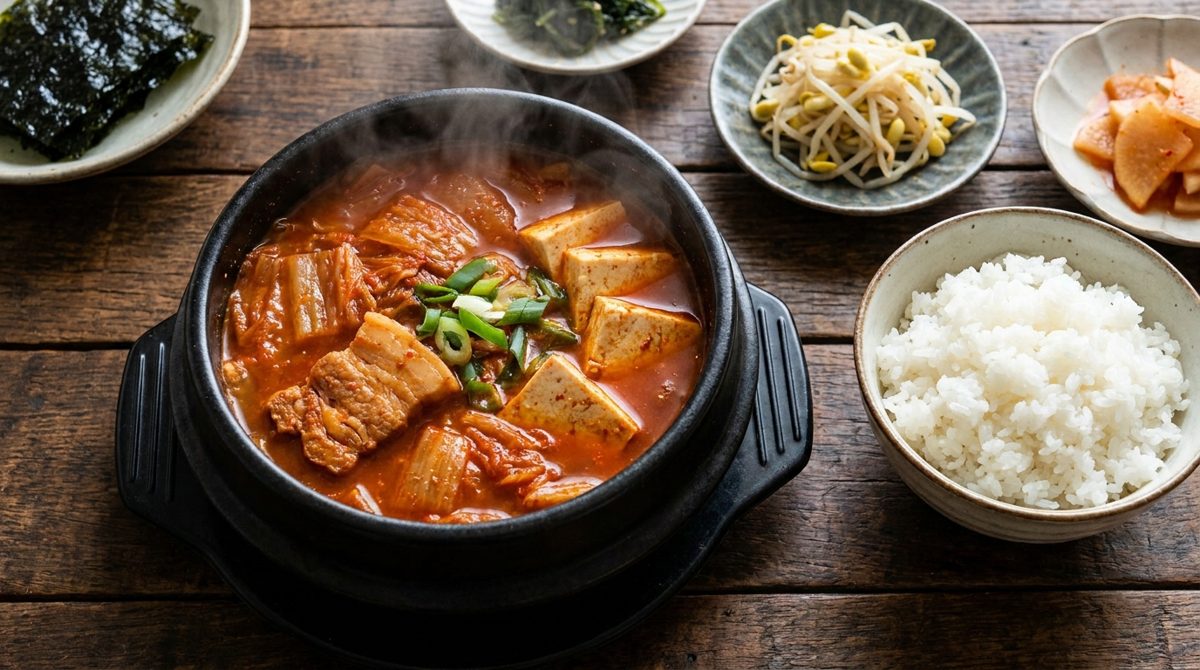
Saw kimchi jjigae on every single menu in Korea and wondering what it actually is? Kimchi jjigae (김치찌개) is Korea’s national comfort stew: well-fermented kimchi simmered with pork, tofu, and scallions in a deep-red, tangy-spicy broth, served bubbling hot with rice. It’s the dish Koreans eat when they want to feel at home — and the one most likely to convert you to fermented food forever. This decoder covers taste, spice level, the pork question, halal and vegetarian answers, allergens, 2026 prices, and how to order it in Korean.
Table of Contents
- Kimchi Jjigae Quick Facts
- What Is Kimchi Jjigae, Exactly?
- What Does Kimchi Jjigae Taste Like?
- Dietary Guide: Vegetarian, Vegan, Halal & Allergens
- How to Order Kimchi Jjigae in Korean (+ 2026 Prices)
- How to Eat Kimchi Jjigae Like a Local
- Types of Kimchi Jjigae
- Where to Try Kimchi Jjigae
- Kimchi Jjigae FAQ
Kimchi Jjigae Quick Facts
| Item | Details |
|---|---|
| Korean name | 김치찌개 (kimchi jjigae) — “kimchi stew” |
| Pronunciation | KIM-chee jee-GEH |
| Type | Stew / everyday main dish, served with rice |
| Spice level | 🌶️ 3 / 5 — warming and tangy rather than punishing |
| Price (2026) | ₩8,000–₩11,000 per person at regular Seoul restaurants, rice included |
| Vegetarian | ❌ Not by default — pork plus anchovy broth, and kimchi itself usually contains fish sauce |
| Vegan | ❌ Only at dedicated vegan or temple food restaurants |
| Halal-friendly | ❌ Not by default (pork) — ask for chamchi (tuna) kimchi jjigae instead |
| Main allergens | Pork, fish (anchovy broth, fish sauce/jeotgal in kimchi), soy |
| Best for | Cold days, kimchi lovers, anyone wanting Korea’s true home cooking |
What Is Kimchi Jjigae, Exactly?
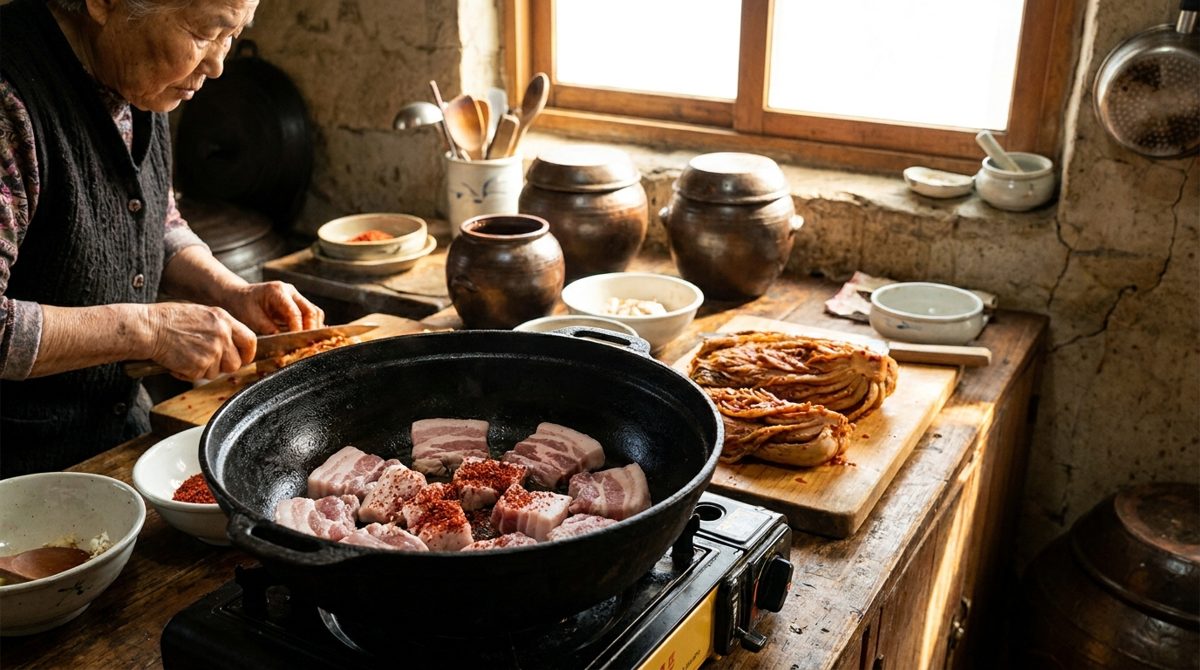
Kimchi jjigae is what happens to kimchi after it wins. Fresh kimchi is a side dish; but once it ferments past its crisp prime — sourer, softer, funkier — Koreans don’t throw it out. They stew it. Old kimchi (mugeunji) goes into a pot with fatty pork, tofu, onion, and scallions, simmers until the flavors fuse, and emerges as something greater than any of its parts.
That’s why this stew is the ultimate test of a Korean kitchen: anyone can buy good pork, but great kimchi jjigae needs kimchi that’s been fermenting for months. Restaurants brag about their aged kimchi the way Italian places brag about nonna’s ragù. The dish embodies Korean home economics — nothing wasted, everything transformed — and it’s the meal most Korean expats say they miss first when they leave the country.
You’ll meet the whole jjigae family in Korea: jjigae means a thick, intensely seasoned stew, saltier and punchier than soup (guk), always shared or served personal-size with rice. Kimchi jjigae is the most popular of them all, ahead of its gentler sibling doenjang jjigae and the wilder budae jjigae. For background on kimchi itself — Korea’s UNESCO-listed fermentation culture — Wikipedia’s kimchi entry is a solid primer.
Pork-and-kimchi is a surprisingly recent pairing, too. For most of Korean history meat was scarce; kimchi stews were fish- or vegetable-based, and it was only in the postwar decades, as pork became affordable, that dwaeji-gogi kimchi jjigae took over as the standard. That timing explains the dish’s place in the culture: it’s the taste of Korea’s boom years — company lunches, student mess halls, and mom’s kitchen on a Friday night. Ask ten Koreans where to find the country’s best kimchi jjigae and eight will name their mother.
What Does Kimchi Jjigae Taste Like?
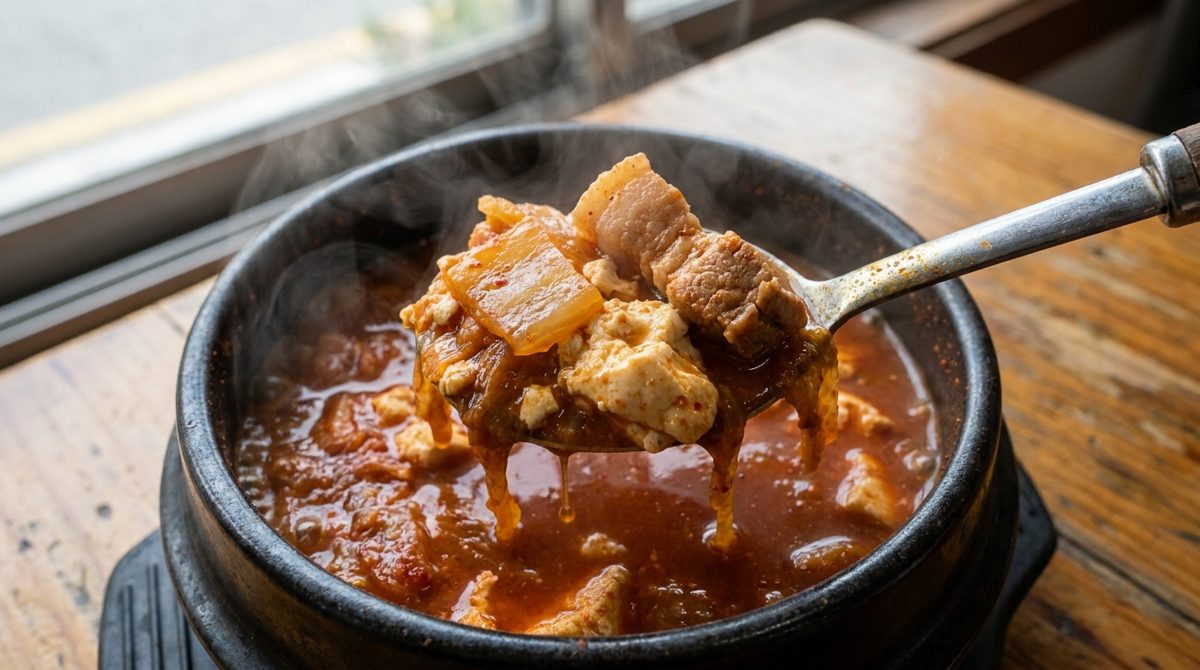
Sour, spicy, savory, rich — in that order. The fermented kimchi gives the broth a bright, almost lemony tang; gochugaru chili brings steady warmth; the pork fat rounds everything into something deeply savory; and the tofu soaks it all up like a sponge. It tastes less “hot” and more “alive” — that lactic sourness is what separates it from every other spicy soup you’ve had.
Texture-wise, expect soft, silky cabbage that melts rather than crunches, custardy tofu, and tender pork slices. The stew arrives volcanic — still bubbling in its black stone pot — so the first two minutes are for stirring, cooling spoonfuls against rice, and inhaling steam. Koreans consider that steam part of the meal.
Is Kimchi Jjigae Spicy?
Moderately — most travelers rate it 3 out of 5. The heat is broth-based and warming, not sharp like raw chili; it builds gently and never really spikes. The sourness actually softens the burn, and eating it the Korean way (spoonful of stew, spoonful of rice) keeps it very manageable. If you handle mild curry or medium salsa, you’ll be fine. Genuinely heat-averse? Order doenjang jjigae instead — same format, nearly zero spice.
Temperature is the other kind of heat to respect: the stone pot keeps the stew at a rolling boil for minutes after it lands on your table. Koreans describe the pleasure of that scalding, spicy, sour first spoonful as siwonhada — literally “refreshing” — one of those Korean food words that makes no sense until the third spoonful, when you break into a light sweat and somehow feel better than before.
Kimchi Jjigae Dietary Guide: Vegetarian, Vegan, Halal & Allergens
Kimchi jjigae is one of the harder famous Korean dishes for restricted diets, and it’s better to know that before you sit down. Here’s the full picture.
| Ingredient concern | In standard kimchi jjigae? | How to handle |
|---|---|---|
| Pork | Almost always — pork belly or shoulder is the default | Tuna (chamchi) versions are common: “chamchi kimchi jjigae juseyo” |
| Fish / seafood | Yes, three ways: anchovy broth, fish sauce in the kimchi, sometimes tuna or canned mackerel versions | Effectively unavoidable outside vegan restaurants |
| Soy | Yes — tofu, soy sauce, sometimes doenjang | Cannot be removed; ask “dubu ppaego” (두부 빼고) to at least skip tofu |
| Wheat / gluten | Sometimes — a spoon of gochujang or noodle add-ins at some shops | Ask; many versions use only gochugaru (gluten-free chili flakes) |
| Egg | No (a steamed egg side may accompany it) | The stew itself is egg-free |
| Beef | Rare | Pork and tuna dominate; beef versions exist but are uncommon |
| Dairy / nuts | No | Traditional recipes contain neither |
| Alcohol | Trace at most | Some cooks add a splash of rice wine to the pork; ask if strict |
Is Kimchi Jjigae Vegetarian or Vegan?
Not by default — and this one fails vegetarians on three separate counts. The meat is pork, the broth base is usually anchovy stock, and the kimchi itself is almost always made with fish sauce or salted shrimp (jeotgal). Asking for “no meat” removes only one of the three. The good news: Korea’s temple cuisine tradition makes 100% plant-based kimchi with no fish products, and Seoul’s vegan restaurants (Insadong and Itaewon have clusters) serve proper vegan kimchi jjigae that tastes remarkably close to the original. If plant-based eating is central to your trip, seek those out and order the real thing safely there.
Is Kimchi Jjigae Halal?
No — standard kimchi jjigae is pork-based, so it is not halal, full stop. But there’s a genuinely good workaround that doesn’t require a specialty restaurant: chamchi kimchi jjigae (참치김치찌개), made with canned tuna instead of pork, is a beloved everyday variation available at many regular stew restaurants. Ask “dwaeji-gogi eopsi chamchi-ro dwaenayo?” (돼지고기 없이 참치로 되나요? — can you make it with tuna, no pork?). Note the shared-kitchen caveat: pots and broths may contact pork in regular restaurants. For fully certified options, check the Korea Tourism Organization’s Muslim-friendly restaurant listings on VisitKorea.
How to Order Kimchi Jjigae in Korean (+ 2026 Prices)
Kimchi jjigae restaurants are everyday lunch spots — quick, cheap, zero ceremony. Order at the table, and rice usually comes automatically. Useful phrases:
| What you want | Say this | Romanized |
|---|---|---|
| One kimchi jjigae, please | 김치찌개 하나 주세요 | kimchi-jjigae hana juseyo |
| Tuna version instead of pork | 참치김치찌개 주세요 | chamchi kimchi-jjigae juseyo |
| Less spicy, please | 덜 맵게 해주세요 | deol maepge haejuseyo |
| Extra rice, please | 공기밥 추가요 | gonggi-bap chuga-yo |
| Is there pork in it? | 돼지고기 들어가요? | dwaeji-gogi deureogayo? |
What it costs in 2026: a single-serving kimchi jjigae with rice and banchan runs ₩8,000–₩11,000 at regular Seoul restaurants — one of the best-value full meals in the city. Specialty restaurants using premium aged kimchi and thick-cut pork charge ₩12,000–₩15,000, and big sharing pots for groups run ₩25,000–₩35,000. Banchan side dishes and water are free and refillable, as always — our Korean dining etiquette guide explains the unspoken rules of the stew table.
One more menu-reading tip: at lunch spots the stew often anchors a set meal — the word 정식 (jeongsik) after a dish name means a full set with extra sides. And when a menu brags about kimchi age, like 3년 묵은지 (three-year aged kimchi), that’s the house’s flex and usually worth the extra ₩2,000. No cash needed; every stew house takes cards.
How to Eat Kimchi Jjigae Like a Local
The stew is a rice-delivery system. Don’t drink it like soup: take a spoonful of rice, dip it into the broth, top it with a piece of kimchi or pork, and eat spoon-first. Koreans alternate constantly between the shared or personal pot and their rice bowl — the rice tempers both heat and salt, which is why the stew is seasoned as boldly as it is.
Two local moves worth copying. First, wait ninety seconds — ttukbaegi stone pots hold boiling temperature long after leaving the stove, and burned tongues are the #1 rookie injury. Second, if you’re sharing a pot, use the serving ladle to move stew into your personal bowl rather than double-dipping your spoon. At lunch rush, you’ll see office workers finish the entire ritual — stew, rice, banchan — in fifteen minutes flat. It’s not rudeness; it’s Korean lunch culture.
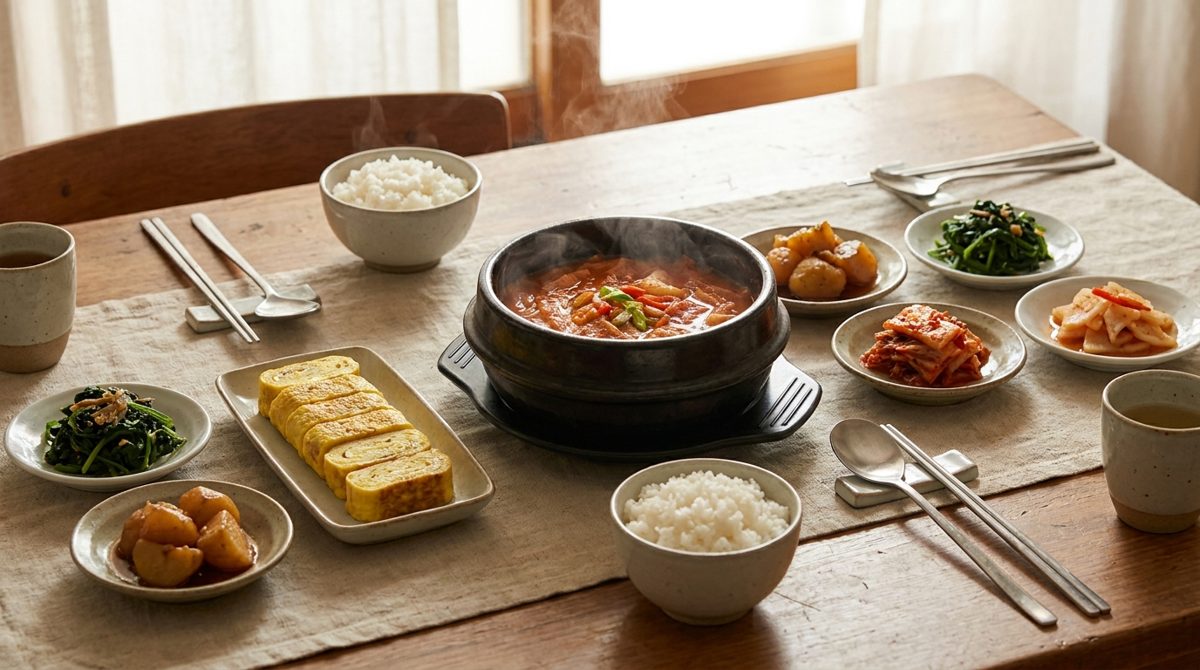
What goes with it: a fried egg or roasted gim (seaweed) if the restaurant provides them, and — for many Koreans — a glass of soju, because the salty-sour broth is legendary drinking food. Some specialty houses add a plate of glistening steamed pork or an egg steamed in its own little ttukbaegi. If the menu offers a kimchi jjigae baekban (set meal), take it: the stew arrives surrounded by a rotating cast of banchan for only a little more money, and it’s the closest a traveler gets to a Korean family dinner table.
Types of Kimchi Jjigae You’ll See on Menus
Dwaeji-gogi kimchi jjigae (돼지고기 김치찌개) — the classic, with pork belly or shoulder; what you get if you just say “kimchi jjigae.” Chamchi kimchi jjigae (참치김치찌개) — canned tuna instead of pork; lighter, a student favorite, and the pork-free option worth memorizing. Kkongchi kimchi jjigae (꽁치김치찌개) — canned saury; funkier and old-school. Mugeunji jjigae (묵은지찌개) — made with extra-aged kimchi, often stewed with big pork ribs; the deepest, sourest, most prized version. Budae jjigae (부대찌개) — technically its own dish (kimchi stew loaded with spam, sausage, and ramen), covered in our budae jjigae decoder.
Where to Try Kimchi Jjigae
Everywhere — it’s on the menu at practically every Korean restaurant, from ₩8,000 office-district lunch spots to specialty houses that simmer their pots on charcoal. The magic rule: look for restaurants that serve only kimchi jjigae, especially near office districts like Jongno, Euljiro, or Yeouido in Seoul — single-dish restaurants live or die by their kimchi. Sogongdong and the alleys around City Hall hide legendary decades-old spots where the pork comes in thick steak-like slabs. It’s also the natural morning-after meal following a Korean BBQ night — many BBQ restaurants serve a finishing pot of it, and the kimchi they grill beside your samgyeopsal is a preview of the stew.
Outside Seoul, kimchi jjigae doubles as a barometer of regional kimchi styles: southern versions run saltier and funkier with more jeotgal, while Gangwon mountain towns lean cleaner and more sour. In Busan, the local baekban set-meal culture often builds an entire spread around a bubbling pot of it — see our Busan baekban travelogue for the full experience.
Kimchi Jjigae FAQ
What does kimchi jjigae mean in English?
“Kimchi stew.” Jjigae is the Korean word for a thick, boldly seasoned stew served with rice — so the name is exactly what it sounds like: kimchi, stewed.
Does kimchi jjigae always have pork?
Usually, yes — pork is the default protein and flavors the broth. But tuna (chamchi) and canned saury (kkongchi) versions are common everyday alternatives at regular restaurants, so avoiding pork doesn’t mean avoiding the dish entirely.
Is kimchi jjigae healthy?
Broadly yes: a serving runs roughly 300–450 kcal before rice, with probiotic-derived compounds from fermented kimchi, protein from pork or tuna and tofu, and plenty of vegetables. The main caveat is sodium — it’s a salty dish by design, which is why it’s eaten with plain rice.
Is kimchi jjigae the same as kimchi soup?
Close but not identical. Jjigae is thicker, saltier, and more intense than Korean soup (guk); kimchi-guk exists and is a lighter, brothier cousin. On menus aimed at travelers, “kimchi soup” almost always means kimchi jjigae.
How much does kimchi jjigae cost in Korea in 2026?
₩8,000–₩11,000 for a single serving with rice and banchan at regular Seoul restaurants; ₩12,000–₩15,000 at specialty aged-kimchi houses; ₩25,000–₩35,000 for large sharing pots.
The Verdict: Should You Order It?
Yes — kimchi jjigae is the single most honest bowl of Korean home cooking you can buy, and at ₩8,000–₩11,000 it’s also one of the cheapest. If you like kimchi even a little, the stew version will multiply that feeling; if you’re unsure about kimchi, the mellowing effect of pork fat and broth is exactly how to learn to love it. Order it on a cold day, pace yourself against the boiling pot, and eat it with rice like everyone around you. Hungry for the next dish? Decode the whole menu with our Korean Food Decoder — every major Korean dish explained with spice levels, allergens, and ordering phrases.