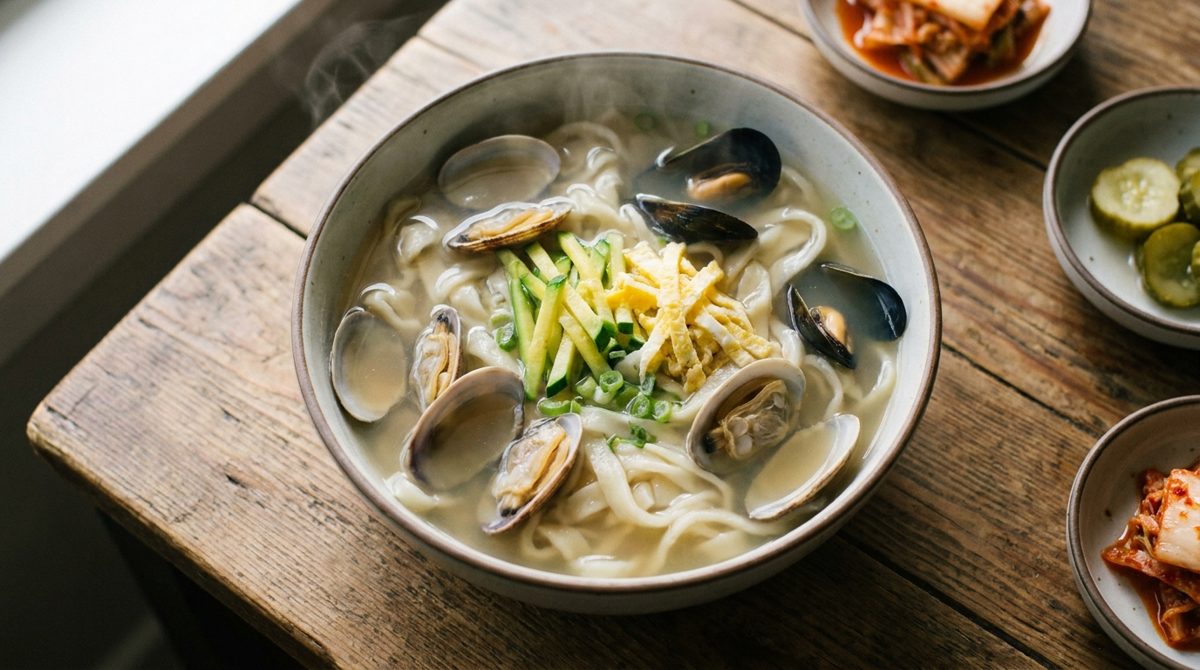
Wondering what kalguksu is on a Korean menu? Kalguksu (칼국수) is Korea’s beloved hand-cut wheat noodle soup — thick, knife-sliced noodles simmered in a light anchovy, seafood, or chicken broth, often finished with clams, egg, and zucchini. It’s cheap, filling, usually mild, and one of the best comfort meals in the country, especially on a rainy afternoon. This decoder page covers taste, spice level, allergens, halal and vegetarian answers, real 2026 prices, and exactly how to order it.
Table of Contents
- Kalguksu Quick Facts
- What Is Kalguksu, Exactly?
- What Does Kalguksu Taste Like?
- Dietary Guide: Vegetarian, Vegan, Halal & Allergens
- How to Order Kalguksu in Korean (+ 2026 Prices)
- How to Eat Kalguksu Like a Local
- Types of Kalguksu
- Where to Try Kalguksu
- Kalguksu FAQ
Kalguksu Quick Facts
| Item | Details |
|---|---|
| Korean name | 칼국수 (kalguksu) — literally “knife noodles” |
| Pronunciation | KAL-gook-soo |
| Type | Hand-cut wheat noodle soup |
| Spice level | 🌶️ 0–1 / 5 standard; spicy “eolkeun kalguksu” variant ~3 / 5 |
| Price (2026) | ₩9,000–₩13,000 in Seoul |
| Vegetarian | ⚠️ Depends on broth — most versions use anchovy, seafood, or chicken stock; ask specifically for a vegetable broth |
| Vegan | ❌ Not standard — broth is almost always animal-based |
| Halal-friendly | ⚠️ Conditional — no pork typically, but broth is rarely halal-certified; ask what stock is used |
| Main allergens | Wheat/gluten (the noodles themselves), shellfish (haemul version), soy |
| Best for | Rainy-day comfort food, budget noodle meals, travelers who want a mild, non-spicy option |
What Is Kalguksu, Exactly?
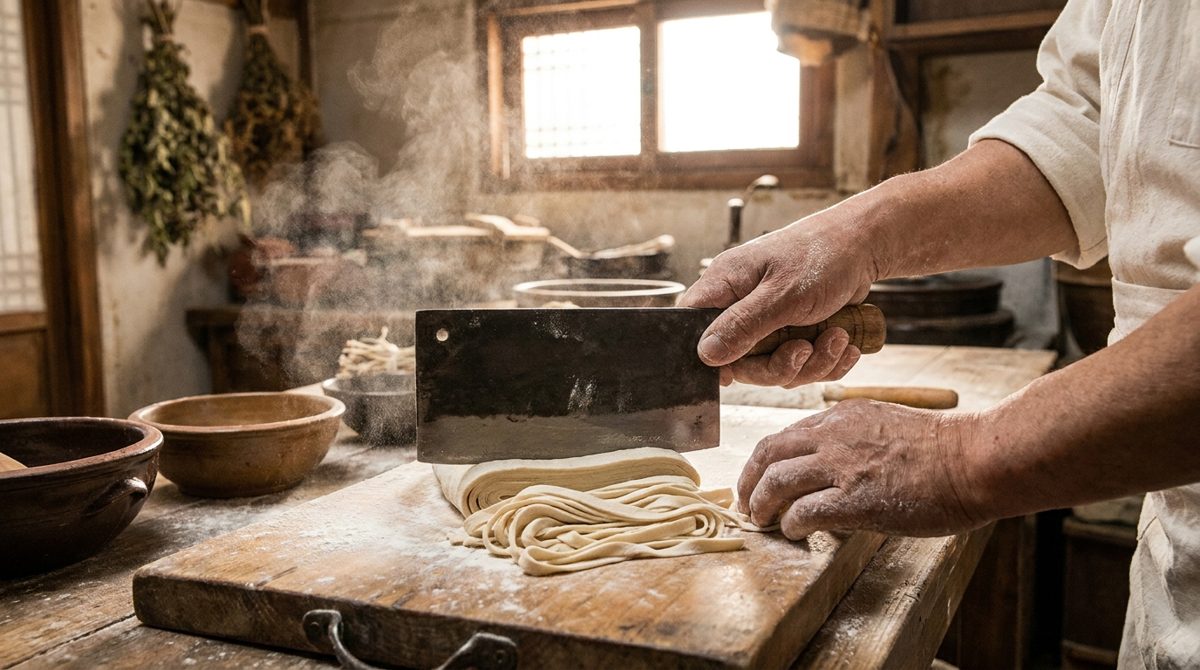
Kalguksu means exactly what it sounds like: kal (knife) + guksu (noodles). Unlike most Korean noodle dishes that use machine-extruded noodles, kalguksu noodles are traditionally rolled into a flat sheet of wheat dough and sliced by hand into wide, slightly irregular strips. That handmade texture — thick, chewy, a little doughy at the center — is the entire personality of the dish.
The dish has humble roots. It became a nationwide staple in the mid-20th century, when American wheat flour aid after the Korean War made wheat noodles cheap and abundant, and home cooks across the country started rolling out dough for family meals. Before that, wheat was a luxury grain in Korea, which is why kalguksu was historically reserved for special occasions like birthdays — long noodles symbolized long life, a superstition still referenced today.
One charming bit of folklore: many Koreans say they crave kalguksu on rainy days, because the sound of rain hitting the pavement or an umbrella resembles the rhythmic thump-thump of a knife slicing noodle dough on a wooden board. Whether or not you buy the theory, kalguksu shops genuinely do fill up on wet days — it’s the country’s go-to rainy-day comfort food, alongside pajeon (savory pancakes).
It’s worth knowing kalguksu’s noodle cousins so menus stop feeling like a guessing game. Janchi-guksu (잔치국수, “banquet noodles”) looks similar in a bowl of light broth, but uses thin, machine-extruded wheat noodles instead of hand-cut ones — thinner strands, silkier bite. Sujebi (수제비) goes the other direction: instead of slicing the dough into strips, cooks tear it into small, irregular flat pieces by hand, giving a softer, more dumpling-like texture in the same style of broth. All three share the same DNA — wheat dough simmered in savory broth — but kalguksu’s thick, ribbon-like noodle is what sets it apart on a menu.
What Does Kalguksu Taste Like?
Kalguksu tastes light, savory, and deeply comforting rather than bold or punchy. The standard broth is built on dried anchovies and kelp (dashima), giving a clean, faintly briny umami base seasoned simply with soy sauce and salt — much lighter and less oily than ramyeon. The noodles themselves are the star: thick, chewy, and slightly starchy, releasing a bit of natural flour into the broth as they cook, which gives the soup a subtle silky body by the time you finish the bowl.
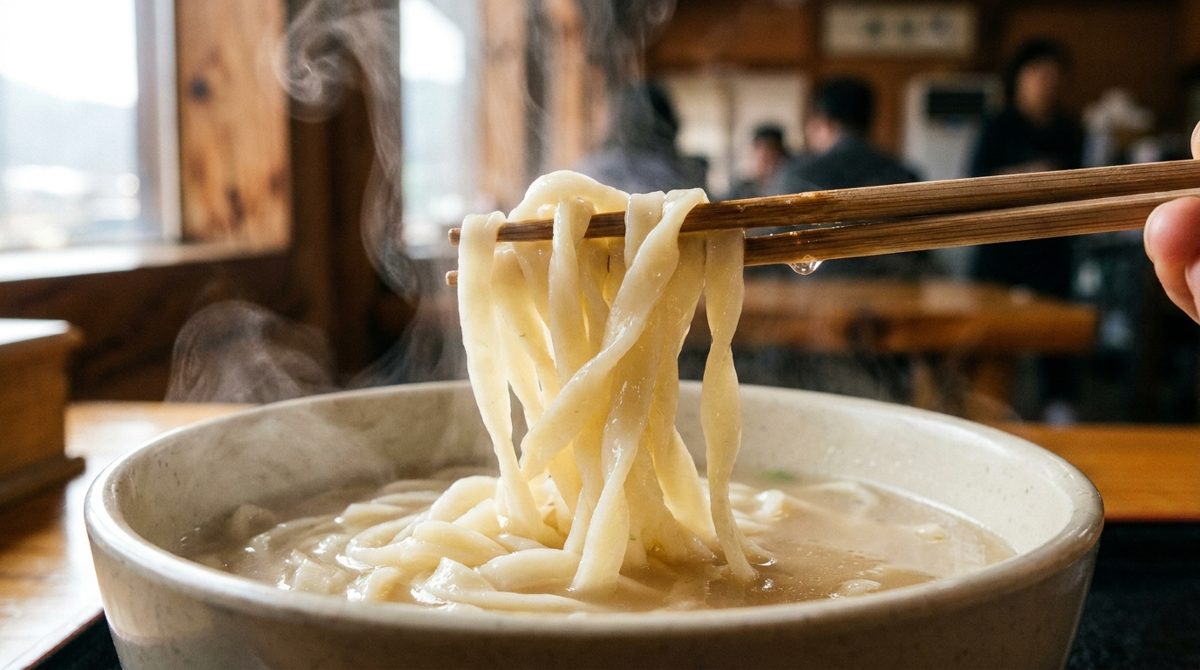
Broth quality varies more than you’d expect between restaurants — some simmer their anchovy stock for hours with dried kelp and radish for a deep, rounded savoriness, while cheaper spots use a quicker stock that tastes thinner and saltier. If your first bowl feels underwhelming, it’s worth trying a second restaurant before writing the dish off; a well-made kalguksu broth is genuinely one of the most comforting things you can eat in Korea.
Is Kalguksu Spicy?
No — standard kalguksu is one of the mildest well-known Korean noodle dishes. The broth is a clear, savory soy-and-anchovy stock with zero chili by default, making it an easy, safe order for anyone who struggles with spicy Korean food. That said, a spicy variant called eolkeun kalguksu (얼큰 칼국수) exists, made with a red chili-oil broth and rated around 3 out of 5 by most visitors — order the standard version if you want zero heat, and check the menu carefully since some restaurants only serve the spicy style by default.
Kalguksu Dietary Guide: Vegetarian, Vegan, Halal & Allergens
Kalguksu looks simple, but the broth is where most dietary surprises hide. Here’s what’s actually in a standard bowl.
One more note for sensitive eaters: many neighborhood kalguksu restaurants use a bit of MSG (monosodium glutamate) or a commercial soup-stock powder to deepen the broth quickly, especially at lower price points. It’s not a health risk for most people, but if you prefer to avoid it, look for restaurants advertising “천연조미료” (natural seasoning only) or ask staff directly — “MSG 안 넣어주세요” (MSG an neoeojuseyo, “please don’t add MSG”).
| Ingredient concern | In standard kalguksu? | How to handle |
|---|---|---|
| Wheat / gluten | Always — the noodles are 100% wheat | Not suitable for gluten-free diets; this is fundamentally a wheat dish |
| Fish (anchovy) | Yes, in the standard broth | The broth base is fish stock even when no fish is visible — important for vegetarians and pescatarians alike |
| Shellfish | Common in the seafood (haemul) version — clams, mussels, sometimes shrimp | Order “myeolchi kalguksu” (anchovy broth, no shellfish) instead, or ask “haemul ppaego juseyo” |
| Chicken | Only in the dak-kalguksu version | Order the standard anchovy or seafood version if avoiding poultry |
| Pork | Rare | Not a standard broth ingredient, but always confirm at unfamiliar restaurants |
| Soy | Yes | Soy sauce is a core seasoning in every version |
| Egg | Often, as a thin garnish strip (jidan) | “Gyeran ppaego juseyo” (계란 빼고 주세요) = no egg |
| Dairy / nuts | No | Traditional kalguksu contains neither |
Is Kalguksu Vegetarian or Vegan?
Be honest with yourself here: standard kalguksu is not vegetarian, even though it looks like a simple noodle soup. The default broth is almost always made from dried anchovies and/or kelp, and many restaurants add seafood or chicken stock for extra depth — even versions without visible fish or meat pieces typically use an animal-based stock. A small number of temple-food restaurants and vegetarian-focused kitchens offer a genuine vegetable-broth kalguksu (야채육수 칼국수), but this is not standard and must be requested specifically; don’t assume a plain-looking bowl is meat- or fish-free. Vegans should treat kalguksu as essentially off-limits unless a restaurant explicitly confirms a plant-based stock, since even “vegetable” versions often still use fish sauce or anchovy for umami.
Is Kalguksu Halal?
Kalguksu doesn’t contain pork or alcohol in its standard recipe, which is a good starting point, but the broth is rarely halal-certified. Anchovy and seafood stocks are generally considered acceptable within halal guidelines by many scholars, though sourcing and cross-contamination aren’t verified at typical restaurants, and the chicken version (dak-kalguksu) uses non-certified poultry. Muslim travelers should ask staff what stock is used before ordering, or look for halal-certified Korean restaurants listed by the Korea Tourism Organization on VisitKorea. If certification matters to you, this dish is best treated as “ask first,” not “safe by default.”
How to Order Kalguksu in Korean (+ 2026 Prices)
Kalguksu restaurants are everywhere, from tiny neighborhood diners to famous chains, and staff are used to simple pointing-at-the-menu orders. These phrases help you get exactly what you want:
| What you want | Say this | Romanized |
|---|---|---|
| One kalguksu, please | 칼국수 하나 주세요 | kalguksu hana juseyo |
| Seafood (clam) version | 해물칼국수 주세요 | haemul-kalguksu juseyo |
| Chicken version | 닭칼국수 주세요 | dak-kalguksu juseyo |
| Spicy version | 얼큰 칼국수 주세요 | eolkeun kalguksu juseyo |
| No shellfish, please | 해물 빼고 주세요 | haemul ppaego juseyo |
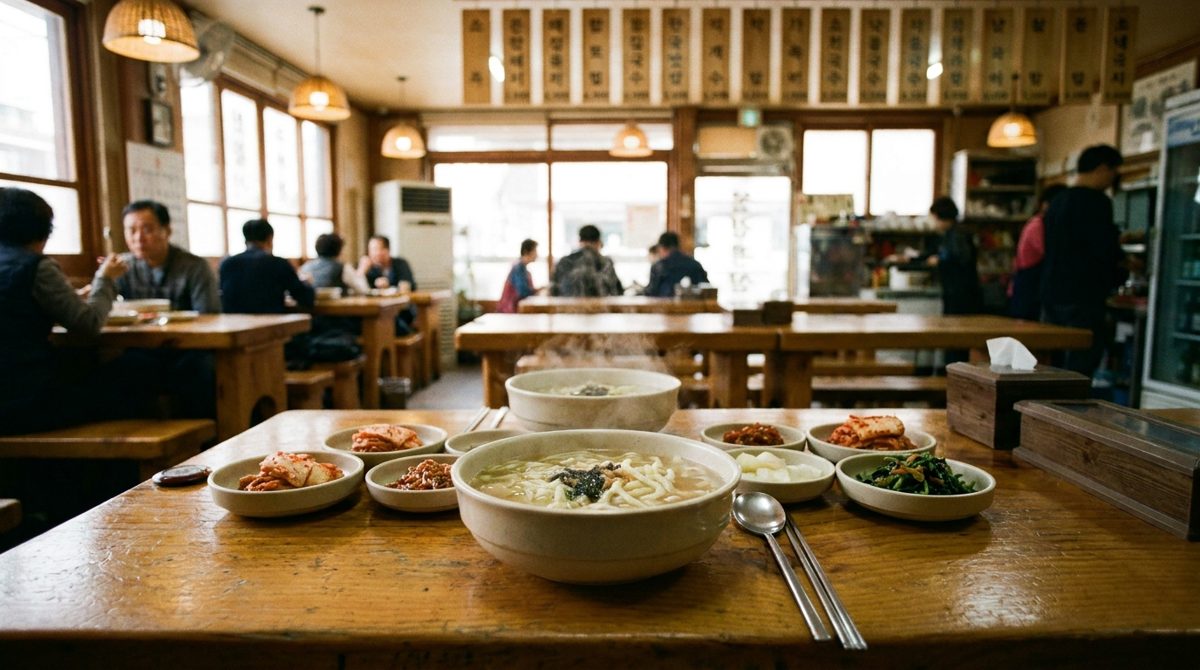
What it costs in 2026: a bowl of standard anchovy-broth kalguksu runs ₩9,000–₩11,000 at a neighborhood restaurant in Seoul. Haemul (seafood) kalguksu with clams and mussels costs a bit more, typically ₩11,000–₩13,000, since shellfish prices fluctuate seasonally. Famous chains like Myeongdong Kyoja sit at the upper end of that range but are worth it for the historic atmosphere. Banchan side dishes — usually kimchi and pickled radish — are free and refillable; see our Korean dining etiquette guide if the side-dish table confuses you.
How to Eat Kalguksu Like a Local
Eat kalguksu with the spoon for broth and chopsticks for noodles, alternating between the two, and don’t be shy about slurping — it’s normal and even encouraged, since it cools the noodles and shows enjoyment. Add a spoonful of kimchi or kkakdugi (cubed radish kimchi) directly into your broth for extra tang and crunch; most locals do this rather than eating kimchi as a separate bite.
A useful local trick: noodles keep softening the longer they sit in hot broth, so eat promptly rather than letting the bowl sit while you chat. If you’re at a Korean BBQ or jjigae restaurant that also serves kalguksu as an add-on, you can order “kalguksu sari” (칼국수 사리) — a portion of raw noodles dropped straight into your simmering pot near the end of the meal to soak up all that flavor. It’s one of the best-kept secrets of Korean group dining.
Most tables also have a small dish of chopped green and red chili in soy sauce (cheong-yang gochu ganjang) or a jar of chili flakes — spoon a little into your broth if you want to build heat gradually instead of ordering the fully spicy version outright. And don’t feel obligated to finish every drop of broth; unlike some noodle cultures, there’s no strong social pressure to drain the bowl, though most people do because it’s genuinely good down to the last spoonful.
Types of Kalguksu You’ll See on Menus
Myeolchi kalguksu (멸치칼국수) — the everyday default, made with a light anchovy-and-kelp broth; what most restaurants serve unless you specify otherwise. Haemul kalguksu (해물칼국수) — loaded with fresh clams, mussels, and sometimes shrimp, giving a sweeter, more briny broth; a favorite at coastal and market restaurants. Dak-kalguksu (닭칼국수) — made with chicken broth and shredded chicken meat, milder and richer, popular in winter. Eolkeun kalguksu (얼큰 칼국수) — the spicy version, built on a red chili-oil broth, closer in heat to yukgaejang than to standard kalguksu. You’ll also see kongguksu on some summer menus — a cold, chilled soybean-broth cousin that shares the same knife-cut noodles but none of the heat.
A few regional and specialty versions are worth flagging if you’re traveling beyond Seoul. Coastal towns near Incheon and the West Sea often serve their haemul kalguksu with a whole crab or extra-large clams as the centerpiece, making the broth noticeably sweeter and more intense. Some restaurants also offer bibim-kalguksu, a brothless version where the same hand-cut noodles are tossed in a spicy-sweet sauce instead of served in soup — closer in spirit to jjajangmyeon than to standard kalguksu, and a good option if you want the noodle texture without the broth.
Where to Try Kalguksu
Kalguksu is remarkably consistent everywhere because it’s home-style cooking, so you rarely go wrong. Myeongdong Kyoja is the most famous chain in Seoul, known for its handmade noodles and mandu combo, and it’s a good first stop if you want a reliable, well-reviewed bowl. Traditional markets are also excellent hunting grounds — see our Seoul food guide for market picks where noodle stalls serve big, cheap bowls to shoppers. If you enjoy kalguksu’s noodle-in-broth format, you’ll likely also love the chicken-broth comfort of samgyetang or the cold noodle contrast of naengmyeon — both decoded elsewhere in our series.
Outside Seoul, coastal cities along the west coast are known for exceptional haemul kalguksu thanks to fresher, cheaper shellfish straight off the boats — worth seeking out if your itinerary includes a beach town. Department store food courts and highway rest-stop food halls also reliably serve a decent, fast bowl if you’re traveling between cities and want something warm and quick rather than hunting for a specific restaurant.
Kalguksu FAQ
What does kalguksu mean in English?
“Knife noodles.” Kal means knife, guksu means noodles — the name describes exactly how the noodles are made: rolled into a sheet and hand-sliced with a knife.
Is kalguksu spicy?
No, not by default. Standard kalguksu uses a mild soy-and-anchovy broth with zero chili. A spicy version called eolkeun kalguksu exists and rates about 3 out of 5, so check the menu if you want to avoid heat.
Is kalguksu vegetarian?
Not by default. The broth is almost always fish- or meat-based, even in versions that look plain. A genuine vegetable-broth kalguksu exists at some temple-food restaurants but must be requested specifically — don’t assume a plain bowl is meat- or fish-free.
Is kalguksu halal?
Kalguksu has no pork or alcohol in its standard recipe, but the anchovy, seafood, or chicken broth is rarely halal-certified. Muslim travelers should ask what stock is used or choose a halal-certified Korean restaurant listed via the Korea Tourism Organization.
How much does kalguksu cost in Korea in 2026?
₩9,000–₩11,000 for standard anchovy-broth kalguksu at a neighborhood restaurant in Seoul, and ₩11,000–₩13,000 for the seafood (haemul) version with clams and mussels.
The Verdict: Should You Order It?
Yes — kalguksu is exactly the kind of unpretentious, deeply satisfying meal that makes Korean home cooking so lovable. It’s mild by default, cheap, filling, and forgiving if you’re not ready for bold spice yet. Just remember it’s a wheat-and-fish-broth dish, not a vegetarian one, and ask before ordering if you have dietary restrictions. Order it on a rainy day for the full local experience, and let the knife-cut noodles do the rest. Hungry for more? Decode the whole menu with our Korean Food Decoder — every major Korean dish explained with spice levels, allergens, and ordering phrases.