Wondering what naengmyeon is and why Koreans eat noodles served in actual ice? Naengmyeon (냉면, “cold noodles”) is Korea’s iconic chilled noodle dish: thin, chewy buckwheat noodles served either in an ice-cold tangy broth (mul naengmyeon) or tossed in a spicy-sweet chili sauce (bibim naengmyeon). It’s the taste of Korean summer and the mandatory finale to a barbecue feast. This decoder page covers taste, spice, allergens — including a serious buckwheat warning — halal and vegetarian answers, 2026 prices, and how to order it in Korean.
Table of Contents
- Naengmyeon Quick Facts
- What Is Naengmyeon, Exactly?
- What Does Naengmyeon Taste Like?
- Dietary Guide: Vegetarian, Vegan, Halal & Allergens
- How to Order Naengmyeon in Korean (+ 2026 Prices)
- How to Eat Naengmyeon Like a Local
- Types of Naengmyeon
- Where to Try Naengmyeon
- Naengmyeon FAQ
Naengmyeon Quick Facts
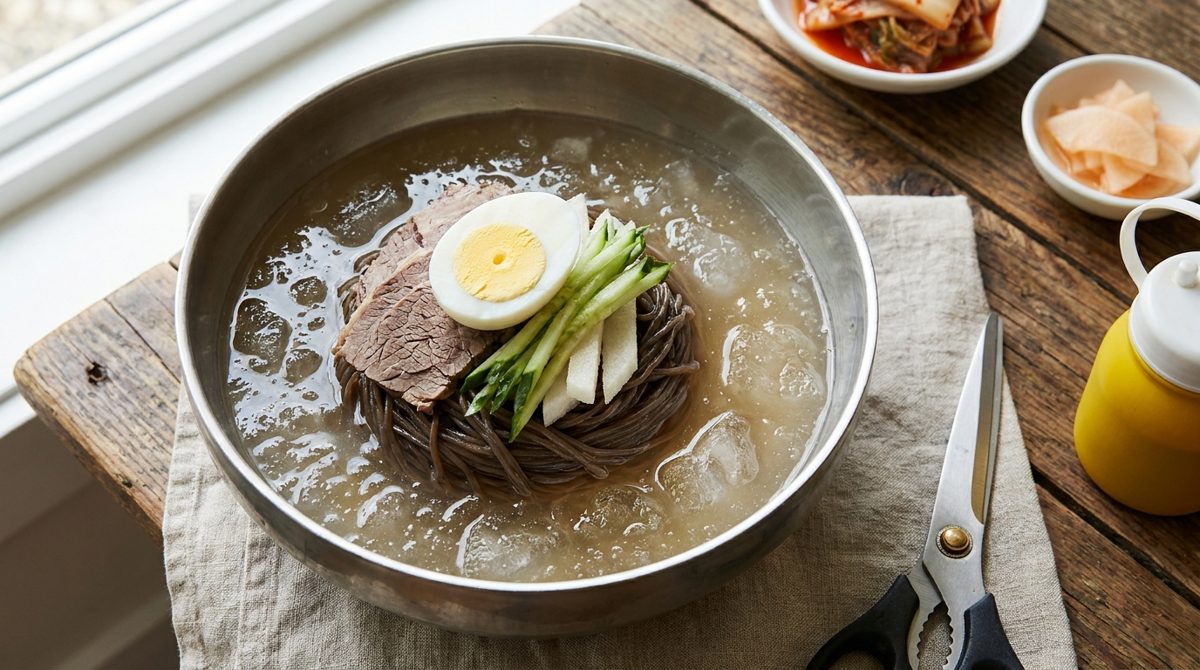
| Item | Details |
|---|---|
| Korean name | 냉면 (naengmyeon) — “cold noodles” |
| Pronunciation | NENG-myun |
| Type | Cold noodle dish / main or post-BBQ finisher |
| Spice level | 🌶️ Mul (broth) 0 / 5 · Bibim (spicy mixed) 3 / 5 |
| Price (2026) | ₩10,000–₩14,000 at regular restaurants; famous Pyongyang-style specialists ₩14,000–₩16,000 |
| Vegetarian | ❌ Not by default — broth is beef (or beef + dongchimi radish brine) |
| Vegan | ❌ Not by default — broth, egg topping, sometimes beef slices |
| Halal-friendly | ⚠️ Conditional — beef broth (not pork) at most places, but not halal-certified; some shops use pork in suyuk toppings |
| Main allergens | Buckwheat (serious allergen), wheat (blended in noodles), egg, mustard and vinegar condiments |
| Best for | Hot summer days, post-BBQ cravings, noodle lovers who want something unlike anything at home |
What Is Naengmyeon, Exactly?
Naengmyeon is a North Korean refugee that conquered the South. The dish was perfected centuries ago in what is now North Korea — Pyongyang for the mild broth version, Hamhung for the chewy spicy version — where it was originally, believe it or not, a winter dish eaten in heated rooms with noodles chilled in icy dongchimi radish-water kimchi. After the Korean War, refugees from the North opened naengmyeon restaurants across South Korea, and their family recipes became some of the most revered restaurant lineages in the country.
Today naengmyeon is the undisputed taste of South Korean summer. The first properly hot week of the year triggers queues outside famous naengmyeon houses, and news programs literally cover “naengmyeon season” opening. But it leads a double life: year-round, it’s also the traditional finisher after Korean barbecue — the cold, sharp counterpoint your body craves after a kilogram of grilled meat. If you’re planning a BBQ night, our Korean BBQ beginner’s guide explains where naengmyeon fits in the meal’s rhythm.
The dish carries emotional weight, too. Because its heartland is north of the border, naengmyeon became a symbol of divided families — when the leaders of the two Koreas met at the 2018 summit, Pyongyang naengmyeon was served, and South Koreans queued for hours at Pyongyang-style restaurants that same evening. Few noodle bowls carry this much history.
One cultural footnote worth knowing: Koreans practice i-naeng-chi-naeng (以冷治冷) — “fight cold with cold” — the summer mirror of eating boiling-hot samgyetang on the hottest days (i-yeol-chi-yeol, “fight heat with heat”). Naengmyeon is the cold half of that philosophy. If you visit in July or August, alternating a sweltering afternoon with an ice-flaked bowl of naengmyeon is as authentically seasonal as Korea gets — our samgyetang guide covers the hot half of the equation.
What Does Naengmyeon Taste Like?
Mul naengmyeon tastes like almost nothing you’ve had before, and that’s the point: an ice-cold, subtly beefy, faintly tangy broth — sometimes with actual ice shards floating in it — over slippery, springy buckwheat noodles with a clean, nutty flavor. Toppings are minimal: a few slices of beef brisket, half a boiled egg, cucumber, and sweet Korean pear. You season it yourself at the table with vinegar and hot mustard. First-timers sometimes find it bland for three bites, then suddenly can’t stop.
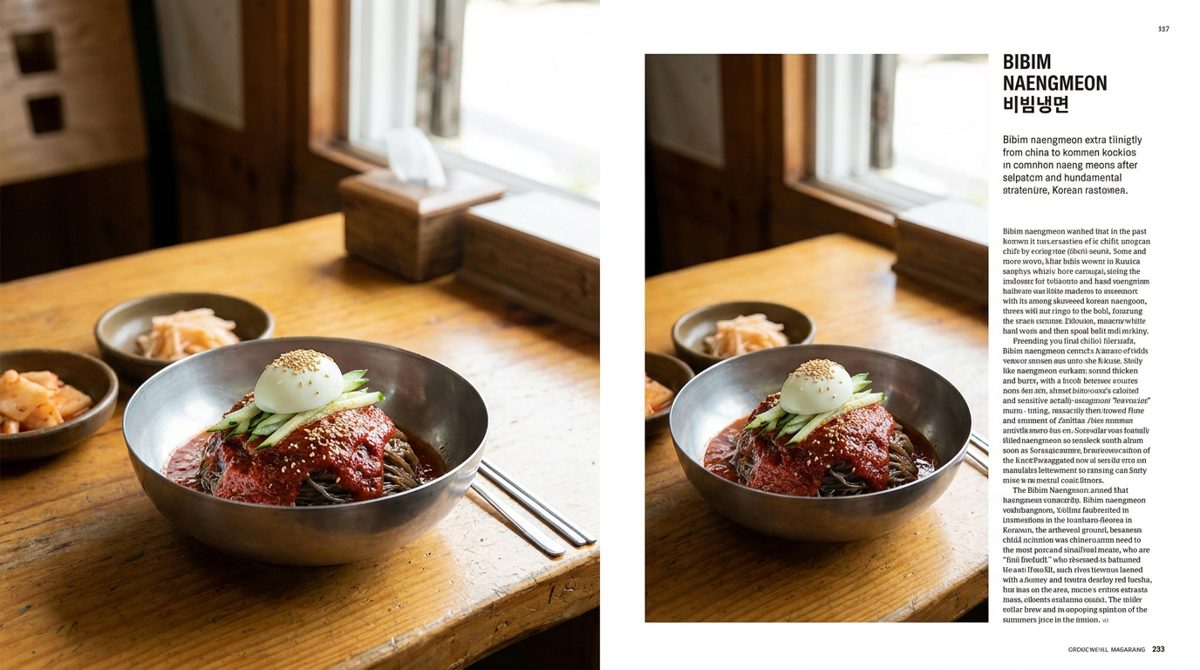
Bibim naengmyeon is the extrovert sibling: the same cold noodles, no broth, coated in a sweet-spicy-tangy gochujang sauce that hits fast and builds. The contrast of icy noodles and warm chili burn is uniquely addictive — sweat and shivers at once.
Is Naengmyeon Spicy?
Depends entirely on which one you order. Mul naengmyeon is 0 out of 5 — no chili at all, unless you add the mustard yourself. Bibim naengmyeon is a genuine 3 out of 5 — sweeter than tteokbokki but with real, building heat. Spice-averse travelers should order mul; heat-seekers order bibim. Can’t decide? Many restaurants let you order mul naengmyeon plus a side of the bibim sauce to mix in gradually.
Naengmyeon Dietary Guide: Vegetarian, Vegan, Halal & Allergens
Naengmyeon carries one allergen trap that deserves bold type, so let’s start there.
| Ingredient concern | In standard naengmyeon? | How to handle |
|---|---|---|
| Buckwheat | Yes — the core ingredient | Buckwheat allergy can be severe (anaphylaxis). If you’re allergic, do not order naengmyeon at all — including “just the broth” |
| Wheat / gluten | Yes — most noodles blend wheat or starch with buckwheat | Not gluten-free despite the buckwheat base; 100% buckwheat noodles are rare (that’s more a specialty makguksu thing) |
| Beef | Yes — broth base and brisket topping | Broth is almost always beef or beef + dongchimi brine |
| Pork | Sometimes | Most shops use beef only, but some Hamhung-style and casual shops top with pork suyuk — ask |
| Egg | Almost always | “Gyeran ppaego juseyo” (계란 빼고 주세요) = no egg |
| Mustard / vinegar | Served as table condiments | Added by you — simply skip them |
| Fish / seafood | Occasionally | Some regional versions (hoe-naengmyeon) top with marinated raw skate or fish — clearly labeled 회 |
| Soy / sesame / dairy / nuts | Minor or none | Sesame seeds often sprinkled on bibim versions; no dairy or nuts traditionally |
Is Naengmyeon Vegetarian or Vegan?
Not by default. The soul of mul naengmyeon is its broth, and that broth is nearly always beef-based (often blended with dongchimi radish-kimchi brine, which is vegetal but mixed with the meat stock). Bibim naengmyeon skips the broth but usually still includes beef slices and egg, and the sauce may contain fish-sauce-seasoned elements. A dedicated vegan restaurant can build a proper plant-based version — several in Seoul do a dongchimi-only summer bowl — but at a regular naengmyeon house, asking for “vegetarian naengmyeon” isn’t really possible. Vegetarians craving cold Korean noodles should look for kong-guksu (콩국수), the soy-milk noodle soup, which is naturally vegetarian and gloriously refreshing.
Is Naengmyeon Halal?
Cautiously promising, with caveats. The good news: naengmyeon is one of the few famous Korean dishes where pork is not the default — the broth and toppings are typically beef. The caveats: that beef isn’t halal-slaughtered at regular restaurants, some cheaper shops use pork in their suyuk (boiled meat) toppings or blend pork into stock, and alcohol isn’t a factor but cross-contamination can be. Muslim travelers who eat non-certified beef often choose mul naengmyeon after confirming “dwaeji-gogi deureogayo?” (돼지고기 들어가요? — does this contain pork?). For certified options, check the Korea Tourism Organization’s Muslim-friendly restaurant listings on VisitKorea.
How to Order Naengmyeon in Korean (+ 2026 Prices)
Naengmyeon restaurants move fast — waiters often take your order seconds after you sit down. Know your answer to one question: mul or bibim?
| What you want | Say this | Romanized |
|---|---|---|
| Cold broth version, please | 물냉면 주세요 | mul-naengmyeon juseyo |
| Spicy mixed version, please | 비빔냉면 주세요 | bibim-naengmyeon juseyo |
| Please cut the noodles | 면 잘라 주세요 | myeon jalla juseyo |
| No egg, please | 계란 빼고 주세요 | gyeran ppaego juseyo |
| Does this contain pork? | 돼지고기 들어가요? | dwaeji-gogi deureogayo? |
What it costs in 2026: expect ₩10,000–₩14,000 at regular naengmyeon restaurants and barbecue houses. The famous Pyongyang-style specialists in Seoul — the decades-old houses with lunchtime queues — now charge ₩14,000–₩16,000 a bowl, a number Koreans grumble about every summer and pay anyway. At barbecue restaurants, a post-meal naengmyeon is often discounted to ₩6,000–₩8,000 as a “sikhu” (after-meal) size. Broth refills from the kettle on your table are free at traditional places.
Two more menu words earn their keep. Sari (사리) means an extra portion of noodles — around ₩3,000–₩4,000 — dropped into your existing bowl when one serving isn’t enough (it often isn’t; naengmyeon is lighter than it looks). And obok/gobbaegi (곱빼기) at casual shops means a double portion from the start. At Pyongyang-style houses you may also see suyuk (수육), plates of chilled boiled beef that regulars order alongside — ask whether it’s beef or pork if that matters to you.
How to Eat Naengmyeon Like a Local
First: the scissors. Your server will appear with kitchen scissors and offer to cut the noodles — say yes (“ne”) unless you enjoy wrestling. Naengmyeon noodles are extraordinarily long and chewy (long noodles symbolize long life, which is why some older Koreans refuse the cut), and uncut noodles have humbled many travelers. Cross-cut twice and you’re set.
Second: season before you slurp. Mul naengmyeon arrives deliberately under-seasoned. Add a swirl of vinegar (sikcho) and a small squeeze of hot mustard (gyeoja) from the table bottles, taste, adjust. The mustard is sinus-clearing wasabi-style heat — start smaller than you think. Then drink the broth straight from the bowl; lifting the stainless bowl with both hands is completely acceptable. At Pyongyang-style purist houses, though, taste the broth before adding anything — the subtle version is the whole point, and dumping mustard in first marks you as a rookie.
Third: the post-BBQ ritual. After a round of grilled pork or beef, Koreans order one naengmyeon per person or one to share — the icy tang cuts through the grease like a reset button. Some go further and drop a spoonful of leftover grilled meat into the cold noodles. Nobody will judge you. This is the single most common way naengmyeon is actually eaten in Korea, so if a barbecue staffer asks “naengmyeon?” at the end of your meal, the correct answer is yes.
Types of Naengmyeon You’ll See on Menus
Mul naengmyeon (물냉면) — “water” naengmyeon: noodles in cold broth. The default. Bibim naengmyeon (비빔냉면) — spicy mixed, no broth. Pyongyang naengmyeon (평양냉면) — the aristocrat: high-buckwheat noodles, austere meat-and-dongchimi broth, subtle to the point of controversy; a dish people learn to love on the third try. Hamhung naengmyeon (함흥냉면) — extra-chewy potato/sweet potato starch noodles, usually served bibim-style, often with hoe (marinated raw skate). Hoe-naengmyeon (회냉면) — the spicy raw-fish-topped version above, a Sokcho and Abai Village specialty. Yeolmu naengmyeon (열무냉면) — summer version in young radish kimchi brine, lighter and tangier. Cousin worth knowing: makguksu (막국수), Gangwon province’s rustic high-buckwheat cold noodle, and milmyeon (밀면), Busan’s wheat-noodle wartime adaptation of naengmyeon.
Where to Try Naengmyeon
Easiest entry point: order it after barbecue anywhere — every grill house serves a competent bowl. For the real thing, Seoul’s legendary Pyongyang-style houses (multi-generation restaurants in Euljiro, Jangchung-dong, and Mapo, several Michelin-listed) serve the purist version worth queuing for; go before noon or after 2pm to dodge the lunch line. In summer, any restaurant sign reading 냉면 개시 (“naengmyeon season open”) is an invitation. In Busan, try milmyeon, the local descendant. And for the meat-feast context where naengmyeon shines brightest, plan a proper grill night with our samgyeopsal beginner’s guide — or cool down another way entirely with our Korean bingsu guide. Prefer your noodles hot and black? That’s the jjajangmyeon decoder.

Day-trippers can go deeper: Chuncheon, an easy hour from Seoul by ITX train, is the capital of makguksu — naengmyeon’s rustic buckwheat cousin — with dozens of specialist restaurants near the lake. And if your trip lands in winter, don’t write naengmyeon off; eating it in a heated room while snow falls outside is the original, centuries-old way, and the famous houses stay full year-round precisely because their regulars know it.
Naengmyeon FAQ
What does naengmyeon mean in English?
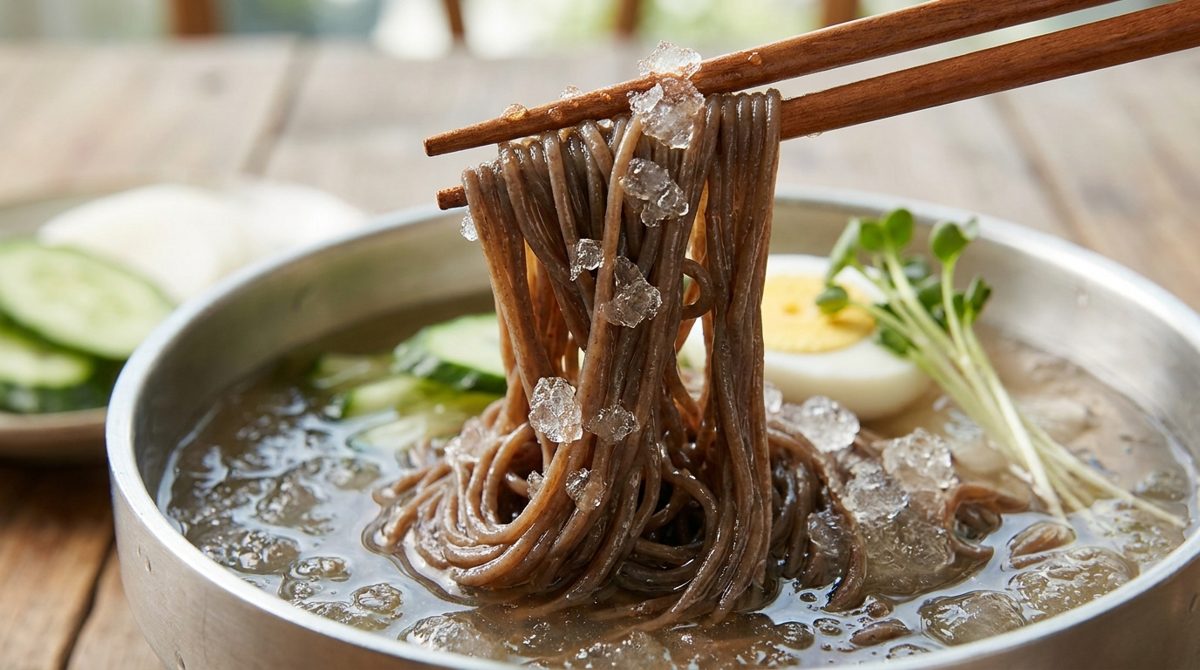
“Cold noodles.” Naeng means cold, myeon means noodles. The dish is served genuinely ice-cold — often with ice floating in the broth.
What’s the difference between mul naengmyeon and bibim naengmyeon?
Mul (“water”) naengmyeon comes in icy tangy broth and is completely non-spicy. Bibim (“mixed”) naengmyeon has no broth — the noodles are coated in a sweet-spicy gochujang sauce, around 3 out of 5 heat. Same noodles, opposite personalities.
Is naengmyeon gluten-free?
No. Despite the buckwheat base, almost all naengmyeon noodles blend in wheat flour or starch for chew. And travelers with buckwheat allergy should avoid the dish entirely — buckwheat reactions can be severe.
Why do Koreans eat naengmyeon after barbecue?
The icy, vinegary broth cuts through the richness of grilled meat and resets the palate — a cold, sharp finale after a hot, fatty feast. It’s the most common way naengmyeon is eaten, year-round.
How much does naengmyeon cost in Korea in 2026?
₩10,000–₩14,000 at regular restaurants, and ₩14,000–₩16,000 at Seoul’s famous Pyongyang-style specialists. Post-BBQ “small” bowls at grill houses run ₩6,000–₩8,000.
The Verdict: Should You Order It?
Yes — and order it the local way. If it’s your first bowl, have mul naengmyeon after barbecue, accept the scissors, season with vinegar and a cautious dab of mustard, and drink the broth from the bowl. If you like heat, make bowl number two a bibim. Just remember the two honest warnings: it’s not vegetarian, and buckwheat allergy sufferers must skip it entirely. Everyone else, order boldly — the worst outcome is discovering you’re a Hamhung person in a Pyongyang restaurant, and that’s a problem more noodles will solve. One bowl in, you’ll understand why an entire country checks the weather forecast and thinks about noodles. Ready for the next mystery on the menu? Decode every major Korean dish — spice levels, allergens, ordering phrases, real prices — in our Korean Food Decoder.