Heard Koreans say rain makes them crave pancakes and wondered what pajeon is? Pajeon (파전, “green onion pancake”) is Korea’s savory pancake: whole green onions bound in a light batter and pan-fried until the edges shatter and the center stays custardy. The most popular version, haemul pajeon, adds squid, shrimp, and clams. It’s non-spicy, made for sharing, and inseparable from makgeolli rice wine on rainy days. This decoder covers taste, allergens, vegetarian and halal answers, 2026 prices, and how to order it in Korean.
Table of Contents
- Pajeon Quick Facts
- What Is Pajeon, Exactly?
- What Does Pajeon Taste Like?
- Dietary Guide: Vegetarian, Vegan, Halal & Allergens
- How to Order Pajeon in Korean (+ 2026 Prices)
- How to Eat Pajeon Like a Local
- Types of Pajeon & Other Jeon
- Where to Try Pajeon
- Pajeon FAQ
Pajeon Quick Facts
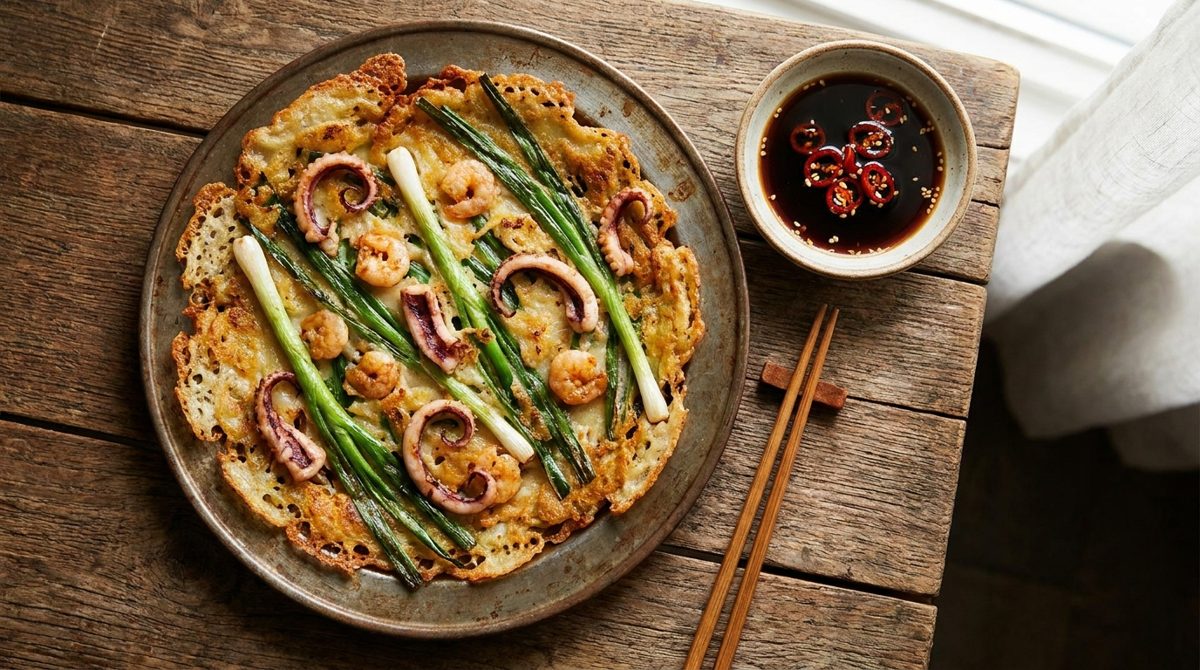
| Item | Details |
|---|---|
| Korean name | 파전 (pajeon) — pa (green onion) + jeon (pan-fried) |
| Pronunciation | PAH-jun |
| Type | Savory pancake / shared side dish or anju (drinking food) |
| Spice level | 🌶️ 0 / 5 — non-spicy (dipping sauce may have mild chili flakes) |
| Price (2026) | ₩12,000–₩18,000 at restaurants and makgeolli pubs; ₩6,000–₩8,000 at traditional markets |
| Vegetarian | ⚠️ Sometimes — plain pa/yachae (vegetable) or kimchi jeon can be, but batter often contains egg and the default is seafood |
| Vegan | ⚠️ Rarely by default — egg in most batters; possible at temple-food and vegan restaurants |
| Halal-friendly | ⚠️ Conditional — no pork or alcohol in the pancake itself; seafood versions are fine if you accept non-certified kitchens; check the batter and menu |
| Main allergens | Wheat (batter), egg, shellfish (shrimp, clams), squid, soy (dipping sauce) |
| Best for | Rainy days, groups sharing plates, makgeolli first-timers, spice-avoiders |
What Is Pajeon, Exactly?
Pajeon belongs to the great Korean family of jeon — anything coated in batter or egg and pan-fried in oil. The pa version elevates the humble green onion: whole scallion stalks are laid in a hot oiled pan, a thin batter of wheat flour (often with rice flour or egg) is poured over, and toppings press in before the flip. Done right, it’s a study in contrast — lacy, crackling edges giving way to a soft, almost custardy middle where the sweet onions have steamed.
Jeon has deep roots in Korean ancestral rites and holiday cooking — Chuseok and Lunar New Year tables groan under platters of assorted jeon, and the smell of frying batter is the smell of a Korean holiday. Pajeon’s most famous regional expression is Dongnae pajeon from Busan, a thick, seafood-loaded version once served to kings, finished with a swirl of egg and eaten with the local swagger that Busan applies to all its food.
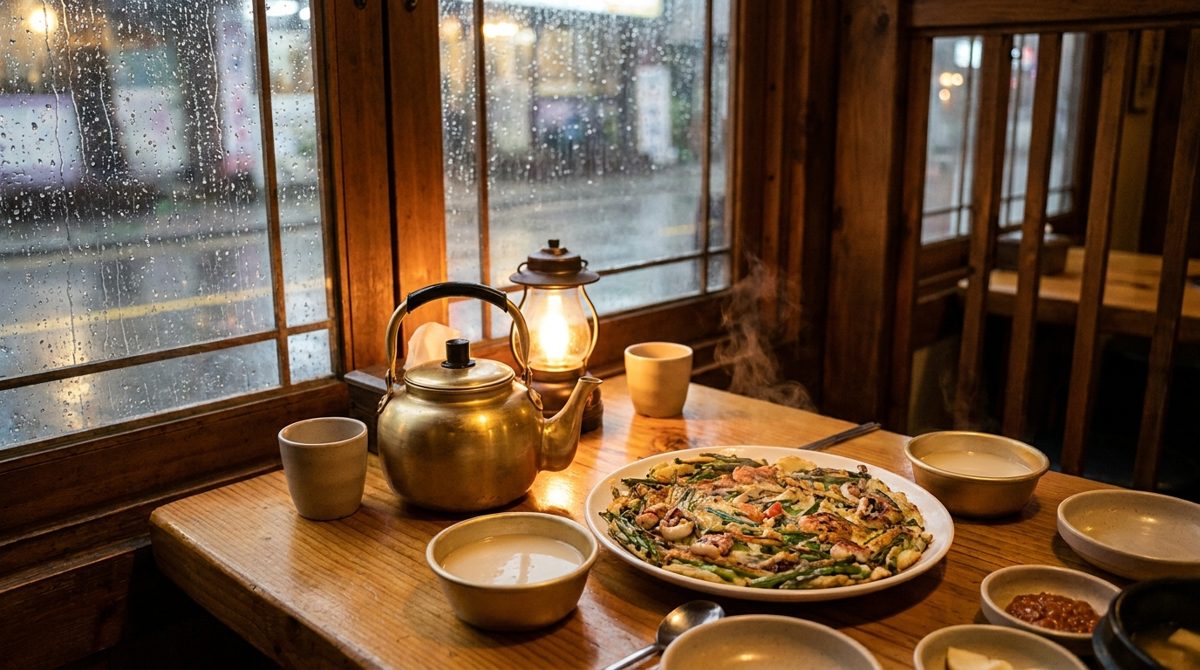
But the modern soul of pajeon is meteorological. Koreans have a national reflex: when it rains, you eat pajeon and drink makgeolli. Theories abound — the sizzle of batter sounds like rain on a tin roof; fried food comforts gray days; flour and alcohol were how farmers waited out wet fields. Whatever the reason, on rainy evenings, pajeon restaurants fill up and delivery apps show jeon orders spiking. It’s one of Korea’s most charming food superstitions, and joining it is effortless cultural immersion.
Pajeon also introduces you to a key Korean concept: anju (안주) — food that exists to accompany drinks. In Korean drinking culture, you almost never drink without eating, and entire menus are organized around what pairs with what: fried chicken with beer, samgyeopsal with soju, and jeon with makgeolli. Pajeon is arguably the definitive anju, which is why you’ll find the best versions not at formal restaurants but at low-ceilinged pubs where the tables are sticky and the atmosphere is perfect.
What Does Pajeon Taste Like?
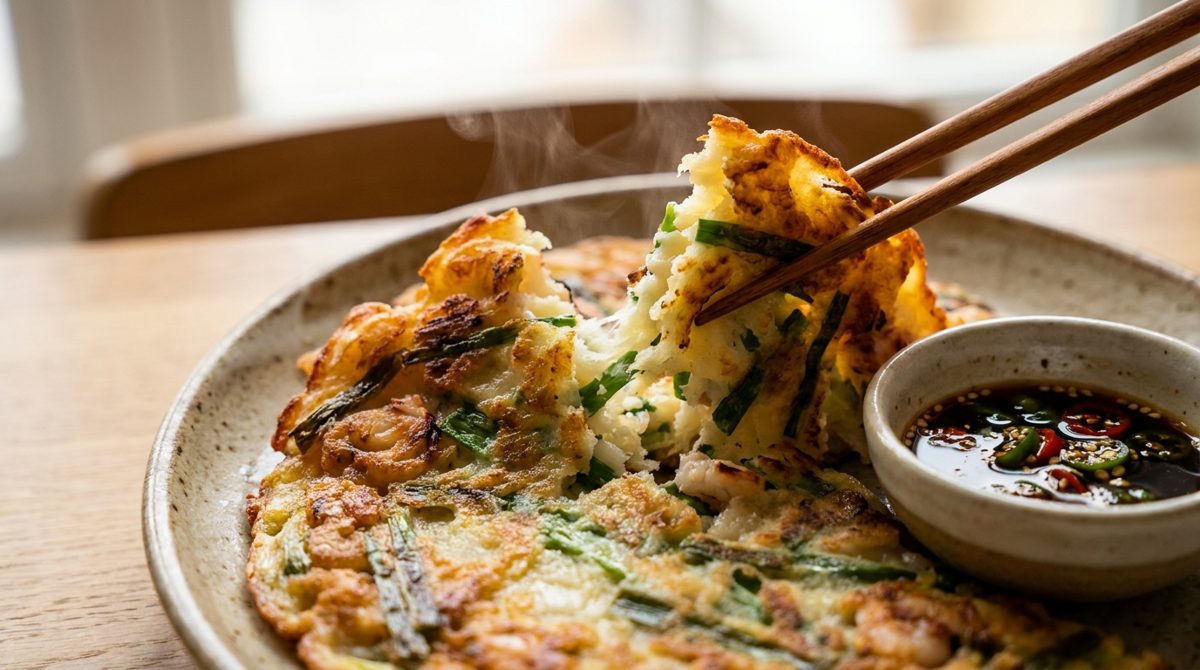
Sweet allium and hot oil, basically — and that’s a compliment. The green onions turn sweet and silky inside the batter, the exterior crisps like a good hash brown, and the seafood in haemul pajeon adds briny chew: springy squid rings, sweet shrimp, occasional clams. The dipping sauce — soy, vinegar, a little chili flake — cuts the oil with salt and acid, and a good pub will refill it without being asked. It’s rich but not heavy, familiar but distinctly Korean, and dangerously easy to finish before the main course arrives.
Quality varies more than most Korean dishes, and the variable is fat and heat. A great pajeon is fried in enough oil to shallow-fry the edges, on a griddle hot enough to set the batter before it soaks; a lazy one is pale, bready, and greasy. You can read a pancake from across the room: look for irregular, deeply browned lacy edges and visible whole scallions. If a restaurant’s jeon comes out uniformly beige and floppy, order your second round somewhere else.
Is Pajeon Spicy?
No — pajeon is a solid 0 out of 5. The pancake itself contains no chili at all. The only heat in the vicinity is the pinch of gochugaru chili flakes floating in the dipping sauce (skip the sauce or ask for it plain if even that’s too much) and the green chili slices some kitchens scatter on top — visible and easy to pick off. For spice-sensitive travelers, pajeon is one of the safest orders on any Korean menu.
Pajeon Dietary Guide: Vegetarian, Vegan, Halal & Allergens
Pajeon looks vegetable-forward, but the default version at most restaurants is haemul (seafood) pajeon — which changes the allergen math completely.
| Ingredient concern | In standard pajeon? | How to handle |
|---|---|---|
| Shellfish (shrimp, clams) | Usually — haemul pajeon is the default at many places | Serious allergy? Order plain pajeon and confirm no shared oil/griddle with seafood versions |
| Squid | Usually, in haemul versions | Same as above — “haemul ppaego” doesn’t help once it’s in the batter; order a different jeon |
| Wheat / gluten | Yes — the batter is wheat flour | No standard gluten-free version; buckwheat memil-jeon exists in Gangwon province |
| Egg | Often — many batters include egg, and Dongnae style adds extra | Ask: “gyeran deureogayo?” (계란 들어가요?) — does it contain egg? |
| Soy | Yes, in the dipping sauce | Eat the pancake without sauce — it’s well-seasoned enough |
| Pork / beef | No (in pajeon) | But watch sibling dishes: yukjeon is beef, some wang-jeon mixes contain meat |
| Dairy / nuts | No | Traditional recipes contain neither |
| Alcohol | Not in the pancake | Makgeolli is served alongside by tradition, not obligation — the food itself is alcohol-free |
Is Pajeon Vegetarian or Vegan?
Sometimes — this is a genuine ⚠️ dish. A plain pajeon or yachae-jeon (vegetable pancake) contains no meat or seafood, and kimchi-jeon is usually just kimchi and batter, so vegetarians have real options. The two traps: most restaurants’ default pajeon is the seafood version (order plain explicitly), and many batters contain egg. Vegans have it harder — egg-free batter exists but you must ask, and the dipping sauce is fine (soy-based). Temple food restaurants and Seoul’s vegan spots make properly vegan jeon; at a market stall, assume egg unless told otherwise. One more note for strict vegetarians: kimchi-jeon uses regular kimchi, which typically contains fish sauce or salted shrimp.
Is Pajeon Halal?
Cautiously friendly. The pancake itself contains no pork and no alcohol — seafood and vegetables are the standard fillings, both halal-acceptable. The caveats are contextual: pajeon is classically served in pubs where alcohol flows (the dish itself stays dry), batters occasionally share fryers or griddles with non-halal items, and no regular jeon restaurant is certified. Muslim travelers comfortable with seafood from non-certified kitchens generally consider haemul pajeon one of the easier Korean dishes. For certified dining, the Korea Tourism Organization maintains Muslim-friendly restaurant listings on VisitKorea.
How to Order Pajeon in Korean (+ 2026 Prices)
Pajeon is a sharing dish — one pancake feeds two to three people alongside other food. Here’s your phrasebook:
| What you want | Say this | Romanized |
|---|---|---|
| One seafood pajeon, please | 해물파전 하나 주세요 | haemul-pajeon hana juseyo |
| Plain green onion pancake | 그냥 파전 주세요 | geunyang pajeon juseyo |
| Kimchi pancake, please | 김치전 주세요 | kimchi-jeon juseyo |
| Does it contain egg? | 계란 들어가요? | gyeran deureogayo? |
| One bottle of makgeolli, please | 막걸리 한 병 주세요 | makgeolli han byeong juseyo |
What it costs in 2026: at sit-down restaurants and makgeolli pubs, a large haemul pajeon runs ₩12,000–₩18,000 — remember it’s a shareable plate, not a personal pancake. At traditional markets, hot-off-the-griddle jeon goes for ₩6,000–₩8,000, often sold by the piece or as mixed assortments. A bottle of makgeolli adds ₩4,000–₩6,000 at a pub, ₩2,000 at a convenience store. Dongnae pajeon at famous Busan houses is pricier — ₩20,000+ — and worth it once.
Ordering etiquette worth knowing: at makgeolli pubs, ordering at least one anju dish per table is expected when you’re drinking — pajeon fills that role perfectly. Portions are genuinely large; a party of two should start with one pancake and add a second only if needed. If the menu offers sizes, “small” (소) feeds two comfortably. Many jeon houses also sell mixed platters by the piece — point at the display case and hold up fingers; it works flawlessly.
How to Eat Pajeon Like a Local
No knife, no slices — pajeon is torn. Grip with chopsticks, tear off a ragged piece (the irregular edges hold more crunch), dip a corner in the sauce, and eat while it’s hot; jeon loses its magic as it cools, which is why Koreans eat it straight off the griddle. At pubs it arrives pre-cut into a grid at most — finishing the job with chopsticks is normal.
Then there’s the liturgy of the pairing. Makgeolli — milky, lightly fizzy, gently sweet rice wine at around 6% — is poured into shallow brass or plastic bowls, not glasses. Pour for others before yourself, receive your bowl with two hands, and stir or swirl the bottle gently first (the good sediment settles). The fried-savory pancake against the cool, tangy-sweet rice wine is one of Korea’s great food-and-drink marriages. If it happens to be raining, congratulations: you’re not eating dinner, you’re performing a national ritual.
Types of Pajeon & Other Jeon You’ll Meet
Haemul pajeon (해물파전) — the classic: green onions plus squid, shrimp, clams. Dongnae pajeon (동래파전) — Busan’s royal-lineage version: thicker, wetter, loaded with seafood, finished with egg. Kimchi-jeon (김치전) — tangy, faintly spicy from the kimchi itself; the beloved home version. Gamja-jeon (감자전) — grated potato pancake, naturally gluten-free at dedicated shops. Nokdu bindaetteok (녹두빈대떡) — the mighty mung-bean pancake, ground fresh and fried in pork fat at Gwangjang Market (note: often contains pork). Memil-jeon (메밀전) — Gangwon’s thin buckwheat crepe. On holiday tables you’ll also meet modeum-jeon (모듬전), the assorted platter — the best way to taste five kinds at once.
Want to recreate it at home after your trip? Every Korean supermarket sells buchim-garu (부침가루), the seasoned pancake mix, next to twigim-garu (튀김가루, frying mix) — many home cooks blend the two for extra crunch. The technique matters more than the recipe: a generous slick of oil, a properly hot pan, batter spread thin, and the patience not to flip early. Souvenir tip: a bag of pancake mix plus a bottle of jeon dipping-sauce base costs under ₩5,000 and travels well — it’s one of the most useful edible souvenirs Korea sells.
Where to Try Pajeon
Three settings, three vibes. For atmosphere, find a makgeolli house or jeon-jip (전집) — dedicated pancake pubs cluster in university districts and around Insadong and Jongno in Seoul; go on a rainy evening and enjoy the packed room. For the market experience, Gwangjang Market’s bindaetteok alley is legendary — griddles the size of car hoods, pancakes fried while you watch; our Seoul food guide maps the best stalls. For the pilgrimage, Busan’s Dongnae district still fries its historic pajeon — pair it with a pork-soup crawl using our Busan restaurant travelogue. Sweet tooth instead? The street-food counterpoint is hotteok, decoded here.
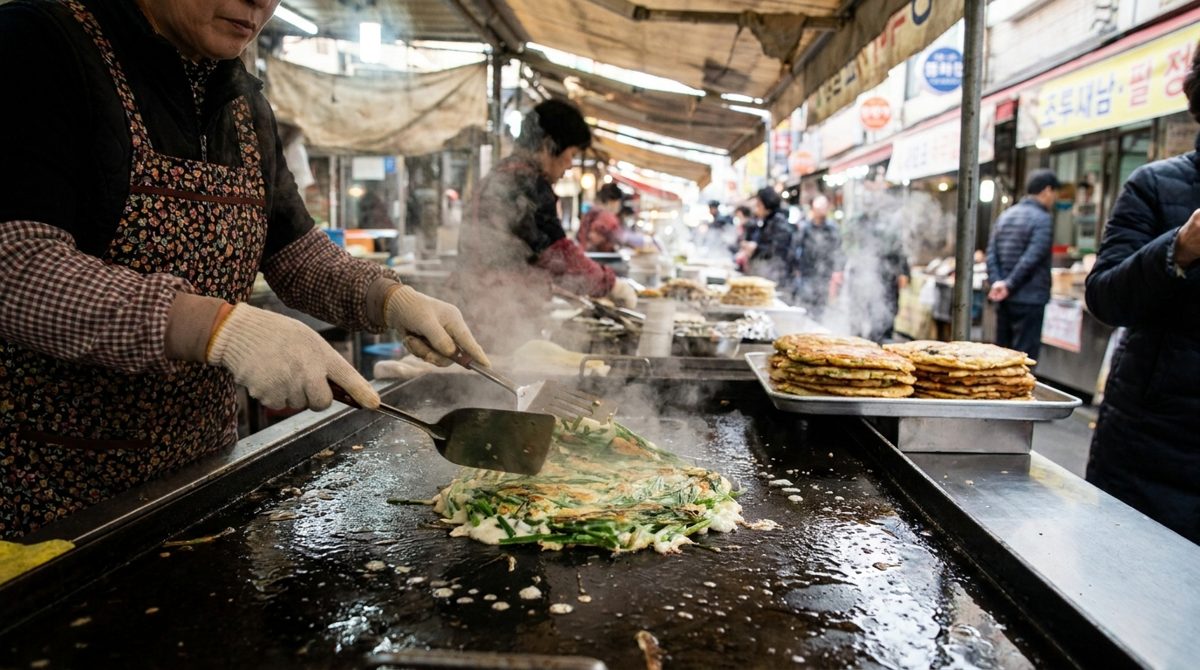
Seoul also hides dedicated “jeon alleys” (전 골목) — clusters of decades-old pancake specialists. The most famous sits near Gongdeok Station (Exit 5), where display cases overflow with twenty kinds of jeon sold by weight; buy a mixed box, grab a bottle of makgeolli, and picnic like a local. University districts — Hongdae, Sinchon, and the area around Ewha — keep the student version of the tradition alive with cheap, enormous pancakes and loud, happy rooms; several storied Sinchon pubs have been frying the same recipe since the 1980s protest era, when jeon and makgeolli fueled a generation of students. On genuinely rainy nights, expect a short queue anywhere good; that’s part of the fun.
Pajeon FAQ
What does pajeon mean in English?
“Green onion pancake.” Pa means green onion (scallion), and jeon is the family name for Korean battered, pan-fried dishes. Haemul pajeon adds seafood — haemul means “seafood.”
Why do Koreans eat pajeon when it rains?
It’s a beloved national tradition: the sizzle of frying batter is said to sound like rainfall, and fried food plus makgeolli rice wine is considered the perfect comfort for a gray day. Rainy days reliably spike pajeon sales across Korea.
Is pajeon vegetarian?
Not by default — most restaurants serve haemul (seafood) pajeon unless you specify. A plain pajeon, yachae-jeon, or kimchi-jeon can be vegetarian, but batters often contain egg and kimchi usually contains fish sauce. Ask before ordering.
What do you drink with pajeon?
Makgeolli — Korea’s milky, lightly sparkling rice wine, served in bowls. The pairing is so canonical that ordering pajeon without makgeolli feels incomplete to many Koreans. Non-drinkers: sikhye (sweet rice drink) or cider work fine.
How much does pajeon cost in Korea in 2026?
₩12,000–₩18,000 for a large sharing pancake at restaurants and pubs, ₩6,000–₩8,000 at traditional market stalls. Busan’s famous Dongnae pajeon runs ₩20,000 and up.
The Verdict: Should You Order It?
Yes — and time it to the weather if you can. Pajeon is zero-spice, deeply satisfying, and the makgeolli pairing is one of the easiest, most joyful cultural rituals a visitor can join: one pancake, one bottle, one rainy window. Shellfish-allergic travelers should order plain or kimchi versions carefully, and vegans need to interrogate the batter — everyone else can tear in freely. Check the forecast tonight: if there’s rain coming, you now have dinner plans, a drink order, and a century of tradition backing both. Next mystery on the menu? Decode every major Korean dish — spice, allergens, prices, phrases — in our Korean Food Decoder.