If you’ve scrolled past a Korean food video this month, you’ve probably seen a crowd lined up outside a convenience store before sunrise, or a dessert that looks suspiciously like a bowl of ramen but is actually ice cream. Welcome to Korea’s convenience store snack craze — a weekly cycle of viral treats, sold-out shelves, and “open runs” that has turned CU and GS25 into two of the most talked-about brands in Korean pop culture right now. It sounds absurd from the outside. From the inside, it’s practically a national sport.
Table of Contents
- What’s Happening in Korea Right Now?
- The Background: Why Did This Start?
- What Are Koreans Actually Saying?
- What This Reveals About Korean Culture
- How Does This Compare Internationally?
- Conclusion
What’s Happening in Korea Right Now?
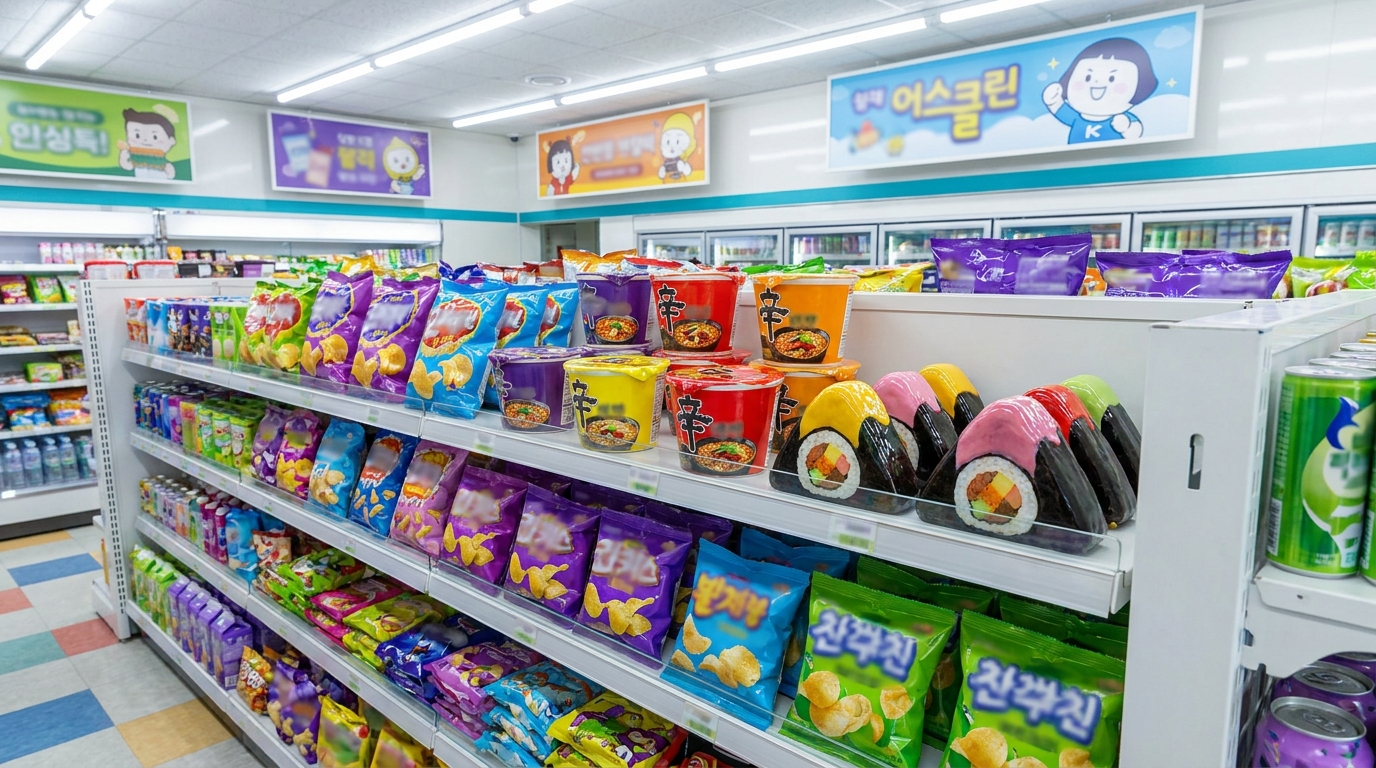
Korea’s convenience store snack craze has reached a genuinely wild point in 2026. The single biggest trend is “hyper-realism” desserts at CU: sweets engineered to look exactly like savory convenience-store staples. Picture a “cup noodle” that is actually mousse cake, or a triangle-shaped kimbap that turns out to be sweet rice cake and cream once you bite into it. CU even opened a dessert-specialized flagship store, CU Seongsu Dessert Park, in Seoul’s trendy Seongsu neighborhood, packing roughly 30% more dessert items onto its shelves than a standard branch.
Then there are the celebrity-chef collaborations. Riding the wave of Korea’s hit cooking survival shows, both CU and GS25 have partnered with well-known chefs to upgrade the humble dosirak (lunch box) into something Instagrammable — think a Gochujang BBQ Pulled Pork Gimbap developed with a celebrity chef, or elaborate versions of Korea’s beloved convenience store dosirak culture. Meanwhile, broadcaster and former athlete Kang Ho-dong sparked a full-blown short-form video challenge around his “spring cabbage bibimbap,” sending fans into stores hunting for the exact ingredients.
The resale market tells its own story. Orion’s limited-edition “Chokchokhan Hwang Cheese Chip” — normally 4,480 won for a 16-pack box — has been resold online for more than 25,100 won, over five times face value, after the entire 380,000-box production run reportedly sold out almost instantly. Yonsei Dairy’s famous “bursting” fresh cream bread has rolled out seasonal pistachio, earl grey, and matcha flavors in limited batches, and “Dubai chocolate” — once a fleeting TikTok trend — is now a permanent shelf item across Korean convenience stores. Every single week, it seems, a new must-have item appears, and every single week, people line up for it.
The Background: Why Did This Start?
To understand Korea’s convenience store snack craze, you first need to understand just how central convenience stores are to daily Korean life. With over 55,000 convenience stores packed into a country roughly the size of Indiana, chains like CU, GS25, 7-Eleven, and Emart24 are not an occasional stop — they’re a daily ritual for millions of commuters, students, and office workers. That density creates an unusually fast, unusually visible retail battlefield: when four major chains are fighting for the same customer on the same block, the only way to stand out is constant, rapid-fire product innovation.
Layer social media on top of that infrastructure and you get combustion. Korea has some of the highest short-form video usage rates in the world, and convenience store chains have gotten extremely good at feeding that machine — sending new products to food influencers before public launch, timing drops around trending shows, and leaning into the aesthetic appeal of a product built to be filmed, not just eaten. A cake that looks exactly like a ramen cup isn’t just a snack; it’s a 15-second video with a built-in twist ending. According to Seoul Economic Daily reporting from March 2026, this social-media-driven food fad cycle has become so intense that it’s now producing genuine shortages — and a documented wave of “consumer fatigue” among shoppers exhausted by the constant chase.
The “open run” phenomenon — crowds gathering before a store even opens or before a specific delivery truck arrives — grew out of this same ecosystem. It started with luxury goods and bakery drops, but convenience stores adopted the model because it works: a video of a line outside a CU at 6 a.m. is, itself, free marketing that guarantees the next drop sells out even faster.
What Are Koreans Actually Saying?
Reactions inside Korea are far more divided than the glossy trend headlines suggest. On one side, younger consumers — particularly Gen Z shoppers who grew up with mukbang and food-review content — treat the weekly hunt as a genuinely fun social activity. Hunting down a sold-out item, trading tips on which branch still has stock, and posting the “unboxing” is part of the appeal, not a chore. For this group, convenience store snacks function almost like limited sneaker drops: the scarcity is the point.
On the other side, there’s real irritation. Older shoppers and busy commuters increasingly complain that regular, useful items get pushed off shelves to make room for trend-chasing novelty products, and that resale scalping — like the 5x markup on Hwang Cheese Chips — rewards bots and bulk-buyers over actual fans. The term “consumer fatigue” (소비자 피로감) has started showing up regularly in Korean business reporting, describing shoppers who feel obligated to chase every viral item just to keep up on social media, only to grow resentful of the cycle. Online communities have also started mocking the trend cycle itself, with commenters joking that they can predict next month’s flavor of Dubai chocolate variant before it’s even announced.
Even so, criticism rarely translates into people opting out. Multiple Korean outlets note that even shoppers who complain about the hype still show up for the next drop — a contradiction that says a lot about how deeply these rituals are now embedded in daily life. For more on the everyday products driving this cycle, see our breakdown of iconic Korean convenience store snacks.
What This Reveals About Korean Culture
Korea’s convenience store snack craze isn’t really about snacks — it’s a compressed case study in how trend velocity works in one of the world’s most connected societies. A few things are worth unpacking here. First, Korea has an unusually strong culture of collective, real-time trend participation: from K-pop fandom rituals to group-buy culture, there’s a well-worn social pattern of “everyone needs to experience this together, right now,” and convenience store snacks slot neatly into that pattern because they’re cheap and physically accessible.
Second, this reflects Korea’s intense relationship with visual presentation and “proof of experience.” Sharing a photo of a rare item isn’t just about the taste — it’s social currency, a small signal that you’re plugged into what’s happening. That’s precisely why “hyper-realism” desserts work so well: the entire product is built around the reveal, the moment of surprise that makes for a satisfying video.
Third, and perhaps most tellingly, the craze exposes the flip side of Korea’s famously fast-moving consumer culture: burnout. The same speed that makes Korean trends so exciting to watch from abroad is, for many people living inside it, exhausting to sustain. The coexistence of enthusiastic hunters and fatigued critics within the same population is not a contradiction — it’s the actual mechanism. FOMO and fatigue feed each other, and both keep the weekly cycle turning. Anyone curious about the broader retail ecosystem behind this should check out our full Korean convenience store guide.
How Does This Compare Internationally?
Korea is far from the only country with a viral snack economy, but its version moves noticeably faster. In the United States, Trader Joe’s and Aldi have built loyal, almost cult-like followings around limited seasonal products — mango cookie butter, viral freeze-dried candy, seasonal Aldi “finds” — but those drops typically happen monthly or seasonally, not weekly, and resale markets, while they exist, are far smaller in scale.
Japan offers the closest cultural cousin. Japanese konbini chains like 7-Eleven, Lawson, and FamilyMart are famous worldwide for constant new-product cycles and genuinely excellent quality control, and Japanese consumers do chase limited-edition items (a Japanese food outlet recently covered Korea-inspired “3D fruit pop” ice bars for exactly this reason). But Japan’s konbini culture tends to prize quiet consistency and craftsmanship over public spectacle — you rarely see a filmed line-up outside a Lawson at dawn the way you do outside a CU. Korea’s version is louder, faster, and far more performative, built for a social media environment where the queue itself is the content.
What sets Korea apart is the combination of retail density, short-form video saturation, and a cultural comfort with public, collective consumption rituals. It’s the same energy that produces K-pop fan projects and pop-up store lines, just aimed at a 2,000-won snack instead of a concert ticket. If you want a taste of how this plays out across an entire aisle, our guide to viral Korean convenience store food combos is a good starting point.
Conclusion: Should You Chase the Craze?
Korea’s convenience store snack craze is unlikely to slow down anytime soon — if anything, the format has proven itself as a genuinely effective marketing engine for CU, GS25, and the brands that partner with them, and “consumer fatigue” hasn’t stopped the lines from forming yet. For visitors, the phenomenon is one of the most accessible ways to understand modern Korean pop culture in real time: no ticket, no reservation, just a willingness to check three convenience stores before breakfast. For locals, it’s a weekly reminder of how fast — and how tiring — trend culture can move when an entire country is watching the same feed.
Planning a Korea trip and want to experience the craze firsthand rather than just watch it online? Start with our Korean food decoder so you know what you’re actually buying, then head straight for the nearest CU or GS25 — just don’t be surprised if this week’s must-have item is already gone by the time you get there.
Sources: Seoul Economic Daily, Seoul Economic Daily, Creatrip.